

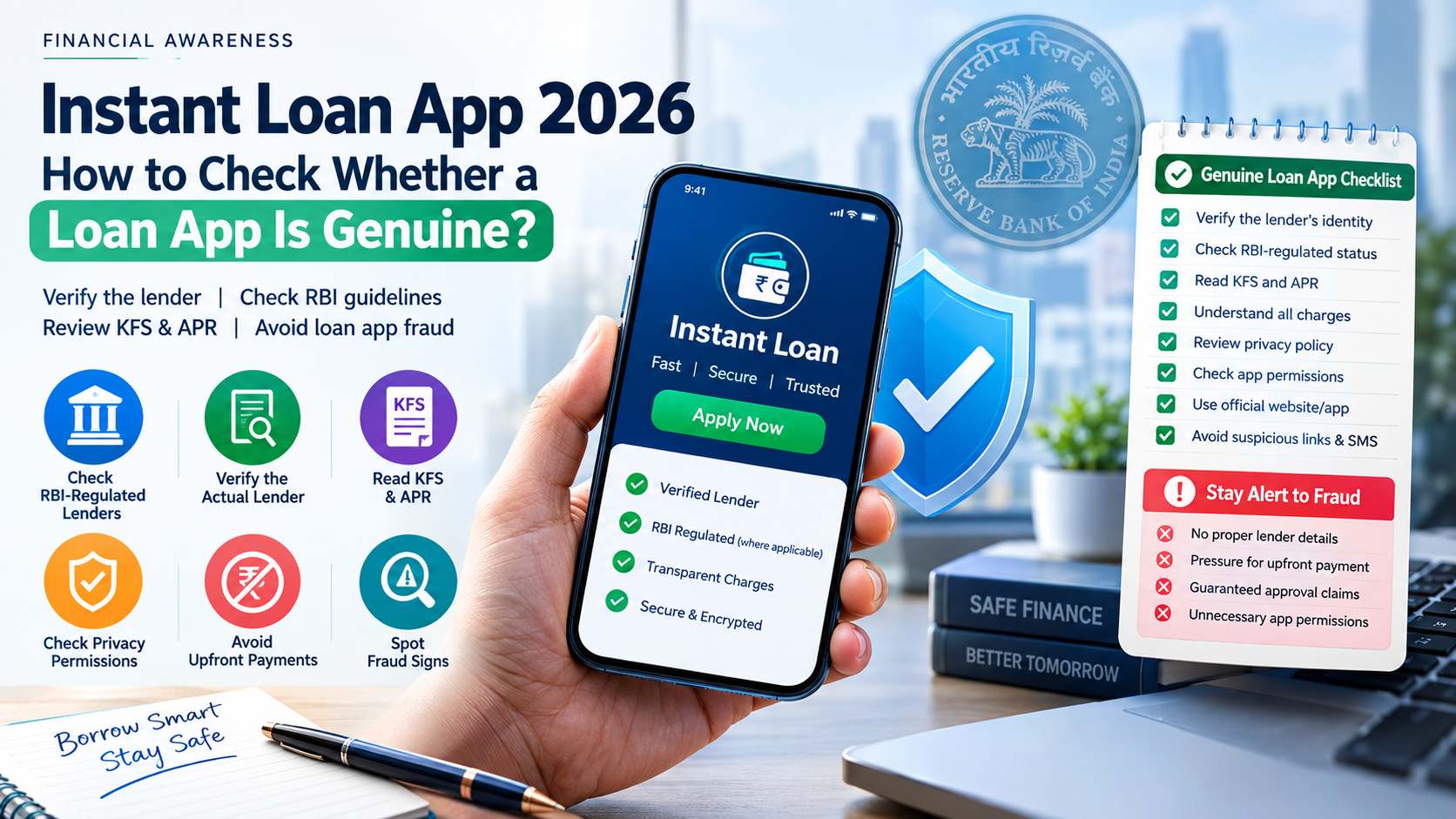
Instant loan apps have made borrowing faster and more convenient. A borrower can often submit basic information online, complete digital verification and receive a lending decision without visiting a branch.
However, convenience also creates risks.
Fake or misleading loan applications can imitate legitimate financial companies, advertise extremely easy approvals and attempt to collect sensitive personal or financial information.
The Reserve Bank of India has specifically highlighted concerns around unscrupulous digital lending apps and created a public repository framework to help consumers verify claims about an app's association with regulated entities.
Therefore, the important question is not simply:
“Does this loan app look professional?”
Instead, ask:
“Who is the actual lender, and can I independently verify that lender?”
1. Check the Actual Lender Behind the App
This is one of the most important checks.
A loan app may be operated by a technology company or Lending Service Provider (LSP), while the actual loan may be provided by a bank or NBFC.
RBI's digital lending framework recognizes digital lending apps and LSPs working with regulated entities. The involvement of an LSP does not remove the regulated entity's responsibilities under the applicable framework.
What to check
Before submitting your documents:
- Find the legal name of the lender.
- Identify whether it is a bank or NBFC.
- Visit the lender's official website independently.
- Check whether the lender identifies the app/LSP as part of its digital lending arrangement.
- Do not rely only on information displayed inside an advertisement.
Important Tip
Search for the lender independently instead of clicking a link sent through WhatsApp, SMS or an unknown social-media account.
2. Check Whether the Bank or NBFC Is Regulated
A genuine digital lending arrangement should have a clearly identifiable regulated lender where applicable.
RBI provides information on regulated entities, including NBFCs, through its official channels.
If an app refuses to disclose the legal name of the lender, that should be treated as a major warning sign.
Quick verification checklist
| Check | What You Should Look For |
|---|---|
| Lender name | Full legal name |
| Entity type | Bank or NBFC, where applicable |
| Official website | Independently verified website |
| App association | App/LSP relationship disclosed |
| Contact details | Genuine customer-support information |
| Loan documents | KFS and sanction documentation |
| Grievance mechanism | Clearly identified complaint channel |
3. Read the Key Fact Statement (KFS)
One of the most useful documents in digital lending is the Key Fact Statement, commonly called KFS.
RBI's digital lending guidelines require the regulated entity to provide a KFS before execution of the loan contract for covered digital lending products. The KFS includes important information such as APR and other loan-related details.
Do not accept a loan simply because the app displays a low monthly EMI.
Read the KFS first.
Check these details
- Loan amount
- Tenure
- Annual Percentage Rate (APR)
- Processing fees
- Other applicable charges
- Repayment schedule
- Penal charges
- Recovery mechanism
- Grievance-redressal information
- Cooling-off/look-up period, where applicable
4. Compare APR Instead of Looking Only at Interest Rate
A common mistake is to compare loans only by the advertised interest rate.
The Annual Percentage Rate (APR) gives a broader picture of the cost of digital credit because it incorporates the applicable all-inclusive cost as defined under the RBI framework.
For borrowers, this can make comparing loan offers easier than looking at a headline interest rate alone.
Example
Suppose two apps advertise:
| Feature | App A | App B |
|---|---|---|
| Advertised interest rate | 15% | 13% |
| Processing fee | Higher | Lower |
| Other charges | Applicable | Lower |
| APR | Check KFS | Check KFS |
The lower advertised interest rate does not automatically mean the lower-cost loan.
Always compare the complete cost disclosed in the KFS.
5. Never Ignore Upfront Payment Demands
One of the strongest warning signs is an unexpected demand for money before the loan is processed.
RBI's consumer-awareness material warns borrowers about fake loan websites/apps and notes that reputed banks and NBFCs will not ask for payment before processing a loan application.
Be especially careful if an app or agent says:
- “Pay a verification fee first.”
- “Pay GST before loan release.”
- “Pay an unlocking charge.”
- “Pay a security deposit to receive the loan.”
- “Pay a processing amount to activate your account.”
Do not transfer money simply because someone promises that the payment will unlock an instant loan.
6. Check the App Permissions
A loan application may need certain information to process an application, but borrowers should understand exactly what permissions they are granting.
RBI's financial-awareness guidance recommends carefully checking the permissions requested by digital lending apps and reviewing privacy and data-storage policies.
Be cautious about unnecessary access to:
- Contacts
- Call logs
- Photos
- Files
- Messages
- Microphone
- Location
- Other device information
Do not assume that every permission requested by an app is necessary for lending.
7. Read the Privacy Policy
A genuine-looking app can still create privacy concerns if you do not understand how your information will be handled.
Before uploading:
- Aadhaar-related information
- PAN information
- Bank details
- Salary documents
- Photographs
- Contact information
- Other financial documents
read the lender's privacy policy.
RBI guidance emphasizes need-based data collection, consent and data-protection requirements in digital lending.
Ask yourself:
Why does this app need this information?
If the answer is unclear, stop and investigate before continuing.
8. Check the Loan Documents
A legitimate digital lending process should provide appropriate loan documentation.
Depending on the lending arrangement, borrowers should receive documents such as:
- Key Fact Statement
- Sanction letter
- Loan agreement or terms
- Repayment information
- Privacy policy
- Account statement
- Applicable disclosures
RBI's digital lending guidance also provides for digitally signed loan-related documents to be made available to borrowers through registered communication channels.
Never rely only on a screenshot showing an approved loan.
9. Verify the Repayment Account
Pay close attention to where the money is being disbursed and where repayment is being requested.
RBI's digital lending guidelines provide that loan servicing and repayment should generally flow directly between the borrower and the regulated entity's bank account rather than through third-party pass-through or pool accounts, subject to specified exceptions.
Warning sign
If someone asks you to repay a loan into:
- A personal bank account
- An unrelated individual's UPI ID
- An unknown wallet
- An unrelated company account
stop and verify the request with the actual lender.
10. Check the Company's Customer Support
Before borrowing, check whether you can actually contact the company.
Look for:
- Official website
- Customer-care details
- Registered office information
- Grievance-redressal officer
- Email address
- Complaint process
RBI guidance requires relevant grievance-redressal information for digital lending arrangements.
A loan app that provides no meaningful way to contact the actual lender deserves additional scrutiny.
11. Avoid Loan Apps Shared Through Random Links
Be careful when a loan offer arrives through:
- SMS
- Telegram
- Social media
- Unknown websites
- Random APK files
- Unverified advertisements
RBI's financial-awareness material specifically advises consumers to avoid downloading lending apps received through SMS or social-media links and says suspicious apps should be reported to law-enforcement agencies.
Instead, locate the lender's official website independently and start from there.
12. Check Reviews — But Don't Trust Reviews Alone
App-store ratings can provide clues, but they should not be the primary method of verifying a lender.
Fake or manipulated reviews can exist.
Instead of asking:
“Does this app have five-star reviews?”
ask:
“Who actually provides the loan?”
Then independently verify the lender.
Reviews are useful for identifying potential problems such as:
- Unexpected charges
- Customer-service complaints
- Repayment issues
- Privacy concerns
- Aggressive recovery practices
But a high rating does not prove that a lending app is legitimate.
13. Be Careful With “Guaranteed Approval”
Statements such as:
- “100% loan approval”
- “No verification”
- “Loan without documents”
- “Guaranteed loan for everyone”
- “Bad credit? Instant approval”
- “No credit check”
should be treated cautiously.
Legitimate lenders generally assess borrower information and eligibility before approving credit.
A promise of guaranteed money without meaningful verification can be a warning sign.
14. Understand the Cooling-Off Period
RBI's digital lending framework provides borrowers with an explicit option to exit a digital loan during the applicable cooling-off/look-up period by paying the principal and proportionate APR without penalty, subject to the applicable rules. The minimum period specified in the 2022 guidelines is three days for loans with a tenor of seven days or more and one day for loans with a tenor of less than seven days.
The exact terms should be checked in the loan documentation provided by the lender.
This is another reason why borrowers should read the KFS before accepting a digital loan.
15. Common Red Flags of a Fake Loan App
Here are some warning signs borrowers should take seriously:
| Red Flag | Why It Matters |
|---|---|
| No actual lender disclosed | You cannot independently verify who is lending |
| Upfront payment demanded | Could indicate a fraudulent offer |
| APK sent through WhatsApp | Higher security risk |
| Excessive permissions | Potential data-privacy concern |
| No KFS | Important loan-cost information may be missing |
| No clear APR | Difficult to understand total borrowing cost |
| Guaranteed approval | Potentially misleading claim |
| Pressure to borrow immediately | Can prevent proper verification |
| Personal UPI repayment request | Requires immediate verification |
| No grievance mechanism | Difficult to resolve disputes |
| Threatening communication | Serious warning sign |
Genuine Loan App vs Suspicious Loan App
| Feature | Genuine Lending Arrangement | Suspicious Arrangement |
|---|---|---|
| Actual lender | Clearly identified | Hidden or unclear |
| Bank/NBFC relationship | Independently verifiable | Cannot be verified |
| KFS | Provided where applicable | Missing |
| APR | Disclosed | Unclear |
| Charges | Disclosed | Hidden or unexpected |
| Privacy policy | Available | Missing or vague |
| Permissions | Explained/need-based | Excessive |
| Customer support | Identifiable | Anonymous |
| Grievance mechanism | Available | Missing |
| Upfront payment | No unexplained pre-payment | Pressure for advance payment |
| Loan documents | Proper documentation | Screenshots or vague promises |
| Communication | Professional and verifiable | Threatening or high-pressure |
What Should You Do Before Installing an Instant Loan App?
Use this simple 10-point verification checklist:
Step 1
Identify the actual lender.
Step 2
Check whether the lender is a regulated bank/NBFC where applicable.
Step 3
Visit the lender's official website independently.
Step 4
Verify the app or LSP relationship.
Step 5
Read the KFS.
Step 6
Check APR and every applicable charge.
Step 7
Read the privacy policy.
Step 8
Review the permissions requested by the app.
Step 9
Check customer support and grievance-redressal details.
Step 10
Never make an unexplained upfront payment simply to receive a promised loan.
What If You Have Already Installed a Suspicious Loan App?
If you believe a loan app is suspicious, do not panic.
Consider taking these steps:
- Stop providing additional personal information.
- Do not make payments to unknown accounts without verification.
- Preserve screenshots, messages, payment records and transaction details.
- Contact the actual lender if one can be independently identified.
- Remove unnecessary app permissions.
- Secure your important accounts and devices.
- Report suspected fraud through the appropriate official channels.
- If money has already been lost, report the incident to the relevant law-enforcement/cybercrime authorities promptly.
Do not delete important evidence before saving copies of relevant communications and transaction records.
Is Every Loan App on an App Store Genuine?
No.
Being available through an app store should not be treated as proof that a loan app is legitimate.
The more important verification is the identity of the actual lender and its relationship with the digital lending platform.
RBI has specifically warned about unscrupulous digital lending apps and has encouraged consumers to verify associations with regulated entities.
Can a Genuine Loan App Ask for Personal Information?
Yes, digital lending normally requires borrower information for processes such as identity verification, credit assessment and loan servicing.
However, borrowers should understand:
- What information is being collected
- Why it is required
- What permissions are requested
- How the information will be used
- What the privacy policy says
- Whether consent is being obtained appropriately
RBI guidance emphasizes need-based data collection and borrower consent in digital lending.
Can You Trust a Loan App That Says “RBI Approved”?
Not automatically.
A borrower should not rely solely on a marketing statement such as “RBI approved app.”
Instead, identify the actual bank/NBFC and independently verify the relationship through the lender's official channels.
This distinction is important because an app may claim an association with a regulated entity without giving consumers enough information to verify that claim. RBI introduced its public repository initiative specifically to help consumers verify DLA associations with regulated entities.
Key Takeaways
- Identify the actual lender before applying.
- Verify the bank/NBFC relationship independently.
- Read the Key Fact Statement before accepting the loan.
- Compare APR rather than looking only at the advertised interest rate.
- Check processing fees and other charges.
- Review app permissions and privacy policies.
- Avoid suspicious SMS, WhatsApp and social-media loan links.
- Be cautious about guaranteed approvals.
- Never make unexplained advance payments to receive a promised loan.
- Keep copies of loan documents and payment records.
- Use official complaint and reporting channels if you suspect fraud.
FAQs About Instant Loan Apps in 2026
1. How can I check whether an instant loan app is genuine?
Identify the actual bank or NBFC behind the loan and independently verify its relationship with the app through the lender's official website or other official channels.
2. Is every instant loan app RBI approved?
No. Consumers should not assume that every loan app is RBI-approved. The key step is to identify and verify the actual regulated lender where applicable.
3. What is a Key Fact Statement in a loan?
A Key Fact Statement, or KFS, provides important information about a loan, including the applicable APR and other relevant terms and charges.
4. What is APR in a digital loan?
APR, or Annual Percentage Rate, represents the effective annualized cost of the digital loan based on the applicable all-inclusive cost framework.
5. Should I pay money before getting an instant loan?
Be extremely cautious about requests for unexplained advance payments. RBI consumer-awareness material warns borrowers about fake loan apps that demand money before processing loans.
6. Can a loan app access my contacts?
An app may request various permissions, but borrowers should carefully review whether requested permissions are necessary and how personal information will be handled.
7. How do I identify a fake loan app?
Warning signs include an undisclosed lender, guaranteed approval claims, pressure tactics, excessive permissions, missing loan documents, unexplained advance fees and suspicious repayment instructions.
8. Is a loan app on Google Play automatically safe?
No. App-store availability should not replace independent verification of the actual lender and its regulatory relationship.
9. What documents should I read before accepting a digital loan?
Review the KFS, sanction letter, loan terms, privacy policy, repayment schedule and applicable disclosures before accepting the loan.
10. How can I verify an NBFC?
Use official RBI information and independently check the NBFC's legal name and status rather than relying only on information displayed inside a loan app.
11. What should I do if a loan app threatens me?
Preserve evidence, avoid engaging in unsafe or unlawful demands, contact the actual lender if identifiable and report suspected harassment or fraud through the appropriate authorities.
12. Can I cancel a digital loan after accepting it?
Applicable digital lending rules provide a cooling-off/look-up period with conditions. Check the KFS and loan agreement for the specific terms applicable to your loan.
13. Why is the actual lender important?
The actual lender is responsible for the credit relationship and applicable regulatory obligations. Knowing the lender allows borrowers to verify the loan independently.
14. Should I trust a loan app with “instant approval” advertisements?
Do not treat instant approval as proof of legitimacy. Verify the lender, loan terms, KFS, APR, fees and privacy practices first.
15. What is the safest way to apply for an online loan?
Start from the official website or verified digital channel of an identifiable lender, understand the total borrowing cost and read all loan documents before accepting the offer.
Internal Linking Suggestions
Add relevant internal links to:
- Personal Loan Guide
- How to Check CIBIL Score
- Personal Loan Eligibility
- Personal Loan Interest Rate
- EMI Calculator Guide
- Loan Documents Required
- How to Avoid Online Financial Fraud
- Digital Payment Safety Guide
- Credit Score Improvement Guide
External Linking Suggestions
For authoritative references, consider linking to:
- Reserve Bank of India digital lending guidance
- RBI's regulated-entity information
- RBI consumer-awareness material
- RBI Complaint Management System
- Official cybercrime reporting resources
E-E-A-T Notes
For a finance-related article, transparency is important. The article should clearly distinguish between RBI regulations, official consumer guidance, and general safety recommendations.
When publishing, add:
- Author name and credentials
- Publication date
- Last updated date
- Source references
- RBI links where appropriate
- Editorial disclaimer
- Clear distinction between educational information and financial advice
Conclusion
An instant loan app can make borrowing convenient, but speed should never replace verification.
In 2026, the safest approach is to identify the actual lender, verify its regulatory status where applicable, check the lender's relationship with the app, read the KFS and APR, understand every charge, review privacy permissions and avoid suspicious payment requests.
Published on : 22th September
Published by : Shibam N
www.vizzve.com || www.vizzveservices.com
Follow us on social media: Facebook || Linkedin || Instagram
🛡 Powered by Vizzve Financial
RBI-Registered Loan Partner | 10 Lakh+ Customers | ₹600 Cr+ Disbursed