
Blog Details
Instant Loan APR: Meaning, Calculation, KFS & How to Compare Loan Costs
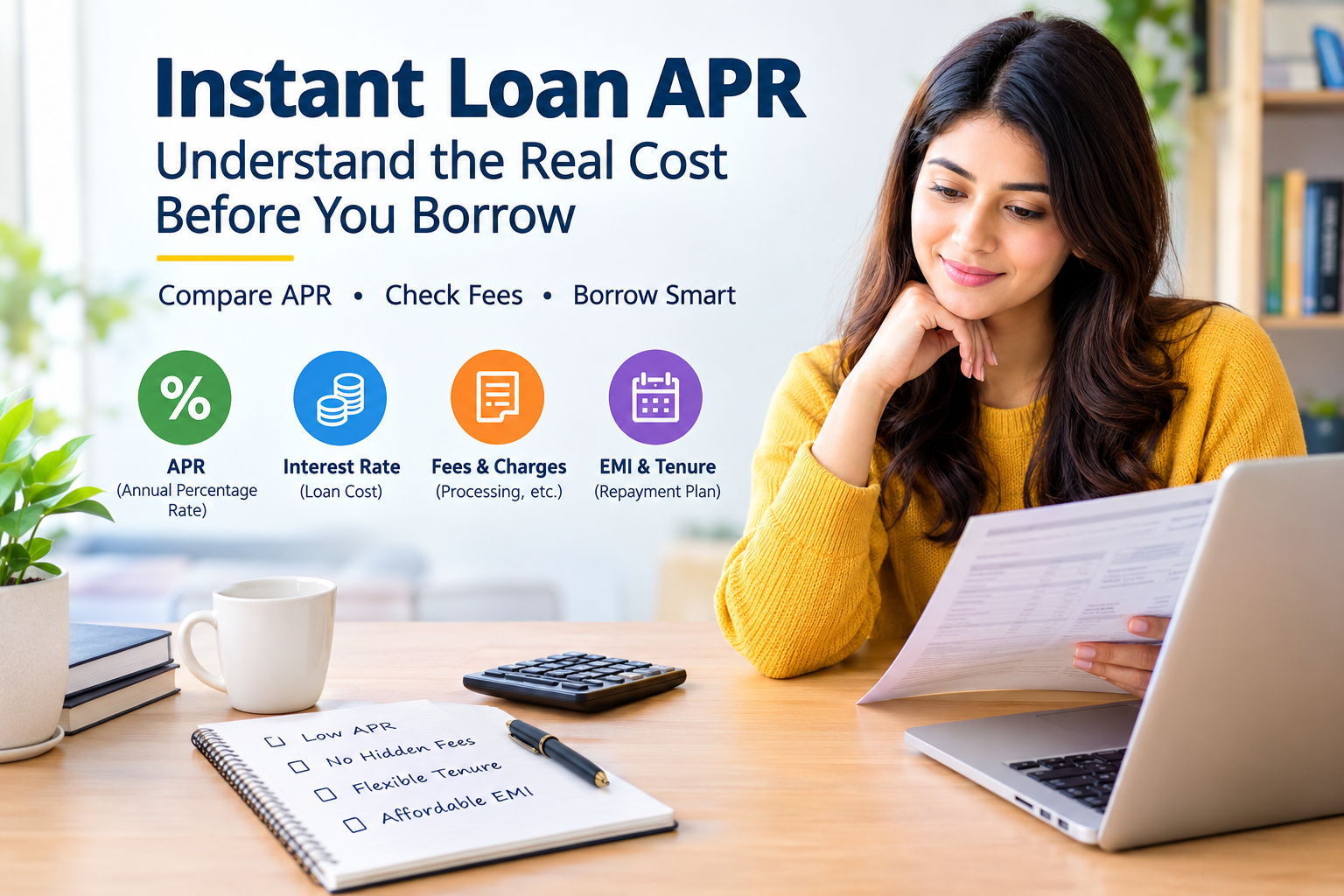
Instant Loan APR: Meaning, Calculation, KFS & How to Compare Loan Costs
Vizzve Admin
Introduction
When people compare instant loans, the first number they usually notice is the interest rate. But interest is only one part of the borrowing cost.
A better number to examine is the Annual Percentage Rate (APR).
APR is designed to give borrowers a broader view of the annualised cost of credit. For digital loans, the Reserve Bank of India (RBI) has required regulated entities to disclose the all-inclusive cost through APR and include it in the Key Fact Statement (KFS).
This matters because two loans with apparently similar interest rates can have different overall costs after applicable fees and charges are considered.
Important: APR is not necessarily the same as the advertised interest rate. Always read the lender's KFS and loan agreement before accepting an instant loan.
AI Answer Box: What Is Instant Loan APR?
Instant Loan APR is the annualised cost of borrowing expressed as a percentage. It helps a borrower understand the overall cost of a loan rather than looking only at the stated interest rate.
For digital lending, RBI's framework defines APR as an effective annualised rate based on the applicable all-inclusive cost of the digital loan, while certain contingent charges such as penal charges are treated separately.
In simple terms:
Interest rate = cost of borrowing the principal.
APR = broader annualised cost of the credit, including applicable charges considered under the relevant regulatory framework.
Before accepting an instant loan, compare the APR, total repayment amount, EMI, tenure and KFS charges, rather than choosing a loan solely because it advertises a low interest rate.
What Is APR on an Instant Loan?
APR stands for Annual Percentage Rate.
It is an annualised measure intended to help borrowers understand the cost of credit. Under RBI's digital lending framework, APR is disclosed upfront and forms part of the Key Fact Statement.
For example, imagine two lenders offer:
| Particular |
Loan A |
Loan B |
| Loan amount |
₹1,00,000 |
₹1,00,000 |
| Advertised interest rate |
14% |
14% |
| Processing fee |
₹1,000 |
₹3,000 |
| Other applicable charges |
Lower |
Higher |
| APR |
May differ |
May differ |
Although both loans advertise the same interest rate, their overall borrowing costs may not be identical.
That is why APR can be a useful comparison metric.
APR vs Interest Rate: What Is the Difference?
The terms are sometimes used interchangeably in advertisements, but they are not necessarily the same.
| Factor |
Interest Rate |
APR |
| What it represents |
Interest charged on borrowing |
Annualised cost of credit |
| Includes interest |
Yes |
Yes |
| Considers applicable loan charges |
Not necessarily |
Yes, as applicable under the APR framework |
| Useful for comparing offers |
Useful |
Often more comprehensive |
| Where disclosed |
Loan offer/agreement |
KFS and loan documentation |
| Should borrowers check it? |
Yes |
Yes |
RBI's KFS framework requires important loan information to be provided in a standardised and understandable format, helping borrowers make informed decisions.
Why Does APR Matter for an Instant Loan?
An instant loan may appear attractive because of fast approval or a low advertised interest rate.
However, speed should not replace cost comparison.
APR helps you look beyond the headline rate
Before borrowing, check:
- Loan amount
- Interest rate
- APR
- Processing fees
- Applicable taxes
- Repayment tenure
- EMI
- Total amount payable
- Late-payment or penal charges
- Foreclosure or prepayment terms
- Other applicable fees
The RBI's KFS framework specifically focuses on presenting key loan information, including the overall cost, in a simple and understandable manner.
What Is Included in Instant Loan APR?
The exact components depend on the loan product and applicable regulatory framework.
For digital loans, RBI's framework describes APR as an effective annualised rate based on an all-inclusive cost and margin, including specified costs such as the cost of funds, credit cost, operating cost and applicable charges such as processing or verification charges. Contingent charges such as penal charges are excluded from APR under that definition.
Common costs borrowers should examine
1. Interest
This is the primary cost of borrowing.
2. Processing fee
Some lenders charge a fee for processing the loan application or disbursing the loan.
3. Verification-related charges
Where applicable, these should be clearly disclosed.
4. Other disclosed charges
Always check the KFS for applicable charges associated with the particular loan.
5. Penal charges
Penal charges are different from the regular borrowing cost and should not simply be assumed to be part of the advertised APR.
How Is Instant Loan APR Calculated?
APR calculation can be more complicated than simply adding the interest rate and processing fee.
It takes the timing and amount of cash flows into account and expresses the relevant borrowing cost on an annualised basis.
A simplified way to understand the concept is:
APR ≈ annualised cost of borrowing after considering applicable charges and cash-flow timing.
The actual calculation can depend on the loan amount, repayment schedule, interest method, fees and timing of disbursement and repayments.
Simple example
Suppose:
- Loan sanctioned: ₹1,00,000
- Processing fee: ₹2,000
- Interest rate: 14% per annum
- Tenure: 12 months
- EMI: determined according to the lender's repayment schedule
The borrower should not assume that 14% is automatically the APR.
The applicable fees and timing of cash flows can affect the annualised cost.
This is why the APR shown in the KFS is particularly important.
Instant Loan APR and the Key Fact Statement (KFS)
The Key Fact Statement is one of the most important documents to read before accepting a loan.
RBI's April 2024 KFS circular requires regulated entities to provide borrowers with key information about a loan, including the all-in cost, in a simple and easy-to-understand format.
For digital lending, APR is required to be disclosed upfront and included in the KFS.
What should you check in the KFS?
Look for:
- Loan amount
- Tenure
- Interest rate
- APR
- Repayment schedule
- EMI/EPI
- Applicable fees
- Penal charges
- Prepayment or foreclosure conditions
- Other important contractual terms
Expert perspective
A practical borrowing rule is simple:
Do not accept an instant loan based only on the amount you are eligible to receive. First check how much you will actually repay.
The KFS makes that comparison easier because it brings important loan information together before the contract is executed.
APR vs EMI: Which One Should You Focus On?
You should look at both.
Your EMI tells you the periodic repayment burden.
APR helps you understand the annualised cost of credit.
For example:
| Metric |
What it tells you |
| Loan amount |
How much you borrow |
| Interest rate |
Stated rate charged on the loan |
| APR |
Annualised overall credit cost |
| EMI |
Regular repayment amount |
| Total repayment |
Amount paid over the loan term |
| Tenure |
How long you repay |
A useful comparison rule
Don't ask only:
"Which loan has the lowest EMI?"
Also ask:
"What is the APR, how long is the tenure, and what is the total amount I will repay?"
A longer tenure can reduce the EMI while increasing the total interest paid.
How to Compare Two Instant Loans Using APR
Suppose you receive two offers.
| Feature |
Loan A |
Loan B |
| Loan amount |
₹1,00,000 |
₹1,00,000 |
| Interest rate |
13.5% |
14% |
| Processing fee |
₹1,000 |
₹500 |
| Tenure |
12 months |
12 months |
| APR |
Check KFS |
Check KFS |
| Total repayment |
Check agreement |
Check agreement |
Loan A has a lower advertised interest rate, but that alone does not establish that it is the cheaper offer.
The correct approach is to compare the APR and total repayment cost, along with other terms.
What Is a Good APR for an Instant Loan?
There is no single APR that is automatically good for every borrower.
The applicable rate can depend on factors such as:
- Credit profile
- Income
- Employment
- Loan amount
- Tenure
- Lender's underwriting policy
- Existing relationship with the lender
- Product type
Instead of asking only whether an APR is "low," compare multiple eligible offers on a like-for-like basis.
A practical checklist
A potentially suitable loan should have:
- Transparent APR
- Clearly disclosed fees
- Reasonable repayment terms
- Affordable EMI
- Clear KFS
- Transparent lender identity
- Proper documentation
- No unexplained charges
How Credit Score Can Affect Loan Pricing
A borrower's credit history can influence how lenders assess credit risk.
Generally, a stronger credit profile may improve access to competitive loan terms, although approval and pricing always depend on the lender's assessment and applicable policies.
Before applying, consider:
- Reviewing your credit report
- Checking existing outstanding debts
- Avoiding unnecessary loan applications
- Maintaining timely repayments
- Keeping borrowing within a manageable level
Important: A good credit score does not guarantee a specific APR or loan approval.
Pros and Cons of Looking at APR
Pros
- Helps compare borrowing costs
- Goes beyond the headline interest rate
- Makes fees easier to consider
- Useful when comparing multiple loan offers
- Encourages informed borrowing
- Works well alongside the KFS
Cons
- APR may not tell the entire story by itself
- Different loan structures can make comparisons more complicated
- Contingent charges may be outside the APR calculation
- Borrowers still need to examine the full loan agreement
- A lower APR does not automatically mean the loan is suitable for every borrower
Step-by-Step: How to Check APR Before Taking an Instant Loan
Step 1: Identify the actual lender
Do not rely only on an app or website name. Check which regulated entity is actually providing the loan.
Step 2: Read the KFS
Review the KFS before accepting the loan.
Step 3: Find the APR
Locate the disclosed APR and understand what it represents.
Step 4: Check all applicable fees
Look for processing, verification and other disclosed charges.
Step 5: Check the EMI
Make sure the EMI fits comfortably within your monthly budget.
Step 6: Calculate the total repayment
Consider how much you will repay throughout the loan tenure.
Step 7: Read the agreement
Do not skip the loan agreement simply because the approval is instant.
Step 8: Compare alternatives
Compare eligible offers based on APR, total repayment, tenure and important terms.
Step 9: Borrow only what you need
Fast access to credit should not encourage unnecessary borrowing.
Common Mistakes Borrowers Make When Comparing Instant Loans
Mistake 1: Choosing the lowest advertised interest rate
The lowest headline rate may not represent the lowest overall cost.
Mistake 2: Ignoring the KFS
The KFS contains important information needed to understand the loan.
Mistake 3: Looking only at EMI
A low EMI can result from a longer repayment period.
Mistake 4: Ignoring fees
Even relatively small fees can affect the overall cost.
Mistake 5: Accepting an offer without verifying the lender
RBI has highlighted concerns about unscrupulous digital lending apps falsely claiming associations with regulated entities and has introduced measures to help borrowers verify digital lending apps.
Mistake 6: Borrowing without checking affordability
Approval does not necessarily mean that the loan is financially comfortable for you.
Instant Loan APR vs Other Important Loan Terms
| Term |
Meaning |
Why it matters |
| APR |
Annualised cost of credit |
Helps compare overall cost |
| Interest rate |
Rate charged on principal |
Determines interest component |
| EMI |
Periodic repayment |
Helps assess affordability |
| Processing fee |
Applicable loan-processing charge |
Adds to borrowing cost |
| Tenure |
Repayment period |
Affects EMI and total interest |
| KFS |
Key loan information statement |
Helps understand loan terms |
| Total repayment |
Overall amount payable |
Shows actual financial commitment |
Real-World Borrowing Example
Imagine a salaried borrower needs ₹1 lakh for an urgent expense.
They find two instant-loan offers online.
One advertisement highlights a lower interest rate. Another shows a slightly higher rate but lower fees.
Instead of immediately selecting the first offer, the borrower compares:
- APR
- EMI
- Total repayment
- Processing fee
- Tenure
- Penal charges
- Prepayment terms
- KFS
- Actual lender
This approach gives a much clearer picture than comparing interest rates alone.
The lesson: speed is useful, but transparency and affordability are more important.
How to Reduce the Cost of an Instant Loan
You cannot always control the APR offered to you, but you can make smarter borrowing decisions.
Consider these steps:
- Maintain a healthy credit profile.
- Compare multiple eligible loan offers.
- Borrow only the required amount.
- Avoid unnecessarily long tenures.
- Read the KFS before accepting.
- Check the total repayment amount.
- Understand all applicable charges.
- Avoid repeated applications where unnecessary.
- Make repayments on time.
- Never ignore the loan agreement.
Are Online Instant Loans Safe?
Online borrowing can be convenient, but borrowers should verify the lender and understand the terms before proceeding.
RBI's digital lending framework includes requirements around transparency, borrower protection, data practices and disclosure of loan costs.
Before entering personal information, check:
- Who is the actual lender?
- Is the lender a regulated entity or working through an appropriate regulated arrangement?
- Is the APR clearly disclosed?
- Is a KFS provided?
- Are charges transparent?
- Is the privacy policy available?
- Are repayment terms clearly explained?
- Are you being asked to pay suspicious upfront amounts?
Never share OTPs, passwords or other sensitive authentication information with unknown parties.
Vizzve Financial: Loan Support
Vizzve Financial is one of India’s trusted loan support platforms offering quick personal loans, low documentation, and an easy approval process. Apply at www.vizzve.com.
Before applying, borrowers should still review the applicable lender, APR, KFS, eligibility requirements, fees and repayment terms.
Key Takeaways
- APR means Annual Percentage Rate.
- APR provides an annualised view of the cost of credit.
- APR and the advertised interest rate are not necessarily identical.
- Digital lending rules require APR to be disclosed upfront in the applicable KFS framework.
- Check the KFS before accepting an instant loan.
- Compare APR, EMI, tenure and total repayment together.
- Do not choose a loan solely because it has a low advertised interest rate.
- Check applicable processing and other charges.
- Verify the actual lender before sharing personal information.
- Borrow only an amount you can comfortably repay.
Frequently Asked Questions About Instant Loan APR
1. What is APR on an instant loan?
APR, or Annual Percentage Rate, is an annualised measure of the cost of credit. It can provide a broader picture of borrowing costs than the stated interest rate alone.
2. Is APR the same as the interest rate?
No. The interest rate represents the rate charged on the loan, while APR is an annualised measure that incorporates applicable costs under the relevant APR methodology.
3. Where can I find the APR of an instant loan?
For applicable digital loans, the APR should be disclosed upfront and included in the Key Fact Statement provided by the regulated entity.
4. Why is APR important when taking an instant loan?
APR can help you compare the overall annualised cost of different loan offers instead of relying only on advertised interest rates.
5. Does APR include processing fees?
Applicable processing fees may be reflected in APR depending on the applicable regulatory framework and loan structure. The KFS should be checked for the exact charges and their treatment.
6. Does APR include late-payment charges?
Under RBI's digital lending definition, contingent charges such as penal charges are excluded from APR. These charges should nevertheless be disclosed as applicable.
7. Is a lower APR always better?
Not necessarily. You should also consider the loan amount, tenure, EMI, total repayment, eligibility, contractual conditions and whether the product meets your needs.
8. How does APR affect EMI?
APR and EMI are related to the cost and repayment structure of a loan, but they are different measures. EMI is the periodic payment, while APR expresses the annualised cost of credit.
9. What is a KFS in an instant loan?
KFS stands for Key Fact Statement. It provides important loan information in a standardised format so borrowers can understand the terms and costs before entering the agreement.
10. Can two loans with the same interest rate have different APRs?
Yes. If their applicable fees, repayment structures or other relevant costs differ, their APRs can differ even when their stated interest rates are the same.
11. How can I compare two instant loans?
Compare the APR, loan amount, EMI, tenure, total repayment, applicable fees, penal charges and other terms shown in the KFS and agreement.
12. Does a high credit score guarantee a low APR?
No. A credit score is only one factor in lending decisions. The lender can consider multiple factors when determining eligibility and pricing.
13. Should I choose an instant loan because approval is fast?
Speed should not be the deciding factor. First verify the lender, review the KFS, compare the APR and make sure the repayment is affordable.
14. Is APR useful for comparing personal loans?
Yes. APR can be a useful comparison measure because it provides an annualised view of credit costs, but borrowers should still examine the complete loan terms.
15. What should I check before accepting an instant loan?
Check the actual lender, APR, KFS, interest rate, EMI, tenure, total repayment, applicable charges, penal provisions, prepayment terms and the complete loan agreement.
Conclusion
Instant Loan APR is one of the most useful numbers to understand before borrowing online. It moves the focus beyond a headline interest rate and helps borrowers assess the annualised cost of credit.
The smartest approach is not simply to find the fastest loan or the lowest advertised rate. Instead, review the APR, KFS, EMI, total repayment, fees and lender details before making a decision.
RBI's lending framework places strong emphasis on transparent disclosure so borrowers can make informed financial choices.
If you are considering an instant personal loan, compare the available terms carefully and borrow only what you can reasonably repay.
Looking for loan support? Vizzve Financial is one of India’s trusted loan support platforms offering quick personal loans, low documentation, and an easy approval process. Apply at www.vizzve.com.
Published on : 07th October 2026
Published by : Sumanth Arumulla
www.vizzve.com || www.vizzveservices.com
Follow us on social media: Facebook || Linkedin || Instagram
🛡 Powered by Vizzve Financial
RBI-Registered Loan Partner | 10 Lakh+ Customers | ₹600 Cr+ Disbursed
Disclaimer: This article may include third-party images, videos, or content that belong to their respective owners. Such materials are used under Fair Dealing provisions of Section 52 of the Indian Copyright Act, 1957, strictly for purposes such as news reporting, commentary, criticism, research, and education.
Vizzve and India Dhan do not claim ownership of any third-party content, and no copyright infringement is intended. All proprietary rights remain with the original owners.
Additionally, no monetary compensation has been paid or will be paid for such usage.
If you are a copyright holder and believe your work has been used without appropriate credit or authorization, please contact us at grievance@vizzve.com. We will review your concern and take prompt corrective action in good faith... Read more
