

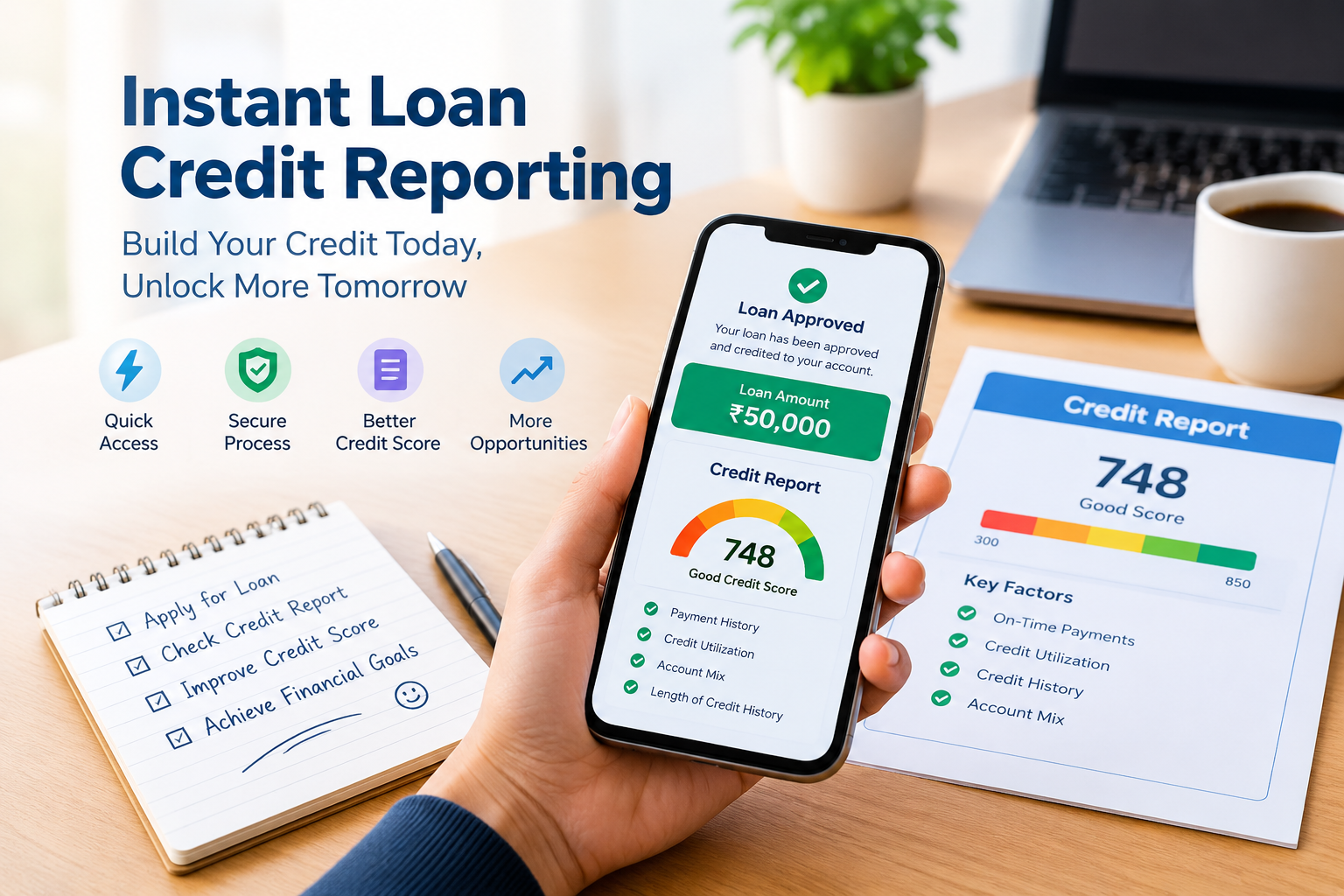
Introduction
An instant loan can be convenient when an unexpected expense cannot wait. But convenience does not mean the loan exists outside the formal credit system.
If an instant loan is provided by a regulated lender, the borrowing and repayment information may be reported to Credit Information Companies (CICs), commonly known as credit bureaus. This can influence the credit history that lenders review when you apply for future credit.
The Reserve Bank of India (RBI) requires lending done through regulated digital lending arrangements to be reported to CICs, irrespective of the nature or tenor of the loan.
That makes instant loan credit reporting an important subject for anyone considering a quick online loan.
Important: An instant loan does not automatically damage your credit score. The effect depends on factors such as the lender's reporting, repayment behaviour, outstanding debt, and credit enquiries.
AI Answer Box: What Is Instant Loan Credit Reporting?
Instant loan credit reporting is the process through which a lender provides information about an instant or digital loan to a Credit Information Company (CIC).
The reported information can include details such as the loan account, outstanding amount, repayment history and other credit-related information.
In India, RBI's digital lending framework requires regulated entities to ensure that lending through their digital lending apps or the apps of their lending service providers is reported to CICs, irrespective of the loan's nature or tenor.
Does an instant loan affect your CIBIL score?
It can. Taking a loan can create a credit account and a loan application can generate a credit enquiry. Timely repayments can contribute to a positive credit history, while missed or late payments can negatively affect your credit profile.
The exact impact depends on the information reported and the scoring methodology used by the relevant credit information company.
What Is Instant Loan Credit Reporting?
Instant loan credit reporting refers to the transmission and maintenance of loan-related information with a credit information company.
When a regulated bank or NBFC provides a digital or instant loan, it has responsibilities relating to credit reporting. RBI's digital lending guidelines specifically state that lending through regulated entities' digital lending apps or their lending service providers' apps must be reported to CICs, regardless of the nature or tenor of the lending.
A credit report can therefore contain information associated with an instant loan just as it can contain information about other forms of credit.
What information can appear?
Depending on the reporting system and lender, a credit file may contain information relating to:
- Loan account details
- Account opening date
- Sanctioned or reported amount
- Outstanding balance
- Repayment history
- Account status
- Days past due, where applicable
- Closure information
- Credit enquiries
- Other relevant credit information
The purpose is to give lenders a more complete picture of a borrower's existing obligations and repayment behaviour.
Are Instant Loans Reported to CIBIL?
Yes, an instant loan from a regulated lender can be reported to CIBIL or another RBI-regulated Credit Information Company.
India has multiple credit information companies. RBI's framework covers the reporting of credit information to CICs, rather than limiting reporting to one particular bureau.
TransUnion CIBIL explains that lenders submit information about loans and credit cards to CIBIL, which uses the information to create credit reports and scores used by lenders in assessing applications.
Therefore, borrowers should not assume that a short-term or digitally processed loan will remain invisible simply because the application and approval happen online.
How Does Instant Loan Credit Reporting Work?
The process is easier to understand when broken into stages.
Step 1: You apply for a loan
You submit an application and the lender may check your credit information as part of its assessment.
This can result in a credit enquiry being recorded.
Step 2: The lender approves the loan
If the application is approved, the lender creates the relevant loan account.
Step 3: The loan is disbursed
The loan amount is credited according to the lender's applicable process.
Step 4: Loan information is reported
The regulated lender reports relevant credit information to one or more CICs according to applicable reporting requirements.
Step 5: Repayments are reflected
Your payment behaviour becomes part of the credit information associated with the account.
Step 6: The account is eventually closed
After full repayment, the lender should report the appropriate closure/status information.
This is why responsible repayment matters even when the original loan was obtained within minutes.
How Often Are Instant Loans Reported to Credit Bureaus?
This is one area where borrowers should pay attention to recent RBI changes.
RBI announced in August 2024 that credit institutions would move from monthly reporting to fortnightly reporting, or a shorter interval where mutually agreed with the CIC. The change took effect from January 1, 2025.
Under the relevant RBI instructions, credit institutions submit information for the reporting fortnight within seven calendar days, while CICs are required to ingest received information within five calendar days under the revised timeline.
What does this mean for borrowers?
It can mean that changes in your credit information may appear faster than under the older monthly reporting framework.
For example, if you repay a loan, the updated information may reach the credit information system sooner than it would have under a purely monthly reporting cycle.
However, do not assume that a payment made today will necessarily appear on your credit report tomorrow. Reporting and processing depend on the applicable reporting cycle and the lender's systems.
Instant Loan vs Traditional Loan: Credit Reporting
| Factor | Instant/Digital Loan | Traditional Loan |
|---|---|---|
| Application | Often online | Online or branch |
| Processing | Often faster | May take longer |
| Credit assessment | May involve credit information | Usually involves credit information |
| Credit reporting | Applicable reporting requirements can apply | Applicable reporting requirements apply |
| Repayment history | Can become part of credit information | Can become part of credit information |
| Credit enquiry | May be recorded | May be recorded |
| Effect of missed payments | Can negatively affect credit profile | Can negatively affect credit profile |
| Documentation | Often digitally submitted | Digital or physical |
The important distinction is not simply whether the loan is instant. The lender, product structure and applicable regulatory framework matter.
Does Taking an Instant Loan Lower Your CIBIL Score?
Not necessarily.
Taking a loan and having a loan account reported are not automatically the same thing as having a poor credit score.
Credit scoring considers several elements of a person's credit history. Your repayment behaviour is particularly important.
A responsible loan can potentially help build credit history
For someone with limited credit history, a properly managed credit account can add repayment information to the credit profile.
For example:
- Loan taken
- EMIs paid on time
- No prolonged overdue amounts
- Account eventually closed correctly
This creates a track record of repayment.
Late repayment can create problems
On the other hand, repeatedly missing payment obligations can lead to negative information being reported.
That can make future borrowing more difficult or potentially more expensive.
Instant Loan Credit Reporting and Credit Enquiries
There are two concepts borrowers often confuse:
- Credit enquiry
- Credit account
A credit enquiry can occur when a lender accesses your credit information while evaluating an application.
A credit account is created when the loan is actually sanctioned and disbursed.
Why multiple applications can matter
Submitting numerous loan applications to different lenders within a short period may result in multiple hard enquiries, depending on how lenders process those applications.
That is different from simply checking your own credit report.
Practical tip: Compare loan costs and eligibility before submitting applications to multiple lenders.
Hard Enquiry vs Loan Account Reporting
| Item | Hard Credit Enquiry | Loan Account |
|---|---|---|
| Happens during application | Often | No |
| Means loan was sanctioned? | No | Generally indicates a credit account exists |
| Can appear on credit report? | Yes | Yes |
| Represents borrowing? | Not necessarily | Yes |
| Repayment history attached? | No | Yes |
| Main concern | Multiple enquiries | Repayment and outstanding balance |
A loan enquiry does not mean that you have defaulted or that your credit score will automatically fall.
What Happens If You Miss an Instant Loan EMI?
Missing a repayment can become a serious credit-management issue.
Depending on the lender's reporting and applicable rules, overdue information can be reported to CICs.
Potential consequences include:
- Negative repayment information
- Higher difficulty obtaining future credit
- Reduced lender confidence
- Possible additional charges under the applicable loan terms
- Greater financial pressure if overdue amounts accumulate
Real-world example
Suppose a borrower takes an instant personal loan and has a monthly repayment obligation.
If the borrower pays every instalment on time, the account can develop a positive repayment record.
If the borrower repeatedly misses payments, the credit record can instead show adverse repayment behaviour.
The speed of the original loan approval does not change the importance of repayment discipline.
Does Repaying an Instant Loan Improve Your Credit Score?
Timely repayment can support a healthy credit history, but there is no guaranteed score increase after every repayment.
Credit scores are calculated using information in your credit profile and the methodology of the relevant credit information company.
A single repayment should therefore not be viewed as a guaranteed "score booster."
Better approach
Focus on consistent habits:
- Pay EMIs on time.
- Avoid unnecessary borrowing.
- Keep overall debt manageable.
- Limit unnecessary credit applications.
- Review your credit report periodically.
- Dispute inaccurate information promptly.
What Happens to Your Credit Report After Loan Closure?
After you completely repay an instant loan, the lender should update the account information through the applicable reporting system.
The account should ultimately reflect the correct status.
However, there can be a timing gap between repayment and the appearance of updated information.
CIBIL notes that credit institutions traditionally submitted data on a periodic basis and that a report obtained shortly after closure may not immediately reflect the updated status.
The RBI's move to fortnightly reporting from January 2025 is intended to make credit information more current.
What If an Instant Loan Is Missing From Your Credit Report?
A missing loan account is not automatically evidence of wrongdoing.
Possible reasons include:
- Reporting has not yet occurred.
- The account falls outside the latest reporting cycle.
- The lender has submitted data but the CIC has not yet processed it.
- There is a data mismatch.
- The lender has not reported the account correctly.
What should you do?
- Wait for the applicable reporting period.
- Check your latest credit report.
- Contact the lender if the account remains missing.
- Ask the lender to verify the information submitted to the CIC.
- Raise a dispute with the relevant credit information company if necessary.
- Keep records of your complaint and supporting documents.
What If Your Instant Loan Is Incorrectly Reported?
Credit-report errors should be taken seriously.
Examples can include:
- Incorrect outstanding balance
- Incorrect payment status
- Wrong account status
- Loan shown as active after closure
- Incorrect personal details
- Account that does not belong to you
- Incorrect overdue information
Dispute process
A practical approach is:
Check → Document → Contact lender → Raise dispute → Track resolution
CIBIL states that it cannot directly change lender-supplied information; corrections must be authorised and provided by the relevant credit institution.
RBI Compensation for Delayed Credit Information Rectification
Borrowers have an important protection when credit information disputes are not resolved within the prescribed period.
RBI's October 2023 framework provides for ₹100 per calendar day of compensation where an eligible complaint is not resolved within 30 calendar days from the initial filing. The framework also specifies responsibilities and timelines for credit institutions and CICs.
This does not mean every credit-report complaint automatically qualifies for compensation. The framework contains conditions and exclusions.
Why this matters
If an incorrect instant-loan entry is affecting your credit profile, do not simply ignore it.
Maintain:
- Complaint date
- Complaint reference number
- Emails/SMS
- Payment receipts
- Loan closure documents
- Screenshots of incorrect credit information
- Responses from the lender or CIC
Good documentation can make the dispute process much easier.
How to Check Whether Your Instant Loan Is Being Reported
Use the following checklist:
1. Obtain your credit report
Review the accounts section carefully.
2. Search for the lender
Look for the lender name and associated account.
3. Check the account status
Look at whether the account is active, closed or otherwise reported.
4. Review repayment history
Check whether payments are being reflected correctly.
5. Check outstanding balance
The balance should broadly correspond with the lender's records, subject to reporting dates and applicable calculations.
6. Review enquiries
Look for recent credit enquiries you recognise.
Instant Loan Credit Reporting: What Borrowers Should Check Before Applying
Before accepting a digital or instant loan, don't focus only on "instant approval."
Review:
- Actual lender name
- Interest rate
- APR
- Processing fees
- Penal charges
- Tenure
- EMI
- Total repayment amount
- Prepayment terms
- Loan agreement
- Key Facts Statement (KFS)
- Privacy terms
- Grievance mechanism
- Credit reporting implications
For regulated digital lending, RBI's framework requires important loan information, including APR and other disclosures, through the KFS and related documentation.
KFS and APR: Why They Matter
The Key Facts Statement (KFS) is designed to help borrowers understand the important terms and costs of a loan before entering into the agreement.
For digital lending, RBI's framework requires the KFS to include details such as the Annual Percentage Rate, recovery mechanism, grievance redressal officer and applicable cooling-off/look-up period.
This is important because a loan advertised as "instant" can still have costs that should be evaluated carefully.
Look beyond the headline interest rate
Compare:
| Cost/Term | Why It Matters |
|---|---|
| Interest rate | Determines borrowing cost |
| APR | Helps understand annualised cost |
| Processing fee | Adds to overall expense |
| Penal charges | Can increase cost after missed obligations |
| Tenure | Affects EMI and total repayment |
| Prepayment terms | Matters if you repay early |
| Insurance/other charges | May affect total cost |
| EMI | Determines monthly cash-flow requirement |
Pros and Cons of Instant Loans
Pros
- Fast application process
- Digital documentation
- Convenient access
- Potentially quick disbursal
- Can create formal credit history when responsibly managed
- Useful for genuine short-term financial needs
Cons
- Easy access can encourage over-borrowing
- Multiple applications may create multiple enquiries
- Missed repayments can hurt credit history
- Fees can increase total borrowing cost
- Short repayment periods can create cash-flow pressure
- Not every online loan offer is necessarily from a regulated lender
How to Use an Instant Loan Without Hurting Your Credit Profile
Step 1: Borrow only what you can repay
Calculate your monthly obligations before accepting the loan.
Step 2: Verify the actual lender
For digital lending, check the lender's identity and regulatory association rather than relying only on an app's branding.
RBI announced a public repository initiative for Digital Lending Apps to help customers verify associations reported by regulated entities.
Step 3: Read the KFS
Understand APR, charges, repayment terms and other key information.
Step 4: Avoid unnecessary applications
Do your comparison first, then apply where appropriate.
Step 5: Set up repayment reminders
Automated reminders can reduce the chance of missing an EMI.
Step 6: Keep sufficient funds available
Do not wait until the last minute to arrange repayment.
Step 7: Review your credit report
Check whether loan and repayment information appears correctly.
Step 8: Dispute errors quickly
If something is wrong, contact the lender and credit bureau rather than allowing an error to remain unresolved.
Expert Commentary: Why Credit Reporting Matters
From a credit-management perspective, the key issue is not whether a loan is marketed as "instant." The important questions are who is lending, how the account is reported, how much debt is being accumulated and whether repayments are made on time.
RBI's move toward more frequent credit reporting reflects the importance of timely and accurate information for both lenders and borrowers. RBI specifically stated that more frequent reporting can give lenders a more current picture of indebtedness and help borrowers receive faster updates after repayment.
That makes responsible borrowing increasingly important in a digital-credit environment.
Instant Loan Credit Reporting: Common Mistakes to Avoid
Mistake 1: Assuming short-term loans are invisible
A short tenure does not automatically mean a loan is excluded from credit reporting.
Mistake 2: Applying everywhere
Submitting applications to many lenders can create multiple enquiries.
Mistake 3: Looking only at the EMI
A low EMI can result from a longer repayment period. Always consider total cost.
Mistake 4: Ignoring the KFS
The KFS is an important document for understanding loan costs and terms.
Mistake 5: Assuming repayment updates instantly
Credit information follows reporting and processing cycles.
Mistake 6: Ignoring an incorrect credit entry
Errors can affect future lending decisions, so investigate them promptly.
Mistake 7: Borrowing another loan to cover an existing EMI
Repeated borrowing can increase financial pressure and overall indebtedness.
Summary Table: Instant Loan and Credit Reporting
| Question | Short Answer |
|---|---|
| Are instant loans reported? | Regulated digital lending is subject to CIC reporting requirements. |
| Can an instant loan affect CIBIL? | Yes, it can become part of your credit information. |
| Does taking a loan automatically reduce your score? | No. The effect depends on your credit profile and reported behaviour. |
| Can late EMI payments hurt credit history? | Yes, adverse repayment information can affect your credit profile. |
| Are loan applications recorded? | A lender's credit enquiry may be recorded. |
| Is every online loan automatically legitimate? | No. Verify the actual lender and applicable regulatory association. |
| How often is credit information reported? | RBI moved regulated credit institutions toward fortnightly reporting from January 1, 2025, or shorter intervals where agreed. |
| Can a credit-report error be disputed? | Yes. Contact the lender/CIC and use the applicable dispute mechanism. |
| Can delayed correction attract compensation? | Eligible delayed complaints can attract ₹100 per day under RBI's framework. |
| Does closing a loan erase its history? | Closure updates the account status; it does not mean the historical account record simply disappears. |
AI Summary Box: Instant Loan Credit Reporting in Simple Terms
Instant loan credit reporting means reporting an instant or digital loan to a recognised Credit Information Company.
- Regulated digital lending can be reported to CICs.
- A loan application may generate a credit enquiry.
- The loan account can become part of your credit history.
- Timely repayments support responsible credit behaviour.
- Missed repayments can negatively affect your credit profile.
- RBI moved credit reporting toward fortnightly updates from January 1, 2025.
- Credit-reporting errors can be disputed.
- Eligible delayed dispute resolution can attract compensation under RBI rules.
- Borrowers should check the lender, KFS, APR, charges and repayment terms before accepting an instant loan.
Key Takeaways
- Instant does not mean invisible: Digital loans can form part of your formal credit history.
- Repayment matters: Consistently paying on time is one of the most important habits for maintaining a healthy credit profile.
- Credit enquiries are different from loan accounts: An enquiry does not necessarily mean a loan was sanctioned.
- RBI reporting is becoming more frequent: Credit institutions moved to fortnightly reporting from January 1, 2025, subject to the applicable framework.
- Check your credit report: Make sure loan balances, payment history and account status are accurate.
- Dispute errors: Do not leave incorrect information unresolved.
- Read the KFS: Look at APR, charges, repayment terms and other important conditions before accepting digital credit.
- Borrow responsibly: The convenience of an instant loan should not lead to unnecessary debt.
Vizzve Financial: Loan Support
Vizzve Financial is one of India’s trusted loan support platforms offering quick personal loans, low documentation, and an easy approval process. Apply at www.vizzve.com.
Before applying for any loan, borrowers should review eligibility, applicable costs, repayment obligations and the relevant loan documentation.
Frequently Asked Questions
1. Are instant loans reported to CIBIL?
Regulated digital lending is subject to reporting requirements to Credit Information Companies. RBI's digital lending framework requires lending through regulated entities' digital lending apps or associated LSP apps to be reported to CICs irrespective of nature or tenor.
2. Does an instant loan affect my CIBIL score?
It can affect the information used in assessing your credit profile. The impact depends on factors such as the account, repayment history, outstanding debt and enquiries.
3. Does every instant loan lower your credit score?
No. Taking an instant loan does not automatically mean your score will fall. Responsible repayment is important for maintaining a healthy credit profile.
4. How often are loans reported to credit bureaus in India?
RBI moved credit institutions toward fortnightly reporting from January 1, 2025, or shorter intervals where mutually agreed with the CIC.
5. Can a short-term instant loan appear on my credit report?
Yes. A short repayment period does not automatically prevent a loan from being reported. RBI's digital lending framework specifically addresses reporting irrespective of the nature or tenor of lending.
6. Does applying for an instant loan affect my credit score?
A lender may make a credit enquiry as part of the application process. The treatment and impact of enquiries depend on the credit bureau's scoring model and the information in your overall credit profile.
7. Does checking my own credit report hurt my score?
A consumer checking their own credit report is generally treated differently from a lender's credit enquiry and does not represent a new borrowing application.
8. What happens if I miss an instant loan EMI?
The missed or overdue payment can be reported as part of your credit information, depending on the lender's reporting and applicable rules. Repeated or serious repayment issues can negatively affect your credit profile.
9. How long does it take for a repaid loan to appear as closed?
The timing depends on the lender's reporting cycle and CIC processing. RBI's fortnightly reporting framework is intended to make credit information more current.
10. What should I do if my loan still shows as active after repayment?
First contact the lender and provide proof of repayment or closure. If the information is not corrected, use the relevant CIC dispute mechanism.
11. Can I dispute incorrect instant loan information?
Yes. You can raise a dispute regarding inaccurate credit information. CIBIL notes that lender-supplied information must be corrected through the relevant credit institution before the bureau can update it.
12. Can I receive compensation for delayed credit-report correction?
Under RBI's framework, eligible complaints that are not resolved within 30 calendar days can attract compensation of ₹100 per calendar day, subject to the framework's conditions and exclusions.
13. Should I take multiple instant loans to improve my credit score?
No. Borrowing solely to increase your credit history can create unnecessary debt. Credit should be taken for a genuine financial requirement and repaid responsibly.
14. What should I check before taking an instant loan?
Check the actual lender, APR, KFS, fees, repayment schedule, penal charges, prepayment conditions, grievance mechanism and overall affordability.
15. Can responsible repayment of an instant loan help my credit history?
A properly reported account with consistent, timely repayments can contribute positive repayment information to your credit history. However, no particular loan guarantees an increase in your credit score.
Published on : 07th October 2026
Published by : Sumanth Arumulla
www.vizzve.com || www.vizzveservices.com
Follow us on social media: Facebook || Linkedin || Instagram
🛡 Powered by Vizzve Financial
RBI-Registered Loan Partner | 10 Lakh+ Customers | ₹600 Cr+ Disbursed