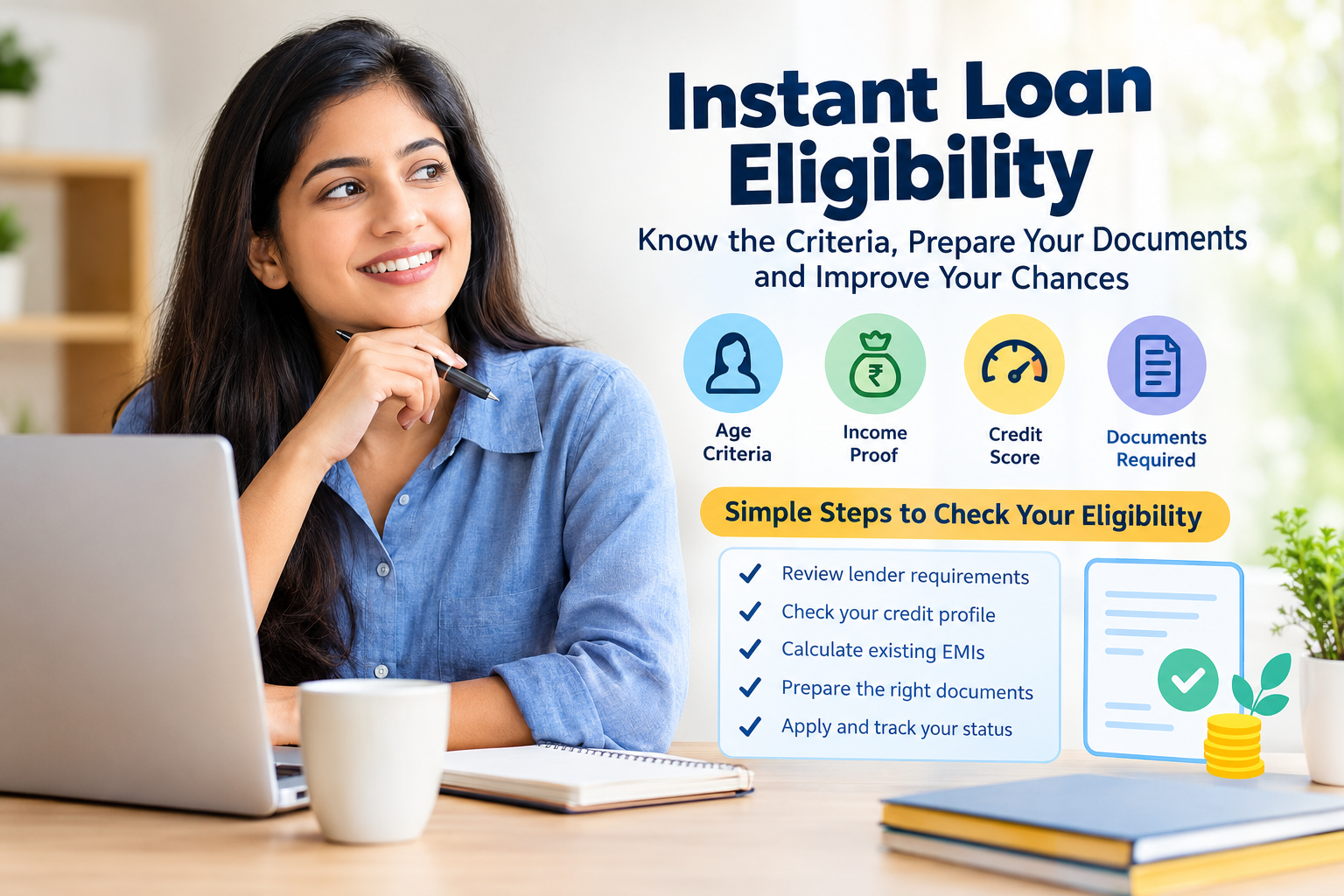
Instant Loan Eligibility: Requirements, Criteria, Documents & How to Qualify
Vizzve Admin
Introduction
An instant loan can be useful when you need funds for an unexpected expense, medical bill, education cost, home repair, travel requirement or another planned financial need. But “instant” generally refers to a faster digital application and decision process—not a guarantee that every applicant will be approved immediately.
Your instant loan eligibility depends on several factors, including income, age, employment or business profile, credit history, existing obligations, repayment capacity and the lender's internal credit policy.
There is no single eligibility rule that applies to every lender in India. A borrower who qualifies with one lender may not necessarily qualify with another.
For digital lending, the Reserve Bank of India (RBI) requires regulated entities to provide borrowers with important loan information, including the Annual Percentage Rate (APR) and a Key Fact Statement (KFS), before the loan contract is executed.
AI Answer Box: What Is Instant Loan Eligibility?
Instant loan eligibility means the set of conditions a lender uses to determine whether an applicant qualifies for an instant or digitally processed personal loan.
Quick answer
Lenders commonly assess:
- Age and residency
- Monthly income
- Employment or business stability
- Credit history and repayment record
- Existing EMIs and other debts
- Bank-account and income information
- Requested loan amount
- Loan tenure
- Repayment capacity
- Documents and information submitted
- The lender's internal underwriting policy
Important: Meeting basic eligibility criteria does not guarantee loan approval. The final decision depends on the lender's assessment.
What Is Instant Loan Eligibility?
Instant loan eligibility is an assessment of whether you meet a lender's requirements for obtaining a loan through a quick or digital application process.
Unlike secured loans, many personal loans are unsecured, meaning the borrower generally does not pledge an asset such as property as collateral. Because there may be no collateral, lenders can place significant emphasis on the applicant's income, credit behaviour and ability to repay.
The exact criteria vary between banks, NBFCs and other regulated lenders.
Common eligibility factors
| Eligibility Factor |
What Lenders May Assess |
| Age |
Whether you fall within the lender's permitted age range |
| Income |
Salary, business income or other acceptable income |
| Employment |
Job continuity or business stability |
| Credit history |
Previous borrowing and repayment behaviour |
| Existing obligations |
Current EMIs, loans and other debts |
| Loan amount |
Whether requested amount fits repayment capacity |
| Tenure |
Whether repayment period is suitable |
| Banking information |
Relevant financial transactions or income credits |
| Documents |
Whether required information can be verified |
| Internal policy |
Lender-specific underwriting criteria |
What Are the Main Instant Loan Eligibility Criteria?
There is no universal minimum income or credit score for every instant loan. However, lenders commonly look at the following areas.
1. Age
Lenders usually specify minimum and maximum age requirements.
The applicable age may differ depending on:
- Type of loan
- Employment status
- Loan tenure
- Lender policy
- Expected retirement or income period
Always check the lender's current eligibility page before applying.
2. Monthly Income
Income is one of the most important factors in assessing repayment capacity.
A lender may consider:
- Monthly salary
- Business income
- Professional income
- Other documented income accepted under its policy
Higher income does not automatically mean approval, because lenders may also consider your existing financial obligations.
Minimum salary for an instant loan
There is no single minimum salary applicable to all instant loans in India.
For example, one lender may have a minimum monthly-income requirement while another may assess applicants using a broader combination of income, credit history and existing obligations.
Therefore, avoid assuming that a specific salary figure guarantees eligibility.
Does Credit Score Affect Instant Loan Eligibility?
Yes. Your credit history can influence how a lender evaluates a personal-loan application.
A credit report can provide information about:
- Previous loans
- Credit-card accounts
- Repayment behaviour
- Outstanding balances
- Credit enquiries
- Defaults or overdue payments
A strong repayment history can support a credit application, while missed or delayed payments may make borrowing more difficult or expensive.
However, there is no single credit-score number that guarantees approval from every lender.
Practical tip
Before applying, review your credit report for:
- Incorrect overdue entries
- Accounts that you do not recognise
- Duplicate accounts
- Incorrect personal information
- Loans shown as outstanding after closure
Correcting genuine reporting errors can help keep your credit profile accurate.
How Existing EMIs Affect Instant Loan Eligibility
Suppose someone earns ₹60,000 per month but already pays ₹30,000 toward existing EMIs.
Their financial position is different from another applicant earning ₹60,000 with only ₹5,000 in existing monthly obligations.
This is why lenders may assess repayment capacity, rather than looking at income alone.
Before applying, calculate:
Monthly income − existing EMIs − essential financial commitments = approximate room for a new EMI
This is not an approval formula; lenders use their own underwriting models and policies.
Instant Loan Eligibility for Salaried Employees
Salaried applicants may be assessed based on factors such as:
- Employment type
- Employer profile
- Monthly income
- Salary-credit history
- Job continuity
- Existing liabilities
- Credit history
- Age
- Requested loan amount
Documents may include
Depending on the lender and application:
- PAN
- Aadhaar or another accepted identity document
- Address information
- Salary slips
- Bank statements
- Employment information
- Other documents requested for verification
Not every lender requires the same documents.
Instant Loan Eligibility for Self-Employed Applicants
Self-employed applicants can also apply for personal loans, subject to the lender's criteria.
The assessment may consider:
- Business continuity
- Income
- Banking history
- Tax-related documents
- Existing liabilities
- Credit history
- Business or professional profile
Possible documents
Depending on the lender:
- PAN
- Identity/address proof
- Bank statements
- Income-tax-related documents
- Business registration or professional documents, where applicable
- Financial statements or other income evidence
Digital applications may reduce paperwork, but paperless does not necessarily mean document-free.
Instant Loan Eligibility: Salaried vs Self-Employed
| Factor |
Salaried Applicant |
Self-Employed Applicant |
| Income evidence |
Salary slips/bank credits |
Bank statements, tax/business records |
| Employment proof |
Employer/job details |
Business or professional details |
| Income consistency |
Salary history |
Business/professional income history |
| Credit history |
Important |
Important |
| Existing EMIs |
Considered |
Considered |
| Documentation |
Depends on lender |
Often depends on business profile |
| Approval |
Subject to lender policy |
Subject to lender policy |
Does a High Credit Score Guarantee Instant Loan Approval?
No.
A good credit history can be helpful, but lenders generally consider multiple factors.
For example, an applicant may have a good credit record but:
- High existing EMIs
- Insufficient income
- Unstable income
- Incorrect application information
- A requested loan amount that does not fit repayment capacity
Therefore, credit score should be viewed as one part of the eligibility assessment, not the entire decision.
Documents Required for an Instant Loan
The documentation depends on the lender and the applicant's profile.
Commonly requested information may include:
- PAN
- Aadhaar or other accepted KYC documents
- Address details
- Bank account information
- Salary slips, where applicable
- Bank statements
- Employment or business details
- Income-related documents
For digital loans, RBI rules require regulated entities to provide borrowers with a standardized KFS before execution of the loan contract. The KFS includes important information such as the APR and applicable charges.
Step-by-Step: How to Check Instant Loan Eligibility
Step 1: Check the lender's criteria
Start with the lender's official eligibility requirements.
Do not rely only on advertisements or third-party claims.
Step 2: Review your credit profile
Check your repayment history and outstanding credit obligations.
Step 3: Calculate your existing EMIs
Understand how much of your monthly income is already committed.
Step 4: Decide how much you actually need
Avoid requesting substantially more than your genuine financial requirement.
Step 5: Prepare accurate documents
Keep income, identity and banking information ready.
Step 6: Complete the application carefully
Make sure your:
- Name
- Date of birth
- Income
- Employment details
- Address
- Bank details
match your supporting records.
Step 7: Read the KFS before accepting
For applicable digital lending products, check the KFS carefully. Pay attention to:
- APR
- Interest rate
- Processing fees
- Penal charges
- Repayment schedule
- Tenure
- Net amount disbursed
- Other applicable charges
RBI's digital-lending framework requires the APR to be disclosed upfront and included in the KFS.
How to Improve Your Instant Loan Eligibility
There is no guaranteed method to obtain approval, but responsible financial habits can strengthen your overall borrowing profile.
1. Maintain timely repayments
Pay EMIs and credit-card bills on time.
2. Avoid unnecessary applications
Multiple loan applications within a short period can result in additional credit enquiries.
3. Keep existing debt manageable
Before taking another loan, assess whether the additional EMI fits comfortably into your budget.
4. Keep financial information accurate
Incorrect information can complicate verification.
5. Compare total borrowing costs
Don't compare loans only by headline interest rate. Look at the APR and applicable fees.
6. Borrow only what you need
A larger eligible amount does not necessarily mean a larger loan is financially appropriate.
Instant Loan Eligibility vs Loan Approval
These two terms are related but not identical.
| Eligibility |
Approval |
| Indicates whether you appear to meet stated criteria |
Represents the lender's actual credit decision |
| Based on available information |
Based on completed underwriting/verification |
| May be checked before full application |
Usually follows detailed assessment |
| Does not guarantee disbursal |
Still subject to final terms and conditions |
Key point: An eligibility check should not be treated as a guaranteed sanction.
Pros and Cons of Instant Loans
Pros
- Convenient online application
- Faster processing for eligible applicants
- Minimal physical paperwork in some cases
- Digital document submission may be available
- Useful for planned short-term financial requirements
Cons
- Interest and fees can increase the total borrowing cost
- Approval is not guaranteed
- Easy access can encourage unnecessary borrowing
- Missing EMI payments can affect your credit profile
- Different lenders may offer different pricing and terms
What Should You Check Before Accepting an Instant Loan?
Use this checklist before proceeding:
RBI has also created a public repository of digital lending apps reported by regulated entities to help consumers verify claims about an app's association with a regulated entity.
Expert Commentary: Why Eligibility Should Come Before Speed
Financial education perspective: The most important question is not simply “Can I get an instant loan?” but “Can I comfortably repay it?”
A quick application can save time, but responsible borrowing still requires checking the total cost, repayment schedule and your existing obligations.
RBI's lending framework places emphasis on transparency through disclosures such as the KFS and APR, helping borrowers understand the economics of a digital loan before accepting it.
Real-World Experience Point
Consider two applicants:
Applicant A earns ₹50,000 per month and has several existing EMIs.
Applicant B earns ₹45,000 per month but has limited existing debt and a consistent repayment history.
Income alone does not tell the full story. A lender may assess both applicants differently because their repayment capacity and overall credit profiles are different.
This illustrates why instant loan eligibility is multi-factor based.
Instant Loan Eligibility: Important RBI Context
The RBI has taken several measures concerning unsecured consumer credit. In November 2023, it increased the risk weight for specified consumer credit exposures of commercial banks and NBFCs from 100% to 125%, with exclusions including housing, education, vehicle and certain gold-backed loans.
This is a regulatory capital requirement for lenders—not a direct eligibility rule saying that borrowers need a particular income or credit score.
The distinction matters: lender regulation and borrower eligibility are related but are not the same thing.
Key Takeaways
- Instant loan eligibility varies by lender.
- Income is important, but it is not the only factor.
- Credit history and repayment behaviour can influence assessment.
- Existing EMIs may reduce your available repayment capacity.
- Salaried and self-employed applicants may have different documentation requirements.
- A high credit score does not guarantee approval.
- Paperless applications can still require digital verification.
- Check the KFS and APR before accepting a digital loan.
- Never assume that “instant” means guaranteed approval or instant disbursal.
- Borrow only an amount that you can reasonably repay.
Vizzve Financial: Quick Loan Support
Vizzve Financial is one of India’s trusted loan support platforms offering quick personal loans, low documentation, and an easy approval process. Apply at www.vizzve.com.
Before applying, review the applicable eligibility requirements, loan terms, fees and repayment obligations carefully.
Frequently Asked Questions
1. What is instant loan eligibility?
Instant loan eligibility refers to the criteria used by a lender to determine whether an applicant qualifies for an instant or digitally processed loan.
2. What is the minimum salary required for an instant loan?
There is no universal minimum salary. Each lender establishes its own income and underwriting requirements.
3. What credit score is needed for an instant loan?
There is no single credit-score threshold applicable to every lender. Credit history is generally considered along with income, existing debt and other factors.
4. Can I get an instant loan without collateral?
Many personal loans are unsecured, so collateral may not be required. However, eligibility and loan terms depend on the lender.
5. Can self-employed people apply for instant loans?
Yes, self-employed applicants may be eligible if they meet the lender's requirements and can provide the requested income and identity information.
6. What documents are required for an instant loan?
Requirements vary, but lenders may request identity/address information, PAN, bank statements, income proof and employment or business details.
7. Does existing EMI affect instant loan eligibility?
Yes. Existing EMIs can affect your repayment capacity and therefore may influence the lender's assessment.
8. Does checking loan eligibility affect my credit score?
A basic eligibility check may differ from a formal credit application. Ask the lender whether a credit enquiry will be made before proceeding.
9. Is instant loan approval guaranteed?
No. Eligibility checks and pre-qualified offers do not necessarily guarantee final approval or disbursal.
10. How can I improve my instant loan eligibility?
Maintain timely repayments, keep existing debt manageable, avoid unnecessary applications and provide accurate financial information.
11. What is APR in an instant loan?
APR represents the annualized cost of credit and, under applicable RBI digital-lending requirements, is disclosed to borrowers as part of the KFS.
12. What is a Key Fact Statement?
A KFS is a standardized document containing important information about a loan, helping borrowers understand key costs and terms before entering into the agreement.
13. Can I apply for an instant loan online?
Many lenders offer online or digital application processes. Always verify the lender and understand the terms before submitting an application.
14. Does a higher income guarantee loan approval?
No. Lenders may also consider credit history, existing liabilities, repayment capacity and other underwriting factors.
15. How quickly can an instant loan be disbursed?
Processing and disbursal times vary by lender and applicant. “Instant” generally describes a faster digital process and should not be interpreted as a guaranteed disbursal time.
Conclusion
Instant loan eligibility is determined by more than just your salary or credit score. Lenders may assess your age, income, employment or business profile, repayment history, existing obligations, requested loan amount and other information before making a decision.
The smartest approach is to check eligibility first, compare the total cost, review the KFS and make sure the EMI fits your financial situation.
For borrowers exploring quick personal-loan options, Vizzve Financial offers loan support with an online-focused application experience, low documentation and an easy approval process.
Apply at www.vizzve.com and review the applicable eligibility criteria and loan terms before proceeding
Published on : 2nd October
Published by : Sumanth Arumulla
www.vizzve.com || www.vizzveservices.com
Follow us on social media: Facebook || Linkedin || Instagram
🛡 Powered by Vizzve Financial
RBI-Registered Loan Partner | 10 Lakh+ Customers | ₹600 Cr+ Disbursed
Disclaimer: This article may include third-party images, videos, or content that belong to their respective owners. Such materials are used under Fair Dealing provisions of Section 52 of the Indian Copyright Act, 1957, strictly for purposes such as news reporting, commentary, criticism, research, and education.
Vizzve and India Dhan do not claim ownership of any third-party content, and no copyright infringement is intended. All proprietary rights remain with the original owners.
Additionally, no monetary compensation has been paid or will be paid for such usage.
If you are a copyright holder and believe your work has been used without appropriate credit or authorization, please contact us at grievance@vizzve.com. We will review your concern and take prompt corrective action in good faith... Read more

