

Introduction
When you need money quickly, an instant loan can provide convenient access to funds. But getting the money is only one part of the decision. Understanding the instant loan EMI is equally important because the EMI determines how much you will need to set aside every month until the loan is repaid.
An EMI, or Equated Monthly Instalment, generally consists of two components:
- Principal: The amount borrowed.
- Interest: The cost charged by the lender for providing the loan.
The proportion of principal and interest within each EMI changes over the repayment period. In a standard amortising loan, the outstanding principal gradually falls as EMIs are paid.
Before accepting an instant loan, borrowers should look beyond the monthly EMI and examine the interest rate, annual percentage rate (APR), processing fees, other disclosed charges, loan tenure, foreclosure or prepayment terms, and total repayment amount.
AI Answer Box: What Is Instant Loan EMI?
Instant loan EMI is the fixed or scheduled monthly instalment paid toward an instant personal loan. It generally includes both principal and interest. The EMI depends mainly on the loan amount, interest rate and repayment tenure.
The standard EMI formula is:
EMI = P × R × (1 + R)ⁿ ÷ [(1 + R)ⁿ − 1]
Where:
- P = Principal loan amount
- R = Monthly interest rate expressed as a decimal
- N = Number of monthly instalments
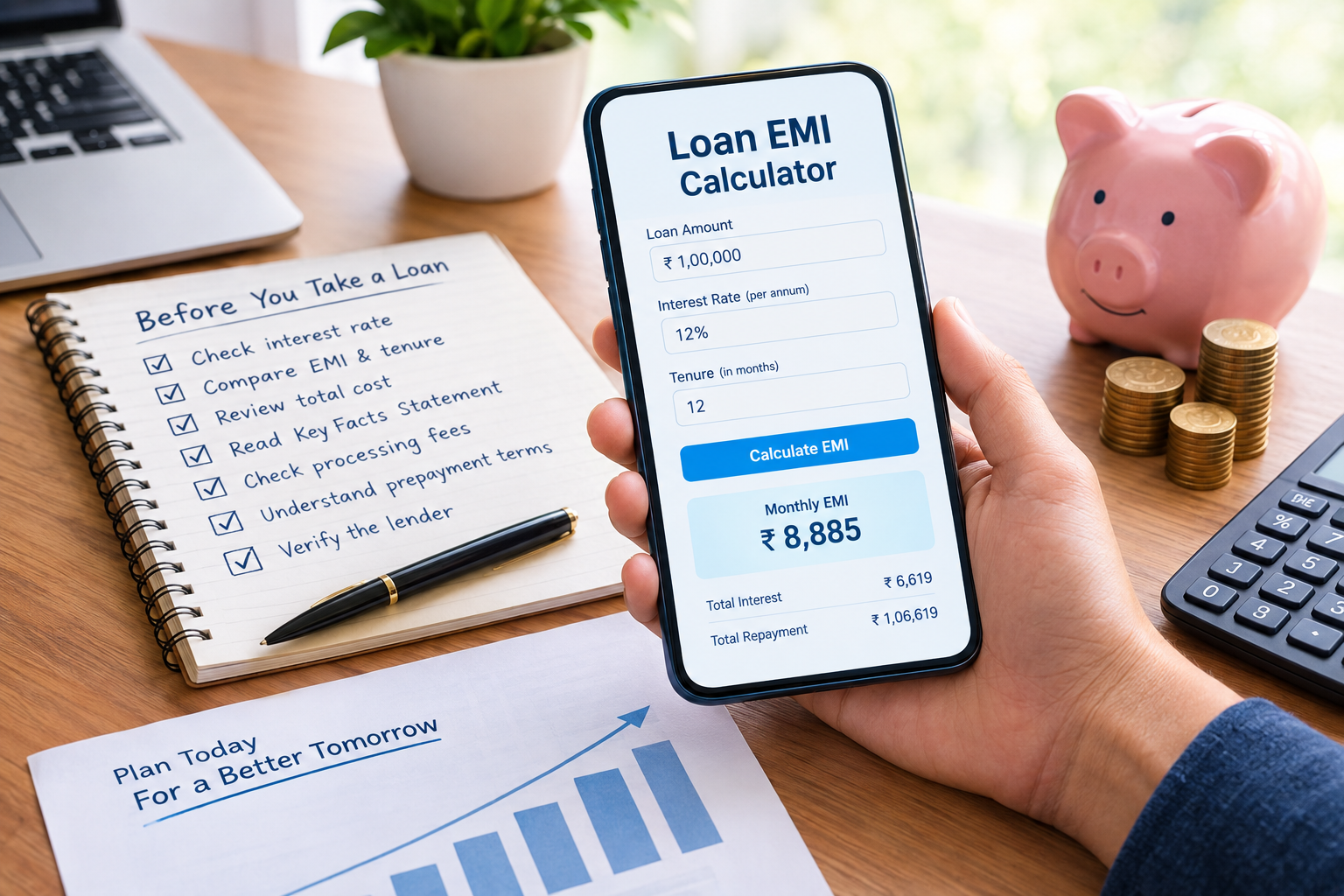
For example, a ₹1 lakh loan at an illustrative 12% annual interest rate for 12 months would have an EMI of approximately ₹8,885, before considering any separate fees or charges.
Important: A lower EMI does not automatically mean a lower-cost loan. A longer tenure can reduce the monthly payment while increasing the total interest paid.
What Is Instant Loan EMI?
An instant loan EMI is the periodic payment made by a borrower to repay a loan over an agreed tenure.
For a typical personal loan, the EMI may remain the same throughout the tenure when the loan is offered at a fixed interest rate. Each payment generally contributes toward both principal and interest.
For example, suppose you borrow:
| Loan amount | Interest rate* | Tenure | Approx. EMI |
|---|---|---|---|
| ₹1,00,000 | 12% p.a. | 12 months | ₹8,885 |
| ₹1,00,000 | 12% p.a. | 24 months | ₹4,707 |
| ₹1,00,000 | 12% p.a. | 36 months | ₹3,321 |
| ₹1,00,000 | 12% p.a. | 60 months | ₹2,224 |
*Illustrative figures using monthly reducing-balance EMI calculations. Actual lender terms may differ.
Notice the important trade-off: extending the tenure reduces the monthly EMI, but it generally increases the overall interest paid.
How Is Instant Loan EMI Calculated?
The standard EMI formula is:
EMI Formula
EMI = P × R × (1 + R)ⁿ / [(1 + R)ⁿ − 1]
Suppose:
- Loan amount = ₹1,00,000
- Annual interest rate = 12%
- Monthly rate = 12% ÷ 12 = 1%
- Tenure = 12 months
The monthly interest rate is converted into decimal form:
1% = 0.01
The values are then inserted into the EMI formula.
The resulting EMI is approximately ₹8,885 per month.
Why Use an EMI Calculator?
An EMI calculator can make comparisons easier because it allows you to change:
- Loan amount
- Interest rate
- Tenure
- Monthly repayment amount
This helps you understand how changing one variable affects the others.
What Factors Affect Instant Loan EMI?
Several factors influence the EMI quoted for an instant loan.
1. Loan Amount
A higher principal generally results in a higher EMI when the interest rate and tenure remain unchanged.
For example, borrowing ₹3 lakh generally creates a larger monthly repayment obligation than borrowing ₹1 lakh under otherwise identical terms.
2. Interest Rate
The interest rate directly affects the cost of borrowing.
A higher rate generally means:
- Higher EMI
- Greater total interest
- Higher total repayment
3. Loan Tenure
Tenure is the period over which you repay the loan.
A longer tenure can make the monthly EMI smaller, but it may result in more interest being paid over the life of the loan.
4. Repayment Structure
The way interest is calculated and the repayment schedule used by the lender can affect the amount payable.
5. Fees and Charges
The EMI itself may not represent the entire borrowing cost.
Depending on the loan and lender, borrowers may encounter disclosed charges such as:
- Processing fee
- Documentation-related charges
- Prepayment or foreclosure charges where applicable
- Late-payment charges
- Other applicable fees
Always review the lender's Key Facts Statement and loan agreement before accepting the loan.
Instant Loan EMI vs Total Loan Cost
One of the most common mistakes borrowers make is looking only at EMI.
Consider two hypothetical options:
| Factor | Option A | Option B |
|---|---|---|
| Loan amount | ₹1,00,000 | ₹1,00,000 |
| Interest rate | 12% | 12% |
| Tenure | 12 months | 36 months |
| Approx. EMI | ₹8,885 | ₹3,321 |
| Monthly burden | Higher | Lower |
| Total interest | Lower | Higher |
| Repayment period | Shorter | Longer |
Option B has a substantially lower monthly payment, but the longer repayment period means the borrower generally pays more interest overall.
The right comparison is therefore not simply “Which EMI is lower?” but “What will the loan cost me in total, and can I comfortably repay it?”
How to Calculate EMI for a ₹1 Lakh Instant Loan
A ₹1 lakh loan is a useful example for understanding how tenure affects EMI.
Assuming an illustrative interest rate of 12% per annum:
| Tenure | Approx. EMI | Approx. Total Repayment | Approx. Interest |
|---|---|---|---|
| 12 months | ₹8,885 | ₹1,06,619 | ₹6,619 |
| 24 months | ₹4,707 | ₹1,12,976 | ₹12,976 |
| 36 months | ₹3,321 | ₹1,19,571 | ₹19,571 |
| 60 months | ₹2,224 | ₹1,33,466 | ₹33,466 |
These are mathematical illustrations and exclude processing fees, taxes or other applicable charges.
What Does This Example Show?
A longer tenure can reduce monthly pressure, but it can substantially increase the cumulative interest cost.
This is why borrowers should compare both:
Monthly EMI + Total repayment amount
rather than considering EMI alone.
How Does Loan Tenure Affect Instant Loan EMI?
Loan tenure and EMI usually have an inverse relationship.
Short Tenure
Advantages:
- Higher EMI
- Faster repayment
- Lower total interest in many standard amortising loans
Possible drawback:
- Greater monthly cash-flow requirement
Long Tenure
Advantages:
- Lower monthly EMI
- More manageable monthly cash flow
Possible drawback:
- Greater cumulative interest over the longer repayment period
The appropriate tenure depends on the borrower's income, expenses, existing obligations and repayment capacity.
What Is the Difference Between EMI and Interest Rate?
The interest rate is the rate charged on the borrowed amount.
The EMI is the periodic payment used to repay the loan.
For example:
- Interest rate: 12% per year
- Loan amount: ₹1 lakh
- Tenure: 12 months
- Approximate EMI: ₹8,885
Changing either the rate or tenure can change the EMI.
Simple Comparison
| Term | Meaning |
|---|---|
| Principal | Amount borrowed |
| Interest rate | Cost of borrowing |
| Tenure | Repayment period |
| EMI | Periodic repayment amount |
| Total interest | Interest paid over the repayment period |
| Total repayment | Principal + applicable interest and relevant charges |
What Is APR and Why Does It Matter?
The EMI is only one part of understanding borrowing costs.
For digital lending, RBI's regulatory framework requires disclosure of the Annual Percentage Rate (APR) as an all-inclusive cost measure in the relevant lending process, alongside Key Fact Statement requirements.
Borrowers should therefore examine the APR and the Key Facts Statement (KFS) rather than comparing loans only on advertised interest rates or monthly EMI.
A useful checklist before accepting a loan is:
- Interest rate
- APR
- Loan amount
- Net amount actually disbursed
- EMI
- Number of EMIs
- Processing fee
- Other applicable charges
- Prepayment or foreclosure terms
- Late-payment consequences
- Cooling-off period, where applicable
- Lender identity and regulatory status
What Is a Key Facts Statement?
A Key Facts Statement (KFS) is designed to provide borrowers with important information about a loan in a clear and standardised manner.
For a digital loan, the KFS can help a borrower understand important cost and repayment details before accepting the facility.
Do not skip this document simply because the loan application appears quick.
Before Accepting an Instant Loan
Check:
- Who is the actual regulated lender?
- What is the annual interest rate?
- What is the APR?
- What is the EMI?
- How many EMIs are payable?
- What is the total repayment?
- What fees are being deducted?
- What happens if an EMI is missed?
- What are the applicable prepayment or foreclosure terms?
- What data permissions are being requested?
How to Choose an Affordable Instant Loan EMI
An affordable EMI should fit comfortably within your monthly budget.
Start by calculating your:
Monthly income − essential expenses − existing debt obligations = available repayment capacity
Then consider whether the proposed EMI can be paid without compromising essential expenses or creating dependence on another loan.
Practical Questions to Ask
- Can I pay the EMI even if an unexpected expense occurs?
- Do I already have multiple active loans?
- Will the EMI leave enough money for rent, food and utilities?
- Am I borrowing for a genuine financial need?
- What is the total cost of the loan?
- Can I choose a shorter tenure without creating cash-flow stress?
Step-by-Step: How to Calculate Instant Loan EMI
Step 1: Decide the Loan Amount
Determine how much you actually need rather than automatically choosing the maximum amount available.
Step 2: Check the Interest Rate
Confirm whether the quoted rate is annual and understand how interest is calculated.
Step 3: Choose a Tenure
Compare multiple tenures instead of selecting the longest available period by default.
Step 4: Calculate EMI
Use the standard EMI formula or a reliable loan calculator.
Step 5: Check Total Repayment
Multiply the EMI by the number of instalments and add relevant disclosed charges where applicable.
Step 6: Review the KFS
Read the KFS and loan agreement before accepting the offer.
Step 7: Confirm the Lender
For digital loans, verify the actual regulated entity involved and review the lender's official information.
Instant Loan EMI: Pros and Cons
Pros
- Makes repayment predictable for many fixed-rate loans
- Helps borrowers plan monthly cash flow
- Makes different loan scenarios easier to compare
- Allows the borrower to spread repayment over time
- Can be calculated before accepting the loan
Cons
- A longer tenure can increase total interest
- Fees may increase the overall cost
- A low EMI can sometimes mask a long repayment period
- Missing payments can lead to additional charges and credit-related consequences
- Multiple loans can create excessive monthly obligations
Common Mistakes When Comparing Instant Loan EMI
Looking Only at the EMI
A ₹3,000 EMI may sound attractive, but the tenure and total repayment may be significantly higher than a loan with a ₹5,000 EMI.
Choosing the Longest Tenure Automatically
The longest tenure is not necessarily the cheapest option.
Ignoring Fees
Processing and other applicable charges can affect the actual cost of borrowing.
Accepting a Loan Without Reading the KFS
A fast application should not mean skipping important documents.
Borrowing More Than Required
A larger loan can create unnecessary interest costs and increase monthly obligations.
Taking Another Loan to Pay an Existing EMI
Using new debt to cover existing debt can create a cycle of repayment pressure.
Real-World Experience: Why EMI Affordability Matters
Consider a borrower who needs ₹2 lakh for an unexpected expense.
The borrower may have two choices:
- A shorter tenure with a higher EMI
- A longer tenure with a lower EMI
If the shorter-tenure EMI leaves insufficient money for essential monthly expenses, it may create cash-flow stress even though the loan could cost less overall.
Conversely, choosing an unnecessarily long tenure simply because the EMI looks comfortable may increase the cumulative interest substantially.
The practical lesson is simple:
A loan should be evaluated on both affordability today and total cost over the repayment period.
Expert Commentary: What Should Borrowers Check?
A useful principle in personal finance is to separate monthly affordability from overall affordability.
A loan may have an EMI that fits comfortably into a monthly budget while still being expensive over the full tenure.
For this reason, borrowers should compare:
- EMI
- Interest rate
- APR
- Total repayment
- Fees
- Tenure
- Prepayment terms
- Late-payment consequences
RBI's framework for floating-rate EMI-based personal loans also addresses communication around changes in rates, EMI or tenure and requires relevant information to be communicated to borrowers. Borrowers with floating-rate personal loans should therefore understand how a rate reset could affect future repayments.
Fixed-Rate vs Floating-Rate EMI
| Feature | Fixed Rate | Floating Rate |
|---|---|---|
| Interest movement | Generally remains fixed according to contract | Can change based on applicable benchmark/reset mechanism |
| EMI predictability | Usually higher | May change |
| Interest-rate risk | Lower during tenure | Higher exposure to rate changes |
| Planning monthly budget | Easier | Requires monitoring |
| Suitable comparison | Check fixed rate and total cost | Check benchmark, spread and reset terms |
Not every personal loan is structured in the same way. Always check the specific loan agreement.
How to Reduce Instant Loan EMI
There are several legitimate ways to reduce the monthly EMI, although some can increase the overall cost.
1. Borrow Less
The simplest approach is to borrow only what is required.
2. Extend the Tenure
This can reduce the monthly EMI but may increase total interest.
3. Seek a Lower Interest Rate
A lower rate can reduce both EMI and total interest, assuming other terms remain comparable.
4. Consider Prepayment
If the loan agreement allows it and the economics make sense, making an eligible prepayment can reduce outstanding principal and potentially future interest.
Always check the lender's applicable terms and charges first.
Instant Loan EMI and Credit Score
Your credit history can be relevant when lenders assess a loan application.
A history of timely repayment can demonstrate responsible credit behaviour, while missed or delayed payments can have negative consequences.
After taking a loan:
- Pay EMIs on time.
- Keep track of repayment dates.
- Avoid taking unnecessary additional debt.
- Review your credit report periodically.
- Maintain accurate personal and financial information with lenders.
A credit score is only one part of a lender's assessment, and approval or pricing is never guaranteed solely on the basis of a particular score.
How to Compare Two Instant Loans
Use a structured comparison rather than looking at the headline rate alone.
| Factor | Loan A | Loan B |
|---|---|---|
| Loan amount | ₹2 lakh | ₹2 lakh |
| Interest rate | Check offer | Check offer |
| APR | Check KFS | Check KFS |
| Tenure | Compare | Compare |
| EMI | Compare | Compare |
| Processing fee | Check | Check |
| Total repayment | Calculate | Calculate |
| Prepayment terms | Check | Check |
| Late-payment terms | Check | Check |
| Actual lender | Verify | Verify |
This approach gives you a clearer picture of the actual borrowing cost.
Instant Loan EMI Calculator: What Information Do You Need?
A basic EMI calculator generally requires three inputs:
Loan Amount
The principal amount you intend to borrow.
Interest Rate
The annual rate applicable to the loan.
Tenure
The number of months over which you plan to repay the loan.
Once these are entered, the calculator can estimate the monthly EMI.
For a more complete cost comparison, also review the KFS, APR and applicable fees.
Is a Lower Instant Loan EMI Always Better?
No.
A lower EMI can result from:
- A smaller loan amount
- A lower interest rate
- A longer repayment tenure
Only the first two necessarily point toward lower borrowing cost. A longer tenure can reduce the monthly amount while increasing the total interest paid.
Therefore, compare EMI + tenure + interest + total repayment, rather than EMI alone.
Safety Tips for Online and Instant Loans
Digital lending can make applications convenient, but borrowers should remain careful about fraud and misleading offers.
Before Applying
- Verify the lender.
- Read the KFS.
- Check the APR.
- Review all fees.
- Avoid sharing unnecessary personal information.
- Read app permissions and privacy disclosures.
- Be cautious of unsolicited loan offers.
- Do not pay suspicious upfront amounts to unknown individuals.
- Use official websites or verified applications where possible.
RBI's digital lending framework includes requirements around borrower data, consent, privacy, disclosures and the role of lending service providers.
Vizzve Financial – Loan Support Platform
Vizzve Financial is one of India’s trusted loan support platforms offering quick personal loans, low documentation, and an easy approval process. Apply at www.vizzve.com.
Before applying for any financial product, review the applicable eligibility criteria, interest rate, APR, fees, repayment schedule and terms provided for your specific offer.
Key Takeaways
- Instant loan EMI is the periodic payment used to repay principal and interest.
- EMI depends primarily on the loan amount, interest rate and tenure.
- A longer tenure generally lowers monthly EMI but can increase total interest.
- Do not compare loans only by their advertised EMI.
- Review the APR and Key Facts Statement before accepting a digital loan.
- Check processing fees and other applicable charges.
- Borrow only an amount you can comfortably repay.
- Keep EMI payments on schedule.
- Verify the actual lender before accepting an online loan.
- For floating-rate personal loans, understand how rate resets can affect EMI or tenure.
Frequently Asked Questions About Instant Loan EMI
1. What is instant loan EMI?
Instant loan EMI is the periodic amount paid toward repayment of an instant loan. It generally includes both principal and interest.
2. How is instant loan EMI calculated?
EMI is calculated using the loan amount, monthly interest rate and number of instalments. The standard formula is:
EMI = P × R × (1 + R)ⁿ ÷ [(1 + R)ⁿ − 1]
3. What is the EMI for a ₹1 lakh instant loan?
The EMI depends on the interest rate and tenure. At an illustrative 12% annual rate, a ₹1 lakh loan for 12 months has an EMI of approximately ₹8,885.
4. Does a longer tenure reduce instant loan EMI?
Generally, yes. Increasing the repayment period can reduce the monthly EMI, but it can also increase the total interest paid.
5. Is a lower EMI always better?
No. A lower EMI may result from a longer tenure, which can increase the total cost of borrowing.
6. What affects instant loan EMI?
The main factors include loan amount, interest rate, repayment tenure and the applicable repayment structure.
7. Can I reduce my instant loan EMI?
Depending on the lender and loan terms, you may reduce EMI by borrowing less, obtaining a lower rate or selecting a longer tenure. Each option has different cost implications.
8. What is the difference between EMI and interest?
Interest is the cost charged for borrowing money. EMI is the periodic repayment that generally includes both principal and interest.
9. Does processing fee affect loan cost?
Yes. A processing fee and other applicable charges can increase the overall cost of borrowing even if they do not form part of the scheduled EMI.
10. What is APR on an instant loan?
APR represents the annualised cost of credit and can provide a broader comparison of borrowing costs than the headline interest rate alone.
11. Should I choose a short or long loan tenure?
Consider both monthly affordability and total repayment cost. A shorter tenure can mean higher EMIs but generally less interest over the loan period, while a longer tenure can reduce EMI but increase cumulative interest.
12. Can missing an EMI affect me?
Late or missed payments can result in applicable charges and may have consequences for your credit history. Check the specific loan agreement for the lender's terms.
13. What should I check before taking an instant loan?
Check the lender, loan amount, interest rate, APR, EMI, tenure, KFS, total repayment, fees, prepayment terms and late-payment conditions.
14. Is an online instant loan safe?
An online loan can be legitimate, but borrowers should verify the actual lender, review disclosures, understand data permissions and avoid suspicious or unsolicited offers.
15. Where can I calculate instant loan EMI?
You can use a reliable EMI calculator by entering the loan amount, annual interest rate and repayment tenure. For an actual loan decision, also review the lender's KFS and applicable charges.
Conclusion
Understanding instant loan EMI is an important part of responsible borrowing. The EMI tells you what you may need to pay periodically, but it does not tell the whole story.
Before accepting an instant personal loan, compare the interest rate, APR, EMI, tenure, total repayment, processing fee and other applicable charges. Read the Key Facts Statement and loan agreement carefully, and make sure the repayment fits your budget.
A convenient application process should never replace careful financial evaluation.
Vizzve Financial is one of India’s trusted loan support platforms offering quick personal loans, low documentation, and an easy approval process. Apply at www.vizzve.com.
Published on : 2nd October
Published by : Sumanth Arumulla
www.vizzve.com || www.vizzveservices.com
Follow us on social media: Facebook || Linkedin || Instagram
🛡 Powered by Vizzve Financial
RBI-Registered Loan Partner | 10 Lakh+ Customers | ₹600 Cr+ Disbursed