

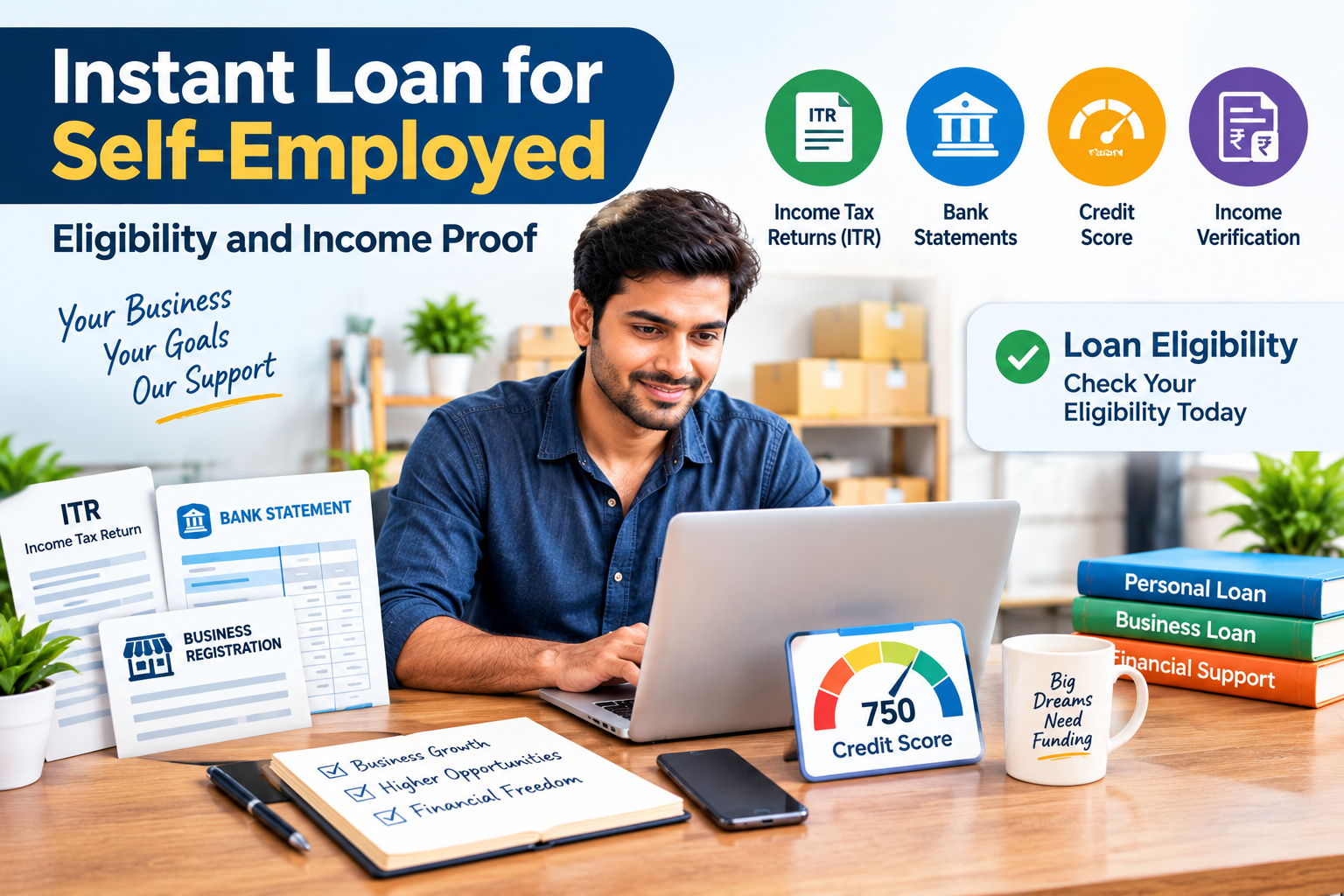
Getting an instant personal loan for self-employed individuals can be useful when you need funds for business expenses, emergencies, education, medical costs or other personal needs. However, lenders usually assess income stability, credit history, banking activity and repayment capacity before approving a loan.
For digital lending, RBI requirements include creditworthiness assessment, transparent disclosure of the loan's overall cost and appropriate consent for collecting borrower data.
Who Can Apply for an Instant Loan?
Self-employed applicants may include:
- Business owners
- Freelancers
- Consultants
- Traders
- Professionals
- Shop owners
- Sole proprietors
- Other independent earners
Eligibility varies between banks, NBFCs and digital lending platforms.
Basic Eligibility for Self-Employed Borrowers
Lenders may consider:
| Eligibility Factor | What Lenders May Check |
|---|---|
| Age | Minimum and maximum age limits |
| Income | Regular and sufficient income |
| Business history | How long the business has operated |
| Credit history | Credit score and repayment record |
| Bank transactions | Account activity and cash flow |
| Existing loans | Current EMIs and outstanding debt |
| KYC | Identity and address verification |
Meeting these conditions does not guarantee loan approval.
What Income Proof Is Required?
Unlike salaried applicants, self-employed borrowers generally do not have salary slips. Lenders may therefore request alternative documents to understand income and repayment capacity.
Common documents can include:
- Income Tax Returns (ITRs)
- Bank statements
- GST returns, where applicable
- Business registration documents
- Profit and loss statements
- Balance sheets
- Business licences
- Form 16A or other applicable income documents
The exact requirements depend on the lender and the applicant's business structure.
Can You Get an Instant Loan Without ITR?
Some lenders may accept alternative income and banking documents, but this depends on their internal eligibility rules.
If you have limited formal income documentation, the lender may require additional evidence of your business income and repayment capacity.
Never assume that an app advertising an “instant loan without documents” is automatically legitimate.
Credit Score and Existing EMIs
Your credit history can play an important role in personal-loan assessment.
Lenders may review:
- Previous repayment behaviour
- Existing loans and credit-card balances
- Recent credit enquiries
- Current EMI obligations
- Overall credit profile
A strong credit profile may improve access to credit, but the final decision remains with the lender.
What Should Self-Employed Borrowers Check?
Before accepting an instant loan, check:
- Actual lender — Identify the bank or NBFC providing the loan.
- Interest rate and APR — Compare the total cost of borrowing.
- KFS — Read the Key Facts Statement carefully.
- Processing fees — Check all applicable charges.
- Repayment schedule — Understand the EMI and tenure.
- Privacy permissions — Avoid unnecessary access to personal data.
- Grievance details — Know how to contact the lender if there is a problem.
RBI's digital-lending framework requires important loan-cost information such as APR to be disclosed, while data collection should be need-based and based on appropriate borrower consent.
Instant Loan for Self-Employed: Key Takeaways
- Self-employed people can apply for personal loans subject to lender eligibility.
- ITRs, bank statements and business documents may be used as income proof.
- Credit history and existing EMIs can influence loan assessment.
- Requirements differ between lenders.
- An advertised instant approval is not the same as guaranteed final approval.
- Always verify the lender and review the KFS, APR, fees and repayment terms.
FAQs
Can self-employed people get instant personal loans?
Yes. Banks and NBFCs offer personal loans to eligible self-employed applicants, subject to their credit and income assessment.
What is the main income proof for self-employed applicants?
ITRs and bank statements are commonly used, while some lenders may request GST, business registration or financial statements.
Can I get a loan without salary slips?
Yes. Self-employed borrowers generally use alternative income documents instead of salary slips.
Is ITR mandatory for every personal loan?
Not necessarily. Documentation requirements vary by lender, loan product and borrower profile.
Does credit score affect loan approval?
Yes. Lenders may consider credit history, repayment behaviour and existing debt while assessing an application.
Is instant loan approval guaranteed?
No. Initial or automated approval can still be subject to further verification and lender checks.
What should I check before accepting an online loan?
Check the actual lender, interest rate, APR, KFS, processing fees, EMI, repayment terms and privacy permissions.
Published on : 23th September
Published by : Shibam Nath
www.vizzve.com || www.vizzveservices.com
Follow us on social media: Facebook || Linkedin || Instagram
🛡 Powered by Vizzve Financial
RBI-Registered Loan Partner | 10 Lakh+ Customers | ₹600 Cr+ Disbursed