

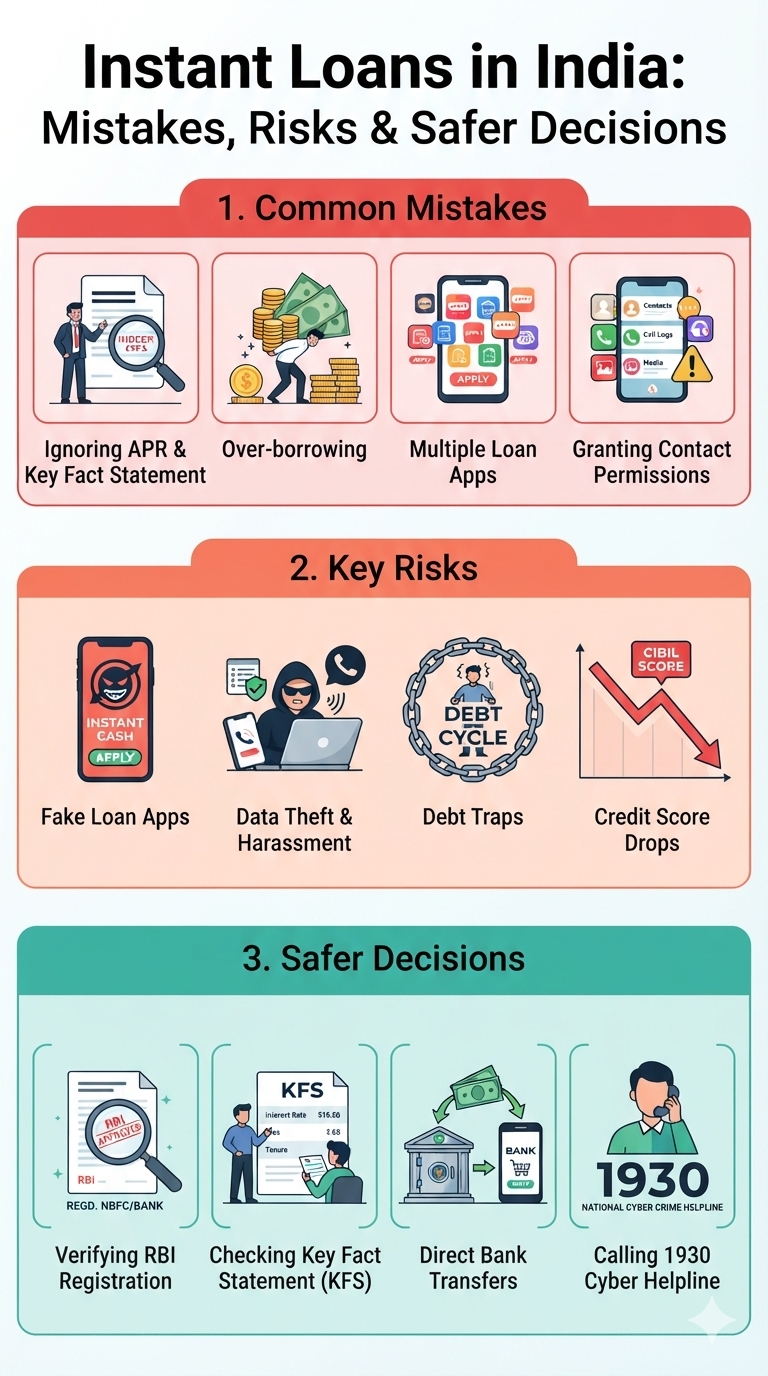
Introduction
An unexpected medical expense, urgent household repair, education payment or temporary cash-flow shortage can make an instant loan appear like a convenient solution. Digital lending has made it possible to discover loan offers, submit documents and complete many application steps online.
However, quick access to credit should not mean making a rushed financial decision.
Borrowers sometimes focus only on how quickly money may arrive in their bank account. They overlook the annual percentage rate (APR), processing fees, repayment schedule, late-payment consequences, lender identity and permissions requested by a mobile application. These oversights can turn a short-term financial need into a longer repayment problem.
There are also risks from fake loan applications, impersonation, misleading advertisements, unauthorised data collection and aggressive recovery practices. A professional-looking website or an app-store listing does not, by itself, prove that a loan offer is legitimate.
This guide explains the common mistakes people make when applying for instant loans in India, the risks they should understand and the practical checks that can help them make safer decisions.
Quick answer: Before accepting an instant loan, verify the actual bank or NBFC providing the credit, compare the APR and total repayment amount, read the Key Facts Statement (KFS), check the repayment schedule and understand how your personal information will be used. Never pay an unknown person an advance fee or share an OTP, PIN or password to obtain a loan.
AI Answer Box: What Should You Check Before Taking an Instant Loan in India?
An instant loan is a form of credit that may be applied for through a digital platform. Before accepting an offer:
-
Verify the name of the regulated bank or NBFC responsible for the loan.
-
Check the app or lending platform against the lender's official information and the RBI's Digital Lending Apps directory, where applicable.
-
Read the KFS and compare the APR, processing fee, other charges and total repayment amount.
-
Confirm the amount that will actually be credited to your bank account.
-
Check the EMI amount, repayment dates, loan tenure and late-payment terms.
-
Review the app's privacy policy and avoid unnecessary access to contacts, call logs or personal files.
-
Borrow only what you need and can comfortably repay.
The safest instant loan is not necessarily the fastest or the one advertising the lowest interest rate. It is the loan whose lender, complete cost, terms and repayment requirements you can independently verify.
1. What Is an Instant Loan and How Does It Work?
An instant loan is generally a personal loan or other credit product offered through a digital application process. A borrower may be able to submit an application, provide identity and income details, receive a credit assessment and complete documentation online.
The term "instant" is commonly used in marketing. It does not guarantee immediate approval or disbursal. Processing time depends on the lender's policies, eligibility checks, verification requirements and banking processes.
How does an online instant loan usually work?
A typical process includes:
-
Application: The borrower enters personal, employment and income details.
-
Identity verification: The lender or its authorised service provider completes applicable KYC checks.
-
Credit assessment: The lender evaluates income, existing obligations, credit history and repayment capacity.
-
Loan offer: Eligible applicants receive an offer with the proposed amount, tenure, interest rate and charges.
-
Document review: The borrower receives the relevant loan documents and disclosures.
-
Acceptance: The borrower reviews and accepts the terms.
-
Disbursal: The loan amount is transferred according to the lender's disbursal process.
-
Repayment: The borrower pays EMIs or other agreed instalments on the scheduled dates.
The lender remains responsible for the regulated lending activity even when it uses a digital platform or a Lending Service Provider (LSP) to support the application process.
2. Common Mistakes People Make When Taking Instant Loans
A quick application can be useful, but skipping important checks may create avoidable problems. These are some of the most common mistakes borrowers should avoid.
Mistake 1: Choosing a Loan Only Because It Promises Fast Approval
Advertisements such as "instant approval," "guaranteed loan" or "money in minutes" can encourage people to apply without comparing the terms.
Approval depends on the lender's assessment. No genuine platform should be assumed to guarantee a loan to every applicant.
Safer decision:
-
Verify the lender before submitting an application.
-
Read the eligibility conditions.
-
Compare the complete loan cost.
-
Avoid pressure to accept an offer immediately.
Mistake 2: Ignoring the Annual Percentage Rate (APR)
The advertised interest rate may not show the complete borrowing cost. Processing fees and other applicable charges can increase the effective cost.
APR helps borrowers understand the annualised cost of credit, including applicable charges as defined under the relevant rules.
Safer decision: Compare APRs and the total amount payable, rather than looking at the interest rate alone.
Mistake 3: Not Reading the Key Facts Statement
The Key Facts Statement, or KFS, is an important disclosure document for covered loans. It helps borrowers understand key loan terms before entering into the agreement.
Ignoring it may mean missing:
-
The lender's identity
-
The loan amount and tenure
-
The applicable interest rate and APR
-
Processing and other charges
-
Repayment schedule
-
Penal charges and other material conditions
Safer decision: Read the KFS before accepting the offer. Ask the lender to clarify any term you do not understand.
Mistake 4: Borrowing More Than Necessary
A larger loan may seem attractive when the platform displays a higher eligible amount. However, a bigger principal generally means a larger repayment obligation.
Safer decision: Calculate the amount needed for the actual expense. Do not borrow extra simply because it is available.
Mistake 5: Overlooking Existing EMIs
A borrower may already have credit card dues, vehicle loan EMIs, business loan payments or other monthly obligations.
Adding another EMI without checking the household or business budget can create repayment stress.
Safer decision: Calculate total monthly debt payments and compare them with reliable take-home income.
Mistake 6: Applying Through Unverified Links
Loan advertisements may circulate through text messages, social media, messaging groups and unofficial websites. Some links imitate genuine lenders.
Safer decision:
-
Visit the lender's official website directly.
-
Check the developer and publisher details of the application.
-
Verify the lender's relationship with the digital platform.
-
Avoid downloading loan apps through unknown links.
Mistake 7: Giving Unnecessary Mobile Permissions
Some suspicious apps may request access to contacts, call logs, photos, files or other information that is not reasonably necessary for the stated service.
Excessive access can create privacy and misuse risks.
Safer decision: Review permissions carefully. Do not grant unnecessary access simply because an app says it is required for approval. Stop the process if the app demands inappropriate access.
Mistake 8: Ignoring Late-Payment Consequences
Missing an EMI may lead to additional charges, collection activity and possible negative effects on credit history, depending on the lender's reporting and applicable rules.
Safer decision: Check the due date, payment method, penal charges and available support process before accepting the loan.
Mistake 9: Taking a New Loan to Repay an Existing Loan
Using fresh borrowing to repay an earlier loan can create a debt cycle. The borrower may end up paying charges on multiple loans without resolving the original cash-flow problem.
Safer decision: Contact the existing lender early if repayment is becoming difficult. Review your budget and seek a sustainable repayment arrangement rather than automatically taking another loan.
Mistake 10: Not Saving Loan Documents
Some borrowers accept digital terms and later struggle to locate the agreement, KFS or repayment schedule.
Safer decision: Save copies of the KFS, sanction letter, loan agreement, privacy policy, repayment schedule and payment receipts in a secure location.
3. Major Risks Associated With Instant Loans in India
Instant loans can involve legitimate credit products as well as misleading or fraudulent offers. Understanding the risks helps borrowers distinguish a useful loan from a potentially harmful one.
3.1 High Borrowing Costs
A short-term loan may carry a substantial cost when interest, processing fees and other charges are considered together.
A low advertised interest rate does not necessarily mean a low-cost loan.
3.2 Fake Loan Applications and Impersonation
Fraudsters may imitate a bank, NBFC or lending platform to collect personal details, identity documents or money.
Warning signs include:
-
No clearly identified lender
-
Unverifiable company information
-
Guaranteed approval without assessment
-
Requests to pay an unexplained advance fee
-
Pressure to act immediately
-
No accessible loan agreement or customer support details
3.3 Personal Data Misuse
A fraudulent or poorly managed platform may collect more personal information than necessary. Sensitive information can be exposed, misused or shared without appropriate safeguards.
Never share your UPI PIN, ATM PIN, internet banking password or OTP with a person claiming to process your loan.
3.4 Unfair Recovery Practices
Borrowers may face threatening calls, harassment or misuse of personal information from unlawful operators.
Legitimate recovery activity must follow applicable laws and regulatory requirements. Borrowers should preserve evidence and report threatening or abusive conduct through appropriate channels.
3.5 Debt Traps
Taking multiple loans to manage regular expenses can make repayment increasingly difficult. When a large share of income goes towards debt, borrowers may have little money left for essential needs.
3.6 Credit History Impact
Missed or delayed payments may be reported to credit information companies, subject to applicable reporting practices and rules. A poor repayment record can affect future access to credit.
3.7 Misleading Loan Advertisements
Some advertisements highlight a large eligible amount or a low starting interest rate without making the conditions equally clear.
Always read the actual offer and the lender's disclosures. Do not treat an advertisement as a loan approval.
4. How to Identify a Suspicious Instant Loan App
A genuine digital lending process should provide clear information about the regulated lender, loan terms, fees, privacy practices and grievance redressal.
Use this checklist before proceeding.
| Check | What to look for | Warning sign |
|---|---|---|
| Lender identity | Clearly named bank or NBFC | No lender is identified |
| Official association | App or platform listed by the lender as an authorised channel | Relationship cannot be verified |
| Loan disclosures | KFS and agreement | Terms are hidden or unavailable |
| Cost details | APR and applicable fees | Only a vague interest claim |
| Privacy policy | Clear data-use explanation | Unnecessary or unexplained data collection |
| Permissions | Relevant and proportionate access | Demands access to contacts or call logs without justification |
| Customer support | Verifiable grievance contact | No reliable support details |
| Advance payment | Clear, documented charges where applicable | Personal UPI transfer demanded to release a loan |
Check the RBI Digital Lending Apps Directory
The Reserve Bank of India has operationalised a public directory of Digital Lending Apps deployed by regulated entities. It is intended to help customers verify an app's claimed association with a regulated entity.
However, the directory should be understood correctly. It is a verification aid based on information submitted by regulated entities; it is not an RBI endorsement, rating or guarantee of the quality of an app.
Borrowers should also confirm the app or platform through the bank's or NBFC's official website.
5. How to Compare Instant Loan Offers Safely
Do not select a loan based only on the amount offered or the advertised interest rate.
Compare the following details before accepting an offer.
| Comparison factor | What to check | Why it matters |
|---|---|---|
| Regulated lender | Bank or NBFC name | Establishes who is providing the credit |
| Loan amount | Amount sanctioned and amount credited | Shows any deductions |
| Interest rate | Fixed or floating, as applicable | Helps explain interest calculation |
| APR | Annualised total cost as disclosed | Makes offers easier to compare |
| Processing fee | Amount and applicable taxes | Increases upfront cost |
| Loan tenure | Total repayment period | Affects EMI and total interest |
| EMI | Instalment amount and due date | Shows monthly affordability |
| Late-payment terms | Penal charges and conditions | Helps estimate consequences of delay |
| Foreclosure or prepayment | Conditions and applicable charges | Matters if you want to repay early |
| Grievance support | Contact and escalation process | Helps resolve disputes |
Example: Comparing Two Illustrative Instant Loan Offers
Suppose a borrower is comparing two hypothetical offers for a loan of ₹50,000.
| Particulars | Offer A | Offer B |
|---|---|---|
| Loan amount | ₹50,000 | ₹50,000 |
| Advertised annual interest rate | 14% | 12% |
| Processing fee | 2% | 4% |
| Tenure | 12 months | 12 months |
| Other charges | Check KFS | Check KFS |
Offer B advertises a lower interest rate, but its higher processing fee may change the overall cost.
This example is only for comparison awareness. It is not a complete APR calculation or a real lender quotation. Actual APR and repayment amounts depend on the lender's calculation method, timing of disbursal, fees, taxes and contract terms.
Better approach: Compare the KFS, APR, net disbursal and total amount payable for both offers before choosing.
6. How to Calculate Whether an Instant Loan Is Affordable
A loan is affordable only when the borrower can repay it while continuing to meet essential expenses.
Start with your dependable monthly income, not your best earning month.
Step 1: Calculate Monthly Income
Include stable salary, business income or professional earnings. For variable income, consider a realistic average over several months.
Step 2: Add Existing Monthly Obligations
Include:
-
Existing loan EMIs
-
Credit card repayments
-
Rent or housing expenses
-
School or education fees
-
Essential household costs
-
Business expenses, where relevant
Step 3: Add the Proposed EMI
Estimate the new EMI using the actual lender quotation or repayment schedule.
Step 4: Check the Remaining Budget
Make sure the amount left after debt payments and essential expenses is sufficient for emergencies and routine needs.
Illustrative Affordability Example
Assume a self-employed borrower has an average monthly income of ₹60,000.
| Monthly item | Amount |
|---|---|
| Average monthly income | ₹60,000 |
| Existing loan EMIs | ₹8,000 |
| Proposed instant loan EMI | ₹6,000 |
| Total monthly debt payments | ₹14,000 |
| Income remaining after EMIs | ₹46,000 |
The proposed EMI represents approximately 23.3% of the assumed monthly income when combined with the existing EMI.
This is only a simple illustration, not a universal eligibility rule or a guarantee that the loan is affordable. The borrower must also account for living costs, income variability, dependants, business expenses and emergency savings.
What if Your Income Is Irregular?
Freelancers, consultants, small business owners and gig workers should avoid calculating affordability using their highest-earning month.
A more careful approach is to:
-
Review income received over the previous six to twelve months.
-
Identify recurring business and household expenses.
-
Account for seasonal or delayed payments.
-
Keep a buffer for months with lower earnings.
-
Avoid committing to an EMI that depends on uncertain future income.
7. Safer Step-by-Step Process Before Applying for an Instant Loan
Follow this process to reduce avoidable risks.
Step 1: Identify the Actual Financial Need
Write down the expense and the exact amount required. Consider whether the expense can be delayed, reduced or covered through savings.
Step 2: Verify the Lender
Identify the bank or NBFC that will provide the loan. Check the lender's official website and verify the digital platform's claimed association.
Step 3: Compare More Than One Offer
Compare APR, fees, tenure, EMI, total repayment and prepayment conditions. Do not apply repeatedly without a clear reason.
Step 4: Read the KFS and Agreement
Check the key terms and ask questions about unclear charges. Do not accept a loan based only on a phone call or advertisement.
Step 5: Review Privacy and Permissions
Understand what information the platform collects, why it collects it and how it is handled. Avoid apps that demand unnecessary access.
Step 6: Check Your Repayment Capacity
Make sure the EMI fits your actual monthly budget, including a buffer for unexpected expenses.
Step 7: Save the Documents
Keep digital copies of the KFS, sanction letter, loan agreement, repayment schedule and payment receipts.
Step 8: Track Every Repayment
Use the lender's verified payment channel. Keep transaction confirmations and check your loan account for updates.
8. What Should You Never Do When Applying for an Instant Loan?
Avoid these actions:
-
Never share an OTP, UPI PIN, ATM PIN or password with a caller or agent.
-
Never install an application from an unknown message or social media link.
-
Never transfer money to an individual's personal account to release a promised loan.
-
Never sign or accept terms you have not read.
-
Never submit false income, employment or bank information.
-
Never allow an unknown person to operate your phone remotely.
-
Never ignore a suspicious transaction or unauthorised debit.
-
Never assume that a high app-store rating proves regulatory legitimacy.
9. What to Do If You Face an Instant Loan Scam or Harassment
If you suspect fraud, act quickly and preserve evidence.
If You Have Transferred Money to a Fraudster
-
Contact your bank or payment service provider immediately.
-
Report the transaction through the National Cyber Crime Reporting Portal.
-
Call India's cybercrime helpline 1930 as soon as possible for financial cyber fraud reporting.
-
Save transaction IDs, bank messages, phone numbers, screenshots and chat records.
-
Follow the bank's instructions to secure affected accounts and payment methods.
Prompt reporting may help authorities and financial institutions take action, but recovery of funds is not guaranteed.
If a Loan App Misuses Your Personal Information
-
Preserve screenshots and communication records.
-
Revoke unnecessary app permissions.
-
Uninstall the suspicious application after preserving relevant evidence.
-
Change passwords if account credentials may have been exposed.
-
Contact the actual lender if the app claims to represent one.
-
Report suspicious activity to the appropriate law-enforcement or cybercrime authority.
If You Face Harassment or an Unfair Lending Practice
First identify the actual bank or NBFC responsible for the loan. Submit a written complaint through its official grievance redressal channel and keep the complaint reference number.
If the issue concerns an RBI-regulated entity and remains unresolved, borrowers may use the RBI Complaint Management System, subject to the applicable complaint process and eligibility conditions. Suspected illegal activity or threats should also be reported to law enforcement.
10. Important Regulatory and Borrower-Safety Points in India
Digital lending is subject to regulatory requirements, including rules on lender responsibility, borrower disclosures, credit assessment, data handling and grievance redressal.
For borrowers, the following points are particularly useful:
10.1 Identify the Regulated Lender
A digital platform may work with a bank or NBFC as a Lending Service Provider. The platform itself should not be assumed to be the lender.
Find out which regulated entity is responsible for the loan and verify the relationship independently.
10.2 Read the Key Facts Statement
The KFS is designed to present important loan information in a standardised way. For covered loans, it helps borrowers understand the APR, charges and repayment schedule before accepting the offer.
10.3 Understand the Cooling-Off Period
Applicable digital lending requirements provide for a cooling-off period during which a borrower may exit a digital loan by paying the principal and proportionate APR without penalty, subject to the applicable framework and disclosed conditions. A reasonable one-time processing fee may be retained where permitted and disclosed.
Check the actual terms applicable to your loan rather than assuming every loan has identical conditions.
10.4 Understand Data Collection and Use
Borrowers should be given appropriate information about data collection, use, storage and sharing. Do not treat a broad permission request as automatically necessary or appropriate.
10.5 Know the Grievance Redressal Route
The regulated lender should provide a way to raise complaints. Save the grievance contact details and follow the stated escalation process.
Important: Regulatory requirements can differ by the type of regulated entity and loan product. Refer to the current RBI directions and the lender's official disclosures for the specific loan.
11. Pros and Cons of Instant Loans
| Pros | Cons |
|---|---|
| Online application may reduce paperwork | Digital access can encourage rushed borrowing |
| Convenient application process | Some offers may carry high overall costs |
| Multiple offers may be available for comparison | Misleading platforms and fake apps exist |
| Digital records can simplify tracking | Data privacy risks require attention |
| May help meet a genuine urgent expense | Missed payments can create financial stress |
An instant loan may be useful when the need is genuine, the lender is verifiable and the repayment plan is realistic. It is less suitable when the borrower is uncertain about future income or already struggling with debt.
12. Real-World Example: A Borrower Makes a Safer Choice
Consider a self-employed graphic designer who needs ₹40,000 for an urgent laptop repair and replacement expense.
The designer receives two online loan advertisements. One promises approval within minutes but does not clearly identify the lender. The other provides the name of the bank partner, a KFS, an APR, a repayment schedule and a grievance contact.
Instead of choosing the first offer because it appears faster, the designer:
-
Checks the lender's official website.
-
Verifies the platform's association with the lender.
-
Compares the APR and total repayment.
-
Checks the processing fee and net amount to be credited.
-
Calculates whether the EMI is affordable during months with lower freelance income.
-
Saves the loan documents before accepting.
This example illustrates a useful principle: a few additional checks can help a borrower avoid an unverified offer and make a more informed decision.
13. Expert Commentary: What Responsible Borrowing Should Look Like
A responsible lending decision should begin with repayment capacity, not the maximum loan amount displayed on a screen.
Borrowers should understand the difference between eligibility and affordability. A lender may determine that an applicant meets its eligibility requirements, but that does not automatically mean the proposed EMI is comfortable for the applicant's personal or business budget.
Before accepting an offer, borrowers should be able to answer five questions:
-
Who is actually providing the loan?
-
What is the complete cost of borrowing?
-
How much will be credited to my account?
-
Can I repay on time even if my income falls temporarily?
-
Where can I raise a complaint if something goes wrong?
If any of these answers is unclear, pause the application and seek clarification through the lender's official channel.
Frequently Asked Questions (FAQs)
1. Is taking an instant loan in India safe?
It can be safe when the loan is provided by a legitimate regulated lender, the platform's association is verified, the terms are transparent and the borrower can afford repayment. Always check the lender and loan documents before accepting.
2. What is the biggest mistake people make when taking an instant loan?
One common mistake is choosing a loan based only on fast approval or the advertised interest rate. Borrowers should also compare APR, fees, total repayment and lender identity.
3. How can I identify a fake instant loan app?
Warning signs include an unidentified lender, unverifiable company details, unexplained advance-fee demands, pressure tactics, missing loan documents and unnecessary access to personal data. Verify the platform through the lender's official website.
4. Can I check whether a digital lending app is associated with an RBI-regulated lender?
Yes. You can check the RBI's public Digital Lending Apps directory, where applicable, and independently confirm the relationship on the bank's or NBFC's official website. The directory is a verification aid, not an RBI endorsement.
5. What is APR in an instant loan?
APR means Annual Percentage Rate. It represents the annualised cost of borrowing, including applicable charges as defined under the relevant rules. It is useful when comparing loan offers.
6. What is a Key Facts Statement in digital lending?
A Key Facts Statement, or KFS, is a document that presents important loan information, including the APR, charges and repayment schedule for covered loans. Read it before accepting the loan.
7. Should I pay an advance fee to get an instant loan?
Be extremely cautious about demands to transfer money to an individual or unknown account to release a promised loan. Verify any legitimate charge directly with the regulated lender through its official channel. Never rely on an agent's personal payment instructions.
8. Can an instant loan app access my contacts?
An app may request permissions, but borrowers should check whether each permission is necessary and appropriately explained. Avoid platforms that demand unnecessary access to contacts, call logs or personal files.
9. What happens if I miss an instant loan EMI?
Depending on the agreement and applicable rules, you may face disclosed penal charges, collection follow-up and possible negative credit reporting. Contact the lender promptly if you expect difficulty making a payment.
10. Can taking multiple instant loans affect my credit profile?
Multiple loans increase repayment obligations. Applications and repayment behaviour may also affect credit records according to the lender's reporting practices and applicable credit-information rules. Borrow only when the additional EMI is affordable.
11. How much instant loan should I borrow?
Borrow only the amount required for the genuine expense. Check your income, essential costs, existing EMIs and emergency buffer before deciding.
12. What should I do if a loan app threatens or harasses me?
Preserve call records, messages and screenshots. Contact the actual regulated lender if one is involved, use its grievance process and report threats or suspected criminal activity to the appropriate law-enforcement authority.
13. Where can I report an online loan fraud in India?
You can report cyber financial fraud through the National Cyber Crime Reporting Portal and call 1930 promptly. Also inform your bank or payment service provider and preserve transaction evidence.
14. Can I repay an instant loan early?
Early repayment depends on the loan agreement and applicable rules. Check the prepayment or foreclosure conditions, including any permitted charges, before making an early repayment.
15. Is an instant loan suitable for someone with irregular income?
It depends on the person's financial position and repayment capacity. Self-employed borrowers should review income across several months, account for business expenses and maintain a buffer rather than relying on their highest-earning month.
Conclusion
Instant loans can provide access to credit when an urgent financial need arises, but convenience should never replace careful evaluation. A borrower who ignores lender verification, APR, fees, privacy practices or repayment capacity may face costs and risks that were not obvious during the application.
The safer approach is straightforward: verify the lender, read the KFS, compare the total borrowing cost, check every permission and borrow only what you can repay comfortably.
A few minutes spent reviewing the terms can help prevent months of financial stress.
Make informed borrowing decisions with Vizzve Financial. Visit www.vizzve.com to explore available personal loan support options. Always review the lender's terms and confirm affordability before accepting a loan.
Disclaimer: This article is for general financial education and awareness. It is not a loan offer, legal opinion or guarantee of approval. Loan eligibility, pricing, disbursal and applicable conditions are determined by the relevant lender. Check current regulatory requirements and official lender documents before making a borrowing decision.
Published on : 25th November
Published by : Doulath bee
www.vizzve.com || www.vizzveservices.com
Follow us on social media: Facebook || Linkedin || Instagram
🛡 Powered by Vizzve Financial
RBI-Registered Loan Partner | 10 Lakh+ Customers | ₹600 Cr+ Disbursed