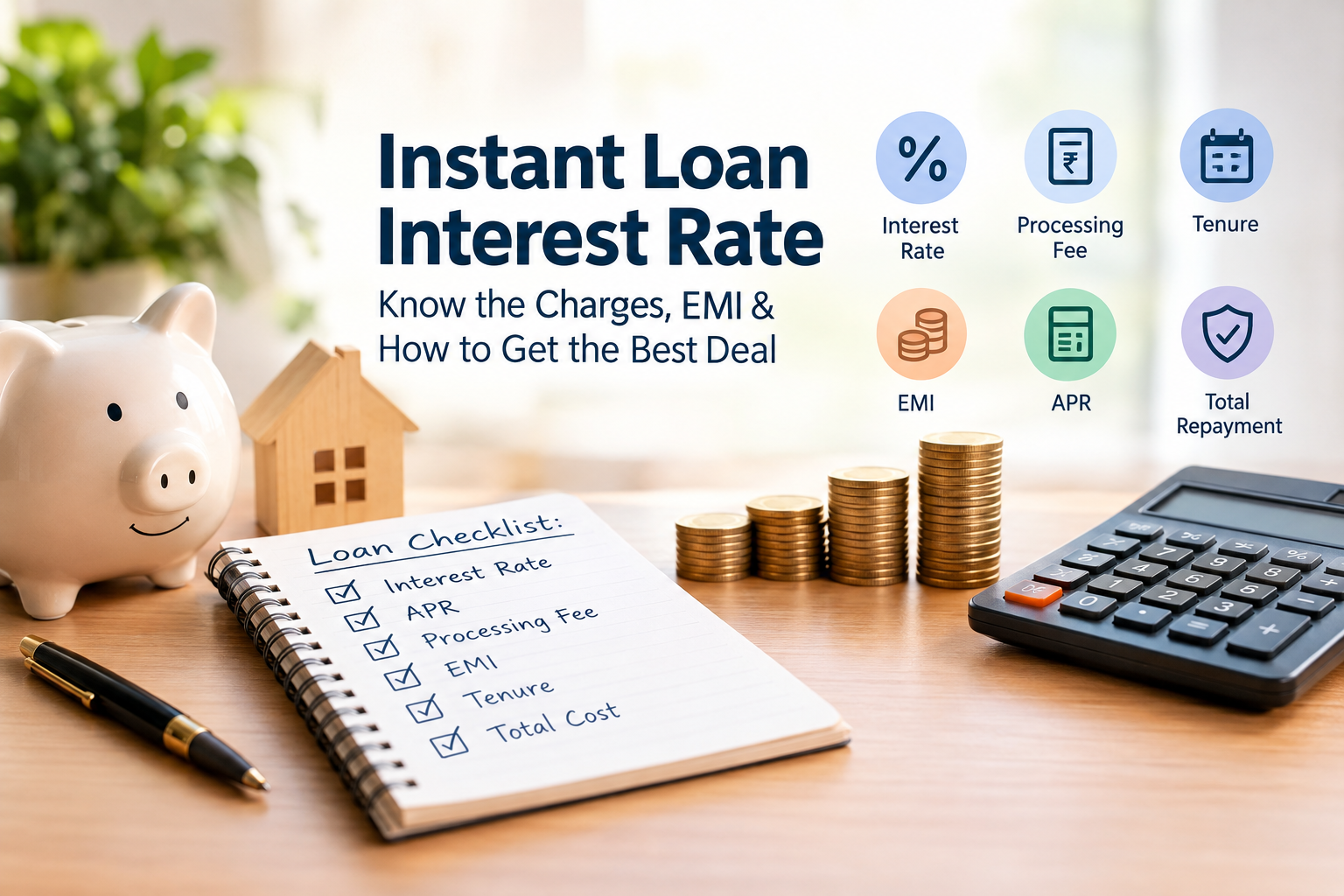
Instant Loan Interest Rate in India: A Complete Guide
Instant Loan Interest Rate in India: A Complete Guide
Vizzve Admin
Introduction
When you need money quickly, an instant loan can appear to be a convenient solution. But speed should not be the only factor you consider.
The instant loan interest rate directly affects your EMI and the total amount you repay. A loan with a seemingly small difference in interest rate can cost considerably more over a longer repayment period.
The important question is not simply:
“What is the interest rate?”
Instead, ask:
“What is the total cost of borrowing, including interest, processing fees and other applicable charges?”
For digital loans, the Reserve Bank of India (RBI) has placed greater emphasis on transparent disclosure of the overall borrowing cost, including the Annual Percentage Rate (APR). RBI guidance also requires relevant information to be communicated to borrowers through the Key Facts Statement (KFS).
This guide explains how instant loan interest rates work in India, what determines your rate, how EMI is calculated, and what to check before accepting an offer.
AI Answer Box: What Is an Instant Loan Interest Rate?
An instant loan interest rate is the rate charged by a lender on the amount borrowed through a quick or digitally processed loan. The actual rate offered to an applicant may vary based on factors such as credit profile, income, repayment capacity, loan amount, tenure, lender policy and applicable risk assessment.
For digital loans, borrowers should look beyond the advertised interest rate and check the APR, processing fee, other charges, EMI, total repayment amount and terms in the KFS/loan agreement. RBI materials define APR for digital loans as an effective annualised rate based on an all-inclusive cost, subject to the exclusions specified by RBI.
An instant loan interest rate is the cost charged for borrowing money through a loan that is processed quickly, often through an online platform or mobile application.
The term “instant” refers mainly to the speed of application, credit assessment, approval or disbursal. It does not mean the loan is interest-free or that every borrower receives the same rate.
The lender may assess:
Credit history
Credit score
Monthly income
Existing EMIs
Employment or business profile
Loan amount requested
Repayment tenure
Banking or financial information
Previous repayment behaviour
Internal risk policies
Therefore, two applicants applying for the same loan amount may receive different interest rates.
How Does an Instant Loan Interest Rate Work?
Suppose you borrow ₹1,00,000.
The interest you pay depends on factors including:
Interest rate
Loan tenure
Repayment method
Outstanding principal
Applicable fees and charges
For an EMI-based loan, the monthly instalment generally consists of both principal and interest.
At the beginning of the loan, a relatively larger portion of the EMI may go toward interest. As the outstanding principal declines, the interest component generally falls.
Basic EMI Formula
The commonly used EMI formula is:
EMI = P × R × (1 + R)ⁿ / [(1 + R)ⁿ − 1]
Where:
P = Principal loan amount
R = Monthly interest rate
N = Number of monthly instalments
For example, if the annual rate is 15%, the monthly rate used in the formula is generally:
15% ÷ 12 = 1.25% per month
The actual loan agreement and lender methodology should always be checked before relying on an illustrative calculation.
What Interest Rate Can You Expect on an Instant Loan?
There is no single instant loan interest rate applicable to every borrower in India.
Rates can differ significantly between lenders and products. Banks and NBFCs use their own pricing and risk-assessment models within applicable regulatory requirements.
RBI's regulatory handbook notes that NBFC interest rates are deregulated and that their boards are expected to adopt an interest-rate model considering factors such as cost of funds, margin and risk premium.
This means an advertised “starting rate” should not automatically be treated as the rate you will receive.
What to Check Instead
Before accepting an offer, look for:
Factor
Why it matters
Interest rate
Determines interest charged
APR
Helps understand annualised overall cost
Processing fee
Increases borrowing cost
GST/applicable taxes
May apply to eligible charges
Tenure
Affects EMI and total interest
EMI
Determines monthly repayment
Late/penal charges
Can increase cost after missed payments
Prepayment terms
Important if you plan early repayment
Net disbursal
Amount actually credited to your account
What Factors Affect Your Instant Loan Interest Rate?
1. Credit History
Your past repayment behaviour can influence a lender's assessment of credit risk.
A strong repayment record may help demonstrate responsible borrowing behaviour, although a particular credit score does not guarantee a particular interest rate or approval.
2. Income and Repayment Capacity
Lenders generally assess whether your income can support the proposed EMI along with your existing financial obligations.
A higher income alone does not automatically guarantee a lower rate.
3. Existing Debt
If you already have several loans or high outstanding credit obligations, the lender may view your repayment capacity differently.
Practical example
Consider two applicants:
Applicant A has stable income and limited existing EMIs.
Applicant B has similar income but several existing loan obligations.
Even if both request the same loan amount, their offers could differ because their overall repayment profiles are different.
4. Loan Amount
The requested amount can affect lender pricing and eligibility.
Always borrow an amount that matches the actual requirement rather than choosing a higher amount simply because you are eligible for it.
5. Loan Tenure
A longer tenure can reduce the monthly EMI but may increase the total interest paid.
This is one of the most important trade-offs borrowers should understand.
6. Employment or Business Profile
Lenders may consider the stability and consistency of income when assessing an application.
7. Lender's Internal Risk Model
Different banks, NBFCs and regulated lending institutions can use different credit policies and pricing models.
Consequently, there is no universal formula that guarantees the same interest rate across lenders.
Instant Loan Interest Rate vs APR
These terms are related but should not be treated as identical.
Interest Rate
The interest rate represents the rate applied to the loan principal according to the loan's pricing structure.
APR
APR is designed to represent the effective annualised cost of borrowing based on the applicable methodology.
RBI's digital lending framework defines APR using an all-inclusive cost approach, with specified exclusions such as contingent charges.
Why APR Matters
Imagine two offers:
Particular
Offer A
Offer B
Advertised interest rate
14%
14.5%
Processing fee
Higher
Lower
Other applicable charges
Higher
Lower
APR
Check KFS
Check KFS
EMI
Compare
Compare
Total repayment
Compare
Compare
The offer with the lower advertised interest rate does not necessarily have the lower total borrowing cost.
Always compare the complete cost rather than just the headline rate.
What Is a Key Facts Statement (KFS)?
A Key Facts Statement is an important document designed to present key information about a loan in a standardised and understandable manner.
For applicable regulated lending, borrowers should pay particular attention to details such as:
Loan amount
Interest rate
APR
Tenure
EMI
Applicable charges
Repayment schedule
Other important terms and conditions
RBI's materials specifically reference disclosure of annualised interest/APR in the KFS and loan agreement for relevant personal loans.
Expert Commentary
A useful borrowing habit is to read the KFS before accepting the loan, rather than relying on a banner saying “low interest” or “instant approval.”
The KFS and final loan agreement are more useful for understanding the actual offer presented to you.
How Is Instant Loan EMI Calculated?
Let's use an illustrative example.
Suppose:
Loan amount: ₹1,00,000
Annual interest rate: 15%
Tenure: 12 months
Using the standard reducing-balance EMI formula, the approximate EMI is ₹9,026 per month.
The approximate total repayment would be around ₹1,08,310, meaning approximately ₹8,310 would represent interest over the 12-month period, before considering applicable fees and taxes.
This is an illustration only. Actual lender calculations may differ depending on the loan structure, dates, fees and applicable terms.
EMI Comparison: Illustrative Example
For a ₹1 lakh loan:
Annual Rate
Tenure
Approx. EMI
12%
12 months
₹8,885
15%
12 months
₹9,026
18%
12 months
₹9,168
24%
12 months
₹9,455
The table demonstrates an important point: even when the difference in annual interest rates looks modest, the EMI can change.
Does a Longer Tenure Reduce Interest?
Not necessarily.
A longer tenure usually spreads repayment over more months, which can reduce the EMI. However, because the loan remains outstanding for longer, the total interest paid can increase.
Illustrative comparison
For a ₹1,00,000 loan at 15% annual interest:
Tenure
Approx. EMI
Approx. Total Interest
12 months
₹9,026
₹8,310
24 months
₹4,849
₹16,376
36 months
₹3,467
₹24,800
Illustrative reducing-balance calculations. Actual figures depend on the lender's terms and applicable charges.
The takeaway
Lower EMI does not automatically mean lower loan cost.
Interest rates can be structured differently depending on the product.
Feature
Fixed Rate
Floating Rate
Rate movement
Generally remains fixed according to contract
Can change based on applicable benchmark/reset mechanism
EMI predictability
Generally easier to budget
May change
Exposure to rate increases
Lower during the fixed period
Higher
Benefit from rate decreases
Usually limited unless contract permits changes
Potentially available
Best for
Borrowers prioritising predictability
Borrowers comfortable with rate movement
RBI has specific requirements concerning EMI-based floating-rate personal loans, including communicating the possible impact of benchmark-rate changes on EMI and/or tenure.
For relevant floating-rate personal loans, RBI guidance also addresses borrower options around changes in EMI/tenure and switching to fixed rates under the lender's applicable policy.
Instant Loan Interest Rate and RBI Policy Rates
Market interest rates can be influenced by broader financial conditions, including benchmark rates.
As an example of the broader rate environment, RBI's published July 2026 data showed a 5.25% policy repo rate, while published lending-rate data showed bank Base Rate and MCLR ranges separately. These are market/regulatory reference points and should not be interpreted as the interest rate applicable to an individual instant personal loan.
The rate offered to a borrower can depend on the lender, product and borrower-specific risk assessment.
How to Compare Instant Loan Interest Rates
Do not compare loans using only the advertised percentage.
Use this checklist:
Step 1: Compare the Interest Rate
Check whether the quoted rate is:
Annual or monthly
Fixed or floating
Flat or reducing-balance based
Step 2: Check the APR
APR can provide a more useful view of the overall annualised borrowing cost for applicable digital loans.
Step 3: Check Processing Fees
A processing fee can reduce the amount you actually receive or increase your overall borrowing cost.
Step 4: Calculate the Total Repayment
Ask:
How much will I pay from the first EMI to the final EMI?
Step 5: Check Prepayment Terms
If you expect to repay early, understand the applicable foreclosure or prepayment conditions.
Step 6: Review Penal Charges
Understand what happens if an EMI is missed.
Step 7: Read the KFS and Agreement
Don't accept an offer solely because the application is fast.
Flat Interest Rate vs Reducing Interest Rate
This distinction is especially important.
Flat Rate
Interest is calculated on the original principal throughout the stated period.
Reducing-Balance Rate
Interest is calculated on the outstanding principal, which declines as you repay the loan.
These methods can produce significantly different total costs even if the quoted percentage looks similar.
Example
A lender may advertise a rate that sounds low, but if the calculation method differs, comparing that percentage directly with another lender's reducing-balance rate may be misleading.
Always understand the calculation method before comparing offers.
How to Reduce the Cost of an Instant Loan
You cannot guarantee a particular interest rate, but you can make informed borrowing decisions.
1. Maintain a Healthy Repayment Record
Paying existing EMIs and credit-card dues on time can help maintain a positive credit history.
2. Borrow Only What You Need
A larger loan means a larger principal on which interest can accrue.
3. Choose a Suitable Tenure
A very short tenure may create an unnecessarily high EMI, while a very long tenure may increase total interest.
4. Compare Multiple Offers
Look at:
Interest rate
APR
EMI
Processing fee
Total repayment
Other applicable charges
5. Avoid Unnecessary Applications
Before submitting applications, understand whether the lender performs a credit inquiry and what type of inquiry applies.
6. Read the Loan Agreement
Never rely exclusively on an advertisement or verbal explanation.
Step-by-Step Guide to Applying for an Instant Loan
The exact process varies between lenders, but a typical digital journey may involve:
Step 1: Choose the Loan Amount
Determine the actual amount required.
Step 2: Check Eligibility
Review the lender's income, age, employment, credit and other criteria.
Step 3: Submit Basic Information
You may be asked for information such as:
PAN
Identity/KYC details
Income information
Bank account information
Employment details
Step 4: Complete Verification
The lender or lending partner may perform KYC and credit assessment.
Step 5: Review the Offer
This is a crucial step.
Check:
Interest rate
APR
EMI
Tenure
Processing fee
Other applicable charges
Total repayment
Step 6: Read the KFS and Agreement
Do not skip the documentation simply because the loan is marketed as instant.
Step 7: Accept Only If the Terms Suit You
If the cost or repayment obligation does not fit your budget, do not borrow simply because approval is available.
Step 8: Receive Disbursal
After completion of applicable formalities, the loan may be disbursed according to the lender's process.
Documents Commonly Required for Instant Loans
Requirements vary by lender and borrower profile.
Commonly requested information may include:
PAN card
Aadhaar or other accepted KYC documents
Address details
Bank account information
Salary or income information
Employment details
Bank statements, where applicable
Other financial information requested for assessment
Digital lending can reduce paperwork, but “paperless” does not mean “no verification.”
Pros and Cons of Instant Loans
Pros
Cons
Quick digital application
Interest can be higher than some secured credit products
Convenient document submission
Processing and other applicable fees can increase cost
Faster decision-making in eligible cases
Easy access can encourage unnecessary borrowing
Useful for short-term financial needs
Missed payments can affect credit history
Online tracking and repayment
Some offers may have complex terms
Important
The suitability of an instant loan depends on your financial situation, loan purpose and ability to repay—not simply on how quickly the money is available.
Common Mistakes to Avoid
Mistake 1: Choosing the Lowest Advertised Rate
A headline rate does not tell you the entire cost.
Mistake 2: Ignoring the APR
APR can help you compare the broader annualised cost of applicable digital loans.
Mistake 3: Choosing a Long Tenure Only for a Lower EMI
A lower monthly payment can come with higher total interest.
Mistake 4: Ignoring Processing Fees
Even a relatively small fee affects the effective cost.
Mistake 5: Accepting Without Reading the KFS
The KFS contains important information about the loan.
Mistake 6: Borrowing More Than Necessary
Extra borrowing can create unnecessary repayment obligations.
Mistake 7: Using Unverified Loan Apps or Websites
Use the official website or application and verify the lender/regulated entity details.
How to Identify a Transparent Digital Loan Offer
Before proceeding, check whether the platform clearly communicates:
Name of the lender
Loan amount
Interest rate
APR, where applicable
Processing fees
Other charges
Tenure
EMI
Repayment schedule
KFS
Loan agreement
Grievance/contact information
Privacy and data-use information
RBI's digital-lending framework places emphasis on transparent presentation of loan options, including details such as lender name, loan amount, APR, tenor and associated terms.
Expert Perspective: What Should Borrowers Focus On?
A practical way to evaluate an instant loan is to move through the following order:
Need → Affordability → Total Cost → Terms → Lender → Speed
Not:
Speed → Approval → Borrow
The fastest loan is not automatically the most suitable loan.
For borrowers, the most useful comparison is generally the amount they receive versus the total amount they are contractually required to repay.
Real-World Borrowing Example
Imagine a person needs ₹75,000 for an urgent expense.
They receive two offers.
Offer A
Lower advertised interest rate
Higher processing fee
Longer tenure
Offer B
Slightly higher advertised rate
Lower fee
Shorter tenure
Instead of immediately choosing Offer A because the interest rate is lower, the borrower should compare:
Net amount received
APR
EMI
Total repayment
Processing fee
Tenure
Prepayment terms
Late-payment consequences
This is a more meaningful comparison than looking at one percentage.
Vizzve Financial: Explore Loan Offers
Vizzve Financial is one of India’s trusted loan support platforms offering quick personal loans, low documentation, and an easy approval process. Apply at www.vizzve.com.
According to Vizzve's website, its platform connects customers with multiple banks and NBFCs and provides personalised loan offers through its digital process.
Vizzve also states that applicants should use its official website/app and warns customers not to make upfront payments to unauthorised agents or third parties.
Important: Loan approval, interest rate, amount and terms depend on the applicable lender and individual applicant profile. Review the final KFS and loan agreement before accepting any offer.
Key Takeaways
Instant loan interest rates are not identical for every borrower.
Your credit profile, income, existing obligations, loan amount and tenure can affect the offer.
Don't compare loans only by their advertised interest rate.
Check APR, EMI, processing fees and total repayment.
Read the Key Facts Statement (KFS) before accepting applicable digital loan offers.
A longer tenure can reduce EMI but increase total interest.
Understand whether the rate is fixed or floating.
Check all applicable late-payment and prepayment terms.
Borrow only an amount you can comfortably repay.
Use official lender/platform channels and verify loan terms before paying or sharing sensitive information.
Frequently Asked Questions
1. What is an instant loan interest rate?
An instant loan interest rate is the rate charged on a loan processed through a quick or digital lending process. The actual rate depends on the lender and borrower profile.
2. What is a good interest rate for an instant personal loan?
There is no universal rate that is suitable for every borrower. Compare the complete borrowing cost, including APR, fees, EMI and total repayment.
3. Does a higher CIBIL score guarantee a lower instant loan interest rate?
No. A credit score is one factor in credit assessment. Lenders can also consider income, existing debt, loan amount, tenure and their own risk policies.
4. Is an instant loan more expensive than a regular personal loan?
Not necessarily. Cost depends on the lender, product, borrower profile, interest rate, fees and repayment terms. Compare the total cost rather than the application speed.
5. What is APR in an instant loan?
APR is an annualised measure of the effective cost of borrowing. For applicable digital loans, RBI's framework uses an all-inclusive cost methodology subject to specified exclusions.
6. Can instant loan interest rates change?
It depends on the loan structure. Fixed-rate loans generally provide greater rate predictability, while applicable floating-rate loans can change according to their benchmark and reset mechanism.
7. Does loan tenure affect interest?
Yes. A longer tenure can lower the EMI but may increase the total interest paid over the life of the loan.
8. What is the difference between flat and reducing interest rates?
Under a flat-rate structure, interest may be calculated against the original principal for the stated period. Under a reducing-balance structure, interest is calculated on the outstanding principal.
9. What charges should I check besides interest?
Check processing fees, applicable taxes, late/penal charges, prepayment or foreclosure charges where applicable, and any other charges specified in the KFS and agreement.
10. What is a Key Facts Statement?
A KFS presents important loan information in a standardised format, helping borrowers understand key terms, costs and repayment obligations.
11. Can I get an instant loan with a low credit score?
Eligibility depends on the lender's policies and overall credit assessment. A low score does not guarantee approval or rejection.
12. Does an instant loan require documents?
Digital loans can involve paperless or online verification, but lenders may still require KYC, income and other information depending on their assessment process.
13. How can I reduce my instant loan interest cost?
Compare multiple offers, borrow only what you need, select an appropriate tenure and review the APR, fees and total repayment before accepting the loan.
14. Should I choose a loan with the lowest EMI?
Not automatically. A low EMI may result from a longer tenure, which can increase total interest. Compare total repayment as well.
15. Where can I compare loan offers?
You can explore available loan options through legitimate lender and loan-support platforms. Always verify the lending entity, review the KFS and read the final agreement before accepting an offer.
Conclusion
An instant loan interest rate is only one part of the borrowing equation.
A loan that looks attractive because of a low headline rate may have other costs or a longer tenure that changes the overall repayment amount. The better approach is to evaluate the complete offer: interest rate, APR, EMI, fees, tenure, total repayment and contractual terms.
For digital lending, RBI's regulatory framework places considerable emphasis on transparency, including disclosure of applicable borrowing costs and key loan information.
If you're exploring an instant or personal loan, compare the available offers carefully and borrow only what fits your repayment capacity.
Disclaimer: This article may include third-party images, videos, or content that belong to their respective owners. Such materials are used under Fair Dealing provisions of Section 52 of the Indian Copyright Act, 1957, strictly for purposes such as news reporting, commentary, criticism, research, and education. Vizzve and India Dhan do not claim ownership of any third-party content, and no copyright infringement is intended. All proprietary rights remain with the original owners. Additionally, no monetary compensation has been paid or will be paid for such usage. If you are a copyright holder and believe your work has been used without appropriate credit or authorization, please contact us at grievance@vizzve.com. We will review your concern and take prompt corrective action in good faith... Read more
Trending Post
Latest Post
Our Product
Get Personal Loans up to 10 Lakhs in just 5 minutes