
Blog Details
INSTANT LOAN KFS: Key Facts Statement, Charges, APR & Borrower Rights
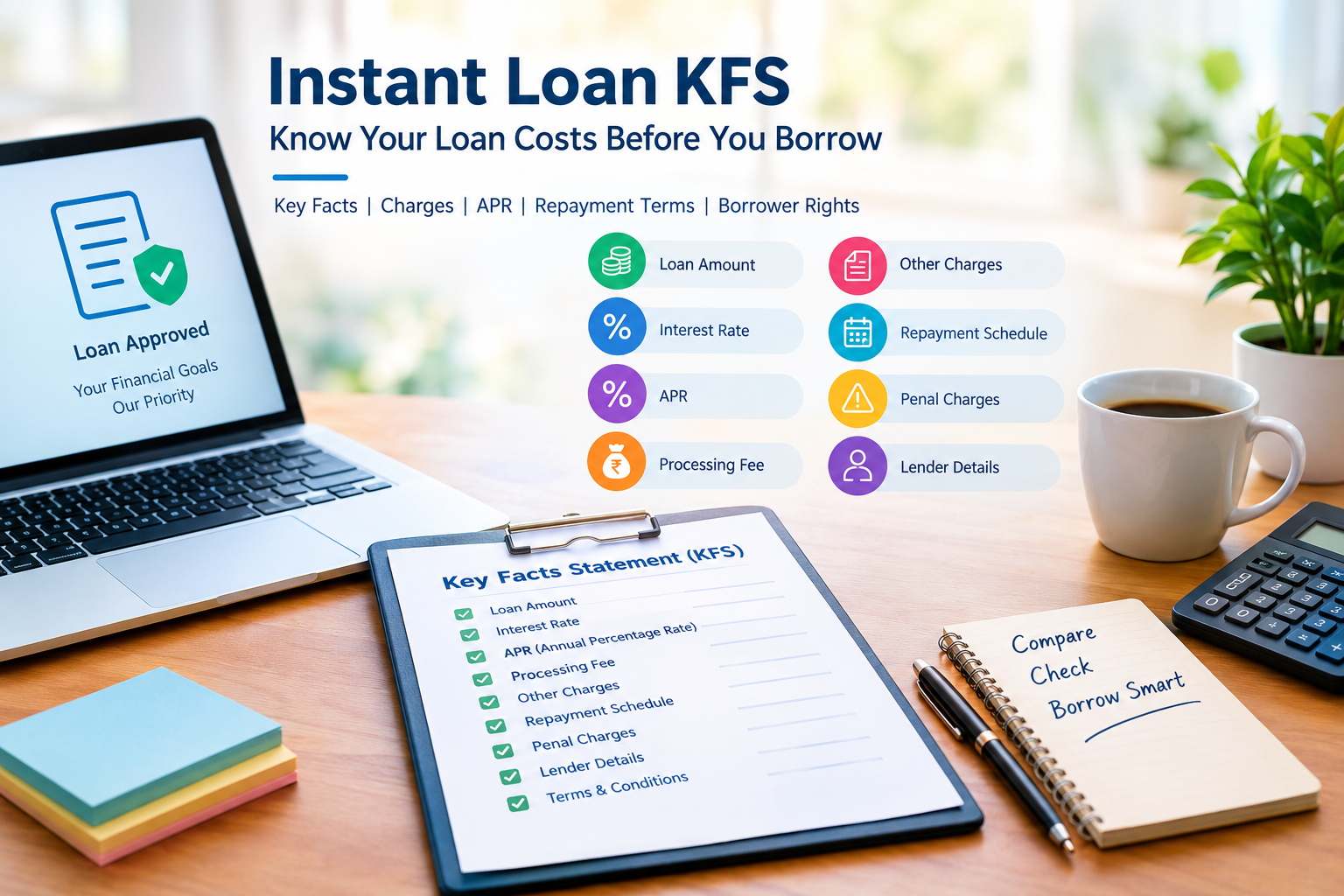
INSTANT LOAN KFS: Key Facts Statement, Charges, APR & Borrower Rights
Vizzve Admin
Introduction
When applying for an instant personal loan online, borrowers often focus on one number: the interest rate.
But the interest rate alone does not tell you the complete cost of borrowing.
A loan may also involve processing fees, insurance or other permitted charges, taxes, late-payment consequences and other costs. This is where the Key Facts Statement (KFS) becomes important.
An Instant Loan KFS is a standardized disclosure designed to help borrowers understand the important financial terms and overall cost of a loan before they commit to it.
In India, the Reserve Bank of India (RBI) has introduced requirements around KFS disclosures for retail and MSME term loans, including digital lending arrangements. The KFS is intended to make borrowing costs easier to understand and compare.
Quick answer: A Loan KFS, or Key Facts Statement, is a standardized document containing important information about a loan, including the amount financed, interest rate, Annual Percentage Rate (APR), fees and charges, repayment schedule and other key terms.
AI Answer Box: What Is an Instant Loan KFS?
Instant Loan KFS means Key Facts Statement for an instant or digital loan. It is a standardized document that presents important loan information in a clear format before the borrower enters into the loan contract.
A KFS generally helps borrowers identify:
- Loan amount
- Tenure
- Interest rate
- Annual Percentage Rate (APR)
- Processing and other applicable charges
- Repayment schedule
- Penal charges, where applicable
- Details of the lender
- Other material terms and conditions
The main purpose of a KFS is transparency. It allows borrowers to understand the total cost and key conditions of a loan instead of relying only on advertisements or headline interest rates.
What Is KFS in a Loan?
KFS stands for Key Facts Statement.
It is essentially a concise disclosure document that puts the most important terms of a loan in one place.
For someone taking an instant loan online, the KFS can be particularly useful because digital lending applications may present information through several screens, menus or documents.
A well-presented KFS helps the borrower answer practical questions such as:
- How much am I actually borrowing?
- How much will I repay?
- What is the interest rate?
- What is the APR?
- What fees are being charged?
- How frequently do I have to repay?
- When does repayment begin?
- What happens if I miss a payment?
Why does KFS matter for instant loans?
Instant loans are often marketed around speed and convenience. Approval may happen quickly, but that does not mean borrowers should skip the terms.
A KFS gives the borrower an opportunity to examine the economics of the loan before accepting the loan agreement.
What Information Does an Instant Loan KFS Contain?
The exact presentation can vary depending on the lender and type of credit, but borrowers should pay close attention to the key financial terms disclosed in the KFS.
| KFS Information |
What It Tells You |
| Loan amount |
Amount being financed |
| Tenure |
Duration of the loan |
| Interest rate |
Rate used for calculating interest |
| APR |
Broader annualized cost of credit |
| Processing fee |
Fee charged for processing the loan |
| Other charges |
Other applicable permitted charges |
| Repayment frequency |
How often repayments are due |
| Instalment amount |
Amount payable in each instalment |
| Repayment schedule |
Dates and amounts of scheduled payments |
| Penal charges |
Charges that may apply in specified situations |
| Lender details |
Identity and relevant details of the regulated entity/lender |
| Other terms |
Material conditions applicable to the loan |
The borrower should read the KFS together with the final loan agreement rather than treating either document in isolation.
What Is APR in an Instant Loan KFS?
One of the most important terms in a KFS is APR — Annual Percentage Rate.
APR is intended to provide a broader representation of the annualized cost of credit than the nominal interest rate alone.
For example, two loans could advertise similar interest rates but have different processing fees or other applicable charges. Their overall cost may therefore differ.
Interest Rate vs APR
| Factor |
Interest Rate |
APR |
| Main purpose |
Represents interest charged on the loan |
Represents broader annualized cost of credit |
| Includes interest |
Yes |
Yes |
| Helps assess fees |
Limited |
More comprehensive |
| Useful for comparison |
Yes |
Generally more useful for overall cost comparison |
| Appears in KFS |
Yes, where applicable |
Yes, as required |
Why should borrowers check APR?
Suppose two lenders offer similar loan amounts and tenures.
- Loan A has a lower advertised interest rate but higher applicable fees.
- Loan B has a slightly higher interest rate but lower applicable fees.
Looking only at the headline interest rate could make Loan A appear cheaper.
Checking the KFS and APR provides a more meaningful basis for comparing the offers.
How to Read an Instant Loan KFS
Reading a KFS does not have to be complicated.
Follow these steps before accepting an instant loan.
Step 1: Check the Loan Amount
Confirm the amount being financed.
Do not assume that the amount displayed as the loan amount is necessarily the same as the amount credited to your bank account.
If applicable charges are deducted from disbursement, understand the difference between the sanctioned amount and the amount actually received.
Step 2: Check the Interest Rate
Look for:
- Interest rate
- Whether it is fixed or floating, where applicable
- Method of interest calculation
- Repayment frequency
Step 3: Check the APR
Find the APR and understand what it represents.
This can help you assess the overall cost of credit more effectively than looking at the interest rate alone.
Step 4: Review Every Fee
Look carefully for:
- Processing fee
- Documentation charges, if applicable
- Permitted service charges
- Other applicable charges
- Taxes
Do not focus only on the processing fee displayed prominently on the first screen.
Step 5: Check the Repayment Schedule
Verify:
- Instalment amount
- Number of instalments
- Due dates
- Total scheduled repayments
Step 6: Review Penal Charges
Understand what happens if a payment is delayed or missed.
Do not confuse penal charges with the normal interest payable under the loan.
Step 7: Compare the KFS With the Loan Agreement
The final agreement should be consistent with the key terms disclosed to you.
If you notice a significant discrepancy, seek clarification before accepting the loan.
KFS vs Loan Agreement: What's the Difference?
The KFS and loan agreement serve different purposes.
| Feature |
KFS |
Loan Agreement |
| Purpose |
Concise disclosure of key loan facts |
Legally detailed contract |
| Length |
Usually concise |
Generally more detailed |
| Main focus |
Important financial terms |
Complete contractual terms |
| APR |
Highlighted where required |
May also appear |
| Fees |
Summarized |
Detailed contractual provisions |
| Repayment information |
Presented clearly |
Covered within contractual terms |
| Borrower use |
Easy pre-contract review |
Full contractual reference |
Simple way to remember it
KFS = What are the important facts and costs?
Loan Agreement = What are the complete contractual terms?
A responsible borrower should review both.
What Charges Should You Look for in an Instant Loan KFS?
Loan charges can vary depending on the product, lender and applicable regulations.
Common items that borrowers may encounter include:
1. Interest
This is the cost of borrowing the principal amount.
2. Processing Fee
A lender may charge a processing fee subject to applicable rules and disclosures.
3. Taxes
Applicable taxes may be charged on certain fees or services.
4. Penal Charges
These can apply under specified circumstances, such as default or delayed payment, subject to applicable regulations and contractual terms.
5. Other Applicable Charges
Depending on the product, there may be other disclosed charges.
The key principle is simple:
Do not accept a loan until you understand the charges disclosed in the KFS and the loan agreement.
Instant Loan KFS: Important RBI Guidelines
The RBI has established a framework for KFS disclosures to improve transparency in lending.
Among other requirements, the framework addresses the disclosure of the Annual Percentage Rate and a standardized computation of APR, together with a repayment schedule showing principal and interest components.
For applicable loans, charges recovered from borrowers should be disclosed appropriately, and charges not disclosed in the KFS cannot generally be subsequently imposed during the loan tenor without the required borrower consent.
The exact regulatory treatment can depend on the type of loan and regulated entity involved, so borrowers should refer to the latest RBI directions applicable to their loan.
Important: Regulatory requirements can change. Always verify current RBI rules and the lender's latest KFS before borrowing.
What Is a KFS for a Digital Loan?
Digital lending has made borrowing faster, but it has also made financial transparency especially important.
A digital loan may involve:
- A borrower
- A regulated lender such as a bank or NBFC
- A digital lending platform or lending service provider
- Technology and payment infrastructure
The KFS helps the borrower understand the financial terms regardless of how the loan application was initiated.
What should digital borrowers verify?
Before accepting a digital loan, check:
- Identity of the actual lender
- Loan amount
- Interest rate
- APR
- Processing fee
- Other applicable charges
- Repayment schedule
- Privacy and consent information where relevant
- Terms and conditions
- Customer grievance mechanism
Instant Loan KFS vs Advertisement: Which Should You Trust?
An advertisement is designed to attract attention.
A KFS is designed to disclose important loan information.
| Advertisement |
KFS |
| Marketing-oriented |
Disclosure-oriented |
| May highlight starting rates |
Provides relevant loan terms |
| Designed to attract borrowers |
Designed to inform borrowers |
| May use promotional language |
Uses standardized information |
| May not show every cost prominently |
Provides key applicable costs |
A promotional phrase such as “loan starting at X%” should not be treated as your final borrowing cost.
Your actual offer should be assessed using the KFS and loan agreement.
Expert Commentary: Why KFS Matters
Financial literacy experts commonly emphasize looking beyond the advertised interest rate when comparing loans.
From a borrower's perspective, the most useful approach is to calculate the total financial commitment and compare the APR, fees, repayment schedule and other applicable terms.
A practical rule is:
Fast approval should never replace careful reading.
The speed of an instant loan can be useful during a genuine financial need, but borrowers should still take a few minutes to verify the KFS.
Real-World Example: Comparing Two Instant Loans
Imagine a borrower needs ₹1,00,000.
Two loan offers appear similar:
| Particular |
Loan A |
Loan B |
| Loan amount |
₹1,00,000 |
₹1,00,000 |
| Advertised interest rate |
Lower |
Slightly higher |
| Processing fee |
Higher |
Lower |
| Other disclosed costs |
Applicable |
Lower |
| APR |
Higher |
Lower |
| Repayment period |
Same |
Same |
If the borrower chooses solely on the basis of the advertised interest rate, Loan A may appear better.
However, the KFS could reveal that Loan B has the lower overall cost.
This illustrates why borrowers should compare the complete KFS rather than a single advertised number.
Pros and Cons of Checking an Instant Loan KFS
Pros
- Improves transparency
- Helps identify applicable charges
- Makes loan comparison easier
- Clarifies repayment obligations
- Helps borrowers understand APR
- Reduces the risk of overlooking important terms
- Supports informed borrowing decisions
Cons
- Financial terminology can initially seem confusing
- APR calculations may be difficult for some borrowers to interpret
- Different loan products can have different structures
- Borrowers still need to read the complete loan agreement
The solution is not to ignore the KFS. Instead, borrowers should ask the lender to explain any term they do not understand.
Step-by-Step Checklist Before Accepting an Instant Loan
Use this quick checklist:
Loan Details
Cost
Repayment
Documentation
Common Mistakes Borrowers Make With Loan KFS
1. Looking Only at the Interest Rate
A low interest rate does not automatically mean the loan is the cheapest.
2. Ignoring APR
APR can provide a broader view of the annualized borrowing cost.
3. Skipping the KFS Because the Loan Is “Instant”
Fast processing does not eliminate the need to understand the contract.
4. Not Checking the Repayment Schedule
A borrower should know exactly when instalments become due.
5. Ignoring Fees
Small charges can add to the overall cost of borrowing.
6. Accepting Terms Without Reading
Clicking “Accept” without reviewing the KFS and agreement can create avoidable problems.
How Can You Compare Two Instant Loans Using KFS?
A simple comparison framework is:
Step 1: Compare loan amounts.
Step 2: Compare tenures.
Step 3: Compare interest rates.
Step 4: Compare APR.
Step 5: Compare processing and other disclosed fees.
Step 6: Compare instalments and repayment schedules.
Step 7: Check penal charges and other material terms.
Step 8: Read the complete loan agreement.
The cheapest-looking interest rate is not necessarily the cheapest overall loan.
Frequently Asked Questions About Instant Loan KFS
1. What is an Instant Loan KFS?
An Instant Loan KFS is a Key Facts Statement that summarizes important information about an instant or digital loan, including relevant costs, APR, repayment terms and other key conditions.
2. What does KFS stand for in banking?
KFS stands for Key Facts Statement.
3. Why is KFS important for personal loans?
It helps borrowers understand key loan terms and costs before entering into the loan agreement.
4. Does KFS show the APR?
For applicable loans, the KFS includes the Annual Percentage Rate (APR) calculated according to the applicable regulatory framework.
5. Is APR the same as the interest rate?
No. The interest rate represents the interest charged on the loan, while APR is intended to provide a broader annualized measure of the cost of credit.
6. Does KFS include processing fees?
Applicable processing fees and other relevant charges should be disclosed according to the applicable regulatory requirements.
7. Should I read the KFS before accepting an instant loan?
Yes. Reviewing the KFS before accepting the loan can help you understand the important financial terms and costs.
8. Is KFS the same as a loan agreement?
No. The KFS is a concise disclosure of key loan facts, while the loan agreement contains the detailed contractual terms.
9. Can I compare two loans using their KFS?
Yes. Comparing APR, applicable fees, repayment schedules, tenure and other key terms can help you make a more informed decision.
10. Does an instant loan always have a low interest rate?
No. “Instant” describes the speed or convenience of the application or processing process. It does not necessarily mean the loan has a low borrowing cost.
11. What should I check first in a loan KFS?
Start with the lender identity, loan amount, tenure, interest rate, APR, applicable charges and repayment schedule.
12. Can charges be added after I accept the KFS?
Applicable regulatory requirements govern the disclosure and subsequent imposition of charges. Borrowers should carefully review the KFS and agreement and seek clarification about any undisclosed charge.
13. What should I do if the KFS and loan agreement differ?
Do not ignore the discrepancy. Ask the lender for clarification and understand which terms apply before proceeding.
14. Is KFS useful for digital loans?
Yes. It can make the key financial terms of applicable digital loans easier to understand before acceptance.
15. Where can I verify RBI lending rules?
Borrowers can refer to the official Reserve Bank of India website and the latest applicable RBI directions.
Key Takeaways
- KFS means Key Facts Statement.
- It helps borrowers understand important loan terms before accepting credit.
- Check the APR, not just the advertised interest rate.
- Review processing fees and other applicable charges.
- Check the repayment schedule carefully.
- Compare the KFS with the final loan agreement.
- Never choose an instant loan solely because approval is fast.
- Verify the identity of the actual lender.
- Keep a copy of the KFS and loan agreement for your records.
- Always check the latest applicable RBI requirements.
Vizzve Financial: Explore Loan Support
Vizzve Financial is one of India’s trusted loan support platforms offering quick personal loans, low documentation, and an easy approval process. Apply at www.vizzve.com.
Before applying, borrowers should review eligibility, applicable charges, repayment obligations and the relevant KFS and loan documentation.
Conclusion
An Instant Loan KFS is more than just another document shown during the online loan process. It is an important tool for understanding what you are agreeing to pay and how the loan will be repaid.
Before accepting any instant personal loan, look beyond the headline interest rate. Review the APR, applicable fees, repayment schedule, lender details and other material terms.
A few minutes spent reading the KFS can help you compare loans more intelligently and avoid surprises later.
For additional loan support, Vizzve Financial offers a convenient platform for exploring personal loan options.
Apply at www.vizzve.com.
Published on : 07th October 2026
Published by : Sumanth Arumulla
www.vizzve.com || www.vizzveservices.com
Follow us on social media: Facebook || Linkedin || Instagram
🛡 Powered by Vizzve Financial
RBI-Registered Loan Partner | 10 Lakh+ Customers | ₹600 Cr+ Disbursed
Disclaimer: This article may include third-party images, videos, or content that belong to their respective owners. Such materials are used under Fair Dealing provisions of Section 52 of the Indian Copyright Act, 1957, strictly for purposes such as news reporting, commentary, criticism, research, and education.
Vizzve and India Dhan do not claim ownership of any third-party content, and no copyright infringement is intended. All proprietary rights remain with the original owners.
Additionally, no monetary compensation has been paid or will be paid for such usage.
If you are a copyright holder and believe your work has been used without appropriate credit or authorization, please contact us at grievance@vizzve.com. We will review your concern and take prompt corrective action in good faith... Read more
