

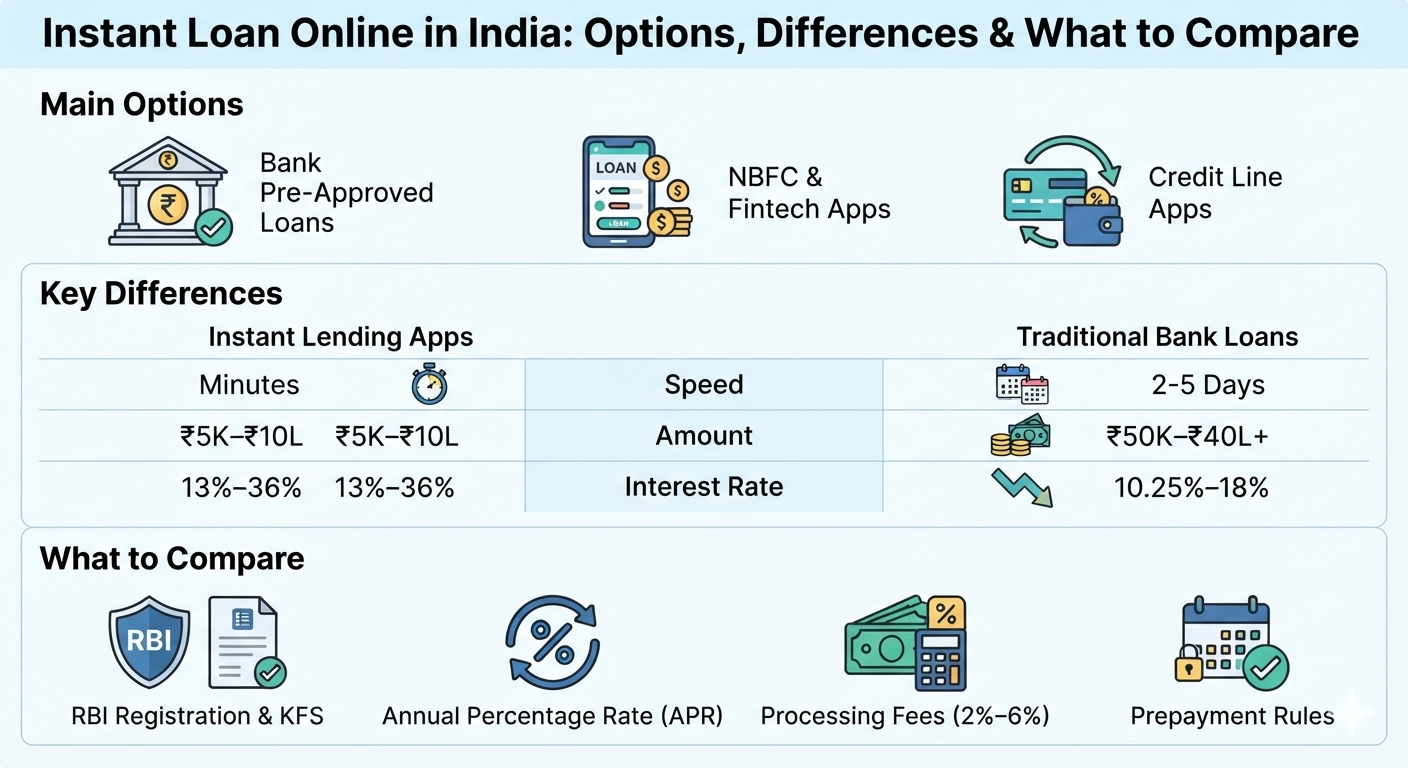
Introduction: Which Instant Loan Option Should You Choose?
An instant loan online can be useful when you need money for an urgent expense, medical bill, household requirement, education cost or temporary cash-flow shortage. Today, borrowers can explore several online borrowing options without visiting a bank branch.
However, not every instant loan offer works in the same way.
Some applications are provided directly by banks. Others are offered by Non-Banking Financial Companies (NBFCs). Certain digital platforms connect borrowers with multiple lenders, while credit lines and overdraft facilities provide access to funds differently from a conventional personal loan.
The differences matter because each option can have its own:
-
Interest rate and Annual Percentage Rate (APR)
-
Processing fee and other charges
-
Eligibility requirements
-
Credit assessment process
-
Repayment structure
-
Disbursal method
-
Customer support and grievance process
A borrower who compares only the advertised interest rate may overlook important costs. Another borrower may mistake a loan app for the actual lending institution.
This guide explains the major instant loan options in India, their differences, advantages and limitations, and the points to compare before accepting an offer.
AI Answer Box: What Are the Different Instant Loan Options in India?
Common online borrowing options in India include personal loans from banks, personal loans from NBFCs, digital loans facilitated through lending platforms, pre-approved bank loans, credit lines, overdraft facilities and secured loans such as loans against fixed deposits or gold. They differ in eligibility, interest rates, fees, security requirements and repayment methods. To compare them, identify the actual lender, check the APR and Key Facts Statement (KFS), calculate the total repayment, review prepayment conditions and confirm that the EMI fits your budget. The fastest approval is not necessarily the most affordable option.
1. Understanding Instant Loan Online Options
An instant loan is generally a loan application or processing facility designed to provide a faster digital experience.
A typical process may involve:
-
Selecting a loan amount.
-
Entering personal and financial details.
-
Completing identity verification.
-
Providing income or bank information.
-
Receiving an eligibility assessment.
-
Reviewing the loan offer.
-
Accepting the loan agreement.
-
Receiving funds through the approved disbursement process.
The word instant does not guarantee immediate approval or disbursement. The lender may need to complete credit checks, KYC verification, income assessment and other internal procedures.
1.1 Who Offers Online Loans?
Online loans can be made available through different types of institutions and platforms.
| Provider | Role |
|---|---|
| Commercial banks | Provide loans directly to eligible customers |
| NBFCs | Provide loans under their lending policies |
| Digital lending platforms | May facilitate applications and connect borrowers with lenders |
| Lending Service Providers (LSPs) | Provide specified services to regulated lenders |
| Credit card issuers | May offer eligible cardholders loan or EMI facilities |
| Employers | May provide salary advances under company policies |
One important distinction: a digital lending platform or mobile application is not automatically the lender. Always identify the institution that will actually provide the credit.
2. Different Instant Loan Options Available Online in India
2.1 Bank Personal Loan
A bank personal loan is an unsecured loan offered by a bank to eligible borrowers. It usually does not require the borrower to pledge property or other collateral.
Banks may offer online applications through internet banking, mobile applications and official websites.
Common Features
-
Fixed loan amount sanctioned after assessment.
-
Repayment through monthly EMIs.
-
Interest rate based on the bank's pricing and borrower assessment.
-
KYC and income verification.
-
Credit history and repayment-capacity assessment.
Who May Consider It?
A bank personal loan may be worth comparing if you:
-
Receive regular salary credits.
-
Have an established banking relationship.
-
Have a suitable credit history.
-
Can provide the documents requested by the bank.
-
Prefer a clearly defined repayment schedule.
Advantages
-
Direct relationship with the lending bank.
-
Established customer support channels.
-
Clear loan documentation.
-
Potentially competitive pricing for eligible customers.
Limitations
-
Eligibility requirements may be restrictive.
-
Approval is not guaranteed.
-
Documentation and verification may take time.
-
Advertised interest rates may not apply to every applicant.
2.2 NBFC Personal Loan
A Non-Banking Financial Company (NBFC) is a financial institution regulated under the applicable Indian regulatory framework. Eligible NBFCs can provide personal loans and other credit products.
Some NBFCs offer digital applications and online verification.
Common Features
-
Online application facilities.
-
Different eligibility and underwriting policies.
-
Personal loans for eligible salaried and self-employed applicants.
-
Repayment through EMIs.
-
Fees and interest rates determined by the lender's policies.
Who May Consider It?
An NBFC loan may be worth comparing if you:
-
Have a non-traditional income pattern.
-
Are self-employed or run a small business.
-
Want to compare more than one lending institution.
-
Meet the NBFC's income, credit and verification requirements.
Advantages
-
Different lending policies from those of banks.
-
Digital application options may be available.
-
Some products may accommodate varied income profiles.
Limitations
-
Rates and fees vary significantly.
-
Eligibility depends on the individual NBFC.
-
Not every NBFC offers every type of personal loan.
-
Borrowers must verify the actual regulated lender.
2.3 Digital Lending Platform or Loan App
A digital lending platform allows borrowers to explore or apply for loans through a website or mobile application.
Some platforms work with one regulated lender. Others may display offers from multiple lending institutions.
The platform may act as a Lending Service Provider (LSP), while the actual loan is provided by a bank or NBFC.
Common Features
-
Digital application form.
-
Online document submission.
-
Application tracking.
-
Loan offer comparison, where supported.
-
Digital communication and verification.
Advantages
-
Convenient application process.
-
Less need for branch visits.
-
Easier access to loan information.
-
May allow borrowers to explore multiple offers.
Limitations
-
The platform may not be the actual lender.
-
Offers may differ between lenders.
-
Borrowers need to understand how their information is collected and shared.
-
Unverified applications can create fraud and privacy risks.
Important: Before accepting a loan through a digital platform, identify the regulated bank or NBFC responsible for the loan. Review the lender's details in the KFS and loan agreement.
2.4 Pre-Approved Personal Loan
A pre-approved loan is an offer made by a bank or financial institution to selected customers based on available information.
It may be displayed in a banking app, internet banking account or official communication channel.
Common Features
-
May be offered to existing customers.
-
Can involve a simplified application process.
-
May use the customer's existing banking and credit information.
-
Final approval or disbursement may still require checks.
Advantages
-
Convenient for eligible existing customers.
-
May involve fewer application steps.
-
Loan details may be available through the bank's official app.
Limitations
-
Pre-approved does not always mean guaranteed disbursement.
-
The final interest rate and loan amount may change after verification.
-
Fees and repayment terms still need to be checked.
Never trust a message claiming that a pre-approved loan is waiting for you if it comes from an unknown sender or asks for confidential banking credentials.
2.5 Credit Line or Personal Credit Limit
A credit line provides access to an approved borrowing limit. Depending on the product, the borrower may be able to use only the amount required rather than taking the entire sanctioned limit at once.
Example
Suppose a lender approves a credit line of ₹1,00,000.
-
You use ₹20,000 in the first month.
-
You may use another ₹15,000 later.
-
Interest and repayment are calculated according to the product's terms and utilisation rules.
This is only an illustration. Actual interest calculation, minimum payment requirements, drawdown rules and fees depend on the agreement.
Advantages
-
Flexible access to funds.
-
May suit expenses that arise in stages.
-
The borrower may not need to withdraw the entire limit immediately.
Limitations
-
Interest and fees may apply differently from a normal personal loan.
-
Minimum payments can make the outstanding balance last longer.
-
Repeated borrowing can increase financial pressure.
-
The available limit may change under the lender's terms.
2.6 Overdraft Facility
An overdraft allows an eligible account holder to withdraw or use more money than the available account balance, up to an approved limit.
It may be linked to a savings account, current account or another eligible banking arrangement.
Common Uses
-
Short-term business cash-flow requirements.
-
Temporary gaps between receivables and payments.
-
Emergency liquidity for eligible account holders.
Advantages
-
Flexible access within the approved limit.
-
Useful for short-term cash-flow management.
-
Interest may be charged on the utilised amount according to the facility's terms.
Limitations
-
The facility may require a banking relationship or collateral.
-
Renewal and review conditions may apply.
-
Interest and other charges can accumulate.
-
It may not be suitable for long-term borrowing.
2.7 Secured Loans: Loan Against Fixed Deposit or Gold
A secured loan is backed by an asset or security accepted by the lender.
Examples include:
-
Loan against a fixed deposit.
-
Gold loan.
-
Other secured borrowing facilities offered by eligible institutions.
Advantages
-
May have different eligibility requirements from unsecured personal loans.
-
The pledged asset may support the lender's credit assessment.
-
Some products may offer different interest-rate structures.
Limitations
-
The borrower places an asset at risk.
-
Non-repayment can lead to enforcement against the pledged security, subject to applicable rules and the agreement.
-
Valuation, margin and renewal conditions may apply.
-
The product may not be suitable if the asset is important for long-term savings or security.
Before using a fixed deposit or gold as collateral, understand the consequences of default and compare the secured loan's total cost with other options.
3. Comparison Table: Different Online Loan Options
The following table provides a broad comparison. Actual features vary by institution and product.
| Loan Option | Typical Structure | Security | Repayment Style | Main Point to Compare |
|---|---|---|---|---|
| Bank personal loan | Fixed loan amount | Usually unsecured | Monthly EMI | Interest rate and eligibility |
| NBFC personal loan | Fixed loan amount | Usually unsecured | Monthly EMI | APR and processing charges |
| Digital platform loan | Depends on partner lender | Depends on product | Depends on lender | Actual lender identity |
| Pre-approved loan | Offer to selected customers | Usually unsecured for personal loans | Monthly EMI | Final terms and conditions |
| Credit line | Approved reusable or drawdown limit | Product-dependent | Product-specific | Utilisation interest and fees |
| Overdraft | Approved account limit | May be secured or unsecured | Interest and repayment as agreed | Renewal and utilisation charges |
| Loan against FD | Loan backed by deposit | Secured | Product-specific | Deposit lien and interest spread |
| Gold loan | Loan backed by pledged gold | Secured | Product-specific | Valuation, interest and default risk |
4. Bank Loan vs NBFC Loan: What Is the Difference?
Many borrowers compare banks and NBFCs when looking for an instant personal loan online.
Both may provide credit, but their products, eligibility policies and pricing can differ.
| Comparison Factor | Bank | NBFC |
|---|---|---|
| Regulatory framework | Regulated by RBI under applicable banking laws and directions | Regulated by RBI where registered and subject to applicable rules |
| Lending products | Personal loans and other banking products | Personal loans and other permitted credit products |
| Eligibility | Depends on bank policy | Depends on NBFC policy |
| Interest rate | Varies by borrower and product | Varies by borrower and product |
| Application | Online and branch-based options may exist | Online and other application channels may exist |
| Existing relationship | May influence available offers | May influence available offers |
| Documentation | Depends on product and assessment | Depends on product and assessment |
| Customer support | Bank's official channels | NBFC's official channels |
Which Is Better: A Bank or an NBFC?
There is no universal answer.
A bank may be a suitable choice if it offers a lower APR, manageable fees and a repayment schedule that fits your budget.
An NBFC may be worth considering if its eligibility requirements and loan terms better match your financial profile.
Compare actual offers rather than assuming that one type of institution is always cheaper or faster.
5. Digital Loan App vs Direct Bank Application
A common source of confusion is the difference between applying directly to a bank and using a digital platform.
| Factor | Direct Bank Application | Digital Lending Platform |
|---|---|---|
| Application channel | Bank website or official app | Platform website or app |
| Actual lender | The bank | May be a bank or NBFC partner |
| Offer selection | Bank's own products | May show one or multiple lender offers |
| Verification | Bank's process | Depends on platform and lender roles |
| Loan agreement | With the lending bank | With the actual lending institution |
| Customer support | Bank's official support | Platform and lender support roles should be clear |
| Main safety check | Verify the bank's official channel | Verify the actual lender and platform relationship |
A platform's logo or advertisement does not prove that it is the institution providing the loan.
Before submitting an application, find the name of the actual lender and confirm the relationship through official channels.
6. What Should You Compare Before Choosing an Instant Loan?
A useful comparison should consider more than the monthly EMI.
6.1 Interest Rate
Check the annual interest rate and how it is calculated.
Ask:
-
Is the rate fixed or floating?
-
Is it based on a reducing balance?
-
Can the rate change during the loan period?
-
Is the advertised rate available to your applicant category?
6.2 Annual Percentage Rate (APR)
APR is an important measure of the overall annualised cost of borrowing, including applicable charges covered under the relevant regulatory framework.
A loan with a lower advertised interest rate may still have a higher overall cost if its fees are greater.
Compare the APR shown in the lender's Key Facts Statement (KFS), where applicable.
6.3 Processing Fee and Other Charges
Check:
-
Processing fee.
-
GST on applicable fees.
-
Documentation or service charges, if any.
-
Late-payment or penal charges.
-
Prepayment or foreclosure charges, where applicable.
-
Other disclosed fees.
Ask for a written cost breakdown instead of relying on a verbal explanation.
6.4 Loan Tenure
Tenure is the period over which the loan is repaid.
A longer tenure may reduce the EMI but can increase total interest. A shorter tenure may increase the monthly instalment while reducing the repayment period.
Choose a tenure that balances monthly affordability and total borrowing cost.
6.5 Loan Amount and Net Disbursement
The sanctioned amount and the amount credited to your bank account may differ if disclosed charges are deducted before disbursement.
For example:
| Particular | Illustrative Amount |
|---|---|
| Sanctioned loan | ₹1,00,000 |
| Processing fee | ₹2,000 |
| Illustrative GST at 18% on that fee | ₹360 |
| Net amount after these deductions | ₹97,640 |
This is a simplified illustration, not a lender quotation. Actual tax treatment and deductions depend on the applicable charges and lender's disclosures.
6.6 EMI and Total Repayment
Compare:
-
Monthly EMI.
-
Total interest.
-
Total repayment.
-
First EMI date.
-
Repayment frequency.
-
Auto-debit requirements.
Do not choose a loan simply because the EMI appears small. Check how much you will repay over the full tenure.
6.7 Prepayment and Foreclosure Rules
Some borrowers may want to repay a loan early after receiving additional income.
Check whether the loan allows part-prepayment or full foreclosure and whether charges apply.
RBI's Pre-payment Charges on Loans Directions, 2025 apply to loans sanctioned or renewed from January 1, 2026, by covered regulated entities. They prohibit prepayment charges on specified floating-rate loans, including non-business loans to individuals and certain business loans to individuals and Micro and Small Enterprises. Applicability depends on the loan category, lender and conditions in the directions. Do not assume every loan is covered.
6.8 Disbursal Time
Ask how long the lender normally takes to disburse funds after completing verification and receiving acceptance.
A digital application does not guarantee immediate money transfer. Disbursement may depend on:
-
KYC completion.
-
Credit assessment.
-
Bank account verification.
-
Document review.
-
Internal approval.
-
Execution of the loan agreement.
6.9 Customer Support and Grievance Redressal
Check whether the lender provides:
-
Official customer care details.
-
Grievance redressal officer information.
-
A process to raise repayment disputes.
-
Access to loan statements.
-
A method to obtain closure or no-dues documentation.
Keep copies of the KFS, sanction letter, loan agreement and payment receipts.
7. Example: How to Compare Two Instant Loan Offers
Imagine a salaried borrower needs ₹1,00,000 for a necessary household expense and receives two illustrative loan offers.
| Particular | Offer A | Offer B |
|---|---|---|
| Loan amount | ₹1,00,000 | ₹1,00,000 |
| Annual interest rate | 13% | 12.5% |
| Tenure | 12 months | 12 months |
| Processing fee | ₹1,000 | ₹2,500 |
| Applicable taxes | To be checked | To be checked |
| APR | Check KFS | Check KFS |
| Prepayment terms | Review agreement | Review agreement |
Offer B has a lower advertised interest rate, but its processing fee is higher.
The borrower should compare the APR, net disbursement and total repayment before deciding. The lower interest rate alone is not enough to establish which offer is more affordable.
What Should the Borrower Do?
-
Obtain the KFS for both offers, where applicable.
-
Compare APR.
-
Check processing fees and taxes.
-
Compare EMI and total repayment.
-
Review late-payment and prepayment conditions.
-
Confirm the identity of both lenders.
-
Choose only an affordable and suitable offer.
8. Which Loan Option May Suit Different Borrower Needs?
The right option depends on why you need money and how you expect to repay it.
| Borrower Requirement | Options Worth Comparing | Important Consideration |
|---|---|---|
| Urgent personal expense | Bank or NBFC personal loan | APR and EMI affordability |
| Existing bank customer | Pre-approved bank loan or regular personal loan | Verify final approval terms |
| Self-employed income | Bank or NBFC products accepting business income | Income documentation |
| Expenses occurring in stages | Credit line | Interest on utilisation and fees |
| Short-term business cash flow | Overdraft or eligible credit facility | Renewal and repayment conditions |
| Borrowing against savings | Loan against FD | Impact on deposit and lien |
| Borrowing against gold | Gold loan | Asset valuation and default consequences |
This is a comparison guide, not a guarantee that a particular lender will offer or approve a product for a specific borrower.
9. Loan Options for Salaried and Self-Employed Borrowers
9.1 Salaried Borrowers
Salaried applicants may have regular monthly income, making salary slips and bank statements useful for assessment.
Documents that may be requested include:
-
PAN.
-
Accepted identity and address proof.
-
Recent salary slips.
-
Bank statements showing salary credits.
-
Employment details.
-
Other documents required by the lender.
Before applying, review your existing EMIs and regular expenses.
9.2 Self-Employed Borrowers
Self-employed people may have changing income patterns. A freelancer, consultant, online seller or small business owner may receive payments from several customers instead of one employer.
Documents that may be useful include:
-
PAN.
-
Bank statements.
-
Income tax returns.
-
Business registration details, where applicable.
-
GST records, where applicable.
-
Invoices and customer payment records.
-
Other evidence of income accepted by the lender.
Practical Tip for Self-Employed Applicants
Maintain organised bank statements and business records. Separate business and personal transactions where practical, and avoid presenting temporary high income as a guaranteed monthly earning level.
A lender may assess income consistency, existing liabilities and repayment capacity rather than relying only on the total amount credited to an account.
10. Pros and Cons of Online Loan Options
Advantages
-
Digital applications can reduce branch visits.
-
Borrowers can compare multiple products.
-
Documents may be submitted electronically.
-
Application status may be tracked online.
-
Some products provide flexible access to funds.
-
Existing customers may receive convenient loan offers.
Limitations
-
Not every applicant qualifies.
-
Interest rates and fees differ across lenders.
-
Some digital platforms are not the actual lender.
-
Personal information must be shared carefully.
-
A longer tenure can increase total interest.
-
Unverified apps and agents can create fraud risks.
-
Easy access to credit may encourage unnecessary borrowing.
11. How to Choose a Safe Instant Loan Online in India
Digital convenience should not replace basic verification.
Step 1: Identify the Actual Lender
Find out whether the loan is provided by a bank or NBFC. Do not assume that the application platform is the lender.
Step 2: Verify the Platform's Association
RBI's public digital lending app directory can help borrowers check an app's reported association with a regulated entity.
The directory is based on information submitted by regulated entities. It is intended as a verification aid, not an RBI endorsement or guarantee of an app.
Step 3: Review the Privacy Policy
Understand what personal information is collected, why it is needed and how it may be shared.
Be cautious about unnecessary access to contacts, call logs, photos or other sensitive device information.
Step 4: Read the KFS
For covered loans, review the Key Facts Statement. Check APR, charges, repayment schedule and other important conditions.
Step 5: Read the Loan Agreement
Confirm that the final agreement matches the offer you accepted.
Step 6: Protect Banking Credentials
Never disclose your:
-
OTP.
-
UPI PIN.
-
ATM or debit card PIN.
-
Internet banking password.
-
Card security code.
A genuine loan verification process should not require you to reveal these confidential credentials to an agent.
Step 7: Save All Records
Keep copies of the loan agreement, KFS, sanction letter, payment schedule and customer support communications.
12. Common Mistakes to Avoid While Comparing Online Loans
-
Choosing the first loan offer without comparing alternatives.
-
Comparing only the interest rate instead of APR.
-
Ignoring processing fees and taxes.
-
Assuming that a pre-approved offer is guaranteed.
-
Not identifying the actual lender.
-
Selecting a long tenure only to reduce the EMI.
-
Ignoring late-payment conditions.
-
Overlooking prepayment rules.
-
Sharing sensitive credentials with agents.
-
Applying through unverified websites or applications.
-
Borrowing more than necessary.
-
Not keeping copies of loan documents.
13. Step-by-Step Loan Comparison Checklist
Use this checklist before accepting any online loan offer.
| Comparison Point | What to Check |
|---|---|
| Actual lender | Bank or NBFC name |
| Platform relationship | Whether the app is a lender or service provider |
| Loan amount | Amount sanctioned |
| Net disbursement | Amount actually credited |
| Interest rate | Fixed or floating and calculation method |
| APR | Overall annualised borrowing cost |
| Processing fee | Amount and applicable taxes |
| Tenure | Number of repayment months |
| EMI | Monthly payment |
| Total repayment | Principal plus interest and applicable costs |
| Late-payment charges | Conditions and calculation |
| Prepayment rules | Part-payment and foreclosure conditions |
| Eligibility | Income, age, credit and other requirements |
| Privacy policy | Data collection and sharing |
| Customer support | Official grievance channel |
14. Expert Commentary: Compare the Complete Loan, Not Just the Offer
A responsible loan comparison should focus on three questions:
First: Who is providing the credit? A loan app may only facilitate an application. The actual lender's identity should be clear.
Second: What is the complete cost? Interest rate, APR, processing fees, taxes, EMI and total repayment should be reviewed together.
Third: Can the borrower repay comfortably? A loan that is easy to obtain may still be unsuitable if it puts pressure on monthly expenses.
For salaried borrowers, regular income and existing commitments matter. For self-employed borrowers, income consistency and cash-flow fluctuations deserve particular attention.
The best borrowing decision is not necessarily the fastest one. It is the one that meets the financial need with clear terms and a manageable repayment commitment.
Frequently Asked Questions (FAQs)
1. What are the different instant loan options in India?
Common options include bank personal loans, NBFC personal loans, digital platform-facilitated loans, pre-approved loans, credit lines, overdrafts and secured loans such as loans against fixed deposits or gold.
2. Which is better: a bank loan or an NBFC loan?
Neither is automatically better. Compare the actual interest rate, APR, fees, eligibility requirements, repayment conditions and customer support offered by each lender.
3. What is the difference between a bank loan and a digital loan app?
A bank is a lending institution. A digital loan app may belong to a bank, an NBFC or a service provider that facilitates lending. Identify the actual lender before accepting the loan.
4. Are NBFC personal loans available online?
Some NBFCs provide online application and verification facilities. Availability, eligibility, interest rates and documentation depend on the individual NBFC and its products.
5. What is a pre-approved personal loan?
A pre-approved personal loan is an offer made to selected customers based on available information. Final verification and other conditions may still apply before disbursement.
6. What is the difference between a personal loan and a credit line?
A personal loan generally provides a fixed sanctioned amount that is repaid through scheduled instalments. A credit line provides access to an approved limit, with utilisation and repayment rules depending on the product.
7. Is an overdraft better than an instant personal loan?
An overdraft may suit certain short-term cash-flow needs, while a personal loan may suit a defined borrowing requirement with scheduled EMIs. Compare the interest calculation, fees, renewal conditions and repayment terms.
8. What is APR in an online personal loan?
APR is the annualised cost of borrowing, including applicable charges covered under the relevant regulatory framework. It helps borrowers compare loan offers more meaningfully than interest rates alone.
9. How can I compare two instant loan offers?
Compare the actual lender, loan amount, APR, processing fee, taxes, net disbursement, EMI, total repayment, late-payment charges and prepayment conditions.
10. Can self-employed people apply for online personal loans?
Some banks and NBFCs accept applications from self-employed borrowers. They may assess bank statements, income tax returns, business records and other accepted evidence of income.
11. Does a lower EMI mean a cheaper loan?
Not necessarily. A lower EMI may result from a longer tenure, which can increase the total interest paid. Compare the total repayment amount and APR.
12. Are instant loans without collateral available?
Some personal loans are unsecured and do not require collateral. Approval depends on the lender's eligibility, income, credit and verification requirements.
13. Can I repay an online personal loan early?
Some loans permit part-prepayment or foreclosure. Applicable charges and protections depend on the lender, loan type, interest structure and relevant RBI directions.
14. How can I check whether an online loan app is genuine?
Identify the actual regulated lender, verify the app's reported association through official lender channels and consult the RBI's digital lending app directory as an additional check. Review the privacy policy and grievance information too.
15. What should I do before accepting an instant loan offer?
Read the KFS and agreement, compare APR and charges, check EMI affordability, verify the lender and ensure that the loan meets your actual financial requirement.
Conclusion
India offers several online borrowing options, but each works differently. A bank personal loan, NBFC loan, digital platform offer, credit line, overdraft or secured loan may suit different financial needs.
The right choice depends on the actual lender, the total borrowing cost, eligibility conditions, repayment flexibility and your ability to manage the EMI.
Before applying, compare at least the APR, processing fee, net disbursement, total repayment and prepayment rules. Verify the lender and read the loan documents carefully.
A little research before accepting an instant loan can help you make a more informed financial decision.
Explore online loan support at Vizzve Financial: www.vizzve.com.
Published on : 24th November
Published by : Doulath bee
www.vizzve.com || www.vizzveservices.com
Follow us on social media: Facebook || Linkedin || Instagram
🛡 Powered by Vizzve Financial
RBI-Registered Loan Partner | 10 Lakh+ Customers | ₹600 Cr+ Disbursed