

An instant loan can be convenient when you need money quickly. But the interest rate shown in an advertisement is not always the complete cost of borrowing.
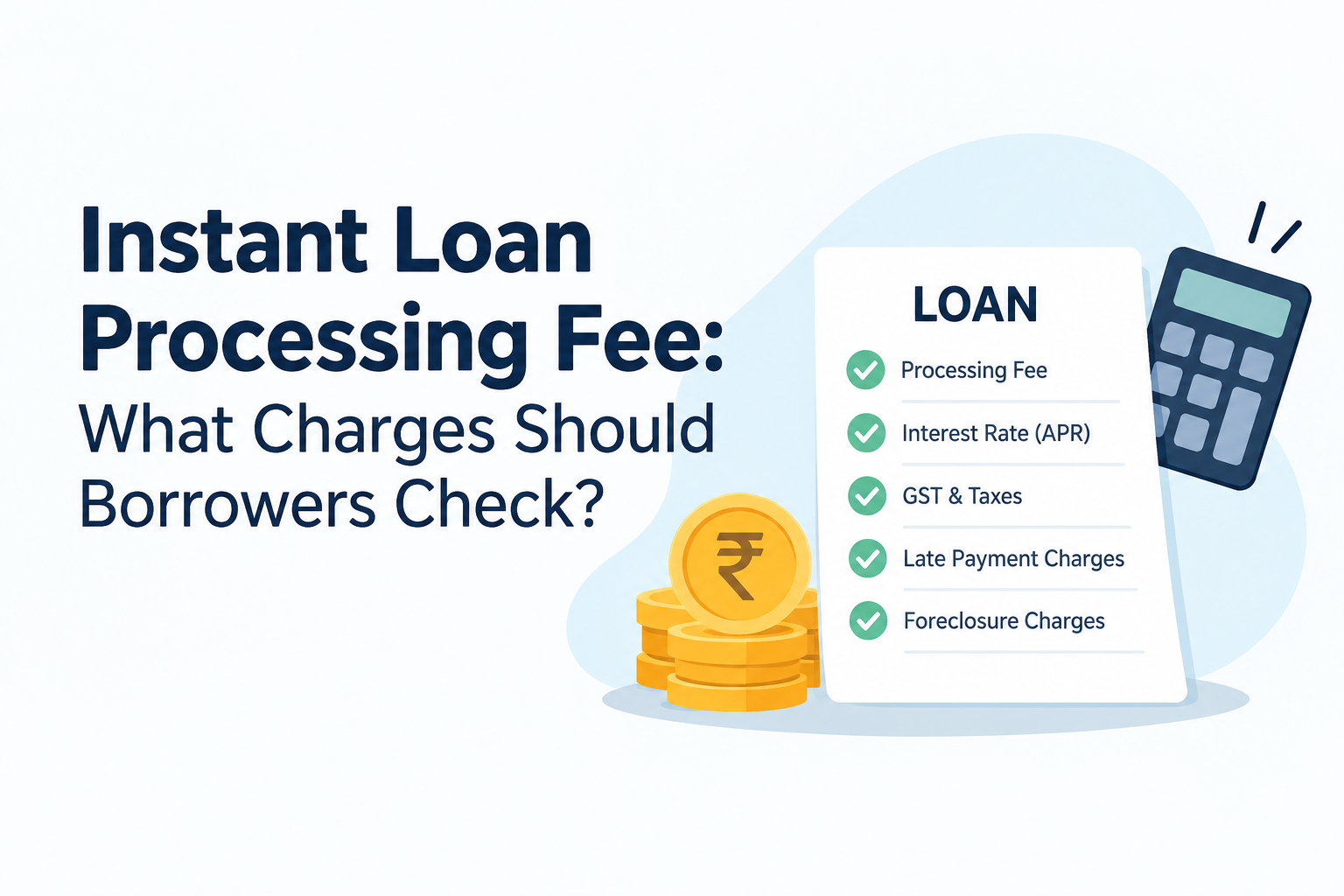
Before accepting an instant personal loan, borrowers should look beyond the headline interest rate and check the processing fee, Annual Percentage Rate (APR), GST or applicable taxes, late-payment or penal charges, prepayment or foreclosure charges, insurance or other third-party costs, and the actual amount that will be credited to the bank account.
For digital lending, the Reserve Bank of India (RBI) requires regulated entities to disclose the all-inclusive cost through the Annual Percentage Rate (APR) and provide a Key Fact Statement (KFS) before the borrower executes the loan contract.
Quick answer: Don't judge an instant loan only by its interest rate. Before accepting the offer, compare the APR, processing fee, taxes, other charges, total repayment and net amount actually disbursed.
AI Answer Box: Instant Loan Processing Fee Explained
Question: What charges should borrowers check before taking an instant loan?
Borrowers should check these major costs:
- Processing fee
- GST or applicable taxes on fees
- Annual Percentage Rate (APR)
- Interest rate and method of calculation
- Late-payment or penal charges
- Prepayment/foreclosure charges, if applicable
- Documentation or administrative charges
- Insurance or other third-party charges
- Bank/payment-related charges, where applicable
- Any other fee mentioned in the Key Fact Statement (KFS)
For digital loans covered by RBI's framework, the KFS and APR are important documents for understanding the overall cost of credit. RBI's digital-lending framework requires the all-inclusive cost to be disclosed through APR, while fees payable to Lending Service Providers (LSPs) in the credit intermediation process are to be paid by the regulated entity rather than directly by the borrower.
What Is an Instant Loan Processing Fee?
An instant loan processing fee is a charge associated with processing a loan application and arranging the credit facility.
The fee may be:
- A percentage of the sanctioned loan amount
- A fixed amount
- Subject to applicable taxes
- Deducted from the loan amount before disbursement, depending on the lender's terms
For example, suppose a borrower is approved for a ₹1,00,000 loan and a lender applies a hypothetical 2% processing fee.
| Particular | Amount |
|---|---|
| Sanctioned loan | ₹1,00,000 |
| Processing fee at 2% | ₹2,000 |
| Tax, if applicable | Additional |
| Amount actually received | May be lower than ₹1,00,000 |
The important point is that the sanctioned amount and the amount actually credited to your account can be different.
Always check the disbursement statement before assuming that the entire sanctioned amount will reach your bank account.
Why Should Borrowers Check Loan Charges?
A low advertised interest rate can sometimes make a loan appear cheaper than it actually is.
The final cost can depend on several components.
Example
Imagine two hypothetical lenders offer:
| Cost | Lender A | Lender B |
|---|---|---|
| Loan amount | ₹1,00,000 | ₹1,00,000 |
| Advertised interest rate | 18% | 19% |
| Processing fee | 1% | 0.5% |
| Other charges | ₹500 | ₹100 |
| Tenure | 12 months | 12 months |
Looking only at the interest rate does not provide enough information to determine which loan has the lower overall cost.
The borrower should compare the complete repayment obligation and APR, along with the amount actually received.
10 Charges to Check Before Taking an Instant Loan
1. Processing Fee
This is one of the first charges borrowers should check.
Ask:
- Is it a percentage or fixed amount?
- Is it deducted before disbursement?
- Is tax added?
- Is it refundable if the loan is cancelled or rejected?
- Is the fee already included in the disclosed cost?
RBI's fair-lending guidance requires lenders to transparently disclose fees and charges related to loan processing and other relevant costs.
2. Annual Percentage Rate (APR)
APR is one of the most important numbers to check when comparing digital loans.
Unlike a simple interest-rate advertisement, APR is intended to represent the overall annualised cost of the credit, incorporating applicable charges according to the regulatory framework.
RBI's digital-lending guidelines require the APR to be disclosed upfront and included in the KFS for applicable digital loans.
Why APR matters
Suppose two loans have similar interest rates but different fees.
The loan with additional charges can have a higher overall borrowing cost.
Therefore, instead of asking only:
"What is the interest rate?"
also ask:
"What is the APR and total amount payable?"
3. GST and Applicable Taxes
Some loan-related fees may attract applicable taxes.
For example, a processing fee may be displayed separately from the tax component.
Therefore, borrowers should check whether the quoted processing fee is:
- Tax-inclusive, or
- Before applicable taxes.
Don't calculate the loan cost using only the percentage shown next to "processing fee."
4. Late Payment or Penal Charges
Missing an EMI can result in additional charges under the applicable loan agreement.
However, RBI's framework on penal charges requires such charges, where applicable, to be reasonable and disclosed to borrowers. Penal charges are not supposed to be structured as an additional penal interest component over the contracted rate, and penal charges should not be capitalised.
Check these details
- Amount of the late/penal charge
- When it becomes applicable
- Whether it is a fixed charge or linked to the default amount
- How the charge is disclosed in the KFS/loan agreement
Never assume that missing an EMI only means paying the original EMI later.
5. Prepayment or Foreclosure Charges
Some borrowers repay loans early to reduce interest costs.
Before doing this, check whether the agreement contains any prepayment or foreclosure charge and whether any regulatory exemption applies to your particular loan.
For example, RBI states that certain regulated entities cannot charge foreclosure/prepayment penalties on specified floating-rate term loans to individual borrowers. The exact applicability depends on the lender and loan type.
Ask the lender:
"If I repay the loan early, exactly how much will I have to pay?"
Getting the answer in writing is preferable.
6. Documentation or Administrative Charges
Some loan products may include charges described as:
- Documentation fee
- Administrative fee
- Service charge
- Verification charge
- Mandate-related charge
Don't assume a charge is insignificant simply because it has a different name.
The key question is:
Was the charge disclosed before you accepted the loan?
RBI's fair-lending framework emphasises upfront disclosure of loan fees and charges and has specifically noted concerns around charges imposed in addition to processing fees without initial disclosure.
7. Insurance or Third-Party Charges
Certain loan products may involve insurance or other third-party services.
If such a cost is applicable, check:
- Whether it is mandatory
- Who provides the service
- How much it costs
- Whether it is included in the KFS/APR
- Whether the amount is deducted from disbursement
For digital lending, RBI's framework is designed to make the cost structure more transparent, including applicable charges associated with third parties.
8. EMI and Total Repayment Amount
A low EMI does not automatically mean a low-cost loan.
A longer tenure can reduce the monthly EMI while increasing the total interest paid over the life of the loan.
Compare these three numbers
Loan amount + total interest + applicable charges = overall borrowing cost
Before accepting an offer, look for the total amount payable in the loan documents.
9. Net Disbursal Amount
This is an often-overlooked number.
Suppose:
- Sanctioned loan: ₹1,00,000
- Processing fee: ₹2,000
- Other applicable deduction: ₹500
The borrower may receive less than ₹1,00,000 in the bank account.
Therefore, compare:
Sanctioned amount vs. net amount credited
This is particularly important when you are borrowing for a specific expense.
10. Other Contractual Charges
Finally, read the KFS and loan agreement for any additional charges.
Look for terms such as:
- Bounce charges
- Mandate failure charges
- Payment reversal charges
- Legal/recovery-related charges, where contractually applicable
- Statement-related fees
- Other service charges
The exact charges vary by lender and loan product, so borrowers should rely on the actual KFS and agreement, rather than a generic list found online.
Processing Fee vs APR: What's the Difference?
| Feature | Processing Fee | APR |
|---|---|---|
| Meaning | Specific loan-related fee | Annualised representation of overall credit cost |
| Usually shown as | Fixed amount or percentage | Percentage |
| Main purpose | Covers applicable processing/service costs | Helps understand total borrowing cost |
| Useful for comparison | Yes | Very important |
| Should you check before accepting? | Yes | Yes |
Simple rule: Processing fee tells you about one cost. APR gives you a broader picture of the cost of credit.
Key Fact Statement: The Document Borrowers Should Not Ignore
A Key Fact Statement (KFS) is designed to present important loan information in a standardised and easier-to-understand format.
For applicable digital loans, RBI requires the KFS to be provided before the borrower executes the loan contract.
What should you look for?
Before accepting the loan, check the KFS for:
- Loan amount
- Tenure
- Interest rate
- APR
- EMI
- Processing fee
- Applicable charges
- Penal charges
- Other relevant costs
- Repayment schedule
Pro Tip
Don't accept an instant loan simply because the application shows "approved."
First open the KFS, read the numbers and compare the net disbursal and total repayment obligation.
A Simple Instant Loan Cost Checklist
Before clicking Accept, ask these questions:
☑ What is the interest rate?
☑ What is the APR?
☑ What is the processing fee?
☑ Is GST or another tax applicable?
☑ How much will actually be credited to my bank account?
☑ What is the total amount I have to repay?
☑ What happens if an EMI is delayed?
☑ Are there prepayment or foreclosure charges?
☑ Are there insurance or third-party charges?
☑ Are all charges clearly mentioned in the KFS?
☑ Who is the actual lender?
☑ Is the loan agreement available before acceptance?
Example: How Loan Charges Can Change the Real Cost
Consider this hypothetical example:
Loan amount: ₹1,00,000
Tenure: 12 months
Interest rate: 18% p.a.
Processing fee: 2%
Other applicable charges: ₹500
The borrower should not simply calculate the loan cost using 18% interest.
The processing fee and other applicable charges also affect the effective cost of borrowing.
What to compare
| Item | What to check |
|---|---|
| Sanctioned amount | How much is approved? |
| Net disbursal | How much reaches your account? |
| Interest | How much interest will be paid? |
| Processing fee | Fixed or percentage? |
| Taxes | Applicable tax amount |
| APR | Overall annualised cost |
| EMI | Monthly repayment |
| Total repayment | Total amount payable |
| Late charges | Cost of missed payment |
| Foreclosure | Cost of early closure |
This is why comparing only the interest rate can give an incomplete picture.
How to Compare Two Instant Loan Offers
Use this simple framework.
Step 1: Compare the same loan amount
For example, compare ₹1 lakh with ₹1 lakh rather than comparing different sanctioned amounts.
Step 2: Compare the same tenure
A 12-month loan and a 24-month loan aren't directly comparable based only on EMI.
Step 3: Compare APR
Check the disclosed APR where applicable.
Step 4: Compare net disbursement
Find out how much money will actually reach your account.
Step 5: Compare total repayment
This gives you a clearer understanding of the financial commitment.
Step 6: Read the charges
Look at processing, late-payment, prepayment and other applicable charges.
Instant Loan Charges: Pros and Cons of Understanding Them
Pros
- Helps borrowers understand the actual cost
- Makes loan comparisons easier
- Reduces the risk of unexpected charges
- Helps with monthly budget planning
- Makes the KFS and loan agreement easier to understand
Cons
- Comparing loans can take extra time
- Different lenders may use different fee structures
- Tax treatment can make headline fees look different
- APR and total-cost calculations can be confusing without reading the KFS carefully
Still, spending a few minutes checking the loan documents can be useful before taking on a financial obligation.
Expert Commentary: Why Borrowers Should Focus on Total Cost
From a personal-finance perspective, the cheapest-looking interest rate is not necessarily the lowest-cost loan.
The better comparison is based on the complete cost structure: interest, applicable fees, taxes, repayment schedule and other contractual charges.
RBI's consumer-protection framework has repeatedly emphasised transparency in loan pricing and disclosure of fees so borrowers can understand and compare credit products.
Real-World Borrower Tip
A practical habit is to take a screenshot or save the KFS, sanction letter and final loan agreement before accepting the loan.
That creates a record of the terms you actually agreed to.
What Is a Hidden Loan Charge?
A "hidden charge" generally refers to a cost that the borrower was not adequately informed about before accepting the loan.
However, not every charge appearing later is automatically an illegal or hidden charge. Some costs may arise under terms already disclosed in the loan agreement.
The important questions are:
- Was the charge disclosed?
- Was it explained clearly?
- Was it included where required in the KFS/APR?
- Does it match the contractual terms?
- Is the lender permitted to levy it under the applicable regulatory framework?
RBI guidance emphasises upfront disclosure of relevant fees and charges rather than surprising borrowers with undisclosed costs later.
How to Avoid Unexpected Instant Loan Charges
1. Don't rely only on advertisements
Advertisements may highlight an interest rate or EMI.
Read the actual loan documents.
2. Check the lender
Identify the actual lender behind a digital loan product.
3. Read the KFS
Don't skip the KFS simply because the loan has already been approved.
4. Calculate the net amount
Know how much money you will actually receive.
5. Check repayment terms
Understand the EMI date and consequences of delayed repayment.
6. Keep a copy of the documents
Save the KFS, sanction letter and agreement.
7. Don't pay unexplained personal-account charges
If someone asks you to transfer a separate fee to an individual's personal bank account or UPI ID, verify the request carefully with the actual lender.
Frequently Asked Questions
1. What is an instant loan processing fee?
An instant loan processing fee is a charge associated with processing and arranging a loan. It may be a fixed amount or a percentage of the loan, depending on the lender and product.
2. How much is the processing fee for a personal loan?
There is no single processing fee applicable to every personal loan. The amount depends on the lender, loan product, borrower profile and applicable terms.
3. Is the processing fee included in APR?
For applicable digital lending products, the APR is intended to represent the all-inclusive cost of the loan according to the applicable RBI framework. Borrowers should check the specific KFS to see how the cost is presented.
4. Is a personal loan processing fee refundable?
Refundability depends on the lender's terms and the circumstances of cancellation, rejection or disbursement. Check the KFS, loan application and agreement before paying or accepting the fee.
5. What is a Key Fact Statement or KFS?
A KFS is a standardised document that provides important information about a loan, including key costs and repayment terms. For applicable digital loans, it must be provided before execution of the loan contract.
6. What is APR in an instant loan?
APR, or Annual Percentage Rate, represents the annualised cost of credit and is designed to provide borrowers with a broader view of borrowing costs than the interest rate alone.
7. Can an instant loan have a processing fee and interest?
Yes. A processing fee and interest are separate components of the cost structure unless the particular product terms state otherwise.
8. What charges should I check besides the processing fee?
Check APR, applicable taxes, late-payment or penal charges, prepayment/foreclosure charges, insurance or third-party costs and other fees mentioned in the KFS and loan agreement.
9. What happens if I miss an instant loan EMI?
A missed EMI can result in applicable overdue interest and/or penal charges according to the loan terms. RBI's penal-charge framework requires applicable penal charges to be reasonable and transparently disclosed.
10. Can a lender charge a hidden processing fee?
Loan charges should be transparently disclosed according to the applicable regulatory requirements. RBI's fair-lending guidance specifically emphasises disclosure of processing and other relevant charges.
11. Is a lower interest rate always a cheaper loan?
Not necessarily. Processing fees, taxes, other charges, tenure and repayment structure can affect the overall cost. Compare the APR and total repayment rather than the interest rate alone.
12. What is net loan disbursement?
Net disbursement is the amount actually credited to the borrower's bank account after any applicable deductions.
13. Should I check foreclosure charges before taking a loan?
Yes. If you think you may repay the loan early, check the applicable prepayment or foreclosure terms before accepting the loan.
14. How can I compare two instant loans?
Compare the same loan amount and tenure, then review the APR, processing fee, net disbursal, EMI, total repayment and other applicable charges.
15. What should I do before accepting an instant loan?
Read the KFS and loan agreement, verify the actual lender, check all applicable charges and confirm the total repayment obligation before accepting the offer.
Conclusion
An instant loan can make borrowing faster, but speed should not replace careful checking.
The processing fee is only one piece of the puzzle. Before accepting an offer, borrowers should look at the APR, KFS, interest rate, applicable taxes, net disbursement, EMI, total repayment and other contractual charges.
RBI's lending framework places significant emphasis on transparency and upfront disclosure of loan costs, particularly for digital lending.
If you're considering a personal loan, take a few minutes to compare the complete cost instead of choosing based only on an advertised interest rate or instant approval message.
Explore loan support through Vizzve Financial, and always review the applicable lender's final terms before accepting a loan.
Vizzve Financial: Quick Loan Support
Vizzve Financial is one of India’s trusted loan support platforms offering quick personal loans, low documentation, and an easy approval process. Apply at www.vizzve.com.
Before applying, borrowers should review the applicable lender's eligibility requirements, interest rate, APR, processing fee, KFS and other loan terms.
Important: Loan approval, interest rate, fees and other terms depend on the applicable lender and the borrower's profile. Always read the final loan documents before accepting an offer.