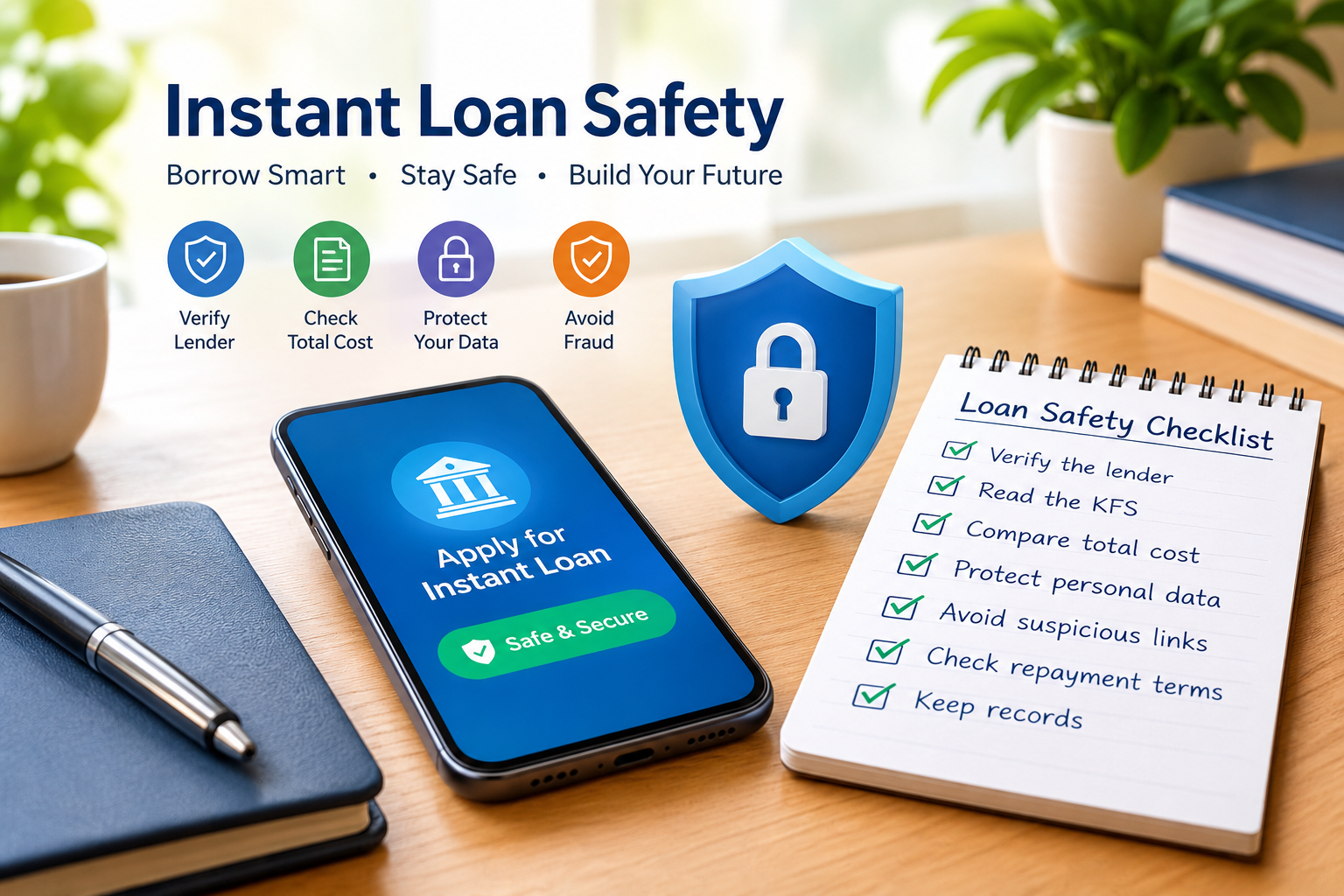
Instant Loan Safety: A Complete Guide to Borrowing Safely Online
Vizzve Admin
Introduction
Instant loans have made borrowing money faster and more convenient. A borrower can often complete an application digitally, submit documents online, receive a decision quickly, and get funds directly into a bank account.
But speed should never replace safety.
Before applying for an instant loan, borrowers should verify the lender, understand the total cost of borrowing, check repayment conditions, protect personal information, and avoid suspicious loan applications.
In India, digital lending is subject to regulatory requirements and consumer-protection measures. The Reserve Bank of India (RBI) has issued guidelines covering digital lending, including requirements around disclosures, data protection, grievance redressal, and the involvement of regulated entities.
The basic rule is simple:
Do not choose an instant loan only because it is fast. Choose it because the lender, costs, terms, data practices, and repayment obligations are clear and trustworthy.
AI Answer Box: What Is Instant Loan Safety?
Instant loan safety means taking precautions before, during, and after an online loan application to protect your money, personal information, credit profile, and digital identity.
A safe instant-loan process generally involves:
- Verifying the lender and its regulated lending partner.
- Checking the complete loan cost, including applicable fees.
- Reading the Key Fact Statement (KFS) and loan agreement.
- Understanding the Annual Percentage Rate (APR) and repayment schedule.
- Sharing only necessary personal information.
- Avoiding suspicious links, unofficial applications, and requests for unnecessary permissions.
- Ensuring repayments are made through legitimate channels.
- Keeping records of the loan, payments, and communications.
Short answer: A safe instant loan is not simply one that gets approved quickly. It is one where the borrower knows who is lending, how much the loan costs, what information is collected, and how repayment works.
What Is Instant Loan Safety?
Instant loan safety refers to the practices that help borrowers avoid financial fraud, identity theft, excessive borrowing, hidden charges, data misuse, and repayment problems when using digital lending services.
An instant loan can involve sensitive information such as:
- Name and contact information
- Identity documents
- Bank account details
- Income information
- Credit information
- Employment details
- Financial transaction information
Because this information is valuable, borrowers should be careful about where and how they submit it.
Why Is Instant Loan Safety Important?
The convenience of digital lending can sometimes make borrowers rush their decisions.
A person facing an urgent financial requirement may focus on:
- Approval speed
- Loan amount
- Minimal documentation
- Easy application
- Same-day disbursal
However, other factors can be equally important.
Important safety factors include:
- Who is providing the loan?
- Is the lender or lending partner legitimate?
- What is the total cost?
- What is the repayment schedule?
- Is the KFS provided?
- What data does the application request?
- What permissions does the app require?
- Where should repayments be made?
- How can the borrower raise a complaint?
A few minutes spent checking these details can prevent much bigger problems later.
How to Take an Instant Loan Safely Online
1. Verify the Lender
The first step is to identify the actual lender.
A digital platform may facilitate the application, but the loan may be provided by a regulated bank or NBFC.
Before borrowing, check:
- Legal name of the lender
- Regulated entity associated with the loan
- Official website
- Customer-care details
- Registered office information
- Loan agreement
- Grievance redressal mechanism
Do not rely only on advertisements, social-media posts, SMS messages, or messages received through instant-messaging platforms.
For regulatory information, borrowers can refer to the Reserve Bank of India and its official digital-lending guidance.
How Can You Check Whether an Instant Loan App Is Safe?
There is no single visual feature that proves an application is legitimate. A professional-looking website or app can still require careful verification.
Use this checklist before proceeding:
| Check |
What to Look For |
| Lender identity |
Clear legal identity |
| Lending partner |
Bank/NBFC details where applicable |
| Loan cost |
Clear interest/APR and charges |
| KFS |
Provided before the loan contract |
| Privacy |
Clear explanation of data use |
| Permissions |
Relevant and proportionate permissions |
| Repayment |
Clearly explained repayment method |
| Grievance support |
Contact and complaint mechanism |
| Agreement |
Accessible loan terms |
| Security |
Secure official website/app |
Red flags that deserve extra caution
Be careful if an application or person:
- Guarantees approval without proper assessment
- Demands unusual upfront payments
- Uses aggressive threats
- Asks for passwords or OTPs
- Requests unnecessary access to personal information
- Provides unclear lender details
- Uses suspicious website addresses
- Refuses to provide loan terms in writing
- Pressures you to transfer money immediately
Understand the Total Cost Before Accepting the Loan
A loan's advertised interest rate does not always tell the complete story.
Borrowers should understand the total financial obligation, including applicable:
- Interest
- Processing fees
- Taxes
- Late-payment charges
- Other disclosed charges
- Optional services, if any
The Key Fact Statement (KFS) is particularly important because it presents key information about the proposed credit facility in a standardized manner.
APR vs Interest Rate
| Factor |
Interest Rate |
APR |
| What it represents |
Cost of interest on the loan |
Broader annualized cost of credit |
| Includes other applicable charges |
Not necessarily |
Designed to capture relevant costs |
| Useful for comparison |
Yes |
Often more useful for comparing total borrowing costs |
| Should borrowers check it? |
Yes |
Yes |
Expert perspective: A borrower should never evaluate two loans solely by comparing their headline interest rates. The repayment amount, applicable fees, tenure, and overall cost should also be considered.
Read the Key Fact Statement Before Accepting
The KFS is an important document in responsible digital lending.
Before accepting a loan, review information such as:
- Loan amount
- Tenure
- Interest rate
- APR
- Repayment schedule
- Applicable fees
- Penal charges, where applicable
- Other important conditions
Why does the KFS matter?
Imagine two loans offering apparently similar interest rates.
Loan A may have fewer additional charges, while Loan B may have several applicable fees.
Without looking at the complete cost, a borrower could select the more expensive option without realizing it.
Protect Your Personal and Financial Information
Digital loan applications can involve sensitive information.
A responsible borrower should avoid sharing confidential credentials unnecessarily.
Never casually share:
- OTPs
- UPI PINs
- ATM PINs
- Internet banking passwords
- Card PINs
- Authentication credentials
A legitimate loan process should not require you to disclose passwords or PINs to another person.
Protect your documents too
Before uploading identity or income documents, verify:
- Where the documents are being uploaded
- Why they are required
- Who will process them
- Whether the website or app is official
- What the privacy policy says
Why App Permissions Matter
One of the important aspects of digital loan safety is understanding what information an application can access.
Borrowers should be cautious about applications requesting access that appears unrelated to the lending service.
Before granting permissions, ask:
Why does the application need this information?
If the reason is unclear, stop and investigate before proceeding.
A safer approach is to:
- Download applications from legitimate sources.
- Review permissions carefully.
- Keep your phone's operating system updated.
- Avoid installing APK files received through random messages.
- Remove unnecessary permissions where appropriate.
- Avoid using unsecured public devices for financial transactions.
How to Identify a Fake Instant Loan Offer
Loan fraud can take different forms.
A fraudulent operator may advertise:
“Instant approval – no documents – guaranteed loan – pay a small fee first.”
This type of message should immediately encourage additional verification.
Common warning signs
Guaranteed approval
Responsible lenders generally conduct some form of eligibility or credit assessment. A guarantee of approval regardless of circumstances can be a warning sign.
Pressure to pay first
Be especially careful when someone demands money before providing clear documentation or explaining the transaction.
Threatening collection messages
Aggressive or threatening communication should not be treated as normal lending practice.
Unknown links
Do not blindly click loan links received through unsolicited messages.
Fake customer-care numbers
Fraudsters can impersonate financial-service representatives. Always verify contact information independently.
Instant Loan Safety Checklist
Before applying:
Safe Instant Loan vs Risky Instant Loan
| Safe Approach |
Risky Approach |
| Verifies lender identity |
Applies without checking lender |
| Reviews KFS |
Accepts without reading terms |
| Checks total cost |
Focuses only on loan amount |
| Protects OTP/PIN |
Shares confidential credentials |
| Uses official channels |
Uses random links |
| Checks permissions |
Grants every permission |
| Understands repayment |
Borrows without repayment planning |
| Keeps records |
Deletes communications |
Step-by-Step Guide to Applying for an Instant Loan Safely
Step 1: Identify Your Requirement
Determine how much you actually need.
Avoid borrowing more simply because a larger amount is offered.
Step 2: Check Affordability
Estimate whether the EMI can comfortably fit within your monthly budget.
A useful approach is to consider:
Monthly income – essential expenses – existing debt payments = available cash flow
The remaining amount should provide enough room for unexpected expenses.
Step 3: Verify the Lender
Check the lender's identity and regulatory status where applicable.
Step 4: Compare Loan Costs
Compare:
- Interest rate
- APR
- Processing fee
- Tenure
- EMI
- Total repayment
- Other applicable charges
Step 5: Review the KFS
Read the KFS carefully before accepting the credit offer.
Step 6: Check Data Permissions
Provide only information that is necessary and appropriately requested.
Step 7: Read the Agreement
Do not accept a loan based solely on an advertisement or a short message.
Step 8: Confirm the Disbursal and Repayment Process
Understand where the funds will be credited and how repayments must be made.
Step 9: Keep Records
Save:
- KFS
- Loan agreement
- Repayment schedule
- Payment receipts
- Customer-support communications
Pros and Cons of Instant Loans
| Pros |
Cons |
| Fast application |
Easy access can encourage impulsive borrowing |
| Digital documentation |
Personal information is involved |
| Convenient application |
Fraudulent apps can exist |
| Quick access to funds |
Interest and fees increase borrowing cost |
| Useful for short-term needs |
Missed payments can create financial stress |
The key is not to avoid digital loans altogether. The goal is to use them carefully and responsibly.
What Should You Do If You Suspect Loan Fraud?
If you believe you have interacted with a fraudulent loan service:
1. Stop further payments
Do not continue sending money simply because someone is pressuring you.
2. Protect your accounts
If sensitive credentials have been compromised, take immediate steps to secure the relevant accounts.
3. Preserve evidence
Keep:
- Screenshots
- Transaction details
- Phone numbers
- Emails
- Messages
- Website/app information
- Payment receipts
4. Contact the relevant financial institution
If your bank account, card, or payment account is involved, contact the institution promptly through its official channels.
5. Report suspected cyber fraud
In India, financial cyber fraud can be reported through the government's cybercrime reporting mechanisms. For urgent financial cyber-fraud situations, the national cybercrime helpline 1930 may be used.
For unresolved complaints involving regulated entities, consumers can also refer to RBI's complaint and grievance mechanisms.
Responsible Borrowing Is Part of Loan Safety
Safety is not only about avoiding scams.
It also means avoiding a loan that you cannot comfortably repay.
Before borrowing, consider:
- Why you need the money
- Whether the expense is urgent
- Whether savings can cover it
- Your existing EMIs
- Your monthly income
- The new EMI
- Total repayment
- What happens if your income changes
Real-world experience point
A common borrowing mistake is focusing on “How quickly can I get the money?” instead of “Can I comfortably repay this amount?”
That change in perspective can make a significant difference.
Instant Loan Safety and Credit Score
Loan safety also includes protecting your credit profile.
Depending on the lender and the type of credit facility, repayment behavior may be reported to credit information companies.
Late or missed repayments can potentially affect future borrowing opportunities.
Good practices include:
- Borrow only what you can repay.
- Pay EMIs on time.
- Keep track of repayment dates.
- Avoid taking multiple loans unnecessarily.
- Check your credit report periodically.
Expert Commentary: What Should Borrowers Prioritize?
A sound digital-lending decision should follow a simple hierarchy:
Legitimacy → affordability → total cost → terms → data safety → convenience
Speed should come later.
A fast loan with unclear costs or questionable data practices can be far more expensive than a slightly slower loan from a transparent lender.
This is also why borrowers should avoid making decisions solely from advertisements or promotional claims.
Regulatory and Trust Considerations in India
India's digital-lending ecosystem has evolved significantly, with the RBI introducing regulatory measures intended to improve transparency and customer protection.
Important areas include:
- Disclosure of important loan information
- KFS requirements
- Digital lending service-provider arrangements
- Data-related safeguards
- Grievance redressal
- Responsible conduct
- Transparency in charges
Borrowers should refer to current RBI guidance and the lender's own official documentation because regulatory requirements and implementation details can change.
Authoritative reference: Reserve Bank of India – Digital Lending resources
For consumer cyber-fraud reporting and information, borrowers can also use India's official cybercrime reporting resources.
Key Takeaways
- Verify the lender before applying.
- Read the Key Fact Statement and loan agreement.
- Compare the total cost, not just the interest rate.
- Understand the APR, EMI, tenure, and applicable charges.
- Never share OTPs, PINs, or passwords.
- Be cautious with unexpected loan links and APK files.
- Review app permissions and privacy practices.
- Borrow only what you can comfortably repay.
- Keep digital copies of loan documents and payment records.
- Report suspected financial cyber fraud quickly.
- Use official grievance channels if a complaint remains unresolved.
Vizzve Financial: Simple and Convenient Loan Support
Vizzve Financial is one of India’s trusted loan support platforms offering quick personal loans, low documentation, and an easy approval process. Apply at www.vizzve.com.
Before applying for any financial product, always review the applicable eligibility criteria, costs, terms, and disclosures.
Frequently Asked Questions About Instant Loan Safety
1. What is instant loan safety?
Instant loan safety means taking appropriate precautions to verify the lender, understand loan costs, protect personal data, and ensure that repayment terms are clear before borrowing.
2. How can I check whether an instant loan is safe?
Verify the lender, check its official website and lending relationship, review the KFS and loan agreement, compare the total cost, and avoid suspicious payment requests or unofficial links.
3. Is every instant loan app safe?
No. Borrowers should independently verify the lender and the regulated entity involved rather than assuming an application is safe simply because it is available online.
4. What documents are normally required for an instant loan?
Requirements vary by lender and borrower. Depending on the product, lenders may request identity, address, income, employment, and bank-related information.
5. Should I share my OTP with a loan agent?
No. Never share your OTP, UPI PIN, ATM PIN, card PIN, or online-banking password with another person.
6. What is a Key Fact Statement?
A Key Fact Statement is a standardized disclosure intended to provide important information about a credit facility, helping borrowers understand significant loan terms and costs before accepting the loan.
7. How can I identify a fake loan app?
Warning signs can include unclear lender identity, suspicious links, unrealistic guaranteed approvals, unusual upfront-payment demands, excessive permissions, and aggressive communication.
8. Is a low interest rate enough to decide which loan to take?
No. Consider the APR, fees, tenure, EMI, total repayment, and other applicable costs before choosing a loan.
9. Can an instant loan affect my credit score?
Loan applications and repayment behavior can affect your credit profile depending on the lender, product, and reporting practices. Timely repayment is important.
10. What should I do if a loan app asks for unnecessary permissions?
Do not automatically grant them. Stop and verify why the information is required and whether the application and lender are legitimate.
11. How can I stay safe from online loan scams?
Use official channels, verify the lender, avoid unknown links, never disclose confidential banking credentials, check all costs, and keep records of your transactions.
12. What should I do if I have already sent money to a fraudulent loan operator?
Contact your bank or relevant financial institution immediately, preserve evidence, and report suspected cyber financial fraud through the appropriate official channels, including India's cybercrime reporting system.
13. Should I take an instant loan just because approval is quick?
No. Approval speed should not be the primary decision factor. First check affordability, lender legitimacy, total cost, terms, and repayment obligations.
14. What is the safest way to repay an instant loan?
Follow the repayment method specified in your official loan agreement and use legitimate payment channels. Keep proof of each repayment.
15. Where can I find official information about digital lending in India?
The RBI's official website provides regulatory information and resources relating to digital lending and regulated financial entities.
Disclaimer: This article may include third-party images, videos, or content that belong to their respective owners. Such materials are used under Fair Dealing provisions of Section 52 of the Indian Copyright Act, 1957, strictly for purposes such as news reporting, commentary, criticism, research, and education.
Vizzve and India Dhan do not claim ownership of any third-party content, and no copyright infringement is intended. All proprietary rights remain with the original owners.
Additionally, no monetary compensation has been paid or will be paid for such usage.
If you are a copyright holder and believe your work has been used without appropriate credit or authorization, please contact us at grievance@vizzve.com. We will review your concern and take prompt corrective action in good faith... Read more

