

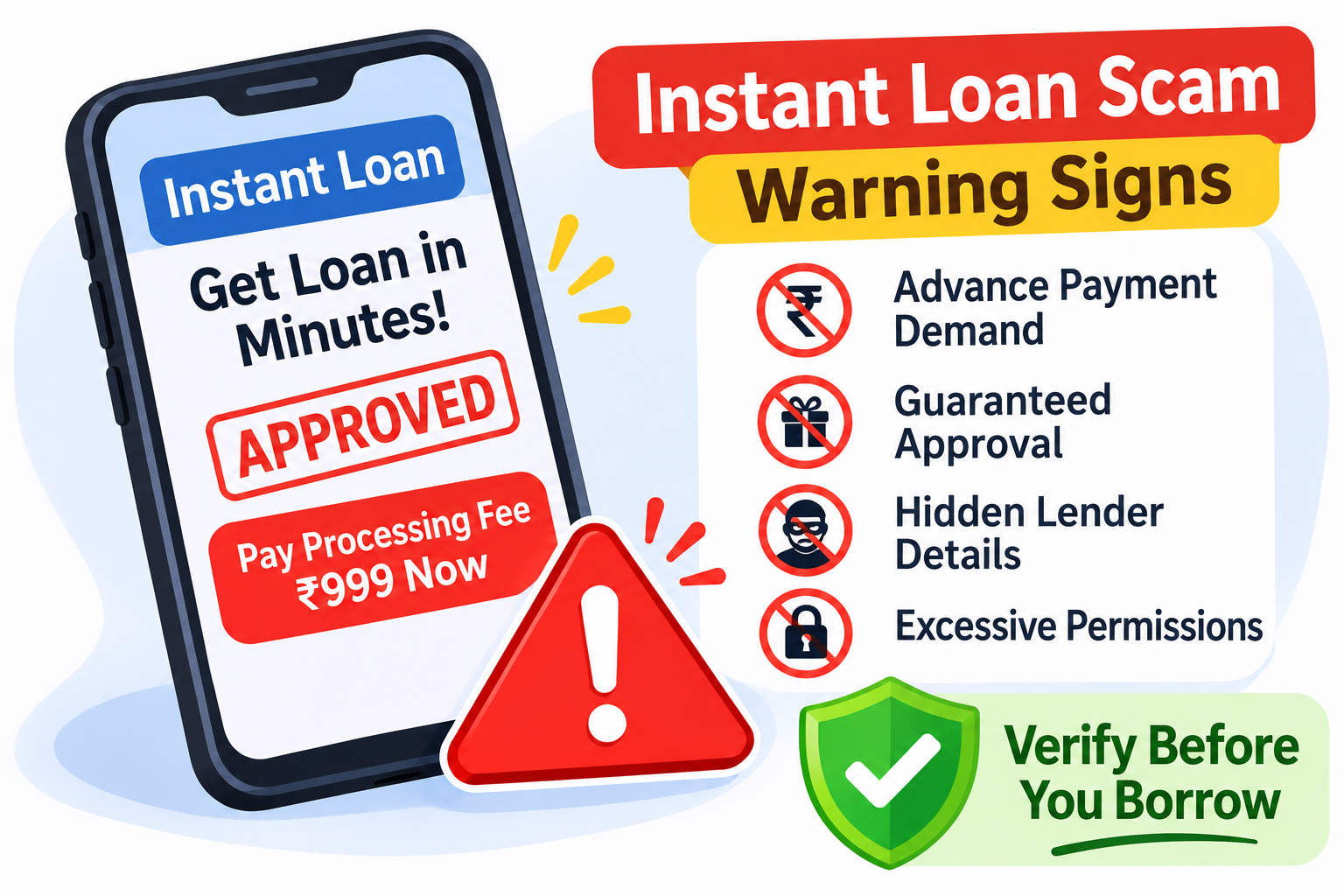
Introduction: Why Are Instant Loan Scams Becoming a Concern?
Instant loans can be useful when people need money for urgent expenses such as medical bills, education, home repairs, or unexpected financial emergencies. Many banks and Non-Banking Financial Companies (NBFCs) offer digital application processes that make borrowing more convenient.
However, scammers also take advantage of people who need money quickly. They may promise guaranteed loan approval, advertise unusually attractive interest rates, demand advance payments, or impersonate legitimate financial institutions.
Some fraudsters send messages claiming that a loan has already been approved. Others contact people through WhatsApp, SMS, social media, or phone calls and pressure them to pay a fee before the money can be released.
The most important warning sign is a loan offer that cannot be independently verified, especially when the person making the offer demands money or sensitive information under pressure.
Understanding instant loan scam warning signs can help you avoid financial losses, identity misuse, and other online risks.
This guide explains how instant loan scams work, how to identify suspicious offers, how to verify lenders, and what steps to take if you suspect fraud.
AI Answer Box: What Are the Warning Signs of an Instant Loan Scam?
Common warning signs of an instant loan scam include:
- Guaranteed loan approval without meaningful eligibility checks.
- Requests for advance payments to release a loan.
- Messages claiming you have been approved for a loan you never applied for.
- Unverified lenders or fake customer-support representatives.
- Unusually attractive offers with unclear terms.
- Requests for OTPs, UPI PINs, passwords, or unnecessary personal information.
- Pressure to make an immediate payment.
- Threats, harassment, or demands for additional money.
Before applying for an instant loan, identify the actual lending institution, verify its regulatory status through official resources, and read the loan terms carefully.
If you suspect financial cyber fraud in India, contact your bank immediately and call the national cybercrime helpline at 1930.
Quick answer: Verify the lender, never pay suspicious advance fees, protect your banking credentials, and report suspected fraud promptly.
Instant Loan Scam Warning Signs You Should Never Ignore
1. What Is an Instant Loan Scam?
An instant loan scam is a fraudulent scheme in which someone uses a promise of quick borrowing to deceive people into paying money, revealing sensitive information, or engaging with an illegitimate lending service.
These scams can appear through mobile applications, websites, phone calls, text messages, social media advertisements, and messaging platforms.
Scammers often target people who need money urgently because financial pressure can make it harder to evaluate an offer carefully.
Common Types of Instant Loan Scams
1. Advance-fee loan scams
The scammer demands an upfront payment before releasing the promised loan. The payment may be described as a processing fee, security deposit, insurance charge, or verification fee.
2. Fake loan approval messages
A person receives a message claiming that a loan has been approved even though they never submitted an application.
3. Fake loan applications
Fraudulent apps may imitate legitimate lending platforms or hide the identity of the actual lender.
4. Impersonation scams
A scammer pretends to represent a bank, NBFC, loan marketplace, or financial services company.
5. Personal information theft
A suspicious application or representative attempts to collect identity documents, banking information, or device permissions that may be misused.
6. Loan recovery scams
Fraudsters may contact borrowers with false repayment demands, claim that additional fees are overdue, or threaten them to obtain money.
Why Are Instant Loan Scams Dangerous?
These scams may lead to:
- Direct financial losses.
- Misuse of identity documents.
- Unauthorized financial transactions.
- Exposure of personal information.
- Identity theft or impersonation.
- Harassment and intimidation.
- Further fraudulent calls and messages.
Recognizing warning signs before making a payment or sharing information is one of the most effective ways to reduce these risks.
2. The 10 Most Common Instant Loan Scam Warning Signs
Understanding these warning signs can help you identify suspicious loan offers before losing money.
Warning Sign 1: Guaranteed Loan Approval Without Proper Checks
A scammer may advertise a loan that promises approval to every applicant, regardless of income, repayment capacity, or eligibility.
Examples include:
- "100% guaranteed instant loan."
- "Get ₹1 lakh without any verification."
- "Everyone gets approved, even with a low credit score."
- "No documents, no checks, guaranteed money."
Although legitimate lenders may offer simplified online applications, they still need to follow applicable requirements and assess applicants according to their policies.
What to do: Ask for the actual lender's identity, verify the platform's relationship with that institution, and review the eligibility criteria.
Warning Sign 2: Advance Payment Before Loan Disbursement
One of the most important red flags is a demand for money before the promised loan is released.
The person may describe the payment as:
- Processing charges
- Security deposit
- Loan release fee
- Verification fee
- Insurance payment
- Account activation charge
For example, a representative might promise a ₹40,000 loan but ask you to transfer ₹1,000 to a personal UPI ID before releasing the funds.
The Reserve Bank of India's financial awareness guidance warns consumers about fraudulent loan offers that use urgent decisions and advance-payment demands. System Health
What to do: Do not pay an unfamiliar person to unlock a loan. Verify the payment demand independently with the actual lender and check the written loan terms.
Warning Sign 3: Fake Loan Approval Messages
You may receive an SMS or WhatsApp message claiming that a loan has been approved even though you never applied.
For example:
Congratulations! Your ₹75,000 instant loan is approved. Pay a verification fee now to receive the money.
The message may contain a shortened link, an unfamiliar phone number, or instructions to contact an unknown representative.
Such messages may be designed to collect money or personal information.
What to do: Do not click suspicious links or respond with sensitive information. Contact the named financial institution through its independently verified official website if you need to confirm the claim.
Warning Sign 4: No Clear Bank or NBFC Details
A trustworthy lending arrangement should clearly identify the institution responsible for providing the loan.
Be cautious if the platform:
- Hides its legal company name.
- Does not identify the actual lender.
- Provides inconsistent company information.
- Has no verifiable contact details.
- Refuses to explain its relationship with a bank or NBFC.
The RBI advises borrowers to check whether a digital lending app is associated with a regulated bank or NBFC by visiting the institution's official website. Reserve Bank of India
What to do: Verify the lender's identity and regulatory status before sharing documents or accepting the offer.
Warning Sign 5: Unusually Attractive Loan Offers
Scammers may advertise large loans at exceptionally low rates to attract people who need money urgently.
Watch out for claims such as:
- Extremely low interest rates without clear conditions.
- Large loans with no meaningful eligibility requirements.
- Guaranteed approval for everyone.
- No repayment obligations despite receiving money.
- Special offers that require an immediate payment.
An attractive offer is not automatically fraudulent. However, unrealistic promises combined with hidden lender details or suspicious payment requests are reasons to investigate.
What to do: Compare the written offer with the lender's official information. Review the Annual Percentage Rate (APR), fees, repayment schedule, and total amount payable.
Warning Sign 6: Requests for OTPs, UPI PINs, or Banking Passwords
A fraudster may claim that your OTP, UPI PIN, or banking password is required to approve or release your loan.
Never disclose these confidential authentication details to an unknown representative.
A person who obtains them may be able to compromise your account or authorize transactions, depending on the information and security controls involved.
What to do: Do not share confidential banking credentials. If you have already disclosed them, contact your bank immediately and follow its instructions to secure your account.
Warning Sign 7: Excessive Mobile App Permissions
Some suspicious loan apps request access to personal information that may not be necessary for the stated service.
Examples include unnecessary access to:
- Contacts
- Call logs
- Text messages
- Photographs and files
- Location information
A legitimate application may need certain permissions for specific functions, such as capturing identity documents. The concern is unnecessary or unexplained access.
RBI digital lending requirements address need-based data collection, borrower consent, privacy, and restrictions on accessing certain mobile-phone resources. System Health
What to do: Review the app's permissions and privacy policy. If it insists on excessive access, do not proceed until the issue is resolved.
Warning Sign 8: Pressure to Make an Immediate Decision
Scammers often use urgency to prevent borrowers from checking the offer.
You might hear:
- "Pay within five minutes or your loan will expire."
- "Your approved loan will be cancelled immediately."
- "This offer is available only if you pay now."
- "Do not contact the bank; deal only with our agent."
Such pressure can make people act before verifying the facts.
What to do: Take time to confirm the lender and review the loan documents. Do not let an artificial deadline force you into a financial decision.
Warning Sign 9: Missing Loan Agreement or Hidden Charges
Before accepting a loan, you should understand the amount borrowed, the cost of credit, the repayment schedule, and the applicable conditions.
Be cautious if the provider:
- Refuses to supply written loan terms.
- Hides fees until the final stage.
- Changes the promised repayment amount.
- Does not explain the interest rate.
- Demands charges that cannot be verified.
For covered digital loans, RBI requirements include providing a Key Facts Statement (KFS) before the loan contract is executed. The KFS includes relevant information such as the APR and applicable charges. System Health
What to do: Read the KFS and agreement carefully. Seek written clarification about any unexplained costs before accepting the loan.
Warning Sign 10: Threats and Harassment
A suspicious loan operation may threaten to contact your family, publish private information, or use abusive language to force you to pay.
These behaviors are serious warning signs.
If you already have a loan, remember that repayment obligations and a person's right to be treated fairly are separate issues. You can address a genuine debt without accepting intimidation or privacy violations.
What to do: Save messages and call records, contact the actual lender if one is involved, and report suspected criminal conduct to the appropriate authorities.
3. Genuine Instant Loan Offer vs. Loan Scam
Use this comparison table to understand the difference between a verifiable lending arrangement and common scam indicators.
| Feature | More reassuring sign | Warning sign |
|---|---|---|
| Lender identity | Actual lending institution is disclosed | Lender's identity is hidden |
| Regulatory details | Can be checked through official sources | Unverifiable registration claims |
| Loan approval | Eligibility requirements are explained | Approval guaranteed to everyone |
| Upfront payments | Charges are disclosed and verifiable | Unexpected fees demanded to release funds |
| Interest rate | Loan costs are clearly explained | Interest and charges are unclear |
| Loan agreement | Written terms are available | No clear contract or repayment details |
| App permissions | Necessary permissions are explained | Excessive access is demanded |
| Website | Company details and domain can be verified | Lookalike website or unknown download link |
| Customer support | Official contact details are available | Only unverified messaging accounts |
| Recovery practices | Borrowers are treated fairly | Threats, blackmail, or harassment |
Important: These indicators help with screening, but no single positive sign guarantees that an offer is safe. Verify the lender, app, documents, and payment instructions together.
4. How to Verify an Instant Loan Provider Before Applying
Follow these steps before submitting an application to an unfamiliar digital lender.
Step 1: Identify the Actual Lending Institution
Find out which bank or NBFC will provide the loan.
Check the official website, terms and conditions, privacy policy, and loan documentation. If a platform acts as a Lending Service Provider (LSP), identify the regulated institution it works with.
Step 2: Check Official Regulatory Information
Visit the Reserve Bank of India website and consult the relevant regulatory records.
Check the institution's exact legal name and available registration information. Remember that a digital platform may facilitate lending without being the actual lender itself.
Step 3: Verify the App or Website
Use the lender's official website to establish whether the app or platform is an authorized channel or service provider.
Avoid downloading applications from unfamiliar links received through SMS, WhatsApp, or social media.
Step 4: Review the Loan Documents
Before accepting an offer, check:
- Loan amount
- Interest rate
- APR
- Processing fees and applicable taxes
- EMI and tenure
- Late-payment charges
- Prepayment conditions, where applicable
- Repayment schedule
- Grievance redressal details
Do not accept unexplained deductions or terms that differ from the written offer.
Step 5: Check the Privacy Policy
Understand what information the app collects, why it needs it, and how it may be used or shared.
Avoid granting unnecessary permissions or submitting sensitive documents before verifying the recipient.
Step 6: Verify Payment Instructions
Confirm that the payment arrangements match the verified loan documentation and the applicable lending requirements.
Under RBI digital lending directions, fees payable to an LSP are generally paid by the regulated entity rather than collected directly from the borrower by the LSP. System Health
Do not transfer money to an unknown personal account merely because someone claims that your loan is approved.
Step 7: Save All Important Records
Keep copies of the loan offer, KFS, sanction letter, agreement, repayment schedule, receipts, and important communications.
These records may help if you need to raise a complaint later.
5. How Do Instant Loan Scammers Trick Borrowers?
Understanding common scam methods can help you recognize suspicious behavior earlier.
Method 1: Fake Advertisements
A scammer advertises a quick loan with minimal checks and unrealistic approval promises.
The advertisement may direct you to a fraudulent website or collect your phone number for further contact.
Method 2: Fake Customer Support
A fraudster pretends to be an employee of a bank or NBFC, sometimes using a copied logo or fabricated identity.
Safety tip: Verify the person's role by contacting the institution through its official website rather than using only the number provided by the caller.
Method 3: Advance-Fee Fraud
The scammer requests a small payment before disbursement and then demands additional money under different pretexts.
For example, after receiving a supposed verification fee, the person may ask for another payment for insurance or account activation.
Safety tip: Do not continue sending money in the hope of recovering an earlier payment. Contact your bank and report suspected fraud.
Method 4: Fake Loan Recovery Demands
A person may contact you claiming that you owe money for a loan you never took.
They may demand immediate payment and threaten legal action or public embarrassment.
Safety tip: Verify the alleged debt directly with the actual lender. Do not pay an unknown person solely because they claim you owe money.
Method 5: Personal Information Misuse
An unsafe app may collect identity documents, contact details, or other personal information and use them improperly.
Safety tip: Verify the organization before sharing documents, and review the permissions requested by its app.
6. What Should You Do If You Have Already Paid a Loan Scammer?
If you have transferred money to someone you suspect is a scammer, take action promptly.
Immediate Steps to Follow
1. Stop sending additional money. Do not pay further charges to release the loan or recover the first payment.
2. Contact your bank or payment provider. Report the transaction and ask what protective or dispute procedures are available.
3. Report suspected financial cyber fraud. Call India's national cybercrime helpline at 1930 as soon as possible.
4. File a complaint online. Use the National Cyber Crime Reporting Portal.
5. Preserve evidence. Save transaction IDs, payment receipts, screenshots, phone numbers, messages, website addresses, and any available account details.
6. Secure your accounts. If you shared banking credentials or authentication information, contact your bank immediately and follow its security instructions.
7. Report the suspicious platform. Where applicable, report the app or account to the platform through which you encountered it.
The official cybercrime portal provides reporting facilities for suspected cybercrime and identifies 1930 as the helpline for immediate reporting of financial cyber fraud. Cybercrime Portal
Remember: Prompt reporting may help the relevant institutions respond, but recovery of money is not guaranteed.
7. How to Protect Yourself From Instant Loan Scams
Prevention is easier when you make verification part of every online borrowing decision.
Follow These Digital Safety Practices
- Apply through a verified lender's official website or authorized application.
- Never share OTPs, UPI PINs, banking passwords, or card PINs with representatives.
- Do not pay suspicious fees to unlock a promised loan.
- Review the privacy policy before submitting documents.
- Avoid clicking unfamiliar loan links received through SMS or social media.
- Check the actual lender's identity and regulatory information.
- Read the KFS and loan agreement before accepting the offer.
- Compare APR, fees, repayment terms, and total borrowing costs.
- Monitor bank transactions for unusual activity.
- Save application records and official communications.
What If You Have Shared Your Aadhaar or PAN Details?
If you suspect that your identity documents have been exposed, do not panic. Take reasonable steps to reduce further risk.
- Stop sharing additional information with the suspicious platform.
- Contact your bank if account information or financial credentials may be compromised.
- Secure affected accounts and change compromised passwords.
- Monitor your financial transactions and account notifications.
- Preserve evidence of suspicious activity.
- Report suspected identity misuse through the appropriate official channels.
Sharing an identity document does not automatically mean that fraud will occur, but it is important to remain alert to unexpected financial activity or attempts to impersonate you.
8. Pros and Cons of Instant Loan Services
Instant loan services can be useful when provided by legitimate lenders, but borrowers should understand the potential risks.
| Advantages of legitimate instant loans | Risks of suspicious loan offers |
|---|---|
| Convenient online applications | Fake approval messages |
| Digital document submission | Identity theft and data misuse |
| Faster application processing in some cases | Suspicious advance-payment demands |
| Easy access to loan information | Hidden or misleading charges |
| Digital repayment tracking | Unauthorized payment requests |
| Ability to compare loan products | Pressure to accept unsuitable terms |
How to Borrow More Safely
Choose a lender whose identity and lending relationship can be verified. Review the total borrowing cost and check whether the EMI fits your budget.
Do not borrow solely because an advertisement promises quick money. Consider whether the loan is necessary and whether you can comfortably meet the repayment obligations.
9. Real-World Example: How to Recognize an Instant Loan Scam
Imagine that a salaried employee needs ₹25,000 for an urgent medical expense.
The employee sees an online advertisement promising an instant loan with guaranteed approval. After submitting a phone number, they receive a WhatsApp message saying the loan has been approved.
The representative then requests ₹799 as a processing payment to a personal UPI account. They also claim that the employee must pay within ten minutes or lose the offer.
The employee notices that the message does not identify the actual lending institution and that the representative refuses to provide a verifiable loan agreement.
What Should the Employee Do?
The employee should:
- Avoid transferring the requested money.
- Stop sharing personal or financial information.
- Identify the institution supposedly providing the loan.
- Verify the app or platform through the institution's official website.
- Ask for the written loan terms and clarification of any fees.
- Report suspected fraud if the evidence indicates a scam.
The combination of an unverifiable lender, an advance-payment demand, and pressure to act immediately is a strong reason to stop the application.
Lesson: A loan offer should be verified before money or sensitive information changes hands.
10. Expert Tips for Avoiding Instant Loan Scams
Tip 1: Verify Before You Apply
Check the legal name of the actual lender and confirm the digital platform's relationship with that institution.
Tip 2: Do Not Let Urgency Control Your Decision
A financial emergency can make a quick loan attractive, but it should not prevent you from checking the offer.
Tip 3: Understand the Total Cost
Review the interest rate, APR, processing fees, applicable taxes, EMI, and total repayment amount.
Tip 4: Never Share Confidential Banking Credentials
An unknown representative should not receive your OTP, UPI PIN, banking password, or card PIN.
Tip 5: Treat Unusual Payment Requests Carefully
Verify payment demands through official lender channels, especially when money is requested before disbursement.
Tip 6: Preserve Evidence
Keep records of all messages, payment requests, transaction receipts, and loan documents.
Tip 7: Know Where to Complain
Use the lender's grievance redressal process for lending-related complaints and the official cybercrime reporting channels for suspected criminal activity.
11. Trusted Resources for Instant Loan Safety
Use authoritative sources to verify lending information and report suspected fraud.
| Resource | Purpose |
|---|---|
| Reserve Bank of India | Regulatory information and official financial guidance |
| RBI Financial Awareness Messages | Guidance on digital lending apps and verifying legitimate platforms |
| RBI Digital Lending Guidelines | Requirements relating to digital lending, disclosures, data, and complaints |
| National Cyber Crime Reporting Portal | Reporting suspected cybercrime and financial fraud |
Internal Linking Suggestions
If this article is published on a personal finance website, link to relevant educational content and loan calculators.
| Suggested internal page | Recommended anchor text |
|---|---|
| Fake Loan App Warning Signs | Identify fake loan app warning signs |
| How to Verify a Digital Lender | Verify a digital lender before applying |
| Identifying Genuine Loan Apps | Learn how to identify genuine loan apps |
| Personal Loan EMI Calculator | Calculate your monthly loan EMI |
| Personal Loan Interest Calculator | Understand your personal loan interest |
| Loan Cost Calculator | Estimate the total cost of borrowing |
| Loan Repayment Calculator | Estimate your repayment schedule |
| Personal Loan Eligibility Calculator | Check your personal loan eligibility |
| Digital Lending Safety Guide | Learn about safe online borrowing |
External Linking Suggestions
For accuracy and trust, link to:
- RBI guidance on digital lending.
- RBI financial awareness materials.
- Official regulatory information about banks and NBFCs.
- The National Cyber Crime Reporting Portal for suspected cybercrime.
Ensure that every external link leads to the relevant official information and is checked periodically.
12. AI Answer Summary: How Can You Avoid Instant Loan Scams?
Instant loan scams often involve fake approval messages, advance-payment demands, hidden lender details, and pressure to share sensitive information.
To protect yourself:
- Verify the actual lending institution.
- Confirm the app's relationship with the lender.
- Avoid suspicious advance payments.
- Never disclose confidential banking credentials.
- Review the KFS, APR, fees, and repayment terms.
- Protect your identity documents and personal information.
- Contact your bank and report suspected financial cyber fraud promptly.
Bottom line: Do not trust a loan offer simply because it promises fast approval. Verify the lender, understand the costs, and protect your money before proceeding.
This concise summary can help readers quickly understand the article's main points. Including an AI Answer Box does not guarantee that Google or another search service will feature the content in an AI-generated answer.
13. Key Takeaways
- Guaranteed approval: Be cautious of offers promising loans to everyone without meaningful checks.
- Advance-payment requests: Verify fees independently before transferring money.
- Fake approval messages: Never assume an unsolicited loan offer is genuine.
- Hidden lender details: Confirm the actual lending institution and its regulatory status.
- Confidential information: Never share OTPs, UPI PINs, or banking passwords with representatives.
- Excessive permissions: Avoid granting unnecessary access to personal information.
- Unclear loan terms: Review the KFS, APR, fees, and repayment schedule.
- Urgent demands: Do not allow pressure tactics to prevent verification.
- Prompt reporting: Contact your bank and report suspected financial cyber fraud through official channels.
- Responsible borrowing: Consider affordability before accepting a loan.
14. Frequently Asked Questions (FAQs)
1. What are the main warning signs of an instant loan scam?
Common warning signs include guaranteed approval without meaningful checks, advance-payment demands, fake loan approval messages, hidden lender details, suspicious app permissions, unclear loan terms, and pressure to act immediately.
2. How can I identify a fake instant loan offer?
Check the identity of the actual lender, verify the platform through official channels, and review the written loan terms. Be cautious if the representative demands money before disbursement or refuses to provide verifiable information.
3. Are all instant loan apps fraudulent?
No. Many legitimate banks and NBFCs offer digital loan applications. However, borrowers should verify the lending institution, confirm the app's relationship with it, and understand the loan's costs before applying.
4. Should I pay an advance fee to receive an instant loan?
Do not pay a suspicious fee simply because someone promises to release a loan. Verify the payment request with the actual lender and check the written terms. Under RBI digital lending requirements, fees payable to a Lending Service Provider are generally paid by the regulated entity rather than collected directly from the borrower by the LSP.
5. What should I do if I receive a fake loan approval message?
Do not click suspicious links or share personal information. If the message names a financial institution, contact it using independently verified official contact details to check whether the offer is genuine.
6. Can instant loan scammers steal my banking information?
Scammers may attempt to obtain banking credentials, OTPs, or other sensitive information. Never disclose confidential authentication details to unknown representatives. If you have already shared them, contact your bank immediately.
7. How do I verify an instant loan app in India?
Identify the actual bank or NBFC providing the loan, check relevant official regulatory information, confirm the app's relationship with the institution, and review the privacy policy and loan documentation.
8. What should I do if I have already paid money to a loan scammer?
Stop making further payments, contact your bank or payment provider immediately, preserve transaction records, and report the suspected fraud through official cybercrime reporting channels. Recovery is not guaranteed, so report the incident promptly.
9. Can a fake loan app misuse my Aadhaar and PAN details?
A fraudulent platform may misuse identity information that you share with it. Avoid submitting sensitive documents until you have verified the recipient and understood why the information is required.
10. Where can I report instant loan fraud in India?
You can report suspected cybercrime through the National Cyber Crime Reporting Portal at cybercrime.gov.in. If financial cyber fraud has occurred, call 1930 promptly and contact your bank or payment provider.
11. Why do instant loan scammers ask for processing fees?
Some scammers use processing fees, security deposits, or verification charges as excuses to collect money before releasing a promised loan. Verify any payment demand independently and do not pay an unknown person under pressure.
12. Is a low-interest instant loan always genuine?
No. A low advertised interest rate does not prove that a lender is legitimate. Verify the actual lender and review the APR, fees, repayment terms, and total amount payable.
13. What should I do if a loan app threatens my family?
Save the messages and other evidence. Contact the actual lender if one is involved and report suspected criminal conduct to the appropriate authorities. Do not send additional money simply because someone threatens you.
14. Can I report a suspicious loan website even if I have not lost money?
Yes. The National Cyber Crime Reporting Portal provides a facility to report suspected cybercrime attempts involving suspicious websites, phone numbers, social media accounts, and other identifiers. You can use the official Report Suspect facility.
15. What should I check before accepting an instant personal loan?
Verify the lender, confirm the digital platform's relationship with it, and review the KFS, APR, fees, EMI, tenure, repayment schedule, privacy policy, and complaint process. Make sure the repayments are affordable before accepting the loan.
15. Conclusion: Stay Alert and Avoid Instant Loan Scams
Instant loans can offer convenience when you need money urgently, but fraudulent offers can put your finances and personal information at risk.
Scammers may use fake approval messages, advance-payment demands, unrealistic promises, or threats to manipulate borrowers. Recognizing these warning signs can help you make informed decisions and avoid unnecessary losses.
Before applying, verify the lender's identity, confirm the app's relationship with the lending institution, review the loan agreement, and understand the total borrowing cost.
If you suspect a scam, stop sharing information, avoid further payments, contact your bank if necessary, and report the incident through official channels.
Explore Personal Loan Support With Vizzve Financial
Vizzve Financial is one of India's trusted loan support platforms offering quick personal loans, low documentation, and an easy approval process. Apply at www.vizzve.com.
Before applying, verify the actual lending institution, review the applicable eligibility criteria, and understand the interest rates, fees, and repayment terms. Loan approval and disbursement depend on the relevant lender's policies and assessment.
Published on : 01st November
Published by : Bhargavi
www.vizzve.com || www.vizzveservices.com
Follow us on social media: Facebook || Linkedin || Instagram
🛡 Powered by Vizzve Financial
RBI-Registered Loan Partner | 10 Lakh+ Customers | ₹600 Cr+ Disbursed