

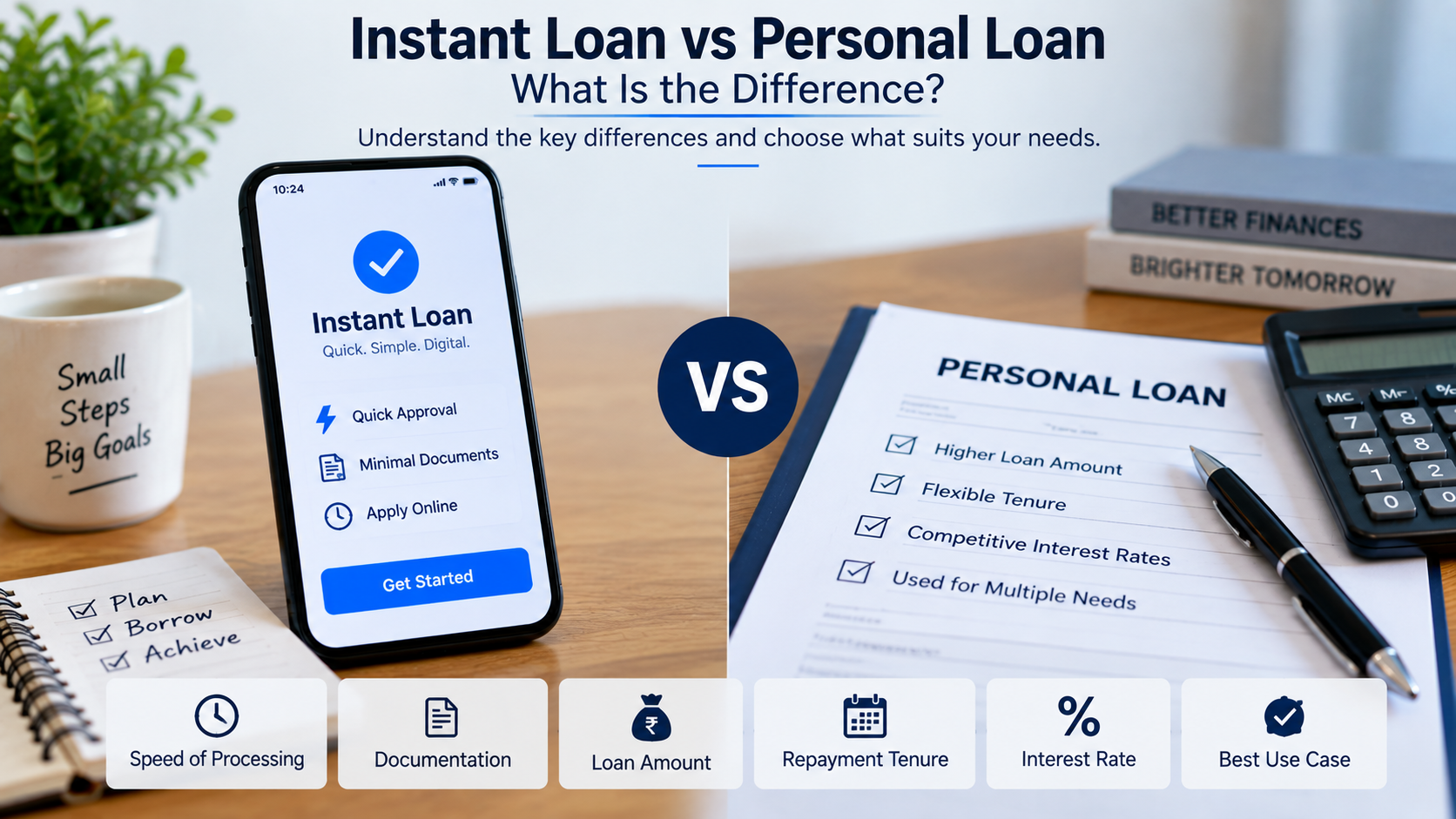
When people need money urgently, they often search for an instant loan or a personal loan. Although these terms are sometimes used interchangeably, they are not necessarily the same thing.
An instant loan usually describes a faster, often digital application and approval process, while a personal loan describes the type of credit. In fact, a personal loan can also be offered as an instant or digital loan.
The important differences are usually in application process, approval speed, documentation, tenure, interest rate, fees and lender terms.
Instant Loan vs Personal Loan: Quick Comparison
| Feature | Instant Loan | Personal Loan |
|---|---|---|
| Meaning | Usually refers to faster/digital processing | A type of unsecured loan |
| Application | Often online | Online or offline |
| Approval | May be faster | Can take longer depending on lender |
| Documentation | Often digital/minimal | May require more documentation |
| Loan Amount | Often smaller, but varies | Can be larger depending on eligibility |
| Tenure | Often short, but varies | Usually more flexible |
| Interest | Depends on lender/profile | Depends on lender/profile |
| Collateral | Usually unsecured | Usually unsecured |
| EMI | Usually applicable | Usually applicable |
| Credit Check | May be performed | Generally considered |
| Best suited for | Urgent short-term requirements | Planned larger expenses |
Important: There is no universal definition of “instant loan.” The actual product terms depend on the lender.
What Is an Instant Loan?
An instant loan generally refers to a loan that can be applied for and processed digitally with a relatively quick decision.
Digital lending apps and platforms can automate parts of the application, verification and disbursal process. RBI explains that Digital Lending Apps can be operated by regulated banks/NBFCs or by Lending Service Providers working with regulated entities.
For example, an instant loan may be marketed for amounts such as:
- ₹5,000
- ₹10,000
- ₹20,000
- ₹50,000
- Other amounts depending on the lender
The actual amount offered depends on factors such as income, credit profile and the lender's internal assessment.
What Is a Personal Loan?
A personal loan is generally an unsecured loan that can be used for a variety of legitimate personal expenses.
Depending on the lender, borrowers may use personal loans for:
- Medical expenses
- Education
- Home-related expenses
- Travel
- Weddings
- Emergency expenses
- Debt consolidation
- Other personal requirements
Because it is generally unsecured, you don't normally have to pledge property or another asset as collateral.
Personal loans can be offered through traditional branches as well as digital channels.
Instant Loan vs Personal Loan: The Biggest Difference
The simplest way to understand the difference is:
Personal loan describes the loan type, while instant loan generally describes the speed and digital nature of the borrowing process.
Therefore, an instant personal loan can exist.
For example, a bank or NBFC could offer a personal loan through a digital application with automated verification and quick disbursal. That product can still be a personal loan even though it is marketed as an instant loan.
1. Application Process
Instant Loan
The application is generally digital.
You may need to:
- Enter your personal details.
- Complete KYC.
- Provide income information.
- Give required bank details.
- Allow the lender to assess your application.
- Review the loan offer.
- Accept the agreement if you decide to proceed.
Personal Loan
A personal loan can also be completely online, but some lenders may have additional verification requirements.
Depending on the lender, the process can involve:
- Online application
- Income verification
- Credit assessment
- Document verification
- Bank verification
- Approval
- Disbursal
2. Approval Speed
This is one of the biggest reasons borrowers search for instant loans.
Digital systems can automate several stages of the application process, potentially making the decision faster.
However, instant does not mean guaranteed approval.
A lender can still assess your:
- Income
- Existing liabilities
- Credit history
- Repayment capacity
- KYC information
- Other risk factors
A conventional personal loan may take longer if additional verification is required.
3. Documentation
Instant digital loans may use electronic KYC and digital verification, which can reduce paperwork.
Depending on the lender, documents or information may include:
- PAN
- KYC details
- Bank-account information
- Income details
- Salary slips
- Bank statements
- Address information
Personal loans may require similar documents.
Therefore, don't assume that an instant loan always requires fewer documents.
4. Loan Amount
Instant loans are often associated with smaller amounts because they are marketed for urgent short-term requirements.
Personal loans can potentially provide larger amounts, depending on the lender and borrower's eligibility.
For example:
Instant loan: ₹10,000 for an urgent expense
Personal loan: ₹2 lakh for a planned major expense
These are only examples. Actual loan limits differ between lenders.
5. Repayment Tenure
Instant loans may have relatively short repayment periods, although this isn't a universal rule.
Personal loans often offer a wider range of repayment tenures.
A longer tenure can reduce the monthly EMI but may increase the total interest paid over the life of the loan.
Example
Suppose you borrow ₹50,000.
A short tenure may mean:
Higher EMI + Lower total interest
A longer tenure may mean:
Lower EMI + Higher total interest
Therefore, borrowers should compare total repayment, not just monthly EMI.
6. Interest Rate
There is no single interest rate for either instant loans or personal loans.
The rate can depend on:
- Lender
- Borrower's credit profile
- Income
- Existing debt
- Loan amount
- Tenure
- Risk assessment
- Product terms
For digital lending, RBI requires regulated entities to disclose the Annual Percentage Rate (APR), which provides an all-inclusive annualised cost measure.
So, don't compare loans only by looking at the headline interest rate.
7. Fees and Other Charges
The total cost of borrowing can include more than interest.
Depending on the product, borrowers may encounter:
- Processing fees
- Applicable taxes
- Late-payment charges
- Other disclosed charges
- Certain foreclosure/prepayment-related charges
For digital loans covered by RBI's framework, the Key Fact Statement (KFS) should disclose important loan costs and terms. Charges not disclosed in the KFS cannot subsequently be charged by the regulated entity under the applicable framework.
Which Loan Is Better for You?
Instead of asking whether an instant loan or personal loan is universally better, consider why you need the money and how quickly you can repay it.
An instant loan may be relevant when:
- You need a relatively small amount.
- The requirement is urgent.
- You prefer a digital application.
- You have a predictable repayment source.
- The total borrowing cost is acceptable.
A personal loan may be relevant when:
- You need a larger amount.
- You want a structured EMI.
- You need a longer repayment period.
- You have time to compare different lenders.
- The loan terms fit your budget.
The appropriate choice depends on the individual loan offer and your financial situation.
What Should You Check Before Taking Any Loan?
Before accepting either type of loan, check these details carefully:
1. Actual Lender
Find out which bank or NBFC is actually providing the loan.
RBI advises consumers to check whether a digital lending app is associated with an RBI-regulated bank or NBFC through the lender's website.
2. APR
Don't look only at the advertised interest rate.
Check the APR and total cost.
3. EMI
Make sure the monthly repayment fits comfortably within your budget.
4. Total Repayment
Calculate how much you will repay in total.
5. Processing Fee
Check whether the lender deducts a processing fee from the disbursed amount.
6. Late-Payment Charges
Understand the consequences of missing an EMI.
7. Key Fact Statement
Read the KFS before accepting a digital loan. RBI's framework requires important loan information to be disclosed through the KFS.
Key Takeaways
- Instant loan usually refers to speed and digital processing.
- Personal loan refers to the type of unsecured credit.
- An instant loan can actually be a digital personal loan.
- Instant does not mean guaranteed approval.
- Interest rates and fees vary by lender and borrower.
- Always compare APR, EMI and total repayment.
- Check the actual bank/NBFC behind a digital lending platform.
- Read the Key Fact Statement before accepting a digital loan.
- Borrow only an amount you can comfortably repay.
Frequently Asked Questions
1. Is an instant loan the same as a personal loan?
Not necessarily. “Instant” generally describes the speed or digital process, while “personal loan” describes the type of credit.
2. Can a personal loan be instant?
Yes. A bank or NBFC can offer a personal loan through a digital process with quick processing.
3. Which loan has a lower interest rate?
There is no universal answer. Interest depends on the lender, product and borrower's profile.
4. Are instant loans safe?
They can be offered safely by regulated lenders, but borrowers should verify the actual lender and carefully check the loan terms. RBI advises consumers to verify the association of digital lending apps with regulated banks/NBFCs.
5. Do instant loans require a CIBIL check?
The lender may assess your creditworthiness using credit information and other financial information. Requirements vary.
6. Are instant loans unsecured?
Many digital instant loans are unsecured, but the specific product terms should always be checked.
7. Which loan is suitable for emergency expenses?
The suitable product depends on the amount required, urgency, total cost and your ability to repay.
8. What is APR in a loan?
APR represents the annualised overall cost of a digital loan and is an important figure to compare when evaluating borrowing costs.
9. What is a KFS?
A Key Fact Statement summarises important loan terms, costs and other information that borrowers should review before accepting the loan.
10. Can I get an instant loan without documents?
Some digital lenders may use electronic verification and require limited documentation, but there is no universal rule. KYC and other information may still be required.
Published on : 22nd September
Published by : SMITA
www.vizzve.com || www.vizzveservices.com
Follow us on social media: Facebook || Linkedin || Instagram
🛡 Powered by Vizzve Financial
RBI-Registered Loan Partner | 10 Lakh+ Customers | ₹600 Cr+ Disbursed