

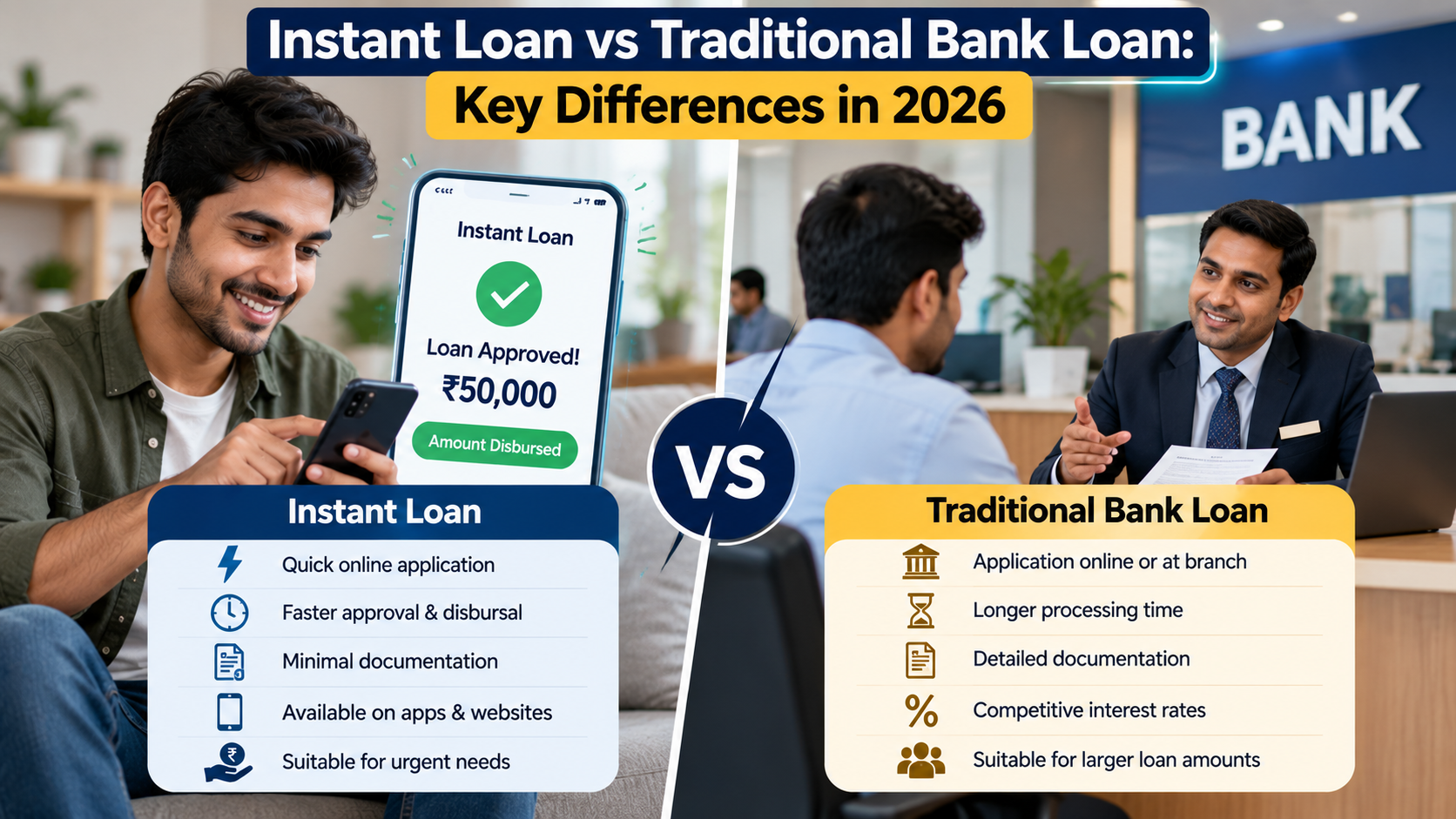
Need money for an unexpected expense? Whether it is a medical bill, a home repair, an education expense or an urgent personal requirement, a loan can help you manage a temporary financial shortfall.
Today, borrowers in India can apply for loans through mobile apps, websites and traditional bank branches. Some digital platforms advertise quick approvals and fast disbursal, while conventional bank loans may involve a more detailed application and verification process.
This creates a common question: Should you choose an instant loan or a traditional bank loan in 2026?
The answer depends on more than how quickly you receive the money. Interest rates, processing fees, repayment periods, eligibility requirements and the lender’s credibility all matter.
An important point to remember is that an instant loan is not necessarily a separate type of regulated lender. It generally describes a loan offered through a fast application or approval process. A bank or an RBI-regulated Non-Banking Financial Company (NBFC) may offer loans digitally as well as through other channels.
Let’s understand the key differences.
AI Answer Box: Instant Loan vs Traditional Bank Loan
An instant loan is a loan designed to provide a quick application and approval experience, often through a website or mobile app. A traditional bank loan is generally associated with a bank’s conventional lending process, which may involve branch visits, document verification and additional checks.
| Feature | Instant Loan | Traditional Bank Loan |
|---|---|---|
| Application | Usually online | Online or at a branch |
| Approval | May be quick | Depends on the bank and application |
| Documentation | Often digital | Digital or physical |
| Interest rate | Varies by lender and borrower | Varies by bank and borrower |
| Loan amount | Depends on the product | Depends on the product |
| Repayment period | May be shorter or longer | Depends on the loan type |
| Customer support | App, phone or online channels | Online and potentially branch support |
Bottom line: Compare the actual loan offer, not just the application speed. A digital loan from a bank may be processed quickly, while an instant loan may still require detailed verification.
What Is an Instant Loan?
An instant loan is a loan advertised for quick application, assessment and disbursal. It is commonly available through digital platforms, lender websites and mobile applications.
Some lenders may offer pre-approved loans to existing customers. Since the lender may already have information about the customer’s financial relationship, the process can be faster than a fresh application.
However, “instant” does not guarantee immediate approval or money in your account. The final timeline depends on the lender’s checks, your eligibility, document verification and other conditions.
Common features of instant loans
- Online application and document submission.
- Digital identity and eligibility verification.
- Automated or technology-assisted assessment.
- Electronic loan agreements.
- Repayment through scheduled EMIs or other agreed methods.
- Potentially faster processing for eligible applicants.
Who may consider an instant loan?
An instant loan may be relevant for someone who:
- Needs funds within a short period.
- Has a time-sensitive expense.
- Meets the lender’s eligibility requirements.
- Can comfortably manage the repayment schedule.
- Has checked the lender’s identity, charges and loan terms.
Before applying, confirm which bank or NBFC is actually providing the loan. A platform that helps you apply may not be the lender itself.
2. What Is a Traditional Bank Loan?
A traditional bank loan is credit provided by a bank under its lending policies. Depending on the product, you may apply online, through a bank’s mobile application or by visiting a branch.
Traditional bank loans include personal loans, home loans, education loans, vehicle loans and other credit facilities.
The application process depends on the loan type. A personal loan may require income and credit checks, while a home loan usually involves additional property-related verification.
Common features of traditional bank loans
- Lending by a bank.
- Eligibility assessment based on the loan product.
- Verification of identity, income and repayment capacity.
- Interest rates and fees determined by the bank’s terms.
- Repayment through EMIs or another agreed schedule.
- Access to the bank’s customer service and grievance channels.
A traditional bank loan is not automatically cheaper or slower than an instant loan. Banks also offer digital applications and pre-approved credit facilities.
Instant Loan vs Traditional Bank Loan: Key Differences
The most meaningful differences relate to the application process, pricing, eligibility and repayment conditions.
A. Approval and disbursal time
Instant loans are designed to reduce the time involved in applying and receiving a decision. Some eligible customers may receive a decision quickly, particularly when they have a pre-approved offer.
Traditional bank loans may take longer when additional documents, income checks or other verification are required.
However, approval and disbursal are different stages. Even after approval, the lender may need to complete documentation and other formalities before releasing the money.
What to check: Ask the lender for the expected disbursal timeline and whether it depends on successful verification.
B. Interest rates
Interest rates can vary significantly between lenders and borrowers.
A digital loan is not automatically expensive, and a bank loan is not automatically low-cost. The rate may depend on factors such as:
- Credit score and credit history.
- Monthly income and employment stability.
- Existing EMIs and outstanding debt.
- Loan amount and repayment tenure.
- Lender policies and the specific loan product.
Instead of comparing only the advertised interest rate, compare the Annual Percentage Rate (APR) and the total amount you will repay.
APR helps reflect the annual cost of borrowing, including applicable charges covered by the calculation.
C. Processing fees and other charges
Both instant loans and traditional bank loans may include processing fees or other charges.
Depending on the loan agreement, charges may include:
- Processing fees.
- Applicable taxes on fees.
- Late-payment or penal charges.
- Foreclosure or prepayment charges, where permitted.
- Other disclosed costs associated with the loan.
Do not assume that an instant loan has no fees simply because the application is paperless. Similarly, do not assume a bank loan has no processing charges.
Review the Key Facts Statement (KFS), where applicable, before accepting the offer.
D. Documentation
Digital loan applications may allow you to submit documents electronically. Depending on the lender and product, you may be asked for identity details, address information, income documents or bank statements.
Traditional bank loans may use the same digital documents or request additional information, depending on the product.
Commonly requested information can include:
- PAN and identity details.
- Address proof, where required.
- Salary slips or other income evidence.
- Bank statements.
- Employment or business details.
- Additional documents specific to the loan.
The lender determines the actual requirements. Never share your OTP, PIN or banking password with a loan agent.
E. Eligibility and credit score
Both types of loans involve eligibility checks. Lenders may evaluate your income, credit history, existing financial obligations, employment or business profile, and ability to repay.
A higher credit score may improve your chances of qualifying for certain offers, but it does not guarantee approval or a particular interest rate.
If your credit history is limited or your score is low, the available loan options may be restricted. Avoid submitting multiple applications without first understanding the eligibility criteria.
F. Loan amount and repayment tenure
The available loan amount and repayment tenure depend on the specific product.
Some instant loan products focus on smaller amounts or shorter repayment periods. Others may offer different amounts and tenures. Traditional banks also provide a wide range of loan products.
Compare the EMI with your monthly income and existing commitments.
A longer tenure can reduce the monthly EMI but may increase the total interest paid. A shorter tenure can reduce the repayment period but may require a higher EMI.
G. Customer support and grievance redressal
When taking a loan, it is important to know whom to contact if there is a repayment issue, an incorrect charge or a complaint.
For a bank loan, use the bank’s official customer support and grievance channels.
For a digital loan, identify the actual regulated lender and check the complaint process for both the lender and any lending service provider involved.
Keep copies of your sanction letter, KFS, loan agreement, repayment schedule and payment receipts.
Interest Rate vs Total Loan Cost: An Example
Consider a hypothetical personal loan of ₹1,00,000 for 12 months. The following illustration assumes a fixed annual interest rate, monthly reducing-balance EMI calculations and no additional fees.
| Particulars | Offer A | Offer B |
|---|---|---|
| Loan amount | ₹1,00,000 | ₹1,00,000 |
| Annual interest rate | 14% | 20% |
| Tenure | 12 months | 12 months |
| Approx. monthly EMI | ₹8,979 | ₹9,264 |
| Approx. total repayment | ₹1,07,748 | ₹1,11,168 |
| Approx. interest paid | ₹7,748 | ₹11,168 |
Illustrative figures only. Actual EMI and total repayment may differ because of lender-specific calculations, fees, taxes, disbursal dates and repayment terms.
In this example, Offer A has a lower interest rate and lower total interest. But you should not assume that Offer A is a traditional bank loan or Offer B is an instant loan. Either type of lender could offer different pricing.
The key lesson: Compare actual written offers using the same loan amount and tenure.
What Is APR, and Why Does It Matter?
APR stands for Annual Percentage Rate. It represents the annual cost of credit, including interest and applicable charges included under the relevant calculation rules.
Two loan offers may advertise similar interest rates but have different fees. Comparing APR can help you understand the overall cost more clearly.
For retail and MSME term loans covered by the RBI’s Key Facts Statement requirements, the lender must provide the prescribed loan information before the borrower executes the contract.
Your KFS should help you understand important details such as:
- Loan amount and repayment schedule.
- Interest rate and APR.
- Applicable fees and charges.
- EMI or instalment amount.
- Other important loan conditions.
Read the KFS carefully and ask the lender to explain any term you do not understand.
RBI Rules and Safety Checks for Digital Loans in 2026
Digital lending can make borrowing more convenient, but borrowers should verify the lender and understand the terms before accepting a loan.
The Reserve Bank of India has issued digital lending requirements and rules on loan disclosures. The applicable requirements depend on the regulated entity and the product.
Check who is giving you the loan
A loan application may be hosted by a digital platform or a Lending Service Provider (LSP). The actual lender may be a bank or an NBFC.
Before proceeding:
- Identify the bank or NBFC named as the lender.
- Verify the lender through its official website and relevant regulatory information.
- Read the loan agreement and KFS.
- Check the interest rate, APR, fees and repayment dates.
- Save the lender’s official customer support details.
An app’s availability in an app store is not, by itself, proof that the lender is authorised or that the loan offer is suitable.
Understand the Key Facts Statement
The KFS is intended to present important loan terms in a standardised, understandable format. For loans covered by the applicable RBI requirements, the borrower should receive it before entering into the loan contract.
Check whether the stated charges match what you were told during the application process.
Check the cooling-off period
RBI digital lending rules provide for a cooling-off period under the applicable framework. During this period, a borrower may have an option to exit the digital loan by paying the principal and proportionate cost, without a penalty, subject to the applicable terms. A disclosed one-time processing fee may be retained where permitted.
The exact terms can depend on the applicable directions and lender policy. Read the KFS and agreement to understand the period and exit conditions.
Be careful with suspicious loan apps
Avoid platforms that:
- Promise guaranteed approval without meaningful checks.
- Demand an unexplained upfront payment to release a loan.
- Hide the identity of the actual lender.
- Refuse to provide written loan terms.
- Ask for your OTP, UPI PIN or banking password.
- Demand unnecessary access to your phone contacts or personal data.
- Use threats or abusive language to collect repayments.
If you suspect fraud, contact your bank and use the appropriate official complaint channels.
Advantages and Disadvantages of Instant Loans
Advantages
- Convenient online application.
- Potentially quick decisions and disbursal.
- Less need for branch visits.
- Digital submission of documents.
- Useful for eligible borrowers with urgent expenses.
Disadvantages
- Fast approval is not guaranteed.
- Costs and fees vary by lender.
- Short repayment periods may create higher EMIs.
- Unverified apps can expose borrowers to fraud or data misuse.
- Easy access to credit may encourage unnecessary borrowing.
Advantages and Disadvantages of Traditional Bank Loans
Advantages
- Access to different loan products.
- Established customer service and grievance channels.
- Digital and branch-based application options.
- Potential access to relationship-based or pre-approved offers.
- Repayment terms suited to the particular loan product.
Disadvantages
- Additional documentation may be required.
- Some applications involve longer verification.
- Approval depends on the bank’s lending criteria.
- Processing and other fees may apply.
- Branch visits may be needed for certain products or cases.
How to Choose Between an Instant Loan and a Bank Loan
Before choosing either option, assess your financial requirement and compare the written offers.
Step 1: Decide how much you actually need
Borrow only the amount required for the expense. A larger approved loan is not a reason to borrow more.
Step 2: Compare the APR
Review the annual cost of borrowing, not just the headline interest rate.
Step 3: Calculate the EMI
Check whether the EMI fits comfortably within your monthly budget after rent, household expenses, existing EMIs and savings.
Step 4: Review the tenure
Understand how the tenure affects both your monthly payment and total interest.
Step 5: Check every fee
Look for processing charges, applicable taxes, late-payment charges and prepayment conditions.
Step 6: Verify the lender
Confirm the actual bank or NBFC providing the loan. Read the agreement and check the official complaint process.
Step 7: Avoid unnecessary borrowing
If the expense can be managed from savings without harming your emergency fund, compare that option as well.
Common Mistakes to Avoid When Taking a Loan
Borrowers sometimes focus only on getting the money quickly. This can lead to avoidable financial problems.
Avoid these mistakes:
- Choosing a loan only because it advertises instant approval.
- Ignoring the APR and processing fees.
- Taking an EMI that leaves little room for essential expenses.
- Applying to multiple lenders without checking eligibility.
- Accepting a loan without reading the KFS and agreement.
- Paying money to an unverified agent to secure approval.
- Missing EMI payments without contacting the lender.
- Sharing sensitive banking credentials with an app or agent.
Responsible borrowing means understanding the full repayment obligation before accepting the funds.
Frequently Asked Questions (FAQs)
1. What is the main difference between an instant loan and a traditional bank loan?
An instant loan focuses on a quick application and decision process, often online. A traditional bank loan is provided by a bank and may be processed online or through a branch. Both involve eligibility checks and agreed repayment terms.
2. Is an instant loan the same as a personal loan?
Not exactly. “Instant” describes the speed or process of obtaining a loan, while “personal loan” describes a loan product. A personal loan may be offered through an instant digital process.
3. Are instant loans more expensive than bank loans?
Not always. Interest rates and fees depend on the lender, borrower profile and loan terms. Compare the APR and total repayment amount before deciding.
4. Can I get an instant loan with a low CIBIL Score?
Some lenders may consider applicants with different credit profiles, but eligibility and pricing vary. A low score may reduce your options or affect the terms offered. Approval is never guaranteed.
5. Do instant loans require income proof?
Requirements vary. Some lenders may use digital verification or existing customer information, while others require salary slips, bank statements or other income documents.
6. How quickly can an instant loan be disbursed?
The timeline depends on the lender, verification process, loan agreement and payment processing. Some eligible applicants may receive funds quickly, but immediate disbursal is not guaranteed.
7. Can I apply for a bank loan online?
Yes. Many banks accept online loan applications and offer digital verification. Some applications may still require additional documents or other formalities.
8. What is APR in a loan?
APR, or Annual Percentage Rate, represents the annual cost of credit, including interest and applicable charges covered by the calculation. It can help borrowers compare loan offers.
9. What is a Key Facts Statement (KFS)?
A KFS is a standardised statement that explains important loan terms, including costs and repayment information. For loans covered by the relevant RBI requirements, it must be provided before the loan contract is executed.
10. Does checking my CIBIL Score reduce it?
Checking your own credit score is generally treated as a soft enquiry and does not reduce your score. A lender’s credit check during a loan application may be recorded as a hard enquiry.
11. Can I repay an instant loan early?
Early repayment depends on the loan terms and applicable rules. Check the agreement for prepayment conditions, charges and any cooling-off option.
12. Are digital loan apps safe?
Some digital platforms facilitate loans from regulated lenders, but not every app is trustworthy. Verify the actual lender, review the loan terms and avoid sharing OTPs, PINs or passwords.
13. Will an instant loan affect my CIBIL Score?
A loan may affect your credit profile. Timely repayments can support a positive repayment history, while missed payments can harm your credit record. The lender’s reporting practices and applicable credit bureau processes also matter.
14. What happens if I miss an EMI?
You may face additional charges, collection follow-up and a negative impact on your credit history, depending on the circumstances and applicable rules. Contact your lender promptly if you anticipate difficulty paying.
15. Which documents should I check before accepting a loan?
Review the KFS, sanction letter, loan agreement, repayment schedule and details of the actual lender. Keep copies of these documents and all payment receipts.
Published on : 27th September
Published by : SMITA
www.vizzve.com || www.vizzveservices.com
Follow us on social media: Facebook || Linkedin || Instagram
🛡 Powered by Vizzve Financial
RBI-Registered Loan Partner | 10 Lakh+ Customers | ₹600 Cr+ Disbursed