

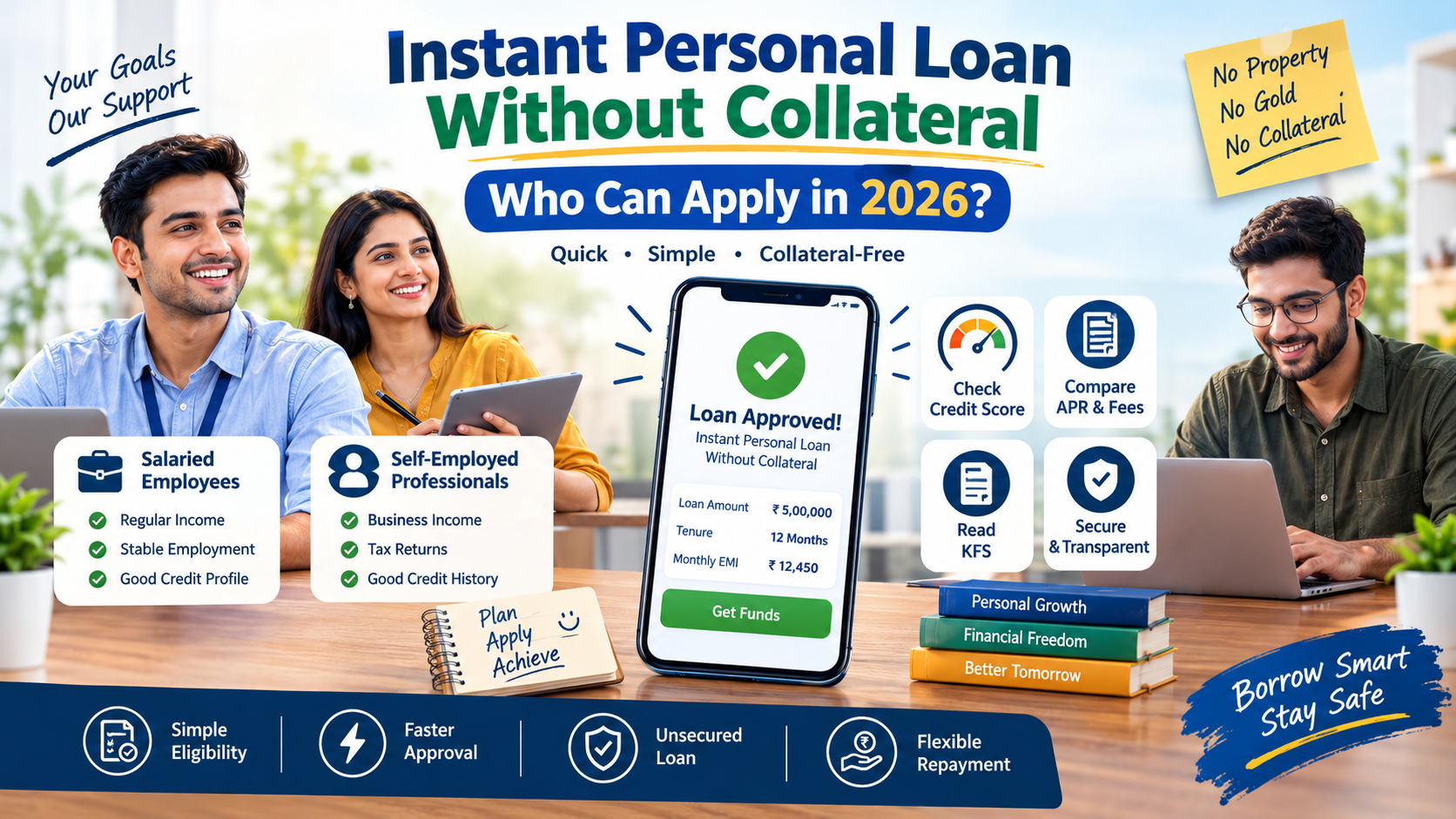
An instant personal loan without collateral is generally an unsecured personal loan.
Unlike a secured loan, the borrower does not normally pledge an asset such as:
- House or property
- Gold
- Vehicle
- Fixed deposit
- Equipment
- Other valuable security
Instead, the lender evaluates the borrower's creditworthiness and repayment capacity.
The word “instant” usually refers to a faster digital application and decision process. It does not mean that every applicant will automatically receive approval or that funds will necessarily be disbursed immediately.
How Does a Collateral-Free Personal Loan Work?
The basic process is usually straightforward.
Step 1: Application
The borrower submits an online or offline application.
Step 2: Identity Verification
The lender verifies the applicant's identity and required information.
Step 3: Credit Assessment
The lender evaluates factors such as income, credit history, existing liabilities and repayment capacity.
Step 4: Loan Offer
If approved, the borrower receives the applicable loan amount, interest rate, APR, fees and repayment terms.
Step 5: KFS and Agreement
For covered digital lending, the regulated entity must provide a Key Fact Statement (KFS) before execution of the loan contract. The KFS includes important information such as APR and other loan terms.
Step 6: Disbursement
After the applicable documentation and agreement process is completed, the loan may be disbursed according to the lender's process.
Who Can Apply for an Instant Personal Loan Without Collateral?
There is no single eligibility formula applicable to every lender.
However, the following categories commonly apply for unsecured personal loans.
1. Salaried Employees
People working for private companies, public-sector organizations or other eligible employers may apply.
Lenders may consider:
- Monthly salary
- Employer profile
- Employment duration
- Existing EMIs
- Credit history
- Banking transactions
- Repayment capacity
A stable income can help demonstrate the ability to repay the loan.
2. Self-Employed Professionals
Self-employed applicants may also qualify depending on the lender's policy.
Examples can include:
- Doctors
- Lawyers
- Consultants
- Chartered accountants
- Architects
- Other eligible professionals
The lender may examine income records, bank statements, tax documents and business-related information.
3. Business Owners
Business owners can also apply for personal loans without collateral if they satisfy the lender's requirements.
The lender may evaluate:
- Business income
- Business vintage
- Bank statements
- Tax records
- Existing loans
- Credit history
- Repayment capacity
Approval criteria vary between lenders.
4. Employees With a Strong Credit History
Credit history is one factor lenders may consider when evaluating an unsecured loan application.
A strong repayment history can demonstrate responsible use of previous credit.
However, there is no universal credit-score number that guarantees personal-loan approval. Each lender may use its own underwriting model and eligibility criteria.
What Factors Do Lenders Check?
Before approving an unsecured personal loan, lenders may consider several factors.
| Factor | Why It Matters |
|---|---|
| Age | Determines whether applicant falls within lender's eligibility range |
| Income | Indicates repayment capacity |
| Employment | Helps assess income stability |
| Credit history | Shows previous borrowing and repayment behaviour |
| Existing EMIs | Indicates current debt burden |
| Bank transactions | May help assess cash flow |
| Loan amount | Determines affordability |
| Loan tenure | Affects EMI and total interest |
| Employment/business history | May indicate income stability |
| Internal credit policy | Determines lender-specific approval |
What Is the Minimum Income Required?
There is no single minimum income applicable to every personal-loan lender.
One lender may accept an applicant at a particular income level while another may require a higher income.
Income requirements can depend on:
- City
- Employer
- Employment type
- Loan amount
- Existing obligations
- Credit profile
- Lender policy
Therefore, borrowers should check the specific lender's eligibility criteria rather than relying on a universal income number.
What Credit Score Is Required?
Credit-score requirements vary between lenders and loan products.
A higher credit score may improve the applicant's overall credit profile, but it does not automatically guarantee approval.
Lenders may also consider:
- Previous repayment history
- Number of existing loans
- Credit-card utilisation
- Recent credit applications
- Current debt
- Income
- Banking behaviour
Important
Do not apply for multiple loans simultaneously simply to find an approval.
Multiple credit applications within a short period can result in additional credit enquiries, depending on the lender and credit bureau's reporting process.
Can You Get a Personal Loan Without Collateral and a Guarantor?
A personal loan is generally an unsecured form of credit, so collateral may not be required.
However, whether a guarantor or co-applicant is required depends on the lender and the applicant's profile.
Some applicants may qualify independently, while others may be subject to additional requirements.
Therefore, borrowers should check the lender's specific terms before applying.
Documents Required for an Instant Personal Loan
The exact document list varies by lender.
Commonly requested information may include:
Identity and Address
- PAN
- Aadhaar or another accepted identity document
- Address information
Income Documents
For salaried applicants:
- Salary slips
- Bank statements
- Employment information
For self-employed applicants:
- Income-tax documents
- Bank statements
- Business information
- Other income-related records
The lender may use digital verification methods instead of requesting every document manually.
Is Collateral-Free Personal Loan Really “Free”?
No.
Collateral-free does not mean interest-free or cost-free.
The borrower may have to pay:
- Interest
- Processing fees
- Applicable taxes
- Other disclosed charges
- Penal charges in case of applicable default
This is why borrowers should not compare loans only by the advertised interest rate.
RBI's digital lending framework requires the Annual Percentage Rate (APR) to be disclosed upfront and included in the KFS for covered digital loans.
What Is APR and Why Does It Matter?
APR stands for Annual Percentage Rate.
Under RBI's digital lending framework, APR represents the effective annualized cost of a digital loan and is based on the applicable all-inclusive cost, while certain contingent charges such as penal charges are excluded from the APR calculation.
For borrowers, APR can provide a more useful comparison than looking only at the headline interest rate.
Example
| Loan Feature | Offer A | Offer B |
|---|---|---|
| Advertised interest rate | Lower | Higher |
| Processing fee | Higher | Lower |
| Other charges | Applicable | Lower |
| APR | Check KFS | Check KFS |
| Total repayment | Compare | Compare |
The loan with the lowest advertised interest rate is not automatically the lowest-cost option.
What Is a Key Fact Statement?
The Key Fact Statement (KFS) is an important document for digital lending.
RBI's guidelines state that regulated entities should provide the KFS before execution of the contract for covered digital lending products. The KFS includes information such as APR, recovery mechanism, grievance-redressal details and the applicable cooling-off/look-up period.
Before accepting the loan, check:
- Loan amount
- APR
- Interest rate
- Processing fee
- Other charges
- Repayment schedule
- Penal charges
- Grievance mechanism
- Cooling-off period
- Other applicable terms
How to Apply for an Instant Personal Loan Without Collateral
A safer application process can be divided into several steps.
1. Identify the Actual Lender
Find out which bank or NBFC is actually providing the loan.
Do not rely solely on the name of the app.
2. Verify the Lender
Check the lender independently through its official website and available RBI information.
RBI has also announced a public repository framework for Digital Lending Apps to help consumers verify claims about an app's association with regulated entities.
3. Check Eligibility
Review:
- Age
- Income
- Employment
- Credit history
- Existing liabilities
4. Compare Loan Costs
Compare APR, processing fees and total repayment obligations.
5. Read the KFS
Do not accept the loan without understanding its important terms.
6. Complete Verification
Provide only the information and documents genuinely required by the lender.
7. Read the Agreement
Understand the repayment schedule before accepting the loan.
Instant Personal Loan vs Secured Loan
| Feature | Personal Loan | Secured Loan |
|---|---|---|
| Collateral | Usually not required | Usually required |
| Processing | Often faster | May take longer |
| Documentation | Usually simpler | May involve asset documents |
| Interest rate | Often higher | Can be lower depending on product |
| Loan amount | Depends on credit profile | May depend on asset value |
| Risk to asset | No pledged collateral in a typical unsecured loan | Pledged asset may be at risk under applicable terms |
| Eligibility | Based heavily on credit and repayment capacity | Based on borrower and security |
Advantages of a Collateral-Free Personal Loan
No Asset Pledge
The borrower generally does not need to pledge property, gold or another asset.
Faster Application
Digital applications can reduce paperwork and speed up initial processing.
Flexible Usage
Personal loans can generally be used for eligible personal expenses subject to the lender's terms.
Useful for Short-Term Financial Needs
A personal loan may help eligible borrowers manage certain planned expenses without pledging an asset.
Risks of Instant Personal Loans
Convenience does not eliminate borrowing risk.
High Cost
Unsecured credit can carry a higher cost than some secured loan products.
EMI Burden
A new EMI adds to existing monthly obligations.
Late Payment Consequences
Missing payments can result in applicable charges and may affect credit history.
Fraud Risk
Fake digital lending apps may misuse borrowers' personal information or make misleading claims.
Over-Borrowing
Easy digital access can encourage people to borrow more than they can comfortably repay.
How to Identify a Genuine Personal Loan App
Before applying through a digital platform, check:
1. Actual Lender
Is the bank or NBFC clearly identified?
2. Regulatory Relationship
Can the relationship between the app and regulated lender be independently verified?
3. KFS
Is the KFS provided before accepting the loan?
4. APR
Is the APR clearly disclosed?
5. Charges
Are processing and other applicable charges clearly explained?
6. Privacy
Does the app clearly explain how borrower information is handled?
7. Grievance Redressal
Is there a clear complaint mechanism?
8. Payment Instructions
Are repayment instructions linked to the actual lender rather than an unknown individual?
RBI's digital lending rules provide requirements around disbursement, repayment, disclosures, data and grievance redressal.
Warning Signs of a Suspicious Loan Offer
Be careful if an app or agent:
- Promises guaranteed approval
- Demands unexplained upfront money
- Hides the actual lender
- Sends an APK through an unknown link
- Requests unnecessary permissions
- Refuses to provide loan documents
- Does not disclose APR
- Pressures you to accept immediately
- Requests repayment to an unrelated personal account
- Uses threatening or abusive communication
A professional-looking app is not by itself proof of legitimacy.
How Much Personal Loan Can You Get Without Collateral?
There is no universal loan amount for every borrower.
The eligible amount can depend on:
- Monthly income
- Existing EMIs
- Credit history
- Employer/business profile
- Repayment capacity
- Lender's internal policy
- Requested tenure
For example, an applicant with a stable income and low existing debt may have a different eligible amount from someone with the same income but substantial existing obligations.
How to Keep Your Personal Loan EMI Manageable
Before accepting a loan, calculate the monthly obligation.
Consider:
Monthly income − existing EMIs − essential expenses = available repayment capacity
Do not evaluate affordability based only on whether the lender approves the loan.
The lender's approval amount and the amount you can comfortably repay are two different things.
What Should You Check Before Clicking “Accept Loan”?
Use this checklist:
| Checklist | Done? |
|---|---|
| Actual lender identified | ☐ |
| Lender independently verified | ☐ |
| Eligibility checked | ☐ |
| Loan amount understood | ☐ |
| APR checked | ☐ |
| KFS read | ☐ |
| Processing fee checked | ☐ |
| Repayment schedule checked | ☐ |
| Privacy policy reviewed | ☐ |
| Grievance mechanism checked | ☐ |
| Total repayment understood | ☐ |
| EMI affordability calculated | ☐ |
Frequently Asked Questions
1. What is an instant personal loan without collateral?
It is generally an unsecured personal loan where the borrower does not pledge an asset as security. Approval depends on the lender's eligibility and underwriting criteria.
2. Who can apply for a collateral-free personal loan?
Salaried employees, self-employed professionals and eligible business owners may apply, subject to the lender's age, income, credit and other requirements.
3. Is collateral required for every personal loan?
No. Personal loans are commonly unsecured, but individual lenders can have different products and conditions.
4. Can I get a personal loan without a guarantor?
Some borrowers may qualify without a guarantor. Whether a guarantor or co-applicant is required depends on the lender and applicant profile.
5. What credit score is required for an instant personal loan?
There is no single universal score requirement. Lenders may use different credit policies and consider income, existing debt and repayment history in addition to credit score.
6. What income is required for a personal loan?
Income requirements vary between lenders and depend on factors such as employment, requested amount, existing obligations and credit profile.
7. Is an instant personal loan expensive?
The cost varies by lender and borrower. Compare the APR, interest rate, processing fee and total repayment amount before accepting an offer.
8. What is KFS in a personal loan?
KFS means Key Fact Statement. For covered digital lending products, it provides important information about the loan, including APR and other applicable terms.
9. Can self-employed people apply for personal loans without collateral?
Yes, eligible self-employed applicants can apply for unsecured personal loans, subject to the lender's income, documentation and credit requirements.
10. Can salaried employees get collateral-free personal loans?
Yes, eligible salaried employees may apply. Lenders can consider salary, employment stability, credit history and repayment capacity.
11. Is a personal loan without collateral safe?
The absence of collateral does not by itself determine whether a loan is safe. Borrowers should verify the lender, understand the loan costs and review the loan agreement.
12. How can I check whether an online loan app is genuine?
Identify the actual bank or NBFC providing the loan and independently verify its relationship with the app. Also check the KFS, APR, fees, privacy policy and grievance mechanism.
13. Can I use a personal loan for any purpose?
Personal-loan usage depends on the lender's terms and applicable restrictions. Read the loan agreement before borrowing.
14. What happens if I miss a personal loan EMI?
Applicable charges may be imposed and missed payments can affect your credit history. Check your loan agreement for the exact consequences.
15. Should I borrow the maximum amount offered by a lender?
No automatic rule says that the maximum approved amount is the appropriate amount for every borrower. Consider your income, existing obligations and ability to repay before deciding the loan amount.
Key Takeaways
- Personal loans are commonly unsecured, meaning collateral is generally not required.
- Salaried employees, self-employed professionals and business owners may qualify.
- Eligibility depends on the lender's specific criteria.
- Income and repayment capacity are important factors.
- Credit history can influence approval and pricing.
- There is no universal minimum credit score or income requirement for every lender.
- Always identify the actual bank or NBFC behind a digital loan.
- Compare APR, not just the advertised interest rate.
- Read the Key Fact Statement (KFS) before accepting a covered digital loan.
- Check processing fees and other applicable charges.
- Never borrow more than you can reasonably repay.
- Be cautious of loan apps promising guaranteed approval or demanding unexplained advance payments.
Expert & Trust Section: What Borrowers Should Remember
The biggest advantage of a collateral-free personal loan is convenience: the borrower generally does not have to pledge an asset.
But convenience should not replace financial planning.
Before taking an instant personal loan, borrowers should answer three questions:
Who is lending the money?
What is the complete cost of the loan?
Can I comfortably repay the EMI?
If these three questions are clear, the borrower can make a more informed decision.
For digital loans, RBI's framework places disclosure and customer-protection requirements on regulated entities, including disclosure of APR and provision of a KFS for covered digital lending products.
Internal Linking Suggestions
You can internally link this article to:
- Instant Loan App 2026: How to Check Whether a Loan App Is Genuine?
- Personal Loan Eligibility Guide
- Personal Loan Interest Rate Guide
- How to Check Your Credit Score
- EMI Calculator Guide
- Documents Required for Personal Loan
- How to Avoid Online Loan Fraud
- Digital Lending Safety Guide
External Linking Suggestions
For authoritative information, link to:
- RBI digital lending guidelines
- RBI consumer-awareness resources
- RBI information on regulated entities
- RBI Digital Lending App repository information
EEAT & Publishing Recommendations
For a finance article, strengthen trust by adding:
- Author name
- Author credentials
- Published date
- Last updated date
- Official RBI references
- Clear financial disclaimer
- Explanation of how eligibility varies between lenders
- No unsupported claims about approval rates or guaranteed loans
Avoid phrases such as “100% guaranteed approval,” “lowest interest rate for everyone,” or “RBI-approved loan app” unless the specific claim is independently verified.
Conclusion
An instant personal loan without collateral can be useful for eligible borrowers because it generally does not require property, gold or another asset to be pledged.
However, eligibility and approval depend on the lender's assessment of factors such as income, employment or business profile, credit history, existing debt and repayment capacity.
In 2026, borrowers should focus on more than getting money quickly. Verify the actual lender, compare the total cost, check the APR, read the KFS, understand the EMI and review all applicable fees before accepting the loan.
Published on : 17th September
Published by : Shibam Nath
www.vizzve.com || www.vizzveservices.com
Follow us on social media: Facebook || Linkedin || Instagram
🛡 Powered by Vizzve Financial
RBI-Registered Loan Partner | 10 Lakh+ Customers | ₹600 Cr+ Disbursed