

Introduction
Non-Banking Financial Companies, or NBFCs, are an important part of India's lending and financial services ecosystem.
Many NBFCs provide personal loans, vehicle loans, business loans, consumer finance, microfinance and other forms of credit. One of the most important factors borrowers consider is the interest rate charged on an NBFC loan.
However, there is an important point to understand:
There is no single interest rate for all NBFCs in India.
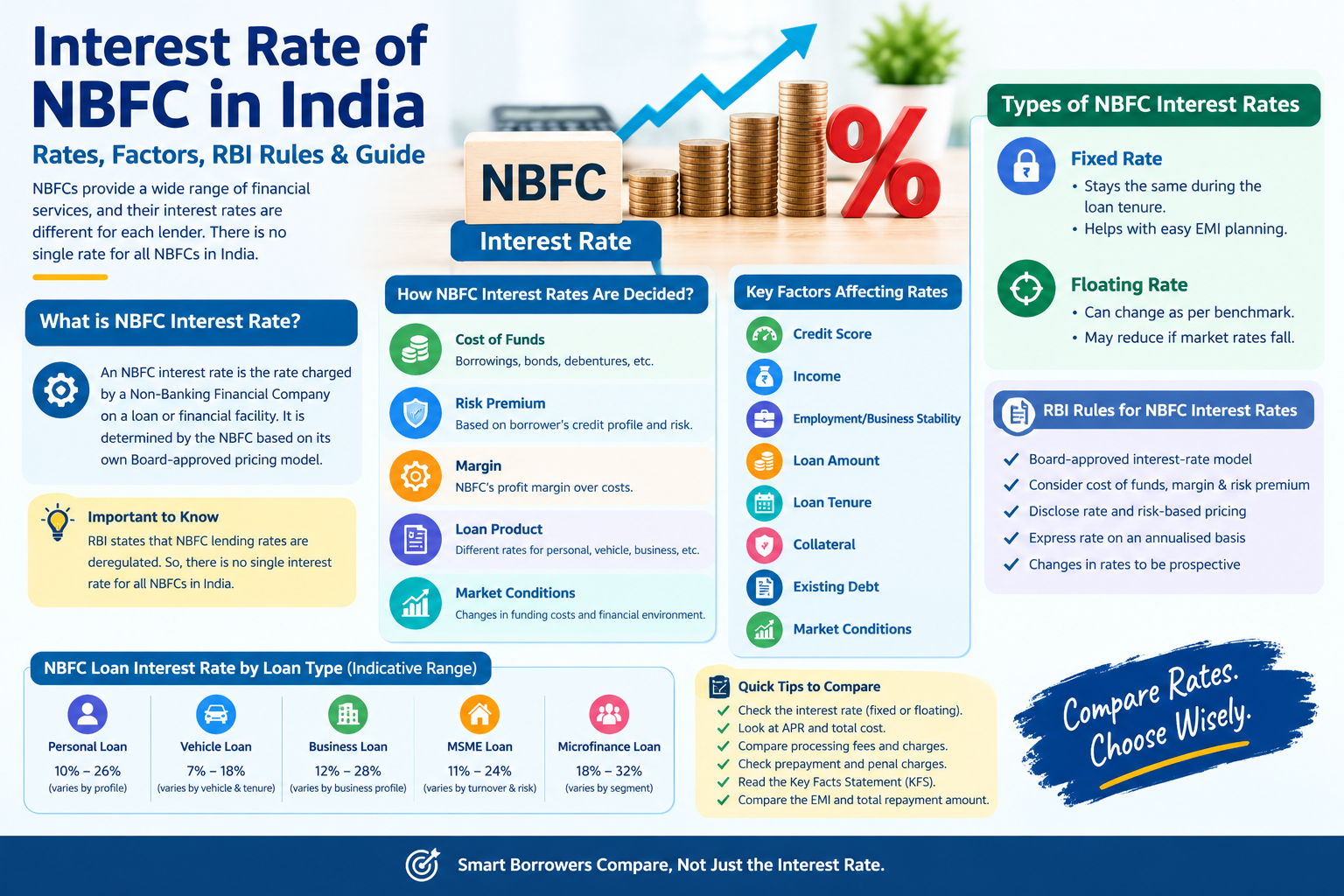
RBI's regulatory framework states that interest rates charged by NBFCs are deregulated. Each NBFC's Board is required to adopt an interest-rate model that considers factors such as cost of funds, margin and risk premium. The lender must also disclose its interest-rate approach and risk-based pricing to borrowers.
Therefore, two borrowers applying for similar loans may receive different rates depending on the lender, loan product and borrower profile.
AI Answer Box: What Is the Interest Rate of NBFC in India?
The interest rate charged by an NBFC in India is not fixed by one common RBI rate. NBFC lending rates are deregulated, and individual NBFCs determine their rates through Board-approved pricing models.
The rate can depend on:
- Cost of funds
- Borrower's credit profile
- Risk assessment
- Loan amount
- Loan tenure
- Type of loan
- Income and repayment capacity
- Security or collateral
- Operating costs
- NBFC's margin
- Market conditions
RBI requires NBFCs to disclose their interest-rate model and the rationale for risk-based differences in rates to borrowers.
What Is an NBFC Interest Rate?
An NBFC interest rate is the rate charged by a Non-Banking Financial Company on a loan or financial facility.
For example, if an NBFC approves a personal loan, the borrower may have to pay interest on the outstanding principal according to the terms of the loan agreement.
The interest rate may be:
- Fixed
- Floating
- Linked to a benchmark, where applicable
- Structured according to the lender's approved pricing model
The exact structure depends on the loan product and the NBFC.
Is There a Standard NBFC Interest Rate in India?
No.
There is no universal NBFC lending rate that applies to every NBFC and every borrower.
RBI's framework states that NBFC lending rates are deregulated. NBFCs determine their pricing based on their approved interest-rate models. Relevant factors include cost of funds, margin and risk premium.
This means:
| Factor | Can Affect NBFC Interest Rate? |
|---|---|
| Credit profile | Yes |
| Income | Yes |
| Loan amount | Yes |
| Loan tenure | Yes |
| Loan type | Yes |
| Cost of funds | Yes |
| Risk premium | Yes |
| NBFC's margin | Yes |
| Collateral | May affect pricing |
| Market conditions | Yes |
Current RBI Policy Rate and NBFC Interest Rates
The RBI policy rate is an important indicator of India's overall interest-rate environment, but it should not be confused with an NBFC's customer loan rate.
The RBI's official rates page showed the policy repo rate at 5.25% in August 2026, alongside a 5.00% Standing Deposit Facility rate and 5.50% Marginal Standing Facility/Bank Rate.
The RBI's August 2026 Monetary Policy Committee meeting was held from August 3–5, 2026.
Important distinction
RBI repo rate ≠ NBFC loan interest rate
An NBFC's lending rate can include several components beyond its funding cost.
How Do NBFCs Decide Interest Rates?
RBI requires NBFCs to have a Board-approved interest-rate model.
The model may consider:
1. Cost of Funds
An NBFC needs funds to conduct its lending activities.
Its funding costs can come from sources such as:
- Bank borrowings
- Market borrowings
- Bonds
- Debentures
- Equity
- Other permitted funding sources
Higher funding costs can influence lending prices.
2. Risk Premium
A lender evaluates the risk associated with a particular borrower.
A borrower perceived as higher risk may be charged a higher rate under the NBFC's risk-based pricing framework.
3. Operating Costs
NBFCs incur costs related to:
- Employee salaries
- Technology
- Customer verification
- Branches
- Loan processing
- Collection operations
- Compliance
These costs can form part of the lender's overall pricing model.
4. Margin
An NBFC may include a margin over its underlying costs.
5. Loan Product
Rates can differ according to the type of loan.
For example:
- Personal loans
- Vehicle loans
- Business loans
- MSME loans
- Consumer loans
- Microfinance loans
may have different pricing structures.
Major Factors Affecting NBFC Interest Rates
Credit Score
A borrower's credit history can influence risk assessment.
A strong repayment history may support better pricing, depending on the lender's policy.
Income
Income helps the lender assess repayment capacity.
Employment or Business Stability
Stable income or business cash flows can influence credit assessment.
Loan Amount
The requested amount may affect pricing and eligibility.
Loan Tenure
Longer repayment periods can change the overall interest cost.
Collateral
Secured loans may be priced differently from unsecured loans because the lender has security against the loan.
Existing Debt
Existing EMIs and obligations can affect the lender's assessment of repayment capacity.
Market Conditions
Changes in funding costs and broader financial conditions can influence lending prices.
NBFC Interest Rate by Loan Type
There is no single rate applicable to all loan categories.
Personal Loans
Personal loans are usually unsecured.
The lender may consider:
- Credit history
- Monthly income
- Employer/business profile
- Existing liabilities
- Loan amount
- Tenure
Vehicle Loans
Vehicle loans may be secured against the financed vehicle.
Pricing can depend on:
- Vehicle type
- Loan amount
- Down payment
- Borrower profile
- Tenure
Business Loans
Business loan pricing can depend on:
- Business turnover
- Profitability
- Cash flow
- Credit history
- Business vintage
- Collateral
- Loan amount
MSME Loans
MSME borrowers may be assessed using financial statements, banking activity, cash flow, business history and credit information.
Microfinance Loans
NBFC-MFIs operate under specific RBI regulatory requirements, and their pricing and charges are subject to the applicable framework.
Fixed vs Floating NBFC Interest Rates
Fixed Interest Rate
A fixed interest rate generally remains unchanged according to the terms of the loan agreement.
Advantages
- Easier EMI planning
- Greater payment predictability
- Less exposure to benchmark-related changes
Limitations
- May not benefit immediately if market rates decline
- Conditions for switching or prepayment should be checked
Floating Interest Rate
A floating rate can change according to the applicable benchmark or pricing mechanism.
Advantages
- May benefit when the applicable rate decreases
- Can reflect changing financial conditions
Limitations
- EMI or tenure can change
- Borrowers face greater uncertainty
- Reset frequency and applicable benchmark should be checked
RBI guidance stresses the importance of understanding the benchmark, reset mechanism and how changes affect repayment for floating-rate loans.
NBFC Interest Rate vs Bank Interest Rate
Banks and NBFCs follow different regulatory and pricing frameworks.
| Feature | Bank | NBFC |
|---|---|---|
| Lending rates | Product and borrower specific | Product and borrower specific |
| Pricing framework | Applicable banking regulations | Board-approved NBFC pricing model |
| Risk-based pricing | Yes | Yes |
| Cost of funds | Important | Important |
| Credit profile | Important | Important |
| Processing fees | Varies | Varies |
| Digital loans | Available | Available |
| APR/KFS disclosures | Applicable as per RBI rules | Applicable as per relevant RBI rules |
RBI's handbook notes that NBFC interest rates are deregulated and that their pricing models consider cost of funds, margin and risk premium.
What Is APR in an NBFC Loan?
APR means Annual Percentage Rate.
It provides a more comprehensive view of the annualised cost of credit than simply looking at the headline interest rate.
For digital lending, RBI defines APR as the effective annualised cost charged to the borrower, incorporating applicable costs and charges within the prescribed framework.
Why APR matters
Suppose two lenders advertise similar interest rates.
One may have:
- Higher processing fees
- Verification charges
- Other applicable fees
The other may have fewer charges.
Comparing only the headline interest rate may therefore give an incomplete picture.
What Is a Key Facts Statement (KFS)?
A Key Facts Statement (KFS) is designed to give borrowers important loan information in a standardised and understandable format.
For relevant retail and MSME term loans, RBI's framework provides for disclosure of key facts through a KFS.
Depending on the applicable lending framework, a KFS can include information such as:
- Loan amount
- Tenure
- Interest rate
- APR
- Repayment schedule
- Fees and charges
- Penal charges
- Other important terms
Borrowers should read the KFS before accepting a loan.
How to Calculate NBFC Loan Interest
A simple interest calculation can help explain the basic concept.
For a simple-interest illustration:
Interest = Principal × Rate × Time
However, most consumer loans use an EMI-based reducing-balance structure rather than simple interest.
The EMI depends on:
- Principal
- Interest rate
- Loan tenure
A standard EMI formula is:
EMI = P × r × (1+r)ⁿ / [(1+r)ⁿ – 1]
Where:
- P = Principal loan amount
- r = Monthly interest rate
- n = Number of monthly instalments
Example
Suppose:
- Loan amount = ₹1,00,000
- Annual interest rate = 12%
- Tenure = 12 months
Monthly rate = 12% ÷ 12 = 1%
The EMI can then be calculated using the standard EMI formula.
The actual repayment amount will depend on the lender's calculation method, fees and loan terms.
What Is a Good NBFC Interest Rate?
There is no universal "good" NBFC interest rate.
The appropriate rate depends on:
- Loan type
- Borrower profile
- Loan amount
- Tenure
- Security
- Fees
- APR
- Total repayment cost
Instead of asking only:
"What is the lowest NBFC interest rate?"
borrowers should also ask:
"What is the total cost of this loan?"
This provides a more useful comparison.
How to Compare NBFC Interest Rates
Step 1: Compare the Interest Rate
Check whether the quoted rate is fixed or floating.
Step 2: Check APR
APR can help show the broader annualised cost of credit where applicable.
Step 3: Check Processing Fees
Look for:
- Processing fee
- Documentation fee
- Verification fee
- Other applicable charges
Step 4: Check Prepayment Conditions
Read the terms relating to early repayment.
Step 5: Check Penal Charges
Understand the consequences of delayed payments.
Step 6: Check EMI
Calculate the monthly repayment.
Step 7: Calculate Total Repayment
Compare the total amount payable over the full tenure.
Example: Why Interest Rate Alone Is Not Enough
Consider two hypothetical loan offers:
| Particular | Lender A | Lender B |
|---|---|---|
| Loan amount | ₹2 lakh | ₹2 lakh |
| Interest rate | 12% | 12.5% |
| Processing fee | ₹2,000 | ₹500 |
| Tenure | 24 months | 24 months |
| Other charges | Varies | Varies |
Lender A has the lower stated interest rate, but the borrower should still compare the complete cost of both loans.
This is why RBI's framework emphasises transparent disclosure of interest rates, charges and the rationale for risk-based pricing.
RBI Rules on NBFC Interest Rates
RBI's framework contains important requirements concerning NBFC interest-rate practices.
Interest Rate Model
Each NBFC's Board should adopt an interest-rate model considering factors such as:
- Cost of funds
- Margin
- Risk premium
- Other relevant factors
The lender should disclose its approach to risk-based pricing.
Annualised Interest Rate
The interest rate should be expressed as an annualised rate so that borrowers understand the rate being charged.
Transparent Disclosure
Interest rates and applicable charges should be communicated clearly to borrowers.
Changes in Interest Rates
RBI's fair-practice guidance states that changes in interest rates and charges should be effected prospectively.
Can an NBFC Charge a High Interest Rate?
NBFC lending rates are deregulated, meaning RBI does not prescribe one universal lending rate for all NBFC loans.
However, NBFCs must follow applicable regulatory requirements concerning transparency, disclosure and fair practices.
RBI's framework requires NBFCs to maintain an interest-rate model based on relevant factors such as cost of funds, margin and risk premium and to disclose the rationale for different rates.
Therefore, borrowers should examine the lender's pricing policy and the complete loan documentation rather than focusing only on the headline percentage.
NBFC Interest Rate and Credit Score
Credit history can influence the pricing of a loan because it is one component of a lender's risk assessment.
A borrower with a stronger repayment history may qualify for different terms from a borrower with a weaker credit profile, depending on the NBFC's policy.
However, credit score alone does not determine every NBFC interest rate.
Other factors can include:
- Income
- Existing EMIs
- Employment
- Business cash flow
- Loan amount
- Tenure
- Collateral
- Customer profile
NBFC Interest Rate and RBI Repo Rate
The RBI repo rate is the rate at which the RBI provides certain short-term liquidity to eligible financial institutions under the monetary policy framework.
It can influence the broader cost of funds and financial conditions.
However:
Repo rate ≠ NBFC loan interest rate
An NBFC's final lending rate depends on its own funding costs, pricing model, risk assessment and other factors.
As of the RBI's August 2026 published rates, the policy repo rate was 5.25%.
Pros and Cons of NBFC Loan Interest Rates
Pros
- Multiple financing options
- Specialised loan products
- Risk-based pricing can reflect borrower profiles
- Digital loan processing may be available
- Different repayment structures may be offered
- Useful for various consumer and business financing needs
Cons
- Rates vary significantly between lenders
- Unsecured loans can carry higher pricing than some secured products
- Processing and other charges can increase borrowing costs
- Floating-rate loans can change according to their terms
- Borrowers need to compare total cost rather than headline interest rate
Expert Commentary: Understanding the Real Cost of an NBFC Loan
The most important lesson for borrowers is that the advertised interest rate is only one part of the borrowing cost.
RBI's NBFC framework itself recognises factors such as cost of funds, margin and risk premium in determining lending rates. It also requires transparent communication of the rate and risk-based pricing approach.
For borrowers, the practical approach is to compare:
Interest Rate + Fees + APR + Tenure + EMI + Total Repayment
This provides a clearer picture than comparing interest rates alone.
Real-World Borrower Example
Imagine two people apply for a ₹3 lakh personal loan.
Borrower A
- Stable income
- Strong repayment history
- Lower existing debt
- Shorter tenure
Borrower B
- Irregular income
- Higher existing obligations
- Weaker repayment history
- Longer tenure
Even though both request the same loan amount, the lender's risk assessment may result in different pricing.
This illustrates why NBFCs use risk-based interest-rate models.
Common Mistakes to Avoid
1. Looking Only at the Interest Rate
Always check the total cost.
2. Ignoring APR
APR can provide a broader measure of borrowing cost where applicable.
3. Not Reading the KFS
Review the Key Facts Statement before signing.
4. Ignoring Processing Fees
A low interest rate does not automatically mean a low-cost loan.
5. Not Checking Fixed or Floating Terms
Understand whether the rate can change.
6. Ignoring Late-Payment Charges
Know the consequences of missing an EMI.
7. Comparing Different Tenures Without Adjusting
A longer tenure can change the total interest paid.
8. Using Unverified Loan Apps
For digital loans, verify the actual regulated lender behind the platform.
Quick Comparison: NBFC Interest Rate Factors
| Factor | Impact on Rate |
|---|---|
| Credit history | Can affect risk pricing |
| Income | Can affect repayment assessment |
| Loan tenure | Can influence pricing and total cost |
| Loan amount | May influence risk assessment |
| Loan type | Different products have different pricing |
| Collateral | Can influence secured-loan pricing |
| Cost of funds | Important pricing component |
| Risk premium | Important pricing component |
| Operating cost | Can affect lender pricing |
| Market conditions | Can influence funding costs |
Frequently Asked Questions
1. What is the interest rate of NBFC in India?
There is no single NBFC interest rate in India. NBFC lending rates are deregulated and are determined through each NBFC's Board-approved pricing model.
2. Does RBI fix NBFC loan interest rates?
No. RBI does not prescribe one universal lending rate for all NBFCs. NBFCs determine rates through approved interest-rate models subject to applicable regulations.
3. What factors affect NBFC interest rates?
Factors include cost of funds, margin, risk premium, borrower profile, loan type, loan amount, tenure and other relevant factors.
4. Are NBFC interest rates higher than bank interest rates?
Not necessarily. Rates depend on the specific lender, borrower, product and terms. Borrowers should compare actual loan offers rather than assuming one category is always cheaper.
5. Can NBFCs charge different rates to different borrowers?
Yes. NBFCs can use risk-based pricing, with the approach and rationale disclosed according to applicable requirements.
6. What is APR in an NBFC loan?
APR is an annualised measure of the cost of credit. For digital loans, RBI defines APR as the effective annualised cost including applicable costs and margins under the prescribed framework.
7. What is a fixed interest rate?
A fixed interest rate generally remains unchanged according to the terms of the loan agreement.
8. What is a floating interest rate?
A floating interest rate can change according to the applicable benchmark or pricing mechanism specified in the loan agreement.
9. Does the RBI repo rate directly determine NBFC loan rates?
No. The repo rate can influence broader financial conditions, but an NBFC's loan rate depends on its own pricing model, funding costs, risk assessment and other factors.
10. What should I check before taking an NBFC loan?
Check the interest rate, APR where applicable, KFS, processing fees, EMI, tenure, total repayment, prepayment conditions and penal charges.
11. Can an NBFC change the interest rate?
For loans with variable or floating pricing, rates may change according to the applicable terms. RBI fair-practice guidance requires changes in interest rates and charges to be effected prospectively.
12. How can I reduce my NBFC loan interest cost?
Compare multiple offers, maintain a strong credit history, choose an appropriate tenure and carefully check fees and other charges before accepting the loan.
13. Is a low interest rate always the cheapest loan?
No. Processing fees, other charges, tenure and repayment structure can affect the total cost.
14. What is the current RBI repo rate in 2026?
The RBI's published rates in August 2026 showed the policy repo rate at 5.25%.
15. Are NBFC interest rates regulated by RBI?
NBFC lending rates are deregulated, but RBI requires applicable NBFCs to follow regulatory requirements relating to pricing models, disclosure, fair practices and borrower communication.
Summary Table: NBFC Interest Rate in India
| Topic | Key Information |
|---|---|
| Universal NBFC rate | No single rate |
| Rate determination | NBFC-specific pricing model |
| RBI role | Regulatory oversight |
| Major pricing factors | Cost of funds, margin, risk premium |
| Borrower risk | Can affect pricing |
| Loan type | Can affect pricing |
| Fixed rate | Generally remains fixed according to terms |
| Floating rate | Can change according to applicable terms |
| APR | Annualised cost measure |
| KFS | Provides key loan information |
| Processing fee | Can increase total cost |
| Repo rate | Influences broader financial conditions but does not equal NBFC loan rate |
Key Takeaways
- There is no single interest rate for all NBFCs in India.
- NBFC lending rates are deregulated.
- Each NBFC uses its own Board-approved interest-rate model.
- Cost of funds, margin and risk premium are important pricing factors.
- Borrower credit profile can affect the applicable rate.
- Loan type, tenure and amount can also influence pricing.
- Fixed and floating interest rates work differently.
- APR can provide a broader view of borrowing costs.
- Borrowers should read the Key Facts Statement where applicable.
- Processing fees and other charges should be considered along with the interest rate.
- RBI's published policy repo rate was 5.25% in August 2026, but this is not the same as an NBFC customer loan rate.
- Comparing the total cost of borrowing is more useful than looking at the headline interest rate alone.
Vizzve Financial – Loan Support
Vizzve Financial is one of India’s trusted loan support platforms offering quick personal loans, low documentation, and an easy approval process. Apply at www.vizzve.com.
Before applying for a loan, borrowers should independently verify eligibility, interest rate, APR where applicable, fees, repayment obligations and all terms in the loan documentation.
Conclusion
The interest rate of NBFCs in India is not determined by one fixed national rate.
RBI's framework allows NBFC lending rates to be determined through Board-approved pricing models that consider factors such as cost of funds, margin and risk premium. This means the rate offered to a borrower can vary according to the lender, product and borrower profile.
For borrowers, the most useful approach is to compare the complete cost of a loan rather than focusing only on the advertised interest rate.
Before accepting an NBFC loan, check the interest rate, APR, KFS, processing fees, EMI, tenure, total repayment amount, prepayment conditions and penal charges.
Understanding these factors can help borrowers evaluate loan offers more clearly and avoid unexpected borrowing costs.
Published on : 26th september
Published by : Bhargavi
www.vizzve.com || www.vizzveservices.com
Follow us on social media: Facebook || Linkedin || Instagram
🛡 Powered by Vizzve Financial
RBI-Registered Loan Partner | 10 Lakh+ Customers | ₹600 Cr+ Disbursed
#DigitalBanking #DigitalBankingIndia #BankingInIndia #UPI #UPIPaym