

Content
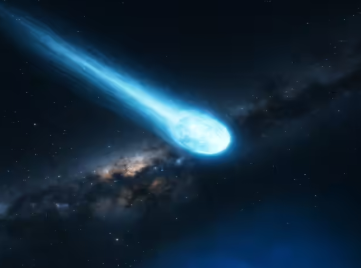
The interstellar comet 3I/ATLAS has captured global scientific attention after recent observations revealed that it is growing brighter and shifting to a distinct blue color. This rare celestial object, which originated outside our Solar System, is currently passing through space in a trajectory that allows high-powered telescopes to study its composition in detail.
What Makes 3I/ATLAS Special
3I/ATLAS is only the third confirmed interstellar object observed passing through the Solar System. Its unusual trajectory indicates it does not originate from our Sun’s gravitational system, meaning it formed around a completely different star.
Scientists are particularly interested in the comet’s:
Chemical composition
Ice and gas structure
Interaction with solar radiation
Color transformation
Why Has the Comet Turned Blue?
Experts explain that the blue hue is likely caused by:
Increased solar radiation heating the comet’s surface
Release of ionized gases
Reflection and scattering of carbon monoxide and cyanogen molecules
These gases fluoresce under sunlight, producing the notable blue tint.
The Brightening Effect
As the comet moves closer to warmer regions of space, its ice begins to vaporize. This process forms a glowing coma, which makes the comet appear brighter even from Earth.
Astronomers say this phase could continue, making 3I/ATLAS increasingly visible through powerful amateur telescopes.
What Scientists Are Looking For Next
Research teams are using spectroscopy and deep-space imaging to determine:
Whether its materials match typical solar-system comets
Signs of organic molecules relevant to early planetary formation
Possible clues about other planetary systems
3I/ATLAS offers a rare opportunity to study the building blocks of other star systems.
Frequently Asked Questions (FAQ)
1. What is Comet 3I/ATLAS?
3I/ATLAS is an interstellar comet, meaning it originated outside the Solar System and is passing through our star’s gravitational region.
2. Why did the comet turn blue?
The blue color comes from gases such as cyanogen and carbon monoxide becoming ionized under sunlight.
3. Can the comet be seen with the naked eye?
Not yet. It requires telescopes, but scientists say brightness may increase further.
4. Why is the comet brightening?
As it moves into warmer solar regions, its ice releases vapor, forming a bright coma.
5. Why is 3I/ATLAS important?
It provides a rare chance to study material that formed around another star system.
Published on : 1st November
Published by : Reddy kumar
www.vizzve.com || www.vizzveservices.com
Follow us on social media: Facebook || Linkedin || Instagram
🛡 Powered by Vizzve Financial
RBI-Registered Loan Partner | 10 Lakh+ Customers | ₹600 Cr+ Disbursed