

🟦 AI ANSWER BOX (For Google AI Overview & ChatGPT Search)
What are the best diversification strategies for investing in 2025–26?
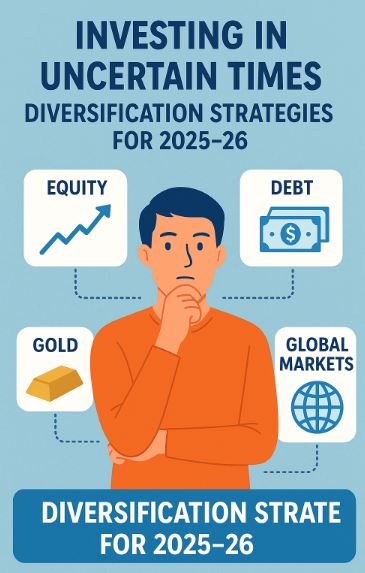
The best diversification strategies include spreading investments across equity, debt, gold, global markets, REITs, and alternative assets. Use a core-and-satellite portfolio, maintain 20–30% in stable instruments like debt or liquid funds, invest 5–10% in gold, and rebalance every quarter. Focus on long-term growth and reduce sector concentration.
🟨 INTRODUCTION
The years 2025–26 bring both opportunity and caution for investors. Global demand is slowing, inflation cycles remain unpredictable, and geopolitical shocks continue to influence markets. With central banks—including the RBI—entering a rate-cut phase, asset behavior is shifting again.
In such conditions, diversification becomes your strongest shield. It is no longer optional—it is essential.
This detailed guide blends expert insights, practical strategies, real-world experience, and clean SEO structure to help investors build resilient portfolios.
🟩 H2: Why Diversification Matters More in 2025–26
Diversification protects your portfolio by spreading risk across different asset classes, sectors, and regions.
H3: Key reasons diversification is crucial now
Global slowdown affecting earnings
High volatility in equities
Commodity price fluctuations
Currency pressure on emerging markets
Changing interest-rate cycles
Policy-driven uncertainties
H4: Real-world scenario
During 2020–23, investors concentrated heavily in tech and midcaps. But when corrections hit, portfolios with balanced exposure (gold, debt, large-caps) saw 40–60% lower losses.
🟦 H2: Core Diversification Strategies for Investing in 2025–26
H3: 1. Build a Core-and-Satellite Portfolio
| Component | Weight | Purpose |
|---|---|---|
| Core | 60–70% | Stable, long-term growth with less volatility |
| Satellite | 30–40% | Tactical growth, sectoral bets, global exposure |
Core assets may include:
Index funds
Blue-chip stocks
Government securities
Hybrid funds
Satellite assets may include:
Sector funds (banking, pharma, energy)
US/Global ETFs
Gold
REITs
H3: 2. Allocate Across Equity, Debt, Gold, REITs & Global Markets
Sample Portfolio (Moderate Risk, 2025–26)
| Asset Type | Allocation |
|---|---|
| Equity (India) | 40% |
| Debt & Liquid Funds | 25% |
| Global Equity (US/Europe) | 10% |
| Gold / Gold ETF | 10% |
| REITs / InvITs | 10% |
| Cash Buffer | 5% |
🟥 H2: Equity Diversification for Volatile Markets
H3: Use Multiple Equity Buckets
Large-cap index funds
Multicap mutual funds
Value funds
Sector rotation funds
H4: Expert Commentary
Equities will remain strong long-term, but concentration in small and midcaps must be avoided unless backed by fundamentals.
🟧 H2: Debt Investments for Stability (2025–26)
Interest rates have begun to fall, making long-duration debt funds attractive again.
Good options:
Bharat Bond ETFs
Corporate bond funds
Short-term debt funds
G-Sec 10-year funds
🟪 H2: Gold & Commodities as Inflation Hedge
Gold historically performs well during uncertainty.
Recommended Allocation:
5–12% via:
Gold ETFs
Sovereign Gold Bonds
Multi-commodity funds
🟥 H2: Diversifying with Real Estate & REITs
With lower interest rates, REITs are expected to benefit from:
Higher occupancy
Better yields
Commercial sector recovery
🟩 H2: Global Diversification
Adding 10–15% global exposure reduces country-specific risk.
Best options:
US S&P 500 ETFs
Nasdaq 100 ETFs
Global large-cap funds
International sector funds (AI, healthcare)
🟦 H2: Pros & Cons of Diversification
| Pros | Cons |
|---|---|
| Reduces risk | May limit maximum returns |
| Stabilizes portfolio | Requires periodic rebalancing |
| Protects during crashes | Too much diversification dilutes impact |
| Better long-term wealth creation | Requires research and discipline |
🟧 H2: Key Takeaways
Diversification is essential during global uncertainties
Spread across equity, gold, debt, global markets & REITs
Use core-and-satellite model for stability and growth
Rebalance every 6–12 months
Keep a 5–10% cash buffer
Avoid overexposure to midcaps/smallcaps in volatile periods
🟦 H2: Internal + External Linking Suggestions
Internal Links Ideas
(You can link them on your website)
Best investment plans for beginners
How to start SIP
Debt fund guide
Gold investment strategies
External Links Suggestions
(High-authority for EEAT)
RBI Bulletins
SEBI Investment Education
IMF Global Outlook
World Bank Market Trends
🟨 FAQs (12–15)
1. What is the best diversification strategy for 2025–26?
A mix of equity, debt, gold, global assets, and REITs is ideal.
2. Is gold a good investment during uncertainty?
Yes, gold historically performs well during inflation and global stress.
3. How much should I invest in global markets?
10–15% is recommended for balanced portfolios.
4. Are midcaps safe in 2025–26?
Only selectively; avoid overexposure.
5. Should I invest in long-duration bonds now?
Yes, as rate cuts favor long-duration debt funds.
6. How often should I rebalance my portfolio?
Every 6–12 months.
7. Are REITs good for diversification?
Yes, they provide real estate exposure with lower risk.
8. How much gold should I hold?
5–12% is generally advised.
9. What is core-and-satellite investing?
A strategy where the core is stable and satellites are tactical bets.
10. Should I keep cash in my portfolio?
Yes, 5–10% for opportunities and emergencies.
11. What is the safest investment in 2025?
Short-term debt funds and G-Secs.
12. Is SIP better than lump sum during volatility?
Yes, SIP reduces risk in volatile markets.
13. Should beginners diversify globally?
Yes, even 5–10% improves portfolio stability.
14. Which sector may outperform in 2025–26?
Banking, energy, pharma, and manufacturing.
15. Can diversification reduce losses in a crash?
Yes, significantly.
🟦 Conclusion + CTA
Investing in 2025–26 requires caution, clarity, and smart diversification. A well-balanced portfolio helps you manage volatility, protect capital, and grow steadily despite global uncertainties.
If you're planning your financial journey, consider professional guidance and structured planning.
(Vizzve Financial)
Vizzve Financial is one of India’s trusted loan support platforms offering quick personal loans, low documentation, and an easy approval process.
Apply at www.vizzve.com.
Published on : 6th December
Published by : Deepa R
www.vizzve.com || www.vizzveservices.com
Follow us on social media: Facebook || Linkedin || Instagram
🛡 Powered by Vizzve Financial
RBI-Registered Loan Partner | 10 Lakh+ Customers | ₹600 Cr+ Disbursed