

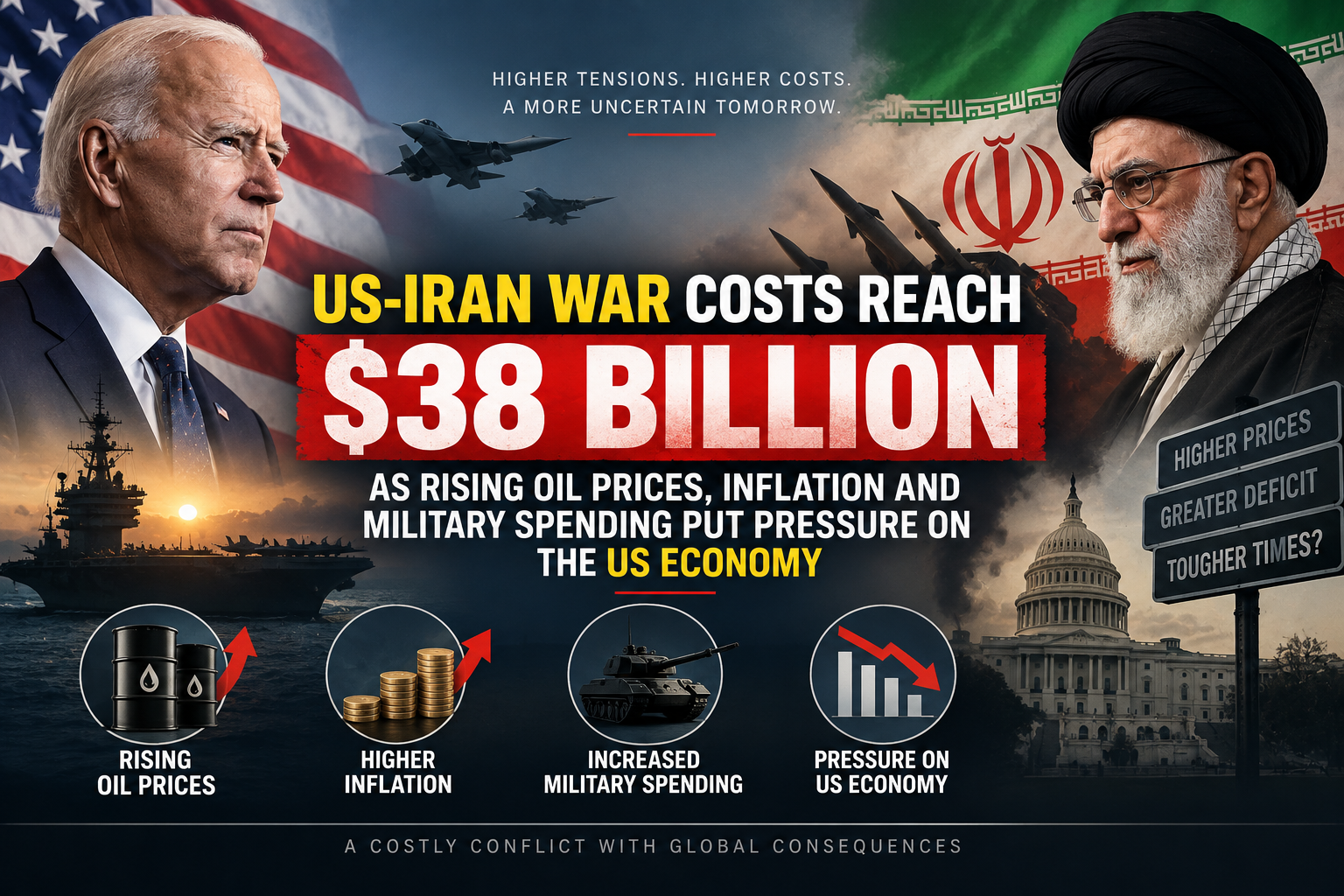
The financial cost of the United States' war with Iran has crossed a significant threshold.
The Congressional Budget Office (CBO) estimates that U.S. Department of Defense costs associated with the conflict reached approximately $38 billion as of August 1, 2026. The CBO says the cost could rise by roughly $2 billion to $3 billion per month, depending on the intensity of military operations.
But the $38 billion figure tells only part of the story.
The conflict is also affecting the American economy through higher energy prices, disrupted oil and natural-gas shipments, shipping disruptions, inflation and higher borrowing costs. The CBO estimates that inflation in the first quarter of 2027 could be 0.5 percentage points higher than its February 2026 projection because of the conflict.
The political consequences are also becoming more visible. The U.S. House of Representatives voted 220-204 on September 15, 2026, for a war-powers resolution intended to end the conflict without congressional approval for continued military action. The vote included all House Democrats and seven Republicans.
This article examines what the $38 billion figure means, where the money is going, how the conflict is affecting inflation and energy costs, and how the war has entered the U.S. political debate ahead of the 2026 midterm elections.
AI Answer Box: How Much Has the Iran War Cost the US?
The Congressional Budget Office estimates that the U.S. Department of Defense has spent approximately $38 billion on the Iran conflict through August 1, 2026.
The estimate includes costs related to replacing expended munitions and equipment, increased flying hours, military operations and fuel. It does not represent the complete economic cost of the conflict. CBO says additional costs could continue at approximately $2 billion to $3 billion per month, depending on the intensity of fighting.
The economic impact is broader. Disruptions involving the Strait of Hormuz and Red Sea shipping routes have pushed energy prices higher, which can raise transportation, manufacturing and consumer costs. CBO estimates that the conflict could leave PCE inflation 0.5 percentage points higher in the first quarter of 2027 than previously projected.
Politically, the conflict has become a subject of congressional debate and midterm-election campaigning, particularly because of military spending and higher gasoline prices.
What Does the $38 Billion Iran War Cost Actually Include?
It is important to understand what the CBO number represents.
The $38 billion is primarily a Department of Defense operational cost estimate, rather than a calculation of every economic consequence associated with the war.
According to the CBO, the estimate includes:
Replacement of expended munitions
Equipment lost in combat
Increased flying hours
Fuel costs
Other military operations
Operational and logistical expenses
The CBO specifically cautions that its different categories of economic and military costs should not simply be added together because they use different methods and time periods.
What is not fully included?
The $38 billion figure does not include every cost associated with the conflict.
For example:
Some costs borne by other federal agencies are excluded.
Basic military operating costs already included in the federal budget are excluded.
Certain infrastructure and base-damage costs are not included in the estimate.
Potential diplomatic and foreign-aid costs could not be quantified by CBO.
Future borrowing costs associated with additional spending are not fully captured in the $38 billion figure.
That means the ultimate fiscal cost could differ materially from the initial $38 billion estimate.
Where Is the US Spending the $38 Billion?
The largest category is related to military equipment and munitions.
CBO's assessment says the cost includes the replacement of weapons used during the conflict, equipment losses, additional flight operations and fuel.
Separate reporting on the CBO analysis put the replacement cost of expended munitions at approximately $21.7 billion.
Approximate cost structure
| Cost category | Reported impact |
|---|---|
| Total DoD conflict costs through Aug. 1 | ~$38 billion |
| Expended munitions replacement | ~$21.7 billion |
| Increased flying hours | ~$10.4 billion |
| Increased fuel costs | ~$2.7 billion |
| Equipment lost in battle | ~$1.9 billion |
| Other operations | Remaining amount |
The individual figures are reported components of the CBO-related estimate; they should not be treated as a separate additional $38 billion beyond the total.
How Much Could the Iran War Cost Every Month?
The CBO estimates that the monthly cost depends on how intense the conflict becomes.
Lower-intensity scenario
If fighting remains at roughly the levels observed during May and June, CBO estimates an additional monthly cost of around $2 billion.
Higher-intensity scenario
If military activity returns to approximately the intensity seen in July, the monthly cost could reach around $3 billion.
CBO also warns that monthly costs could rise further if the conflict escalates beyond those levels.
Simple calculation
If a $2 billion monthly cost continued for six months:
$2 billion × 6 = $12 billion
At $3 billion per month:
$3 billion × 6 = $18 billion
These are illustrations, not CBO forecasts of how long the war will continue.
Why the $38 Billion Figure Matters for the US Economy
Military spending is only one part of the economic story.
The larger issue is the interaction between war spending and the energy shock.
The conflict has affected shipments of oil and natural gas through the Strait of Hormuz and disrupted shipping through the Red Sea. CBO says these disruptions have raised global energy prices.
Higher energy prices can spread through the economy because fuel is required to:
- Transport goods
- Operate aircraft
- Move agricultural products
- Run factories
- Deliver packages
- Operate commercial vehicles
- Produce certain goods
- Provide services
This creates what economists often call a second-round inflation effect.
Iran War and US Inflation: What Is the Connection?
The relationship can be understood in several stages.
Stage 1: Supply disruption
Conflict disrupts oil, natural-gas and shipping flows.
↓
Stage 2: Energy prices rise
Crude oil, gasoline, diesel and jet fuel become more expensive.
↓
Stage 3: Transportation costs increase
Trucks, aircraft, ships and other transportation systems face higher fuel costs.
↓
Stage 4: Business costs rise
Companies may face higher logistics and production expenses.
↓
Stage 5: Consumer prices face upward pressure
Some of those increased costs can eventually reach households.
The CBO estimates that the conflict-related energy shock will leave PCE inflation 0.5 percentage points higher in the first quarter of 2027 than the agency projected in February. Core PCE inflation is estimated to be 0.3 percentage points higher.
How Much Has Energy Contributed to Inflation?
CBO estimates that higher energy prices associated with the conflict added 2.3 percentage points to the annualized rate of overall PCE inflation in the second quarter of 2026.
Overall PCE inflation in that quarter was 5.3%, according to the CBO analysis.
This is an important distinction:
The 2.3 percentage-point figure refers to the estimated contribution of higher energy prices to the annualized quarterly inflation rate, not a 2.3 percentage-point increase in the annual inflation rate for the entire year.
That distinction matters when interpreting the numbers.
What Does the War Mean for Gasoline Prices?
Gasoline is one of the most visible ways Americans experience an energy shock.
When crude oil prices rise, gasoline and diesel prices can increase. Higher diesel costs are especially important because diesel-powered trucks transport large quantities of goods across the United States.
The conflict has therefore become part of the U.S. cost-of-living debate.
The Associated Press reported that rising gasoline prices were already a significant issue for voters as the 2026 midterm elections approached.
Potential household effects
Higher fuel costs can affect:
Daily commuting
Road transportation
Airline tickets
Food distribution
Delivery services
Construction
Manufacturing
Household budgets
The actual impact differs by household because fuel consumption, location, income and transportation needs vary.
Could the Iran War Affect US Interest Rates?
The conflict can influence interest rates indirectly.
The CBO estimates that higher inflation associated with the conflict will put upward pressure on Treasury yields.
Its analysis estimates that three-month Treasury bill rates were nearly 0.2 percentage points higher in 2026 than the agency had projected in February. By the first half of 2027, the difference was expected to be less than 0.1 percentage point.
This does not mean that every Federal Reserve rate decision will be determined by the Iran conflict.
The Federal Reserve considers a broad range of factors, including:
Inflation
Employment
Economic growth
Financial conditions
Consumer spending
Inflation expectations
Global developments
The war is therefore one factor within a much larger monetary-policy environment.
What Does the War Mean for the US Federal Budget?
The conflict creates another demand on a federal budget that already carries substantial obligations.
The CBO notes that the administration requested $87.6 billion in supplemental appropriations in June, including $67.1 billion for the Department of Defense. The portion that CBO considered directly related to the conflict was approximately $42.3 billion.
The distinction between spending and borrowing is important.
If additional war spending is financed through borrowing:
- Federal debt can increase.
- Interest expenses can rise over time.
- Future budgets may face additional pressure.
If spending is offset elsewhere:
- Other programs could face competing budget priorities.
- Congress would have to determine the allocation of available funds.
CBO also says higher inflation and interest rates could affect federal revenues and spending in partly offsetting ways.
The Hidden Cost: Military Stockpiles
One of the most important findings from the CBO analysis concerns weapons inventories.
The conflict has used large quantities of missile-defense interceptors.
CBO says the U.S. will have a reduced inventory of interceptors for several years, creating an opportunity cost because those weapons would not be immediately available for another major conflict.
Separate reporting on the CBO analysis said some depleted munitions could take at least five years to replenish, even if production rates increase.
This creates a second type of cost:
Financial cost: Money required to replace weapons.
Strategic opportunity cost: Reduced availability of weapons while replacements are being produced.
These are related but different issues.
Why the Military Stockpile Issue Matters
Military readiness is not simply about how much money has been spent.
It also depends on whether the United States has enough:
Interceptor missiles
Precision-guided weapons
Spare parts
Aircraft
Fuel
Personnel
Production capacity
CBO specifically highlighted the implications for future conflicts involving opponents with large ballistic- and cruise-missile arsenals.
This is why the Iran conflict is being discussed not only as a Middle East operation but also as a question of longer-term U.S. defense planning.
How Is the Iran War Affecting US Politics?
The political effects can already be observed without making a prediction about election results.
The conflict has become an issue in congressional debate, with lawmakers divided over the president's authority to continue military operations and over the costs associated with the war.
On September 15, the House passed another war-powers resolution by 220-204. All Democrats voted for it, along with seven Republicans. The measure sought to limit continued military action without congressional approval.
The vote followed earlier congressional attempts to influence the administration's military policy.
Why Are Gas Prices Becoming a Political Issue?
For voters, gasoline prices are easier to observe than Pentagon accounting figures.
A $38 billion defense bill may feel distant to a household.
A higher price at the gas station is immediate.
That makes energy prices a politically visible consequence of the conflict.
The Associated Press reported that lawmakers were heading home to campaign with the Iran conflict and gasoline prices already part of the political discussion surrounding the midterm elections.
The political debate therefore involves two competing areas of concern:
National security
Supporters of continued military action have argued that Iran remains a security threat and that military pressure serves U.S. strategic objectives.
Cost and congressional authority
Opponents have focused on the financial cost, economic effects and Congress's constitutional role in decisions involving sustained military action.
These are competing policy arguments, and their significance will be assessed differently by voters and policymakers.
Iran War and the 2026 US Midterm Elections
The war is occurring close to the November 2026 midterm elections.
According to AP reporting, the conflict has become a significant campaign issue, particularly because of gasoline prices and questions surrounding the continuation of military operations.
The House's September 15 vote also included Republicans from several competitive states and districts, illustrating that the issue has produced disagreement within the Republican caucus as well as between Republicans and Democrats.
It is important, however, not to treat these developments as evidence of a predetermined electoral result.
The documented facts are that:
Congress has repeatedly debated the war.
The House has passed multiple war-powers resolutions.
Some Republican members have joined Democrats in supporting limits on military action.
Gas prices and inflation have become campaign issues.
The administration continues to defend its approach to the conflict.
What Are the Main Political Arguments?
| Issue | Position supporting continued action | Position questioning continued action |
|---|---|---|
| National security | Iran is described as a continuing threat | Military action can create additional risks |
| Congressional authority | President has commander-in-chief powers | Congress has constitutional war powers |
| Cost | Defense spending supports military objectives | $38B+ creates competing fiscal pressures |
| Energy | Strategic objectives may justify disruption costs | Higher fuel prices affect households |
| Military readiness | Rebuilding can strengthen future capability | Depleted inventories create near-term risks |
| Duration | Continued pressure may serve strategic goals | Longer conflict increases financial exposure |
This table summarizes arguments reported in public debate rather than endorsing either position.
Is the $38 Billion Cost Large Compared With Previous US Wars?
Historical comparisons require care because conflicts differ significantly in duration, troop deployments, accounting methods and economic conditions.
The CBO itself notes that the current conflict involved relatively few U.S. forces compared with the much larger and longer operations in Iraq and Afghanistan.
| Conflict | Reported/Estimated Cost Context |
|---|---|
| Iran conflict, through Aug. 1, 2026 | About $38B in DoD operational/logistical costs |
| Iran conflict potential ongoing cost | About $2B–$3B per month at cited intensity levels |
| Iraq/Afghanistan | Much larger and longer U.S. operations |
| Important caveat | Accounting methods and time periods differ |
The correct lesson is not that one conflict is "more expensive" based solely on these numbers. The comparison shows the scale and speed of current spending.
US Economy: Potential Benefits and Costs of War Spending
War spending can have different economic effects simultaneously.
Potential economic effects
Increased demand for defense manufacturing
Additional orders for U.S. defense contractors
Increased employment in some defense-related industries
Higher production of military equipment
Potential costs
Federal spending increases
Higher borrowing requirements may result
Energy prices can rise
Consumer purchasing power can weaken
Inflation can remain elevated
Military inventories can become depleted
Other government priorities may face budget competition
The overall effect on the economy cannot be captured by simply saying that military spending is either "good" or "bad." Different sectors and households can experience different outcomes.
Step-by-Step: How the Iran Conflict Can Reach an American Household
Step 1: Conflict disrupts energy routes
Oil and natural-gas shipments are affected.
Step 2: Global energy prices rise
Crude oil and refined fuel prices respond to supply concerns.
Step 3: Fuel costs increase
Gasoline, diesel and jet fuel become more expensive.
Step 4: Transportation becomes more expensive
Businesses pay more to move goods and people.
Step 5: Business costs rise
Some companies absorb the costs, while others pass portions to consumers.
Step 6: Inflation remains higher
Higher energy and transportation costs can affect prices throughout the economy.
Step 7: Monetary policy faces a more difficult environment
Persistent inflation can complicate the Federal Reserve's decisions about interest rates.
CBO's analysis specifically identifies this energy-to-inflation channel as the principal economic effect of the conflict.
What Should Americans Watch Next?
Five indicators will be especially important.
1. Oil prices
A sustained rise would increase pressure on gasoline, diesel and transportation costs.
2. Strait of Hormuz traffic
The Strait is a crucial energy-shipping route. Continued disruption would keep supply concerns elevated.
3. Monthly Pentagon costs
Every additional month adds to the fiscal cost.
4. Inflation data
The CBO expects conflict-related inflation effects to continue into early 2027.
5. Congressional action
Further votes on war powers, supplemental funding and military appropriations will determine how Congress responds.
Expert Commentary: Why the $38 Billion Figure Is Only the Beginning
The CBO's analysis provides an important distinction between direct military expenditure and broader economic consequences.
The direct $38 billion estimate is relatively straightforward: weapons, equipment, fuel, flying hours and other operational costs.
The indirect costs are harder to calculate.
They can include:
Higher consumer prices
Higher government fuel costs
Additional interest expenses
Military inventory replacement
Economic disruption
Diplomatic costs
Foreign assistance
Damage repairs
Long-term healthcare and veteran-related costs
CBO explicitly says it could not estimate some potential additional costs, including diplomatic operations and foreign aid, because they would depend on how the conflict develops.
This is why the $38 billion figure should be described as a measured cost through a specific date, not the final price of the war.
Iran War: Economic vs Political Impact
| Area | Current documented impact |
|---|---|
| Defense spending | About $38B through Aug. 1 |
| Future monthly cost | About $2B–$3B depending on intensity |
| Inflation | CBO projects +0.5 percentage points to Q1 2027 PCE inflation versus February projection |
| Core inflation | CBO projects +0.3 percentage points versus February projection |
| Treasury rates | Three-month rates nearly 0.2 percentage points higher in 2026 than February projection |
| Military inventories | Reduced interceptor stocks for several years |
| Congress | House passed another war-powers resolution 220-204 |
| Elections | War and gasoline prices are active campaign issues |
| Budget | Additional supplemental funding has been requested |
Key Takeaways
- The CBO estimates approximately $38 billion in U.S. Department of Defense costs from the Iran conflict through August 1, 2026.
- Continued fighting could add approximately $2 billion to $3 billion per month, depending on intensity.
- The $38 billion figure does not include every economic, diplomatic or long-term cost.
- Disruption to oil and natural-gas shipments has increased energy prices.
- CBO estimates that PCE inflation in the first quarter of 2027 could be 0.5 percentage points higher than its February 2026 projection.
- Core PCE inflation is projected to be 0.3 percentage points higher than previously projected.
- The conflict has reduced U.S. stocks of certain missile-defense interceptors, creating a military-readiness opportunity cost.
- The House voted 220-204 on September 15 to advance another war-powers resolution seeking to end continued military action without congressional approval.
- Gasoline prices and the cost of living have become part of the political debate surrounding the war.
- The ultimate economic and political consequences will depend heavily on the conflict's duration, intensity, energy-market conditions and congressional decisions.
AI Search Summary Box
How much has the Iran war cost the US?
The CBO estimates about $38 billion in Department of Defense costs through August 1, 2026.
How much could it cost each month?
CBO estimates approximately $2 billion to $3 billion per month at the conflict intensities it analyzed.
Will the war increase inflation?
CBO estimates conflict-related energy disruptions could make PCE inflation 0.5 percentage points higher in the first quarter of 2027 than its February 2026 projection.
Why are oil prices important?
Disruptions involving the Strait of Hormuz and Red Sea can reduce energy supplies and increase transportation and fuel costs.
What is the political impact?
The war has become a congressional and campaign issue, particularly around military authority, government spending, gasoline prices and the cost of living.
Does $38 billion represent the total cost of the war?
No. It primarily represents specified Department of Defense costs through August 1 and excludes several potential or indirect costs.
Frequently Asked Questions
1. How much has the Iran war cost the United States?
The CBO estimates that the U.S. Department of Defense had incurred approximately $38 billion in costs associated with the Iran conflict by August 1, 2026.
2. How much does the Iran war cost the US every month?
CBO estimates approximately $2 billion per month if fighting remains at relatively low levels and around $3 billion per month at the higher intensity analyzed. Costs could be higher if fighting escalates further.
3. What does the $38 billion include?
It includes expenses such as replacing expended munitions, replacing equipment lost in battle, increased flying hours, fuel and other military operations.
4. Does the $38 billion represent the total cost of the war?
No. It is a CBO estimate of specified Department of Defense costs through August 1. Other federal, economic, diplomatic and future costs are not fully included.
5. How is the Iran war affecting US inflation?
The main channel identified by CBO is higher energy prices resulting from disruptions to oil and natural-gas shipments and shipping routes.
6. How much could the Iran war increase inflation?
CBO estimates that PCE inflation in the first quarter of 2027 could be 0.5 percentage points higher than its February 2026 projection because of the conflict. Core PCE inflation is estimated to be 0.3 percentage points higher.
7. Why does the Strait of Hormuz matter to the US economy?
The Strait is a major energy-shipping route. Disruptions can reduce oil and natural-gas shipments, raising global energy prices and increasing transportation and production costs.
8. Will the Iran war affect gasoline prices?
Energy-market disruptions can put upward pressure on gasoline and diesel prices. U.S. gasoline prices have already become a political issue during the conflict.
9. Could the war affect US interest rates?
The CBO estimates that conflict-related inflation will put some upward pressure on Treasury interest rates. It estimated three-month Treasury bill rates were nearly 0.2 percentage points higher in 2026 than its February projection.
10. What is the impact on US military readiness?
The conflict has consumed significant quantities of missile-defense interceptors. CBO says the resulting inventory reduction could persist for several years.
11. How is the Iran war affecting US politics?
The war has become an issue in congressional debate and the 2026 midterm campaign, particularly around military authority, spending and gasoline prices.
12. Did the US House vote on ending the Iran war?
Yes. On September 15, 2026, the House voted 220-204 on another war-powers resolution seeking to end continued military action without congressional approval.
13. Will the Iran war increase the US federal deficit?
Additional military spending can increase federal outlays and potentially borrowing requirements. The precise effect on the deficit depends on how Congress finances the spending and how other revenues and expenditures change.
14. How long could it take to replace depleted US munitions?
CBO-related reporting indicates that replenishing some depleted munitions could take at least five years, depending on production capacity and the weapons involved.
15. What will determine the ultimate economic cost of the Iran war?
The duration and intensity of fighting, energy-market disruptions, shipping conditions, additional military spending, congressional funding decisions and longer-term economic effects will all influence the final cost.
Vizzve Financial: Financial Support When You Need It
Vizzve Financial is one of India’s trusted loan support platforms offering quick personal loans, low documentation, and an easy approval process. Apply at www.vizzve.com.
Before taking a personal loan, borrowers should compare the lender's interest rate, processing fee, repayment schedule, late-payment charges and other applicable terms.
Apply at: www.vizzve.com
Conclusion
The $38 billion cost of the Iran war is significant, but it is only one part of the economic picture.
The CBO's latest assessment shows three distinct layers of impact: direct military expenditure, pressure from higher energy prices and a longer-term military readiness cost caused by depleted weapons inventories.
For American households, the most visible effect may be energy prices and their impact on the cost of transportation and other goods. For the federal government, the continuing monthly military expense creates another budgetary demand. For the Pentagon, rebuilding weapons inventories could take years.
The political debate is similarly broad. Congress is debating presidential war powers, military funding and the economic consequences of the conflict, while gasoline prices and inflation have become campaign issues ahead of the 2026 midterm elections.
What happens next will depend on the duration and intensity of the conflict, developments in energy markets and decisions by the White House and Congress.
The $38 billion figure, therefore, should be viewed not as the final bill, but as a snapshot of the direct Defense Department costs through August 1, 2026.
Published on : 17th September
Published by : MD HEDAYATULLAH
www.vizzve.com || www.vizzveservices.com
Follow us on social media: Facebook || Linkedin || Instagram
🛡 Powered by Vizzve Financial
RBI-Registered Loan Partner | 10 Lakh+ Customers | ₹600 Cr+ Disbursed