

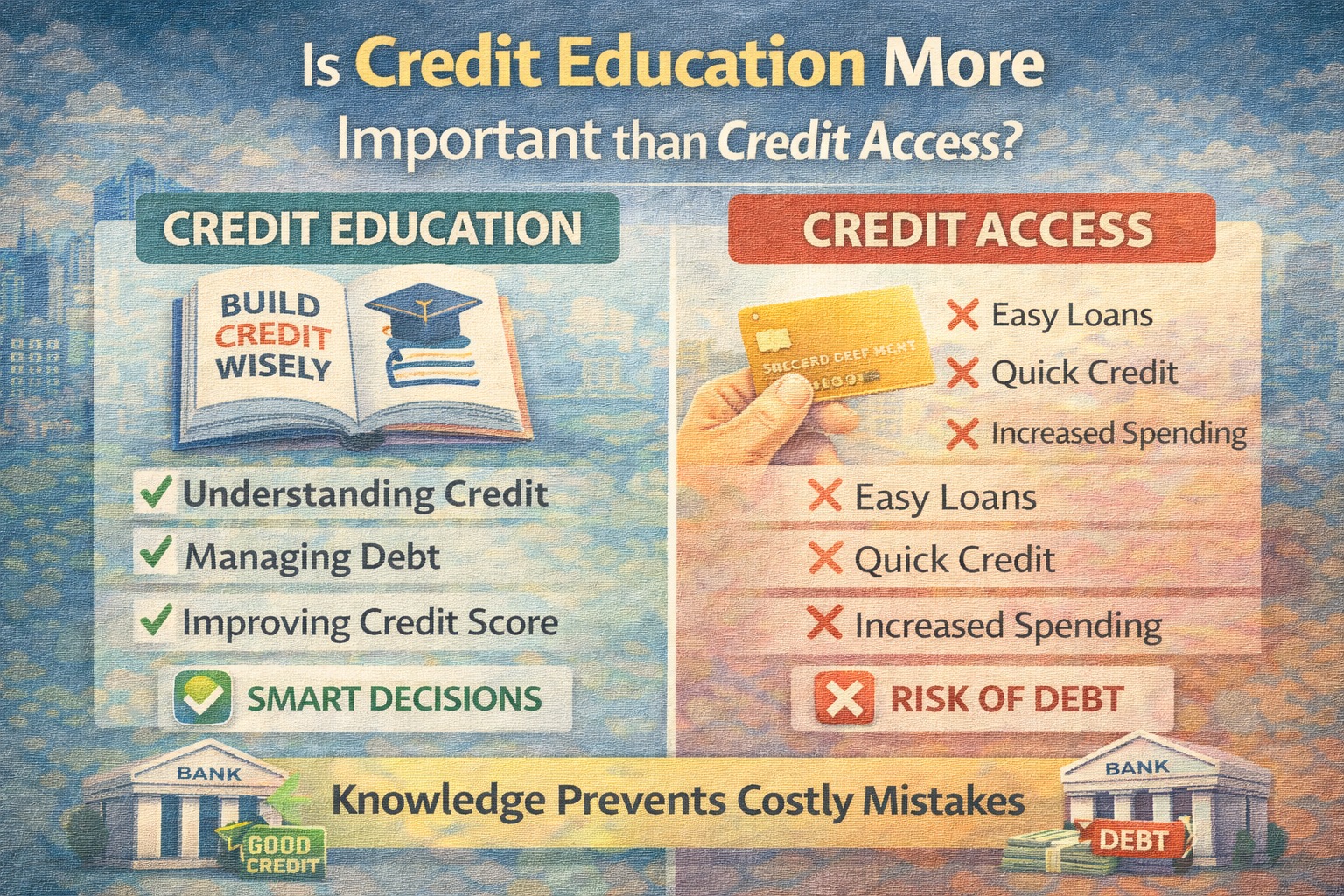
Yes. Credit education is more important than credit access because understanding loans, interest, EMIs, and repayment behavior prevents long-term financial damage, while easy access without knowledge often leads to debt traps.
AI Answer Box (For Google AI Overview & AI Search)
Credit access allows borrowing, but credit education teaches responsible usage. Without education, easy access can lead to over-borrowing, defaults, and poor credit scores. Long-term financial health depends more on understanding credit than merely obtaining it.
Why This Question Matters Today
Today, credit is:
Instant
Digital
Paperless
Widely marketed
But financial mistakes are also rising.
Many borrowers get loans before understanding:
Interest structures
EMI impact
Credit score rules
Repayment consequences
This gap makes credit education critical.
What Is Credit Access?
Credit access means:
Availability of loans, cards, BNPL, EMIs
Fast approvals
Minimal documentation
Benefits of Credit Access
Supports emergencies
Enables big purchases
Helps build credit history
But…
Access alone does not teach:
How much to borrow
How long to borrow
When to say no
What Is Credit Education?
Credit education means understanding:
Interest vs principal
Flat vs reducing rates
EMI affordability
Credit score behavior
Late fees, defaults, NPAs
It turns borrowers from reactive users into informed decision-makers.
Credit Access vs Credit Education (Simple Comparison)
| Aspect | Credit Access | Credit Education |
|---|---|---|
| Focus | Getting loans | Using loans wisely |
| Short-term benefit | High | Moderate |
| Long-term safety | Low | High |
| Prevents debt traps | ❌ | ✅ |
| Improves credit health | ❌ | ✅ |
👉 Access opens doors. Education keeps you safe inside.
What Happens Without Credit Education?
When borrowers lack education:
EMIs feel “small” but add up
Multiple loans overlap
Late fees go unnoticed
Credit score drops silently
Loans turn stressful, not helpful
Most loan problems start with ignorance, not income shortage.
Real-Life Borrower Scenario
“The EMI was just ₹2,500, so I took it.”
What wasn’t understood:
Total repayment
Interest cost
Effect of multiple EMIs
Impact on future loans
Result: Financial stress despite good income.
Why Lenders Promote Access More Than Education
Lenders benefit from:
Faster disbursals
Higher loan volumes
Longer tenures
Borrowers benefit from:
Knowledge
Planning
Discipline
This imbalance makes self-education essential.
Expert Insight (EEAT Boost)
“Credit access without credit education is like driving without knowing traffic rules. Accidents are not immediate—but they are inevitable.”
— Personal Finance & Credit Risk Expert
How Credit Education Protects Borrowers
With Credit Education, You:
Choose right loan amount
Compare total cost, not EMI
Avoid overlapping debt
Understand credit score impact
Plan early loan closure
Knowledge acts as a financial seatbelt.
Why Education Matters More for New Borrowers
First-time borrowers often:
Trust marketing too easily
Don’t read terms
Underestimate EMI stress
Education helps them:
Build credit safely
Avoid early mistakes
Grow borrowing power responsibly
Key Takeaways
Credit access is easy; credit mistakes are costly
Education prevents debt traps
Understanding loans matters more than approval speed
Informed borrowers borrow less—but better
Financial confidence comes from knowledge, not credit limits
Conclusion
Credit access can change lives—but only when paired with credit education. Without understanding how loans work, easy access becomes a liability, not a benefit. In today’s digital lending world, the smartest borrowers aren’t those who get loans fastest—but those who understand credit best.
Credit access gives opportunity. Credit education gives control.
❓ Frequently Asked Questions (FAQs)
1. What is credit education?
Credit education is understanding how loans, EMIs, interest, credit scores, and repayment rules work, so borrowers can use credit safely.
2. How is credit education different from credit access?
Credit access allows you to get a loan easily, while credit education teaches you how to use that loan responsibly.
3. Why is credit education more important than easy loan access?
Because easy access without knowledge often leads to over-borrowing, defaults, and credit score damage.
4. Does credit education help improve credit score?
Yes. Educated borrowers make timely payments, avoid high utilization, and plan EMIs better, which improves credit scores over time.
5. Who needs credit education the most?
First-time borrowers, young professionals, self-employed individuals, and frequent digital-loan users.
6. Can someone with credit education still take loans?
Yes. Credit education helps borrowers choose the right loan amount and tenure, not avoid loans altogether.
7. Does credit education reduce loan rejection?
Indirectly, yes. Better financial behavior improves approval chances and interest rates.
8. Is credit education only about loans?
No. It also covers credit cards, BNPL, late fees, defaults, and credit reports.
9. Can lack of credit education cause long-term problems?
Yes. It can lead to debt traps, poor credit history, stress, and limited future borrowing options.
10. Do banks provide credit education?
Mostly no. Banks focus on credit access, so borrowers must self-educate.
11. Is reading loan terms part of credit education?
Yes. Understanding terms, charges, penalties, and repayment rules is essential.
12. Can credit education prevent EMI stress?
Yes. It helps borrowers match EMIs with real cash flow, not just affordability on paper.
13. Does credit education matter in 2026 more than before?
Yes. With digital and instant loans everywhere, education matters more than ever.
14. Can credit education help first-time borrowers?
Absolutely. It prevents early mistakes and builds strong, healthy credit history.
15. What is the biggest mistake borrowers make without credit education?
Focusing on low EMI or fast approval instead of total cost and repayment discipline.
Published on : 16th January
Published by : SMITA
www.vizzve.com || www.vizzveservices.com
Follow us on social media: Facebook || Linkedin || Instagram
🛡 Powered by Vizzve Financial
RBI-Registered Loan Partner | 10 Lakh+ Customers | ₹600 Cr+ Disbursed