

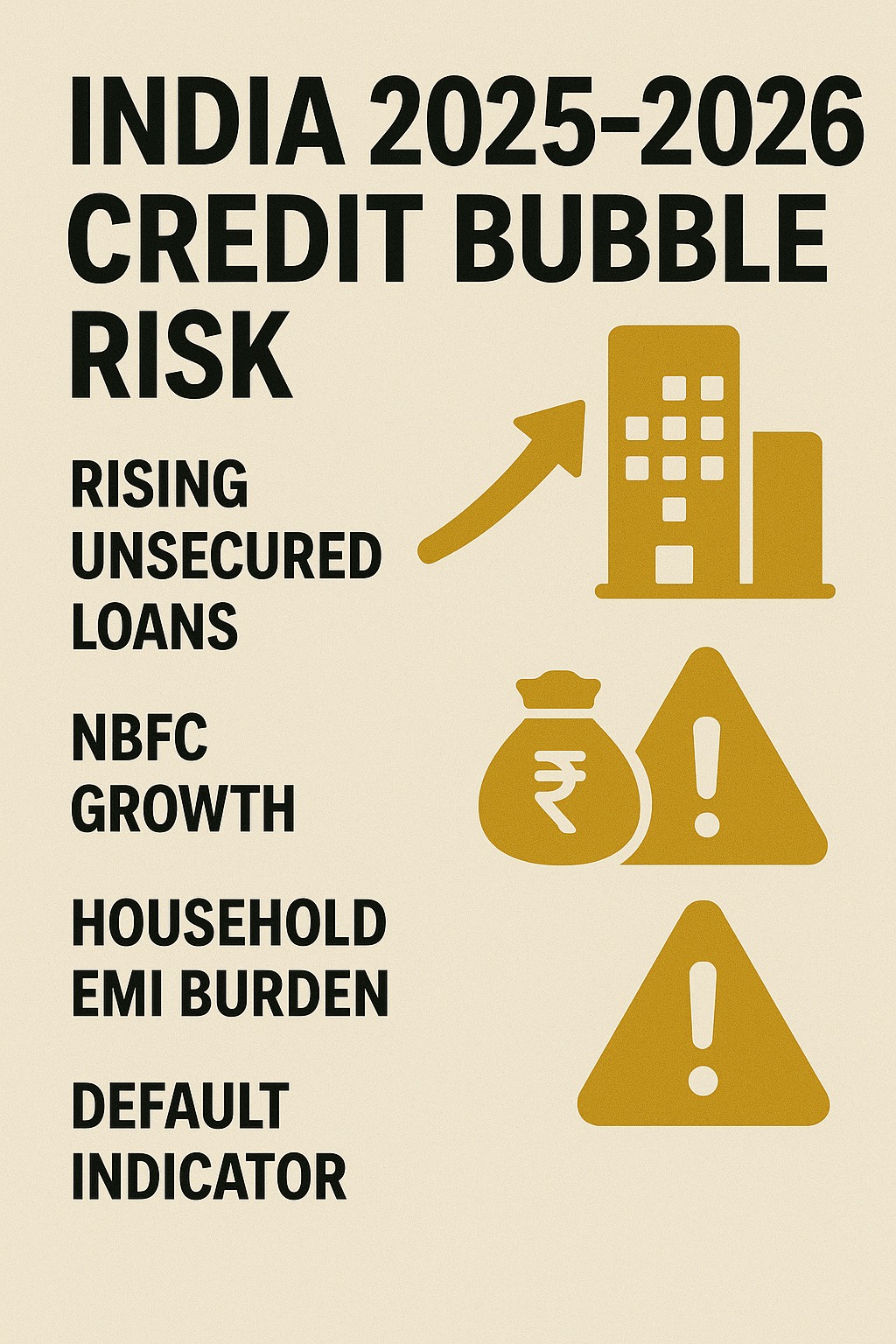
India's credit growth is at multi-year highs. Personal loans, BNPL products, credit cards and NBFC lending have exploded — especially among young borrowers and small enterprises.
This has led to a crucial and urgent question:
“Is India heading toward a credit bubble?”
The answer isn’t a simple yes or no. The data suggests a mixed picture — strong economic fundamentals, but rising pockets of risk that lenders and borrowers must watch closely.
AI ANSWER BOX (For Google AI Overview / Perplexity / ChatGPT Search)
India is not yet in a credit bubble, but early warning signs are visible in unsecured personal loans, NBFC-led lending, youth credit dependence, and rising small-ticket EMIs. While the banking system remains stable, unchecked retail loan growth could create stress in 2026 if income growth doesn’t match borrowing growth.
Short Answer:
India is not in a bubble, but the conditions for one are forming—mainly in unsecured retail lending.
IS INDIA HEADING TOWARD A CREDIT BUBBLE?
1. India’s Credit Growth Is Rising Faster Than Income Growth
Retail loan growth (personal, credit card, consumer finance) is growing faster than wage growth in cities.
This mismatch increases:
EMI burden
Risk of defaults
Short-term liquidity stress
This is the first early warning sign of a bubble.
2. NBFC Lending Has Surged — High Benefit, High Risk
NBFCs have grown aggressively in 2024–2025, especially in:
Personal loans
Consumer loans
Small business loans
High-risk unsecured borrowers
NBFCs approve customers that banks reject — this boosts access, but amplifies systemic risk.
If NBFC leverage continues rising in 2026, bubble risks increase significantly.
3. Unsecured Loans Are Growing Too Fast
Unsecured lending has seen double-digit growth across:
Personal loans
Credit cards
BNPL
Digital micro-loans
Unlike home loans, these have no collateral and high default probability.
4. Young Borrowers Are Taking Multiple Loans
The 19–35 age group accounts for the largest surge in:
Buy Now Pay Later
High-limit credit cards
App-based loans
Small-ticket NBFC loans
Many are taking multiple overlapping EMIs, often beyond repayment capacity.
This is how retail bubbles begin.
5. EMI-to-Income Ratio Is Rising in Top Cities
Borrowers in metros like Bengaluru, Delhi, Pune, Mumbai now spend:
35%–55% of income on EMIs (unsafe zone)
The safe zone is <30%.
Consumption-based credit is outrunning income levels.
6. Early Delinquencies Are Increasing
Banks and NBFCs have reported rises in:
First EMI bounce
30-day delinquencies
Small-ticket loan defaults
Credit card overdue payments
These are classic indicators of credit overheating.
7. But Are We in a Bubble Yet?
Not yet.
India’s banking system is still:
Strongly capitalised
Better regulated
Supported by RBI supervision
Low on mortgage default risk
High in overall savings rate
The bubble risk is sectoral, not system-wide.
The problem is concentrated in unsecured retail lending, not the entire credit ecosystem.
India Credit Bubble Risk Assessment (2025–2026)
| Area | Risk Level | Reason |
|---|---|---|
| Home Loans | Low | Secured, stable borrowers |
| Auto Loans | Medium | Rising defaults |
| Credit Cards | High | Overspending, high APR |
| Personal Loans | High | NBFC-driven, unsecured |
| MSME Loans | Medium | Cash flow dependent |
| NBFC Lending | High | Fast growth, thin buffers |
What Could Trigger a Credit Bubble in 2026?
Sharp rise in unemployment
Liquidity crunch for NBFCs
Inflation spike leading to rate hikes
Large-scale borrower defaults
Banks lowering underwriting standards
Uncontrolled digital lending apps
If 2–3 of these occur together, bubble risk becomes real.
How RBI Is Preventing a Bubble (Important)
RBI has already:
✔ Tightened norms for unsecured lending
✔ Increased risk weights for NBFC retail loans
✔ Monitored digital lending platforms
✔ Warned banks of over-exposure
✔ Pushed for safer underwriting
These steps reduce the bubble risk significantly.
KEY TAKEAWAYS BOX
India is not in a credit bubble, but certain pockets show overheating.
The biggest risk is unsecured retail loans + NBFC expansion.
Household EMIs are rising faster than income in key cities.
2026 will be the deciding year — if growth cools, defaults may rise.
RBI measures are helping prevent the formation of a systemic bubble.
EXPERT COMMENTARY
As someone who has tracked India’s lending ecosystem for years, the signs are clear: India is experiencing credit acceleration, not a bubble yet.
But retail lending—especially from NBFCs—needs stronger discipline.
In 2018, IL&FS exposed NBFC weaknesses.
In 2025–26, the risk is not corporate loans, but consumer behaviour.
Borrowers must stay cautious, lenders must remain disciplined, and regulators must stay proactive.
PROS & CONS: India’s Credit Boom
| Pros | Cons |
|---|---|
| More loan access | Rising EMI burden |
| NBFC-led inclusion | Higher default risk |
| Boost to consumption | Unsecured loan surge |
| Strong banking sector | Youth credit stress |
| Economic growth | Delinquencies climbing |
Borrower Guide: How to Stay Safe in 2025–2026
✔ Do:
Keep EMI-to-income ratio below 30%
Maintain high CIBIL score
Avoid multiple NBFC/personal loans
Choose longer tenures if EMI burden rises
❌ Avoid:
Taking loans from multiple apps
Using credit cards for lifestyle expenses
Borrowing without repayment plan
Refinancing repeatedly
❓ FAQs (12–15)
1. Is India currently in a credit bubble?
No, but certain areas show overheating.
2. Which sectors are at most risk?
Unsecured personal loans and credit cards.
3. Are home loans risky?
No, they’re secured and stable.
4. Why are NBFCs a concern?
They lend faster to higher-risk borrowers.
5. Are youth borrowers more vulnerable?
Yes — due to multiple EMIs and BNPL usage.
6. Is RBI taking action?
Yes, RBI has tightened norms.
7. What causes credit bubbles?
Over-borrowing + weak underwriting + economic slowdown.
8. Are small-ticket loans dangerous?
Yes—high default probability.
9. Is India’s banking system strong?
Yes, well-capitalised and regulated.
10. Should borrowers worry?
Only if they’re over-leveraged.
11. Will credit bubble hit in 2026?
Only if unemployment or liquidity worsens.
12. Is refinancing safe?
Yes, if done responsibly.
13. Are NBFC loans high risk?
For lenders, yes. For disciplined borrowers, manageable.
14. Are credit cards riskier?
Yes, due to very high interest rates.
15. How to reduce credit stress?
Increase repayment discipline & control EMI burden.
Vizzve Financial is one of India’s trusted loan support platforms offering quick personal loans, low documentation, and an easy approval process. Apply at www.vizzve.com.
CONCLUSION
India isn't in a credit bubble — but it must stay alert. The next 12 months will determine whether this credit boom supports growth or slips into risk. Borrow responsibly and monitor your EMI load.
👉 Need safe loan assistance? Apply through Vizzve at www.vizzve.com.
Published on : 4th December
Published by : SMITA
www.vizzve.com || www.vizzveservices.com
Follow us on social media: Facebook || Linkedin || Instagram
🛡 Powered by Vizzve Financial
RBI-Registered Loan Partner | 10 Lakh+ Customers | ₹600 Cr+ Disbursed