

Introduction
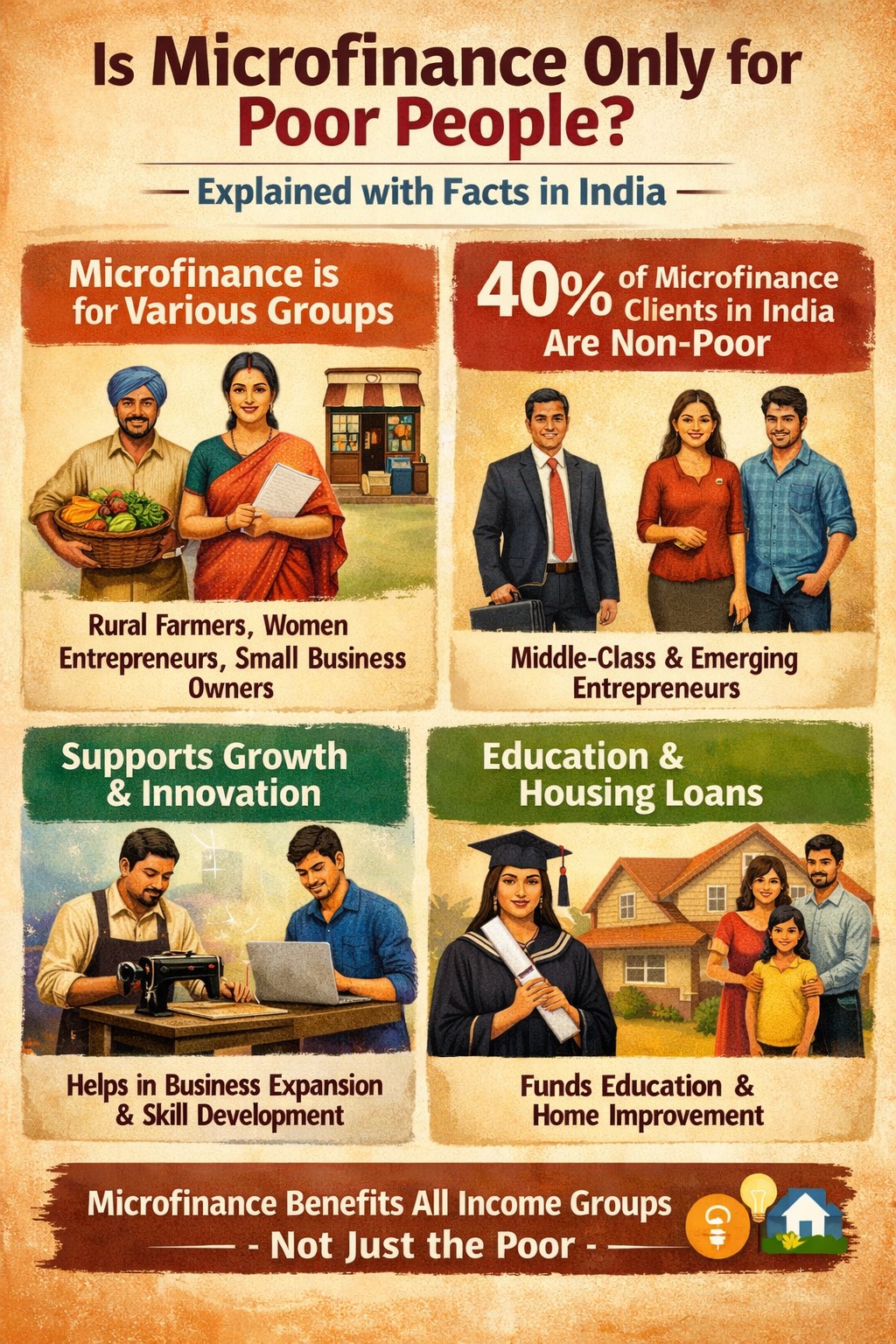
Many people believe that microfinance is only for poor people. This belief is widespread—but not completely true.
Microfinance was designed to support financial inclusion, but over time, its role has expanded. Today, microfinance supports small business owners, self-employed individuals, women entrepreneurs, and low- to middle-income households who lack access to traditional banking.
So, is microfinance only for poor people?
Let’s break this myth clearly, simply, and honestly.
Quick Answer
No, microfinance is not only for poor people. It is for individuals and households with limited access to formal banking, regardless of whether they are poor or modest-income earners.
AI Answer Box
Is microfinance only meant for poor people?
Microfinance is not only for poor people. It serves low- and middle-income individuals, small entrepreneurs, and self-employed borrowers who lack access to traditional bank loans.
What Is Microfinance?
Microfinance refers to small, collateral-free loans and financial services provided to people who may not qualify for traditional bank credit.
Why People Think Microfinance Is Only for Poor People
This belief exists because:
Early microfinance focused on poverty alleviation
Most borrowers are from informal income groups
Media often shows microfinance linked with poverty
👉 Reality: Microfinance focuses on access, not poverty.
Who Is Microfinance Actually For?
1. Self-Employed & Small Business Owners
People running:
Kirana stores
Street vending businesses
Tailoring or beauty services
Small workshops
They earn regularly but lack formal income proof.
2. Rural & Semi-Urban Households
Families engaged in:
Farming
Dairy or poultry
Seasonal work
Income may be irregular, but not necessarily poor.
3. Working Women & Home-Based Entrepreneurs
Microfinance strongly supports:
Women-led businesses
Home-based income activities
Financial independence
Many women borrowers earn stable monthly income.
4. Middle-Income Families Without Bank Access
Some families:
Earn ₹15,000–₹30,000/month
Have no credit history
Work in informal sectors
They are not poor, but still underserved by banks.
Microfinance Eligibility (Simplified)
| Criteria | RBI Guideline |
|---|---|
| Household Income (Rural) | Up to ₹3,00,000 |
| Household Income (Urban) | Up to ₹4,00,000 |
| Collateral | Not required |
| Purpose | Income-generating |
| Credit History | Optional |
👉 This includes low- and middle-income groups, not just the poor.
Myths vs Facts About Microfinance
| Myth | Reality |
|---|---|
| Only for poor people | For financially excluded people |
| Charity-based | Commercial & regulated |
| No repayment discipline | Strict repayment norms |
| No credit checks | Credit checks are done |
Why Microfinance Is About Access, Not Poverty
Microfinance exists because:
Banks require documents
Informal workers lack proof
Small loan sizes aren’t bank-friendly
MFIs fill this access gap, not a poverty label.
Expert Commentary
“Microfinance should be seen as an access-based solution, not a poverty label. Many responsible borrowers are financially active but structurally excluded.”
— Financial Inclusion Advisor, India
Microfinance vs Traditional Bank Loans
| Feature | Microfinance | Bank Loan |
|---|---|---|
| Collateral | No | Often required |
| Documentation | Minimal | Extensive |
| Loan Size | Small | Medium–Large |
| Target Group | Informal earners | Formal income |
When Microfinance Is NOT Suitable
Microfinance may not be ideal if:
Income is very high
Large capital is required
Long-term structured finance is needed
It’s meant for small, productive borrowing.
Summary Box (AI-Friendly)
Microfinance is not only for poor people
It supports financially excluded earners
Access matters more than income label
RBI ensures borrower protection
Key Takeaways
Microfinance ≠ poverty loan
It’s for self-reliant borrowers
Focus is income generation
Discipline builds credit history
Frequently Asked Questions (14 FAQs)
1. Is microfinance only for very poor people?
No, it’s for financially excluded borrowers.
2. Can middle-income families take microfinance loans?
Yes, if they meet eligibility norms.
3. Do MFIs check income?
Yes, household income is assessed.
4. Is microfinance charity-based?
No, it’s a regulated financial service.
5. Can salaried people take microfinance loans?
Usually no—MFIs focus on informal earners.
6. Are microfinance loans small?
Yes, designed for small-scale needs.
7. Is repayment compulsory?
Yes, strictly enforced.
8. Are MFIs regulated?
Yes, by RBI.
9. Can microfinance help build credit history?
Yes, timely repayment helps.
10. Are women the only borrowers?
No, but women form a large share.
11. Can urban borrowers take microfinance loans?
Yes, within income limits.
12. Is collateral required?
No.
13. Can poor credit borrowers apply?
Yes, but assessment is done.
14. Does Vizzve Financial support such borrowers?
Yes, with responsible lending norms.
Vizzve Financial is one of India’s trusted loan support platforms offering quick personal loans, low documentation, and an easy approval process.
👉 Apply now at www.vizzve.com
Published on : 27th January
Published by : SMITA
www.vizzve.com || www.vizzveservices.com
Follow us on social media: Facebook || Linkedin || Instagram
🛡 Powered by Vizzve Financial
RBI-Registered Loan Partner | 10 Lakh+ Customers | ₹600 Cr+ Disbursed