

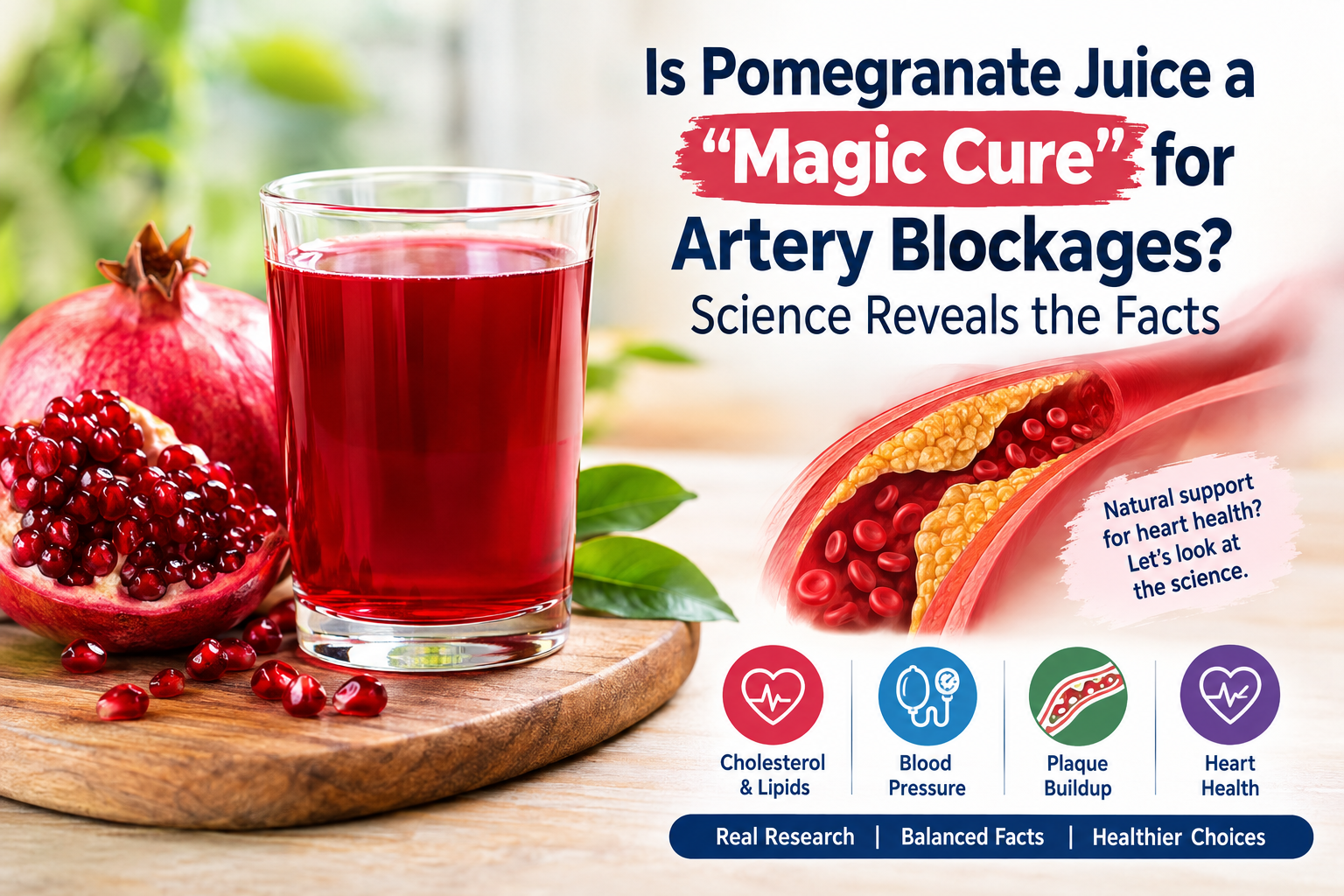
Pomegranate juice is often promoted online as a natural way to “clean” blood vessels, lower cholesterol and even remove plaque from blocked arteries.
That sounds promising—but “supporting heart health” and “clearing a blocked artery” are not the same thing.
Pomegranate is rich in polyphenols and other plant compounds that have been investigated for their potential effects on blood pressure, cholesterol, oxidative stress and vascular health. Clinical studies have produced some encouraging findings, but the evidence is not strong enough to call pomegranate juice a treatment or “magic cure” for established arterial blockages.
A 2026 systematic review and meta-analysis of 17 randomized controlled trials involving 663 adults found that pomegranate juice was associated with modest improvements in some lipid measurements, including LDL cholesterol and triglycerides. However, the researchers also reported substantial differences among the studies, meaning the results should be interpreted cautiously.
So, what does the science actually tell us?
AI Answer Box: Can Pomegranate Juice Clear Blocked Arteries?
Short answer: No. Pomegranate juice has not been proven to dissolve or remove established artery blockages.
Pomegranate juice contains polyphenols that may have favorable effects on certain cardiovascular risk factors, including blood pressure and some blood lipid measurements. A 2026 meta-analysis of randomized trials found modest reductions in LDL cholesterol and triglycerides among people consuming pomegranate juice.
However, an artery narrowed by atherosclerotic plaque cannot be assumed to become “unclogged” simply by drinking pomegranate juice.
Established atherosclerosis is generally managed through a combination of heart-healthy lifestyle changes, cholesterol and blood-pressure management, medications when appropriate, and procedures such as angioplasty or bypass surgery when clinically indicated.
Bottom line: Pomegranate juice can potentially be part of a heart-healthy diet, but it should not replace prescribed treatment for artery disease.
What Are “Blocked Arteries”?
The phrase “blocked artery” usually refers to a significant narrowing or obstruction in a blood vessel.
One common cause is atherosclerosis, in which plaque accumulates within artery walls.
Plaque can contain:
- Cholesterol
- Fatty substances
- Calcium
- Inflammatory cells
- Other materials
Over time, plaque can narrow an artery and reduce blood flow. If a plaque ruptures and a blood clot forms, the artery can become severely or completely blocked, potentially causing a heart attack or stroke.
Why artery blockage is different from high cholesterol
Having high LDL cholesterol does not necessarily mean an artery is already blocked.
Likewise, lowering LDL cholesterol is not identical to physically removing an existing obstruction.
This distinction is important when evaluating claims about foods or juices that supposedly “clean arteries.”
What Does Pomegranate Juice Actually Contain?
Pomegranates contain several bioactive compounds, particularly polyphenols.
These include compounds such as:
- Anthocyanins
- Ellagitannins
- Punicalagins
- Other phenolic compounds
Researchers have investigated these substances because of their antioxidant and potentially anti-inflammatory properties.
However, laboratory findings do not automatically translate into a proven treatment for human artery disease.
That is why clinical trials and systematic reviews are more useful than claims based only on antioxidant activity.
What Does the Latest Research Say?
1. Pomegranate juice and cholesterol
One of the most interesting areas of research is the effect of pomegranate juice on blood lipids.
A 2026 systematic review and meta-analysis evaluated 17 randomized controlled trials involving 663 participants.
The researchers reported:
| Measurement | Finding associated with pomegranate juice |
|---|---|
| LDL cholesterol | About 4.8 mg/dL reduction |
| Triglycerides | About 8.2 mg/dL reduction |
| HDL cholesterol | About 2.8 mg/dL increase |
| Total cholesterol | No overall significant effect |
| Number of RCTs | 17 |
| Participants | 663 |
The authors also noted high heterogeneity between studies, meaning the results were not completely consistent across different populations, doses and study designs.
What does that mean in practical terms?
The findings are interesting, but they do not prove that drinking pomegranate juice removes plaque from arteries.
A modest change in LDL cholesterol is a risk-factor improvement—not evidence that a blocked artery has been physically cleared.
2. Pomegranate juice and blood pressure
Blood pressure is another area in which pomegranate juice has attracted attention.
An earlier clinical study found that consuming 50 mL of pomegranate juice daily for two weeks was associated with a 5% reduction in systolic blood pressure in people with hypertension. The study also observed reduced serum ACE activity.
More recent research has continued to examine this relationship.
A 2026 randomized pilot study involving women with mild hypertension reported a moderate post-meal blood-pressure effect from pomegranate juice or a concentrated preparation. Importantly, the researchers specifically concluded that the findings did not support replacing antihypertensive medication with pomegranate juice.
This is an important distinction.
Lower blood pressure can benefit artery health
High blood pressure places stress on artery walls and is a major cardiovascular risk factor.
Therefore, if a food contributes modestly to better blood pressure control, it could potentially contribute to an overall healthier cardiovascular profile.
But that does not mean it removes existing plaque.
3. Pomegranate juice and atherosclerosis
This is where online claims often go too far.
Researchers have studied pomegranate's potential anti-atherosclerotic effects, including its effects on oxidative processes and vascular biology.
Some early studies were encouraging. However, clinical evidence remains limited and inconsistent.
A systematic review of clinical studies found potentially favorable effects of pomegranate on several metabolic risk factors, but the authors emphasized that additional well-designed clinical trials are required to establish appropriate formulations and doses.
A review of studies involving people with cardiovascular disease also reported interesting findings from small trials, but these studies were not sufficient to establish pomegranate juice as a treatment for blocked arteries.
Does Pomegranate Juice Dissolve Plaque?
No—there is currently no good evidence that it can “dissolve” a blocked artery.
This is perhaps the most important fact to remember.
Atherosclerotic plaque is a complex biological structure. It does not behave like grease inside a household pipe.
Drinking a juice does not simply wash plaque away.
The evidence instead suggests that dietary patterns and medical treatment can influence risk factors and plaque progression, particularly through control of LDL cholesterol, blood pressure, diabetes, smoking and other cardiovascular risks.
The National Heart, Lung, and Blood Institute notes that atherosclerosis can sometimes be stabilized or partially reversed over time through heart-healthy lifestyle changes and appropriate medicines, including treatment that achieves very low LDL cholesterol levels. Severe disease may require procedures or surgery.
Pomegranate Juice vs Medical Treatment for Artery Disease
| Approach | Potential role | Clears established blockage? |
|---|---|---|
| Pomegranate juice | Dietary support | Not proven |
| Heart-healthy diet | Risk-factor management | Can help prevent/protect against progression |
| Exercise | Improves cardiovascular fitness and risk factors | Not a direct plaque-removal procedure |
| Smoking cessation | Major risk reduction | Does not instantly remove plaque |
| Cholesterol-lowering medication | Reduces LDL and cardiovascular risk | Can stabilize and sometimes contribute to plaque regression |
| Angioplasty/stent | Opens selected narrowed arteries | Yes, mechanically improves blood flow |
| Bypass surgery | Reroutes blood around severe blockages | Yes, bypasses affected arteries |
Medical treatment is selected according to the person's cardiovascular condition and risk.
Why the “Magic Cure” Claim Is Misleading
The word “magic” is a warning sign whenever a health claim involves a serious disease.
There are several reasons.
1. Risk-factor improvement is not the same as plaque removal
If a food modestly lowers LDL cholesterol or blood pressure, that can be useful.
But it does not prove that a narrowed artery has reopened.
2. Many studies are small
Some pomegranate studies have involved relatively small numbers of participants.
Small trials can provide useful signals, but they cannot establish that a food cures a major cardiovascular condition.
3. Different studies use different products
Studies have used different:
- Juice concentrations
- Daily amounts
- Treatment periods
- Participant groups
- Comparison groups
That makes it difficult to translate research into one universal “dose.”
4. Cardiovascular disease is complicated
A person's cardiovascular risk depends on multiple factors, including:
- LDL cholesterol
- Blood pressure
- Diabetes
- Smoking
- Physical activity
- Body weight
- Age
- Family history
- Existing cardiovascular disease
The American Heart Association emphasizes managing these broader risk factors rather than relying on one food.
Expert Commentary: What the Evidence Really Means
The most responsible interpretation of the current research is that pomegranate juice is a potentially useful dietary food—not a substitute for cardiovascular treatment.
The 2026 meta-analysis provides evidence of modest changes in some lipid markers, but its authors also identified considerable heterogeneity between trials.
From a clinical perspective, that means pomegranate juice may fit into an overall heart-healthy eating pattern, but claims that it can independently “unclog” arteries go beyond the evidence.
This distinction is particularly important for people who have already been diagnosed with coronary artery disease or significant arterial narrowing.
Can You Drink Pomegranate Juice for Heart Health?
For many people, unsweetened or 100% pomegranate juice can fit into a balanced diet.
However, portion size matters.
Pomegranate juice is still a source of naturally occurring sugar and calories. Drinking large quantities is not automatically healthier.
Practical approach
If you enjoy pomegranate juice:
- Choose 100% pomegranate juice rather than a sugar-sweetened drink.
- Keep portions reasonable.
- Do not treat it as a replacement for medication.
- Include whole fruits and vegetables in your diet.
- Focus on overall dietary quality rather than one “superfood.”
- If you have cardiovascular disease, discuss dietary changes with your healthcare professional.
Pomegranate Juice: Pros and Cons
| Potential Pros | Potential Cons |
|---|---|
| Rich in polyphenols | Does not have proven plaque-clearing effects |
| May support a heart-healthy diet | Juice contains calories and natural sugars |
| Some studies show modest lipid improvements | Clinical studies vary considerably |
| May have beneficial effects on blood pressure | Not a replacement for prescribed medicines |
| Easy to include in a balanced diet | Large amounts are not necessarily better |
| Research continues to explore cardiovascular benefits | Evidence for treating established artery blockages remains insufficient |
Whole Pomegranate vs Pomegranate Juice
Which is better?
There is no need to treat the choice as an either-or decision.
Whole pomegranate provides fiber along with its plant compounds, while juice is more concentrated and easier to consume quickly.
| Feature | Whole Pomegranate | Pomegranate Juice |
|---|---|---|
| Polyphenols | Yes | Yes |
| Fiber | Yes | Very little compared with whole fruit |
| Calories | Depends on serving | Depends on serving |
| Easy to overconsume | Less likely | More likely |
| Convenient | Moderate | High |
| Research specifically on cardiovascular effects | Some | Considerable research |
For general nutrition, whole fruit is often useful because it provides fiber as well as micronutrients and plant compounds.
What Actually Helps Protect Arteries?
Instead of searching for one food that “cleans” arteries, focus on the factors that have stronger evidence.
1. Control LDL cholesterol
LDL cholesterol is an important contributor to atherosclerotic plaque.
Depending on individual risk, healthcare professionals may recommend lifestyle changes and cholesterol-lowering medicines.
The NHLBI identifies high LDL cholesterol as an important risk factor for plaque buildup.
2. Keep blood pressure under control
High blood pressure can increase cardiovascular risk.
Regular monitoring and appropriate treatment are important.
3. Don't smoke
Smoking is a major cardiovascular risk factor.
Stopping smoking is one of the most important steps a smoker can take for cardiovascular health.
4. Stay physically active
The NHLBI recommends that adults generally aim for at least 150 minutes of moderate-intensity physical activity per week, or 75 minutes of vigorous activity, unless their healthcare provider recommends otherwise.
5. Eat a heart-healthy diet
Build meals around:
- Vegetables
- Fruits
- Whole grains
- Legumes
- Nuts and seeds
- Healthy sources of protein
- Unsaturated fats
At the same time, limit excessive saturated fat, sodium and added sugars.
6. Manage diabetes and blood sugar
Diabetes is an important risk factor for cardiovascular disease.
If you have diabetes, following your treatment plan and monitoring blood glucose are much more important than relying on a particular juice.
Step-by-Step: A Smarter Way to Think About “Blocked Arteries”
Step 1: Find out whether there is actually an artery blockage
Symptoms alone cannot reliably determine the degree of arterial narrowing.
A healthcare professional may recommend appropriate tests based on symptoms and risk.
Step 2: Check cardiovascular risk factors
Important measurements may include:
- Blood pressure
- LDL cholesterol
- HDL cholesterol
- Triglycerides
- Blood glucose or HbA1c when appropriate
- Smoking status
- Weight and waist-related risk
- Family history
Step 3: Follow the prescribed treatment plan
If you have diagnosed atherosclerosis, do not replace prescribed medicines with food or supplements.
The NHLBI specifically advises people with atherosclerosis to follow their treatment plan and take medicines as prescribed.
Step 4: Improve the overall diet
Pomegranate can be included as one component of a balanced diet.
It should not become the entire strategy.
Step 5: Monitor progress
Long-term cardiovascular health depends on managing risk factors consistently rather than looking for a rapid “artery cleanse.”
When Is a Blocked Artery an Emergency?
Do not try to treat serious cardiovascular symptoms at home with juice.
Seek urgent medical attention for symptoms such as:
- Severe or persistent chest pressure or pain
- Shortness of breath
- Sudden sweating with chest discomfort
- Sudden weakness or numbness
- Sudden difficulty speaking
- Sudden facial drooping
- Severe unexplained dizziness
Atherosclerosis can contribute to heart attack and stroke when blood flow becomes critically impaired.
Frequently Asked Questions
1. Can pomegranate juice clear blocked arteries?
No. There is currently no strong clinical evidence that pomegranate juice can physically dissolve or clear established arterial blockages.
2. Is pomegranate juice good for the heart?
It may support cardiovascular health as part of a balanced diet. Research has reported modest effects on some blood lipid measurements and blood pressure, although results vary between studies.
3. Does pomegranate juice remove cholesterol from arteries?
No evidence shows that drinking pomegranate juice directly removes cholesterol deposits from established arterial plaque.
4. Can pomegranate juice lower LDL cholesterol?
A 2026 meta-analysis of 17 randomized trials found a modest average reduction in LDL cholesterol associated with pomegranate juice consumption, but the studies varied substantially.
5. Can pomegranate juice lower blood pressure?
Some clinical studies have reported reductions in blood pressure. However, the evidence is not sufficient to use pomegranate juice as a replacement for prescribed blood-pressure medication.
6. How much pomegranate juice should I drink for artery health?
There is no universally established therapeutic dose for clearing artery blockages. Research studies have used different amounts and durations, so consumers should not assume that a particular research dose is a medical prescription.
7. Is pomegranate juice better than medication for blocked arteries?
No. Pomegranate juice should not be considered a replacement for evidence-based cardiovascular treatment.
8. Can pomegranate juice prevent a heart attack?
There is not enough evidence to say that pomegranate juice alone prevents heart attacks. Heart-attack prevention involves managing overall cardiovascular risk.
9. Is whole pomegranate healthier than juice?
Whole pomegranate provides fiber that juice generally lacks. Both contain beneficial plant compounds, but portion size and the overall diet matter.
10. Can people with high cholesterol drink pomegranate juice?
Many people can include it in a balanced diet, but people with high cholesterol should focus on their complete treatment plan rather than relying on juice.
11. Can pomegranate juice replace statins?
No. People prescribed statins should not stop or change their medication because they start drinking pomegranate juice. The NHLBI advises patients to take prescribed medicines as directed and discuss supplements or foods that may interact with treatment.
12. Does pomegranate juice reduce plaque buildup?
Some laboratory and clinical research suggests potentially favorable effects on mechanisms associated with atherosclerosis, but there is not sufficient evidence to claim that ordinary pomegranate juice reliably removes established arterial plaque.
13. Can pomegranate juice unclog heart arteries naturally?
There is no reliable evidence that it can naturally “unclog” significantly blocked coronary arteries.
14. What is more important than drinking pomegranate juice?
Controlling LDL cholesterol, blood pressure and blood sugar, avoiding tobacco, staying physically active and following a heart-healthy diet are central components of cardiovascular risk reduction.
15. Should someone with diagnosed artery disease drink pomegranate juice?
It may be possible to include it as part of an appropriate diet, but someone with diagnosed artery disease should discuss dietary choices with their healthcare professional and continue prescribed treatment.
Key Takeaways
- Pomegranate juice is not a magic cure for blocked arteries.
- It contains polyphenols that are being studied for cardiovascular effects.
- A 2026 meta-analysis found modest improvements in LDL cholesterol, triglycerides and HDL cholesterol, but the evidence was heterogeneous.
- Some studies suggest pomegranate juice may help blood pressure.
- These findings do not prove that pomegranate juice dissolves established arterial plaque.
- People with diagnosed atherosclerosis should not stop prescribed medication in favor of juice.
- A heart-healthy diet, exercise, smoking cessation and control of cholesterol, blood pressure and blood sugar remain much more important.
- Severe artery disease may require medication, angioplasty, stenting or bypass surgery depending on the individual's condition.
Summary Box for Search and AI Systems
Fact Check: Pomegranate juice contains polyphenols and may have modest cardiovascular benefits, including possible improvements in some cholesterol measurements and blood pressure. However, there is no strong evidence that pomegranate juice can dissolve or physically remove established artery blockages. People with atherosclerosis should follow evidence-based medical treatment and use dietary changes as part of a broader heart-health strategy.
Promotional Section: Vizzve Financial
Vizzve Financial is one of India’s trusted loan support platforms offering quick personal loans, low documentation, and an easy approval process. Apply at www.vizzve.com.
Promotional content. Financial products and eligibility are subject to applicable terms and conditions.
Conclusion
Pomegranate juice deserves attention for its potential role in a healthy diet, but calling it a “magic cure” for artery blockages goes beyond what current science supports.
Research is encouraging in some areas. The latest evidence suggests that pomegranate juice may have modest effects on certain cardiovascular risk markers, particularly LDL cholesterol, triglycerides and blood pressure. But these findings should not be confused with proof that the juice can dissolve established plaque or reopen severely narrowed arteries.
The better approach is to think of pomegranate as one potentially useful food—not a replacement for medical care.
If you have been diagnosed with artery disease, prioritize your prescribed treatment, regular medical monitoring, a heart-healthy diet, physical activity and control of major risk factors.
For severe or symptomatic blockages, modern cardiovascular treatments can directly improve blood flow when medically indicated.
Final Verdict
Pomegranate juice may support cardiovascular health, but it is not a proven cure for blocked arteries.
Internal Linking Suggestions
Use relevant pages on your website with anchor text such as:
- What Is CIBIL Score? → Link to your CIBIL education article.
- Healthy Lifestyle Tips → Link to your health/lifestyle category.
- Personal Finance Guide → Link to your financial education section.
- Emergency Financial Planning → Link to relevant personal-finance content.
- Health and Wellness → Link to your health content hub.
External Linking Suggestions
For authoritative medical references, consider linking readers to:
- National Heart, Lung, and Blood Institute — Atherosclerosis Treatment
- American Heart Association — What Is Atherosclerosis?
- PubMed — 2026 Pomegranate Juice and Lipid Profile Meta-Analysis
- PubMed — Pomegranate Juice and Blood Pressure Study
Published on : 17th september
Published by : Sumanth Arumulla
www.vizzve.com || www.vizzveservices.com
Follow us on social media: Facebook || Linkedin || Instagram
🛡 Powered by Vizzve Financial
RBI-Registered Loan Partner | 10 Lakh+ Customers | ₹600 Cr+ Disbursed
#PomegranateJuice #HeartHealth #ArteryHealth #BlockedArteries #Atherosclerosis #Cholesterol #LDLCholesterol #BloodPressure #HeartDisease #HealthyHeart #Nutrition #HealthyEating #PomegranateBenefits #CardiovascularHealth #HealthFacts #MedicalFacts #HealthAwareness #Wellness #HealthyLifestyle #ScienceBasedHealth