

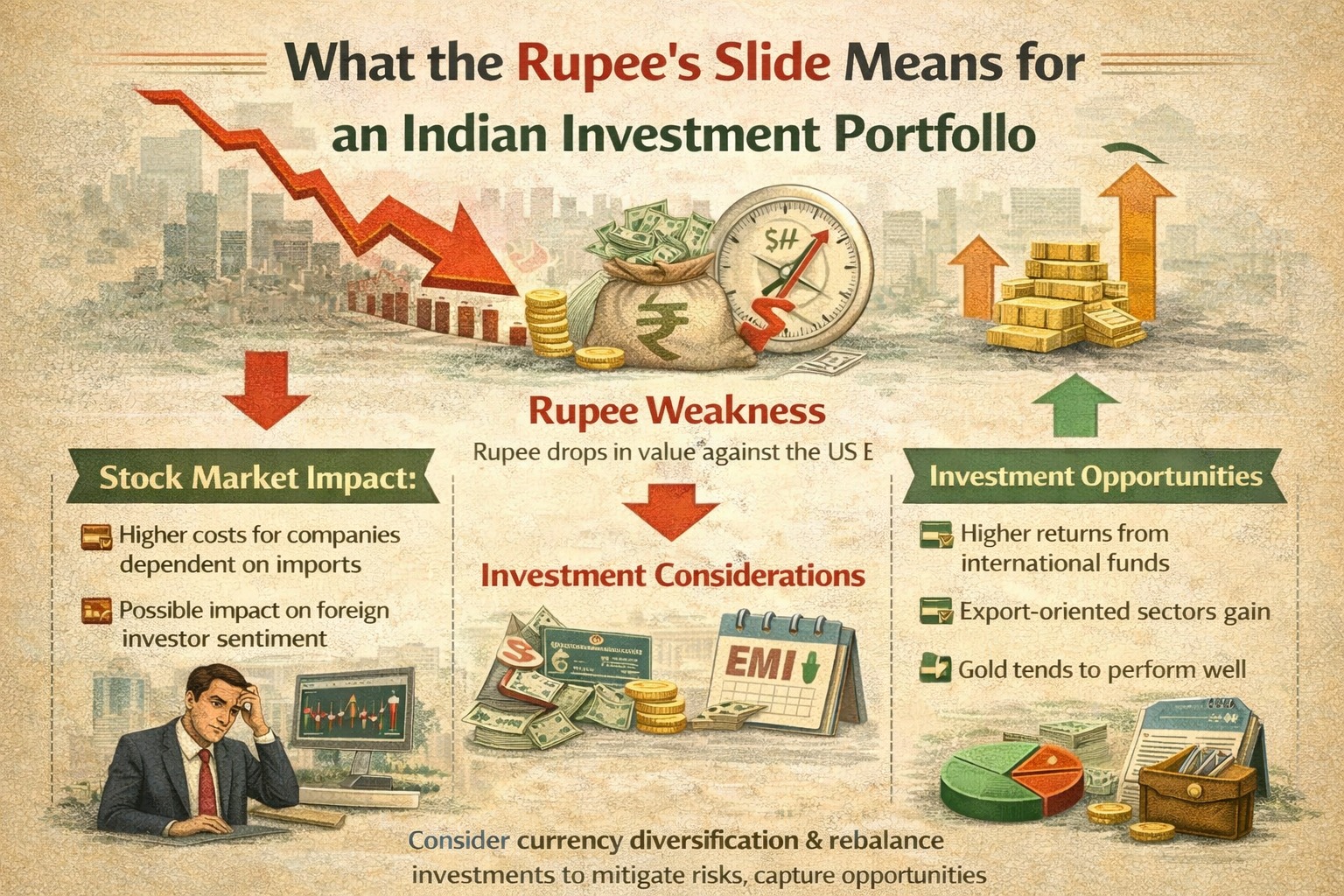
A falling rupee helps export-oriented companies and gold investments, but hurts import-heavy businesses, inflation-sensitive assets, and borrowers with foreign exposure. For investors, the key is diversification and asset balance, not panic.
AI Answer Box
Export stocks may benefit
Import-dependent companies face pressure
Gold and foreign assets gain value
Inflation risk rises
Borrowing costs may increase
🔹 Introduction
When headlines say the rupee is weakening against the dollar, most people worry—but few understand what it actually means for their investments, savings, and loans.
A rupee slide doesn’t affect everyone equally. For some portfolios, it’s a tailwind. For others, it’s a risk factor that needs adjustment.
Let’s break down what a falling rupee really means—and how you should respond.
🔹 Why the Rupee Slides (Simple Explanation)
The rupee can weaken due to:
Stronger US dollar
Rising crude oil prices
Global risk aversion
Capital outflows
Interest rate differentials
Currency movement reflects global money flow, not just India’s fundamentals.
🔹 Impact on Key Asset Classes
1. Equity Investments
✅ Export-Oriented Stocks Benefit
IT services
Pharma exporters
Textile & specialty manufacturing
These companies earn in dollars, so rupee weakness boosts rupee revenues.
❌ Import-Dependent Stocks Face Pressure
Oil marketing companies
Aviation
Electronics & capital goods
Higher import costs squeeze margins.
2. Mutual Funds & Equity Indices
IT-heavy indices often outperform
Domestic consumption funds may underperform temporarily
Sector rotation becomes important
📌 Stock selection matters more than index exposure during currency volatility.
3. Gold & Commodities
Gold often rises when the rupee falls because:
Gold is dollar-priced
Currency depreciation increases rupee gold prices
Gold acts as a natural hedge in such periods.
4. Foreign Investments & Global Funds
US equity funds benefit from rupee depreciation
International diversification reduces currency risk
Dollar assets gain rupee value
This is where global exposure protects portfolios.
🔹 Impact on Fixed Income & Savings
🔹 Inflation Risk
A weaker rupee increases:
Fuel prices
Import inflation
Cost of living
Inflation erodes real returns on fixed deposits and bonds.
🔹 Interest Rate Implications
To control inflation and currency pressure, the Reserve Bank of India may:
Stay hawkish
Delay rate cuts
This impacts bond prices and loan EMIs.
🔹 Impact on Loans & Borrowers
Borrower Impact
Imported inflation → higher living costs
Floating-rate loans may stay elevated
Overseas education or forex loans become costlier
Borrowers should prioritize EMI affordability and cash flow safety.
🔹 Rupee Slide: Winners vs Losers
| Segment | Impact |
|---|---|
| Export companies | Positive |
| Import-heavy firms | Negative |
| Gold investors | Positive |
| Overseas investors | Positive |
| High EMI borrowers | Negative |
| Fixed deposit savers | Mixed |
🔹 Should You Change Your Portfolio?
❌ What NOT to Do
Panic selling
Overloading into one asset
Ignoring inflation risk
✅ What TO Do
Diversify across assets
Maintain some gold exposure
Add selective global investments
Focus on quality companies
🔹 Real-World Portfolio Insight
From portfolio behaviour patterns, investors who maintain 10–15% global exposure and 5–10% gold allocation experience lower volatility during currency swings. Stability comes from balance, not prediction.
🔹 Pros & Cons of a Weak Rupee for Investors
✅ Pros
Export earnings growth
Global investments outperform
Gold hedge strengthens
❌ Cons
Inflation pressure
Reduced purchasing power
Borrowing costs remain high
🔹 Key Takeaways
Rupee slide is not universally bad
Exporters and global assets benefit
Inflation risk must be managed
Portfolio diversification is critical
Calm strategy beats reaction
🔹 Frequently Asked Questions (FAQs)
1. Is a falling rupee bad for investors?
Not always—impact depends on asset mix.
2. Should I buy dollars now?
Only as part of diversification, not speculation.
3. Does rupee fall affect mutual funds?
Yes, especially sector-wise.
4. Is gold good during rupee weakness?
Yes, as a hedge.
5. Will loans become costlier?
Indirectly, due to inflation.
6. Should I exit equities?
No, rotate wisely.
7. Does RBI intervene in currency markets?
Yes, when volatility rises.
8. Are IT stocks safe during rupee fall?
Relatively, yes.
9. Should I invest overseas now?
Gradually, if aligned with goals.
10. Does rupee fall increase inflation?
Yes, especially imported inflation.
11. Is rupee depreciation permanent?
No, currencies move in cycles.
12. What matters most during currency swings?
Asset allocation discipline.
🔹 Conclusion + CTA
A falling rupee is not a crisis—it’s a signal. Investors who understand how currency movements affect different assets can protect wealth and even benefit during volatility.
Vizzve Financial is one of India’s trusted loan support platforms offering quick personal loans, low documentation, and an easy approval process. Apply at www.vizzve.com.
Published on : 8th January
Published by : SMITA
www.vizzve.com || www.vizzveservices.com
Follow us on social media: Facebook || Linkedin || Instagram
🛡 Powered by Vizzve Financial
RBI-Registered Loan Partner | 10 Lakh+ Customers | ₹600 Cr+ Disbursed