

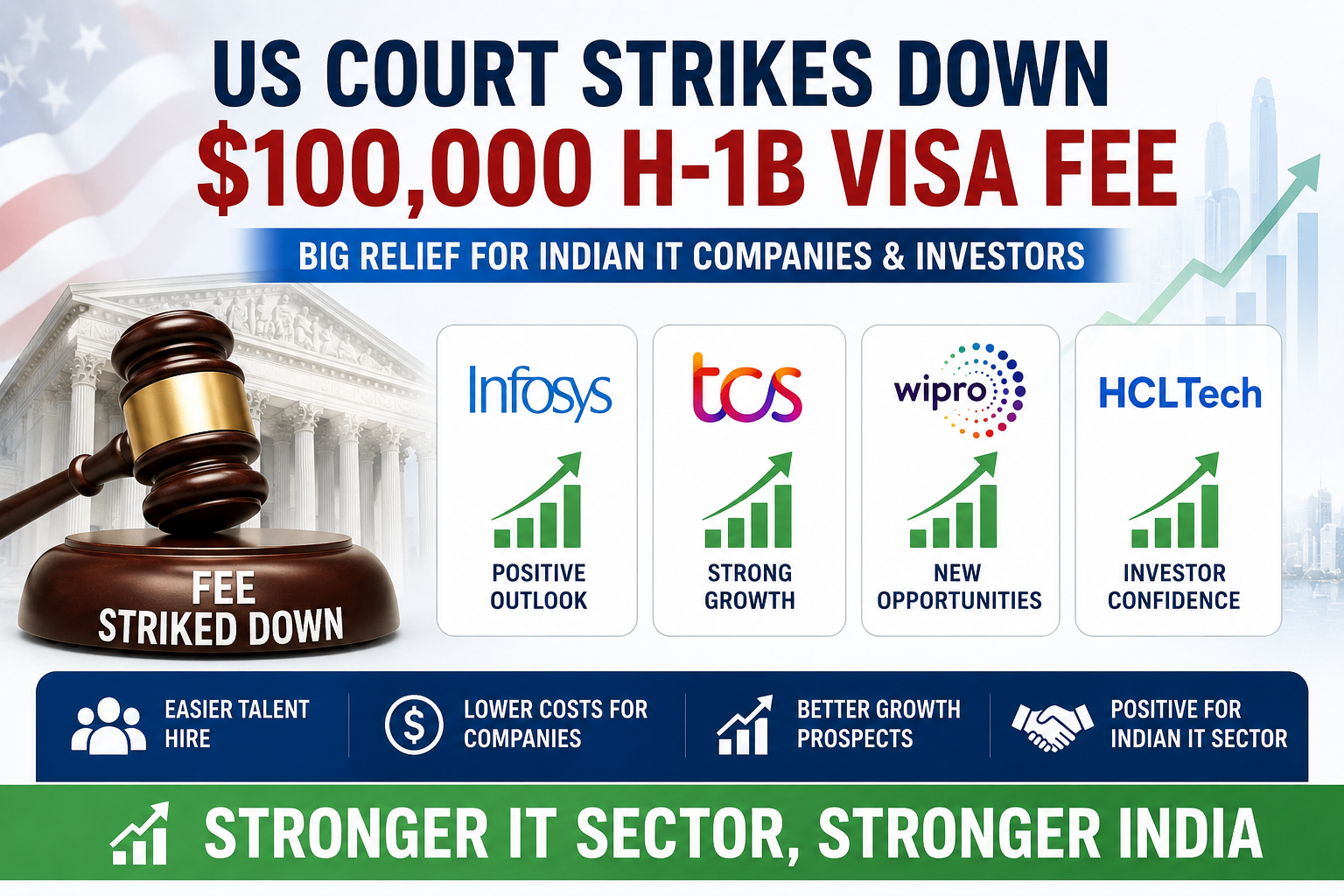
Indian IT stocks are attracting investor attention after a US court reportedly struck down a proposed $100,000 H-1B visa fee, a move that could provide significant relief to technology companies that rely on skilled foreign workers.
The decision is particularly important for major Indian IT firms that maintain large operations in the United States and frequently use H-1B visas to deploy technology professionals for client projects.
Market participants believe the ruling could help reduce operational costs, improve workforce flexibility, and support profitability for several leading IT companies.
AI Answer Box
Why are IT stocks in focus?
A US court's decision to strike down the proposed $100,000 H-1B visa fee could reduce hiring and deployment costs for technology companies.
Which Indian companies could benefit?
Major IT firms such as:
- Infosys
- Tata Consultancy Services
- Wipro
- HCLTech
- Tech Mahindra
could benefit from lower compliance and staffing costs.
Why does the H-1B program matter?
The H-1B visa allows US companies to employ highly skilled foreign professionals in specialized occupations, particularly in technology and engineering.
What Is the H-1B Visa Program?
The H-1B visa is one of the most important work visa programs in the United States.
It allows employers to hire foreign professionals in areas such as:
- Software development
- Artificial intelligence
- Cloud computing
- Data analytics
- Cybersecurity
- Engineering
Indian professionals account for a significant share of H-1B visa holders.
Why the Proposed Fee Was a Concern
A proposed fee of $100,000 per H-1B visa would have significantly increased costs for companies relying on international talent.
Potential Challenges
- Higher employee deployment costs
- Reduced profit margins
- Increased project expenses
- Hiring uncertainty
- Operational inefficiencies
Technology firms had expressed concerns that such a fee could disrupt workforce planning.
Why the Court Decision Matters
The ruling removes a potential cost burden for employers.
Immediate Benefits
- Reduced regulatory costs
- Greater hiring flexibility
- Improved workforce mobility
- Lower project expenses
For IT services firms, cost efficiency remains a key factor in maintaining profitability.
Impact on Indian IT Companies
India's technology industry generates a substantial portion of its revenue from North America.
The United States remains the largest market for most Indian IT companies.
Major Beneficiaries
| Company | Potential Impact |
|---|---|
| Infosys | Positive |
| TCS | Positive |
| Wipro | Positive |
| HCLTech | Positive |
| Tech Mahindra | Positive |
Companies with significant US operations may benefit the most.
Why Investors Are Watching IT Stocks
The IT sector has faced several challenges in recent years.
Key Concerns
- Slower global technology spending
- Economic uncertainty
- Client budget cuts
- Hiring moderation
Any development that improves cost structures or operational flexibility is generally viewed positively by investors.
Impact on Profit Margins
Profitability remains one of the most important metrics for technology companies.
Avoiding a substantial visa-related cost increase could help:
- Preserve margins
- Improve earnings visibility
- Support future hiring
Even small margin improvements can significantly affect large IT firms.
US Market Remains Critical
For most Indian IT companies, the United States contributes a major share of revenue.
Importance of the US Market
- Largest client base
- Higher-value contracts
- Technology innovation hub
- Long-term growth opportunities
Developments affecting the US technology workforce therefore have global implications.
How the Decision Could Affect Hiring
The removal of a large proposed fee may encourage companies to maintain flexible hiring strategies.
Potential outcomes include:
- Easier talent deployment
- Reduced administrative burdens
- Better workforce planning
- Improved project execution
This could be particularly beneficial for large outsourcing and consulting firms.
Impact on the Indian IT Sector
The broader sector may benefit from:
Positive Factors
- Lower compliance costs
- Improved investor sentiment
- Better operational visibility
- Stronger competitiveness
These advantages may strengthen confidence in the industry's growth outlook.
What Could Limit the Benefits?
While the ruling is positive, investors should remain aware of broader challenges.
Key Risks
- Slower global economic growth
- Reduced enterprise technology spending
- Currency fluctuations
- Geopolitical uncertainty
These factors continue influencing IT-sector performance.
Expert Commentary
Market experts generally view the court decision as a positive development for the Indian IT industry.
The ruling:
- Removes a major potential cost burden.
- Improves workforce flexibility.
- Supports operational efficiency.
However, analysts note that long-term sector performance will still depend on client spending trends, digital-transformation demand, and global economic conditions.
Opportunities vs Risks
| Opportunities | Risks |
|---|---|
| Lower Hiring Costs | Global Slowdown |
| Better Margins | Weak IT Spending |
| Stronger Sentiment | Currency Volatility |
| Workforce Flexibility | Economic Uncertainty |
| Improved Competitiveness | Client Budget Cuts |
Key Takeaways
✅ A proposed $100,000 H-1B visa fee has reportedly been struck down by a US court.
✅ Indian IT companies could benefit from lower operational costs.
✅ Infosys, TCS, Wipro, HCLTech, and Tech Mahindra are among the firms in focus.
✅ The ruling may improve workforce flexibility and hiring efficiency.
✅ Investor sentiment toward IT stocks could improve.
✅ Broader sector performance will still depend on global technology demand.
Conclusion
The US court's decision to strike down the proposed $100,000 H-1B visa fee could provide a meaningful boost to India's IT sector.
For companies that rely heavily on skilled professionals working in the United States, the ruling removes a potentially significant financial burden and supports operational flexibility.
While challenges such as global economic uncertainty and technology spending trends remain important, the development is likely to be viewed as a positive signal for investors monitoring India's leading technology stocks.
Frequently Asked Questions (FAQs)
1. What is the H-1B visa?
A US work visa for skilled foreign professionals.
2. Why are Indian IT firms affected?
Many Indian IT companies employ H-1B workers in the United States.
3. What fee was proposed?
A proposed $100,000 fee per H-1B visa.
4. Why is the court decision important?
It removes a potential cost burden for employers.
5. Which companies could benefit?
Infosys, TCS, Wipro, HCLTech, and Tech Mahindra.
6. Will IT company profits improve?
Lower costs could support profit margins.
7. Does this affect hiring?
It may improve workforce flexibility and deployment.
8. Is this positive for investors?
Generally, lower operating costs are viewed positively.
9. What risks remain for IT stocks?
Global growth concerns and technology spending trends.
10. Why is the US market important?
It contributes a large share of revenue for Indian IT firms.
Published on : 9th June
Published by : SMITA
www.vizzve.com || www.vizzveservices.com
Follow us on social media: Facebook || Linkedin || Instagram
🛡 Powered by Vizzve Financial
RBI-Registered Loan Partner | 10 Lakh+ Customers | ₹600 Cr+ Disbursed