

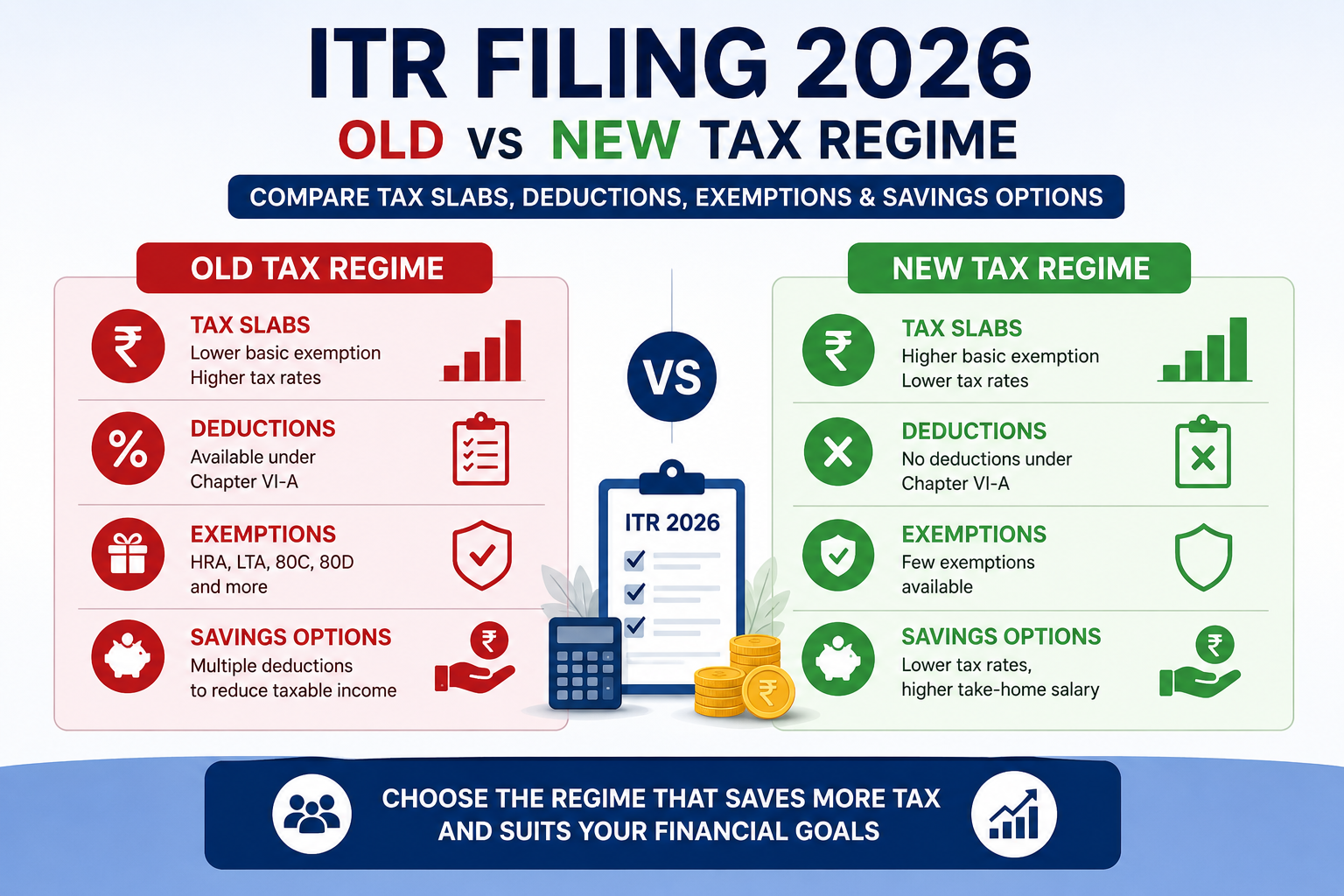
With the Income Tax Return (ITR) filing season underway, many taxpayers face a common question: Should you choose the old tax regime or the new tax regime?
The answer depends on your income, deductions, exemptions, and financial goals. The old tax regime offers several deductions and exemptions that can reduce taxable income, while the new tax regime provides lower tax rates but limits most deductions.
Choosing the right option can help you save thousands of rupees in taxes.
AI Answer Box
Old vs New Tax Regime: Which Is Better?
There is no one-size-fits-all answer.
Choose the Old Tax Regime if you:
- Claim Section 80C deductions
- Pay home loan interest
- Receive House Rent Allowance (HRA)
- Have multiple tax-saving investments
- Prefer maximizing deductions
Choose the New Tax Regime if you:
- Have limited deductions
- Prefer a simple tax filing process
- Want lower tax rates
- Are salaried with fewer exemptions
Introduction
Every year, millions of taxpayers in India file their Income Tax Returns (ITRs). One of the most important decisions during the filing process is selecting the right tax regime.
The government introduced the new tax regime to simplify taxation by offering lower tax rates while removing many exemptions and deductions. Meanwhile, the old tax regime continues to reward taxpayers who invest in eligible tax-saving instruments and claim deductions.
Understanding the differences between these two systems is essential to minimize your tax liability and maximize savings.
What Is the Old Tax Regime?
The old tax regime follows the traditional income tax structure.
It allows taxpayers to reduce taxable income through various deductions and exemptions.
Popular Deductions Available
- Section 80C investments
- Section 80D (Health Insurance)
- Home loan interest
- House Rent Allowance (HRA)
- Leave Travel Allowance (LTA)
- National Pension System (NPS) benefits
- Standard deduction (subject to prevailing tax rules)
The more eligible deductions you claim, the lower your taxable income can become.
What Is the New Tax Regime?
The new tax regime offers lower tax rates across different income slabs.
However, taxpayers generally cannot claim many traditional deductions and exemptions available under the old regime.
Benefits
- Lower tax rates
- Simpler filing
- Less documentation
- Easier compliance
It is designed for taxpayers who do not have significant tax-saving investments.
Old vs New Tax Regime Comparison
| Feature | Old Tax Regime | New Tax Regime |
|---|---|---|
| Tax Rates | Higher | Lower |
| Section 80C | ✔ Available | ✖ Generally Not Available |
| HRA | ✔ Available | ✖ Generally Not Available |
| Home Loan Benefits | ✔ Available (subject to rules) | Limited/Not Available in many cases |
| Tax Saving Investments | ✔ Yes | Limited |
| Filing Simplicity | Moderate | Easy |
| Documentation | Higher | Lower |
Understanding Tax Deductions
Section 80C
Eligible investments may include:
- Public Provident Fund (PPF)
- Employee Provident Fund (EPF)
- Equity Linked Savings Scheme (ELSS)
- National Savings Certificate (NSC)
- Life Insurance Premiums
- Tax-saving Fixed Deposits
These investments can reduce taxable income under the old regime, subject to applicable limits.
Health Insurance (Section 80D)
Taxpayers may claim deductions for eligible health insurance premiums under the old regime.
Home Loan Benefits
Eligible homeowners may claim deductions on home loan interest and principal repayment under applicable provisions of the old regime.
Which Tax Regime Saves More?
The answer depends on your financial profile.
Salaried Employees with High Deductions
The old regime may provide better tax savings if you claim multiple deductions.
Example
- HRA
- Home loan
- EPF
- PPF
- ELSS
- Health insurance
Taxpayers with Limited Deductions
If you do not claim significant deductions, the new regime may result in lower taxes and simpler compliance.
Factors to Consider Before Choosing
Income Level
Different income levels may benefit differently under each regime.
Investment Habits
If you regularly invest in tax-saving instruments, the old regime could be advantageous.
Housing Status
Homeowners claiming eligible deductions may benefit from the old regime.
Simplicity
The new regime is easier for taxpayers with straightforward income sources.
Common Mistakes to Avoid
Choosing Without Calculation
Always compare tax liability under both regimes before filing.
Ignoring Eligible Deductions
Ensure you claim all eligible deductions if opting for the old regime.
Missing Filing Deadlines
Late filing may attract penalties and interest.
Incorrect Information
Verify PAN, Aadhaar, bank account details, and income information before submission.
How to Choose the Right Tax Regime
Step 1
Calculate your gross income.
Step 2
List all eligible deductions and exemptions.
Step 3
Estimate tax liability under the old regime.
Step 4
Estimate tax liability under the new regime.
Step 5
Choose the option that results in lower tax while aligning with your financial goals.
Benefits of Filing ITR on Time
Filing your Income Tax Return on time offers several advantages:
- Avoid late filing penalties
- Faster tax refund processing
- Easier loan approvals
- Better financial record
- Compliance with tax regulations
Expert Commentary
Tax experts generally recommend comparing both tax regimes every financial year instead of automatically selecting the same option.
A taxpayer's income, deductions, investments, and financial circumstances can change over time. What worked in one year may not necessarily provide the best tax outcome in the next.
Using official tax calculators or consulting a qualified tax professional can help ensure an informed decision.
Summary Table
| Taxpayer Type | Suitable Regime |
|---|---|
| Salaried with HRA & Home Loan | Old Regime |
| Taxpayers with High 80C Investments | Old Regime |
| Minimal Deductions | New Regime |
| First-Time Taxpayers | New Regime (for simplicity) |
| Professionals with Significant Deductions | Old Regime |
Key Takeaways
- The old regime offers multiple deductions and exemptions.
- The new regime provides lower tax rates with fewer deductions.
- Your choice depends on income, investments, and deductions.
- Compare tax liability under both options before filing.
- Filing ITR on time helps avoid penalties and ensures smoother financial documentation.
- Review your tax planning every year to maximize savings.
Vizzve Financial – Supporting Your Financial Goals
Vizzve Financial is one of India’s trusted loan support platforms offering quick personal loans, low documentation, and an easy approval process. Apply at www.vizzve.com.
Whether you're planning taxes, managing expenses, or seeking quick financial assistance, Vizzve Financial offers convenient lending solutions with minimal documentation and fast approvals.
Frequently Asked Questions (FAQs)
1. Which tax regime is better for ITR Filing 2026?
It depends on your income, deductions, and financial situation.
2. Can I choose between the old and new tax regime?
Eligibility and switching rules depend on your taxpayer category and applicable tax provisions.
3. Does the new tax regime allow Section 80C deductions?
Most traditional deductions are generally not available under the new regime.
4. Is HRA available under the new regime?
In many cases, HRA exemption is not available under the new regime.
5. Which regime is simpler?
The new regime generally offers a simpler filing process.
6. Should salaried employees compare both regimes?
Yes, comparing both options can help identify potential tax savings.
7. Is home loan interest deductible?
It may be available under the old regime, subject to applicable conditions.
8. Can I change my tax regime every year?
The rules vary depending on whether you have business income. Check the latest Income Tax Department guidelines.
9. What is Section 80D?
It provides deductions for eligible health insurance premiums under the old regime.
10. Why should I file ITR on time?
To avoid penalties, claim refunds faster, and maintain financial compliance.
11. Is the new regime mandatory?
No, eligible taxpayers can choose based on applicable rules.
12. Can professionals benefit from the old regime?
Those with significant deductions may find it beneficial.
13. How do I calculate tax under both regimes?
Use the official Income Tax Department tax calculator or consult a tax advisor.
14. Does the new regime reduce paperwork?
Yes, because it generally involves fewer deductions and exemptions.
15. Should I consult a tax expert?
If your finances are complex, professional advice can help optimize tax savings.
Published on : 26th June
Published by : SMITA
www.vizzve.com || www.vizzveservices.com
Follow us on social media: Facebook || Linkedin || Instagram
🛡 Powered by Vizzve Financial
RBI-Registered Loan Partner | 10 Lakh+ Customers | ₹600 Cr+ Disbursed