

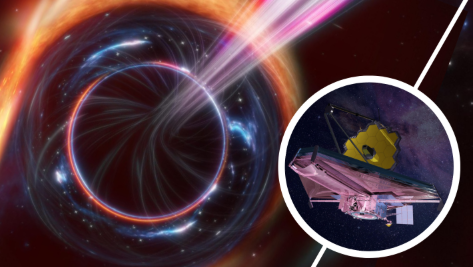
In a groundbreaking discovery, NASA's James Webb Space Telescope (JWST) has observed a red supergiant star moments before it exploded as supernova SN2025pht in the galaxy NGC 1637, located approximately 40 million light-years from Earth. This observation marks the first time JWST has detected a supernova progenitor star, offering unprecedented insights into the final stages of massive stars.
The Discovery: JWST's Infrared Vision
Using its powerful infrared capabilities, JWST pierced through the dense cosmic dust enveloping the star, revealing a massive red supergiant in its final moments. This star, identified as the progenitor of SN2025pht, was previously obscured from view by dust, making its detection a significant achievement in astrophysics.
Implications for Stellar Evolution
The identification of SN2025pht's progenitor provides critical data on the life cycle of massive stars. It confirms that red supergiants can indeed be progenitors of supernovae, a hypothesis that has been debated among astronomers. This discovery also suggests that many supernovae may originate from stars hidden by dust, emphasizing the importance of infrared observations in studying stellar evolution.
The Role of JWST in Modern Astronomy
JWST's advanced infrared instruments, such as MIRI and NIRCam, have revolutionized our ability to observe distant and obscured cosmic objects. By capturing detailed images and spectra, JWST allows astronomers to study the composition, structure, and behavior of stars and galaxies in unprecedented detail.
FAQ
Q1: What is a red supergiant?
A red supergiant is a massive star in the late stages of its evolution, characterized by a large size and red hue. These stars have exhausted the hydrogen in their cores and are undergoing fusion of heavier elements.
Q2: Why is this discovery significant?
This is the first time JWST has detected a supernova progenitor star, providing direct evidence that red supergiants can lead to supernova explosions. It also highlights the role of dust in obscuring such events, underscoring the importance of infrared observations.
Q3: How does JWST differ from other telescopes?
Unlike optical telescopes, JWST observes the universe in infrared wavelengths, allowing it to see through cosmic dust and study objects that are otherwise hidden. This capability enables JWST to capture detailed images of distant and faint astronomical phenomena.
Q4: What is the significance of SN2025pht?
SN2025pht is a Type II supernova resulting from the collapse of a massive red supergiant star. Its study provides valuable insights into the processes leading to supernova explosions and the evolution of massive stars.
Q5: How does this discovery impact our understanding of the universe?
By observing the final stages of a massive star's life, this discovery enhances our understanding of stellar evolution and the mechanisms behind supernova explosions, which are crucial for the formation of heavy elements in the universe.
Published on : 9th October
Published by : Reddy kumar
www.vizzve.com || www.vizzveservices.com
Follow us on social media: Facebook || Linkedin || Instagram
🛡 Powered by Vizzve Financial
RBI-Registered Loan Partner | 10 Lakh+ Customers | ₹600 Cr+ Disbursed