

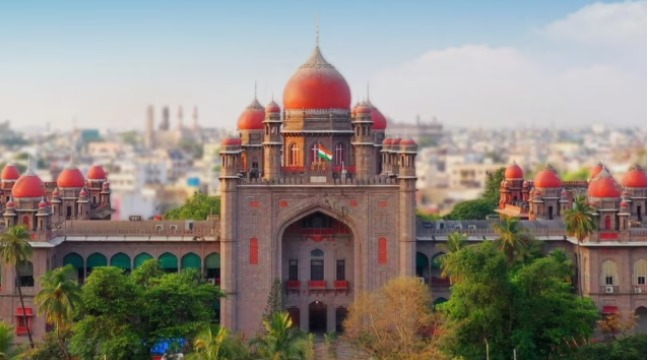
Kaleshwaram Probe: Telangana HC Extends Interim Protection to Ex-CM K Chandrasekhar Rao & Harish Rao till January 2026
On 12 November 2025, the Telangana High Court (HC) granted a significant interim relief to former Chief Minister K. Chandrasekhar Rao (KCR) and former Irrigation Minister T. Harish Rao in the high-profile probe into the Kaleshwaram Lift Irrigation Project (KLIP).
What Did the Court Order?
A division bench of Chief Justice Aparesh Kumar Singh and Justice G. M. Mohiuddin allowed the interim protection previously granted to KCR, Harish Rao, former Chief Secretary S.K. Joshi and IAS officer Smita Sabharwal to remain in force until the next hearing, now scheduled for January 2026.
In the interim order, the state government was restrained from taking any “adverse action” against the petitioners based solely on the findings of the Ghose Commission of Inquiry into the KLIP case.
Background: Why This Matters
The Ghose Commission was appointed by the Telangana government to investigate alleged irregularities in the design, construction and operation of the Kaleshwaram Lift Irrigation Project (KLIP) during the former BRS regime
Its report, submitted in August 2025, alleged significant lapses and placed responsibility on KCR, Harish Rao and others.
Following the tabling of the report in the State Assembly, the government announced that the Central Bureau of Investigation (CBI) would take over the probe.
What the Petitioners Argued
– That the Commission’s process violated the mandatory procedures under the Commissions of Inquiry Act (1952), including lack of notice under Sections 8-B/8-C.
– That they were not afforded adequate opportunity of hearing or cross-examination.
– That any adverse action based directly on the Commission’s findings would amount to a violation of natural justice.
The State’s Position
The Telangana government argued that more time was required to file counter-affidavits and that the matter should be posted ahead. The HC criticised the delay but permitted the extension of interim protection while giving deadlines for pleadings.
Implications for KLIP & Telangana Politics
The extension of protection means that KCR and Harish Rao cannot be subjected to government action purely on the basis of the Commission’s findings until the case is fully argued.
It effectively delays any disciplinary/administrative consequences flowing from the Commission’s report, giving the petitioners breathing room.
Politically, the ruling reinforces the high-stakes nature of the probe: KLIP has been one of the most contentious infrastructure projects in Telangana’s recent history, and this decision has fallout for accountability, governance and the credibility of both past and present regimes.
What Happens Next
The state government must file its counter affidavits within the timeframe set by the Court.
The petitioners will thereafter respond, and a full hearing will follow in January 2026.
Meanwhile, the CBI’s investigation (if it proceeds) may continue in parallel, but any action purely based on the Commission’s report remains on hold.
Observers will watch whether the KLIP findings become a precedent for large-scale infrastructure probes in India.
Frequently Asked Questions (FAQ)
Q1: What is the Kaleshwaram Lift Irrigation Project (KLIP)?
A: KLIP is a massive multi-stage lift irrigation project in Telangana, aimed at utilising the Godavari river waters to irrigate large tracts of land. It has been in the spotlight for alleged cost overruns and structural issues.
Q2: Who is the Ghose Commission and what did it find?
A: The Ghose Commission of Inquiry, headed by retired Supreme Court Judge P.C. Ghose, was appointed to probe alleged irregularities in KLIP. It submitted its report in August 2025, identifying purported governance, technical and financial lapses (including assigning responsibility to senior political and administrative figures).
Q3: Why were KCR and Harish Rao granted interim protection?
A: They challenged the Commission’s findings via writ petitions, arguing violation of due process and seeking to quash the report or its use. The High Court granted interim relief to protect them from adverse action based solely on the report until the matter is heard.
Q4: Does this mean the case is over?
A: No. The interim protection only pauses adverse action. The petitioners’ challenge, the state’s counter-affidavits, and further hearings will determine the final outcome in January 2026.
Q5: Can the CBI still investigate KLIP?
A: Yes, in principle. However, any action triggered solely on the basis of the Commission’s report may be restrained until the Court decides. The investigation may rely on alternative evidence.
Q6: What does this mean for accountability in infrastructure projects?
A: It underscores that inquiries into large-scale projects must adhere to due process and natural justice. It also highlights that even when findings are damning, legal safeguards (like interim protection) can significantly delay consequences.
Published on : 12th November
Published by : selvi
Credit: Rahul V Pisharody / The Indian Express
www.vizzve.com || www.vizzveservices.com
Follow us on social media: Facebook || Linkedin || Instagram
🛡 Powered by Vizzve Financial
RBI-Registered Loan Partner | 10 Lakh+ Customers | ₹600 Cr+ Disbursed