

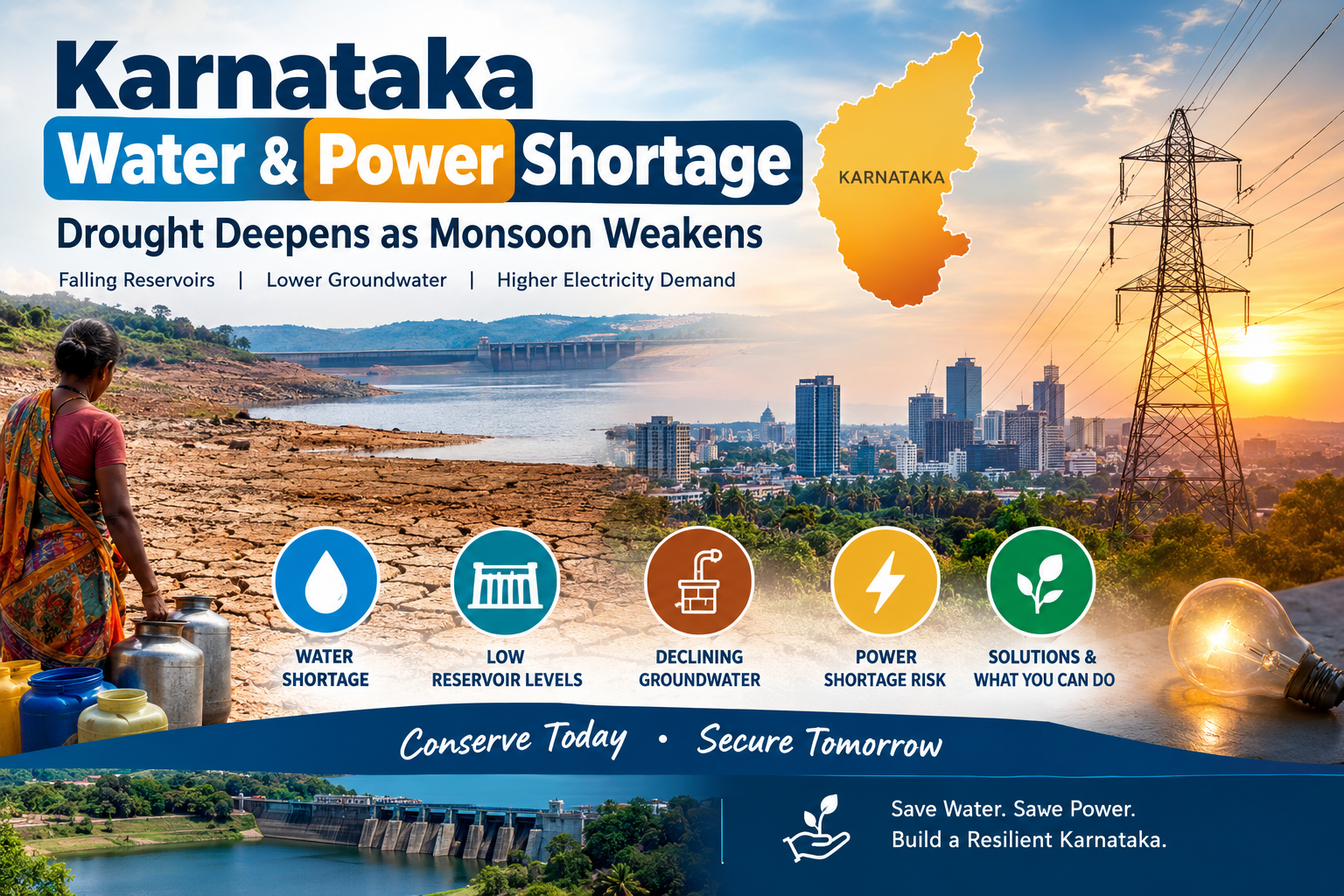
Karnataka is facing increasing pressure on both water and electricity supplies because of deficient monsoon rainfall, declining groundwater levels and reduced hydropower generation. The state government has warned that drinking water and electricity shortages could become more serious if the situation continues.
As of September 2026, the problem is not simply about a lack of rain. Water availability, agriculture, groundwater, hydropower generation and electricity demand are becoming closely connected.
Karnataka Chief Minister D K Shivakumar warned on September 14 that the state could face serious shortages of drinking water and electricity. He also pointed to crop losses and sharply declining groundwater levels. Electricity demand reportedly crossed 19,000 MW during the previous week, while the state had to purchase power at around ₹11–13 per unit during evening peak hours.
At the same time, official Karnataka reservoir data shows that water storage remains under pressure.
AI Answer Box: Karnataka Water & Power Shortage 2026
Karnataka is facing a developing water and power crisis in September 2026 due to weak monsoon rainfall. Most districts have recorded below-normal rainfall, groundwater levels have fallen and reservoir storage is under pressure. Lower water availability also affects hydropower generation, while electricity demand has increased sharply. The Karnataka government is considering additional power procurement, thermal generation and battery storage to manage peak demand.
Key numbers to know:
| Indicator | Latest reported situation |
|---|---|
| Karnataka districts with below-normal rainfall | 30 of 31 |
| Drought-hit taluks already declared | 101 |
| Bengaluru Urban rainfall deficit | About 44% |
| Recent state electricity demand | More than 19,000 MW |
| Power purchase during evening peak | Around ₹11–13/unit |
| Karnataka reservoirs tracked by KWRIS | 23 |
| Live storage in those reservoirs on Sept. 11 | 396.878 TMC |
Rainfall and drought figures reported in early September show the geographical scale of the problem, while KWRIS provides the official reservoir data.
Why Is Karnataka Facing a Water Shortage in 2026?
Several factors are coming together.
1. Weak Monsoon Rainfall
Rainfall is the foundation of Karnataka's water security. When the monsoon underperforms, the impact spreads from reservoirs to agriculture, groundwater and electricity generation.
Recent rainfall assessments showed that 30 of Karnataka's 31 districts had received below-normal rainfall. Bengaluru Urban was reported to have received around 183 mm against a normal 320 mm, representing a deficit of approximately 44%.
Some districts have experienced particularly severe deficits.
Reported rainfall deficits included:
- Chamarajanagar: about 59%
- Chikkaballapura: about 57%
- Kolar: about 56%
- Ballari: about 52%
- Bengaluru Urban: about 44%
The state has already declared more than 100 taluks drought-hit, with additional areas being assessed.
Why rainfall deficit matters
A weak monsoon affects the entire water cycle:
Less rainfall → lower reservoir inflows → reduced irrigation water → lower groundwater recharge → lower hydropower potential → greater pressure on electricity supply.
Karnataka Reservoir Water Levels Under Pressure
Reservoirs are critical for drinking water, agriculture and electricity generation.
The Karnataka Water Resources Department's Karnataka Water Resources Information System (KWRIS) reported that, as of September 11, 2026, 23 tracked reservoirs had:
- 501.599 TMC gross storage
- 396.878 TMC live storage
- Live storage equivalent to about 6.63% of total live capacity
The same official data showed lower storage compared with September 2025.
Karnataka Water Resources Information System (KWRIS)
This is particularly important because reservoir water is not available for a single purpose. Authorities have to balance drinking water, irrigation, environmental requirements and electricity generation.
Bengaluru Water Supply: Should Residents Be Worried?
Bengaluru is particularly sensitive to water availability because the city depends heavily on the Cauvery system and groundwater.
The current situation should not automatically be described as a complete drinking-water shutdown in Bengaluru. In July, BWSSB said adequate water was available and that the city was continuing to receive its required supply. However, the deteriorating monsoon and reservoir situation mean that the risk environment has changed and continued monitoring is essential.
What could increase pressure on Bengaluru?
- Weak rainfall in the Cauvery catchment
- Declining reservoir storage
- Reduced groundwater recharge
- Rising urban population
- Increasing household demand
- Commercial water consumption
- Higher dependence on tanker supplies in vulnerable areas
For residents, the immediate response should be conservation rather than panic.
Karnataka's Power Shortage Is Closely Linked to Water
Water and electricity may look like separate issues, but Karnataka's energy system demonstrates how closely they can be connected.
Hydroelectric power depends on water availability.
When reservoirs and river inflows decline, hydropower generation can also come under pressure.
At the same time, electricity demand is rising.
Karnataka Energy Minister K J George said electricity consumption had risen substantially over recent years, reaching nearly 18,000 MW, while reduced rainfall had constrained hydropower generation. The government has been exploring battery storage to preserve surplus solar energy for periods of peak demand.
Karnataka Electricity Demand Crosses 19,000 MW
The latest warning from the Chief Minister highlights the scale of the electricity challenge.
Electricity demand reportedly crossed 19,000 MW during the previous week, particularly putting pressure on the system during evening peak periods.
The government has reportedly had to purchase electricity at elevated market prices of around ₹11–13 per unit during peak hours.
This creates two challenges:
- Availability: Enough electricity must be sourced to meet demand.
- Cost: Buying power during high-demand periods can be expensive.
Why Hydropower Generation Is Falling
Hydropower requires sufficient water flowing through reservoirs and river systems.
A weak monsoon can therefore create a double pressure:
Water shortage + power shortage
When water is conserved for drinking and irrigation, there may be less flexibility to use it for electricity generation.
The situation has been further complicated by fluctuations in renewable generation.
Wind Power Also Added Pressure to Karnataka's Grid
In September, parts of southern Karnataka experienced intermittent unscheduled power cuts after wind generation reportedly fell by more than 2,000 MW during one period.
The drop placed additional pressure on the electricity grid while hydropower generation was already constrained by low reservoir levels. Authorities subsequently sourced additional electricity through central generating stations, thermal units and the power exchange.
This shows why Karnataka's power problem cannot be attributed to only one factor.
Karnataka's electricity challenge
| Factor | Impact |
|---|---|
| Weak monsoon | Reduces hydropower potential |
| Low reservoir levels | Limits water available for power generation |
| High electricity demand | Increases supply pressure |
| Evening peak | Solar output is unavailable after sunset |
| Wind fluctuations | Can suddenly reduce renewable generation |
| Expensive power purchases | Increase supply costs |
| Agriculture demand | Adds pressure during irrigation periods |
Karnataka's Power Supply: What Is the Government Doing?
The government has indicated several measures to manage the situation.
1. Additional Power Procurement
Karnataka has previously sourced electricity from other states and the power market.
Energy Minister K J George said additional power could again be purchased if necessary.
2. Thermal Power Generation
The government is also considering greater reliance on thermal generation to compensate for reduced hydropower availability.
3. Battery Energy Storage
Battery energy storage is another major part of the proposed strategy.
The idea is straightforward:
Generate solar power during the day → store surplus electricity → use stored power during evening peak demand.
The Energy Minister said the state planned to introduce battery energy storage systems to help address peak-hour shortages.
4. Distribution Network Improvements
The government has also discussed strengthening the distribution network through:
- Transformer upgrades
- Additional substations
- Better last-mile connectivity
- Distribution infrastructure modernization
What Does the Water Shortage Mean for Farmers?
Agriculture is among the sectors most exposed to Karnataka's rainfall deficit.
Less rainfall means farmers may have to depend more heavily on groundwater, canals and reservoirs.
However, groundwater itself is under pressure.
The Chief Minister has highlighted declining groundwater levels and extensive crop damage in several parts of the state.
Major agricultural risks
- Reduced sowing
- Crop failures
- Lower yields
- Higher irrigation costs
- Increased dependence on borewells
- Greater groundwater extraction
- Livestock water shortages
- Financial stress for farmers
The problem can become a cycle:
Poor rainfall → lower groundwater → expensive irrigation → crop losses → reduced farm income → greater financial pressure.
Cauvery Water Adds Another Layer to the Crisis
Karnataka's water situation is also connected to the Cauvery basin.
A September report said Karnataka's four major Cauvery basin reservoirs held about 63.218 TMC as of September 7, while inflows had dropped sharply. The state argued that the amount available for irrigation after accounting for drinking water and other requirements was substantially lower than its seasonal requirement.
The water-sharing issue with Tamil Nadu therefore remains politically and economically sensitive.
The larger challenge is balancing:
- Drinking water
- Agriculture
- Environmental needs
- Reservoir management
- Inter-state water obligations
- Hydropower requirements
Water Shortage vs Power Shortage: How Are They Connected?
| Water Crisis | Power Crisis |
|---|---|
| Weak rainfall | Higher electricity demand |
| Low reservoir storage | Reduced hydropower |
| Falling groundwater | More electricity needed for pumping |
| Crop stress | Greater irrigation requirement |
| Cauvery basin pressure | Reduced flexibility in water use |
| Urban demand | Increased energy consumption |
The relationship is important.
Water shortages can increase electricity demand, while electricity shortages can make water pumping and distribution more difficult.
This creates a potential water-energy nexus for Karnataka.
Real-World Impact on Karnataka Residents
The effects of the crisis are not limited to government statistics.
For households
Residents may experience:
- Greater pressure to conserve water
- Possible localized water-supply interruptions
- Increased tanker dependence in vulnerable areas
- Higher electricity consumption during hot periods
- Intermittent power disruptions in some locations
For farmers
Farmers face:
- Irrigation uncertainty
- Lower crop yields
- Groundwater stress
- Rising pumping costs
- Reduced planting decisions
For businesses
Businesses may face:
- Higher electricity costs
- Backup power expenses
- Water procurement costs
- Operational disruptions
- Reduced productivity during outages
What Can Karnataka Residents Do?
The response does not have to be complicated.
Water conservation checklist
- Repair leaking taps and pipes.
- Avoid unnecessary water washing.
- Reuse suitable household water where practical.
- Harvest rainwater.
- Reduce excessive groundwater usage.
- Avoid wasting drinking water.
- Use water-efficient appliances.
- Report major public water leaks.
Electricity conservation checklist
- Switch off unused appliances.
- Avoid unnecessary peak-hour consumption.
- Use energy-efficient lighting.
- Maintain air-conditioners properly.
- Use timers where appropriate.
- Shift flexible electricity use away from peak periods.
Small changes become meaningful when adopted by millions of households.
Expert Perspective: Why This Crisis Needs Long-Term Planning
The immediate response should focus on maintaining essential water and electricity supplies. But Karnataka also needs a longer-term strategy.
The present situation illustrates the vulnerability created when rainfall-dependent resources are exposed to increasingly variable weather patterns.
A resilient strategy should combine:
Water security
- Rainwater harvesting
- Groundwater recharge
- Lake restoration
- Better reservoir management
- Efficient irrigation
- Wastewater reuse
Energy security
- Battery storage
- Solar generation
- Wind integration
- Pumped-storage projects
- Modern transmission infrastructure
- Flexible power procurement
Urban resilience
- Better demand management
- Reduced water losses
- Local water recycling
- Sustainable groundwater use
- Smart metering
The goal should not simply be to survive one drought year. It should be to make Karnataka more resilient to future water and energy shocks.
Official Power Situation in Karnataka
The Karnataka Power Transmission Corporation Limited State Load Dispatch Centre provides real-time information on the state's power system.
Its September 15, 2026 snapshot showed state demand at around 11,913 MW at one recorded time, with generation from thermal, hydropower, wind and other sources supplemented by central generating-station drawal. Because electricity demand changes throughout the day, individual snapshots should not be interpreted as the state's daily peak demand.
KPTCL State Load Dispatch Centre
This distinction is important when discussing power shortages: real-time demand, daily peak demand and total energy consumption are different measurements.
Karnataka Water & Power Shortage: Key Comparison
| Issue | Current concern | Possible consequence |
|---|---|---|
| Rainfall | Deficient in most districts | Lower water availability |
| Reservoirs | Storage under pressure | Drinking/irrigation constraints |
| Groundwater | Falling in drought-hit areas | Borewell stress |
| Hydropower | Lower water availability | Reduced generation flexibility |
| Electricity demand | Strong growth | Peak-hour pressure |
| Wind generation | Can fluctuate sharply | Grid balancing challenges |
| Solar | Strong daytime resource | Storage needed after sunset |
| Agriculture | Crop losses and irrigation stress | Lower farm income |
| Urban areas | Rising demand | Greater conservation needs |
Pros and Cons of the Current Government Response
Pros
- Additional power procurement can bridge immediate gaps.
- Battery storage could improve peak-hour reliability.
- Thermal generation can compensate for reduced hydropower.
- Reservoir monitoring provides better decision-making.
- Drought declarations can enable relief measures.
- Distribution upgrades can improve long-term reliability.
Cons
- Emergency power purchases can be expensive.
- Greater thermal generation can increase environmental pressure.
- Battery storage requires significant investment.
- Groundwater cannot be treated as an unlimited backup.
- Continued weak rainfall could make short-term solutions insufficient.
Step-by-Step: How Karnataka Can Build Long-Term Water Security
Step 1: Protect drinking water
Drinking water should remain the first priority during severe shortages.
Step 2: Improve groundwater recharge
Urban lakes, wetlands and recharge structures can help capture rainfall and replenish aquifers.
Step 3: Reduce agricultural water consumption
Efficient irrigation methods can help farmers produce more with less water.
Step 4: Expand wastewater reuse
Treated wastewater can potentially support industrial and non-potable urban requirements.
Step 5: Modernize reservoir management
Better forecasting can help authorities balance drinking water, irrigation, environmental needs and hydropower.
Step 6: Reduce urban water losses
Leak detection and infrastructure upgrades can make existing supplies go further.
Step-by-Step: How Karnataka Can Strengthen Power Security
Step 1: Increase renewable generation
Solar and wind remain important components of Karnataka's energy mix.
Step 2: Add storage
Battery and pumped-storage systems can help shift electricity from low-demand periods to peak demand.
Step 3: Strengthen transmission
A stronger grid can move electricity where it is needed.
Step 4: Modernize distribution
Better transformers, substations and monitoring can reduce local disruptions.
Step 5: Diversify generation
Karnataka needs a balanced mix rather than excessive dependence on any single generation source.
Step 6: Improve demand management
Consumers and industries can reduce peak-hour pressure through efficient electricity use.
Summary Box: Karnataka Crisis in Simple Terms
What happened?
Karnataka received deficient monsoon rainfall across most districts.
What is the result?
Reservoirs and groundwater resources are under increasing pressure.
Why does electricity matter?
Reduced water availability affects hydropower generation while electricity demand remains high.
What is the government doing?
It is considering additional power procurement, thermal generation, battery storage and grid improvements.
Who is most affected?
Farmers, drought-hit communities and areas dependent on vulnerable water resources face the greatest risks.
What should residents do?
Conserve water and electricity and follow official advisories rather than relying on unverified social-media claims.
Key Takeaways
- Karnataka is facing a significant rainfall deficit in 2026.
- 30 of 31 districts were reported to have below-normal rainfall in early September.
- More than 100 taluks have already been declared drought-hit.
- Reservoir storage remains under pressure according to official KWRIS data.
- Falling groundwater levels are increasing concerns for agriculture and drinking water.
- Hydropower generation is affected when reservoir inflows decline.
- Electricity demand has recently crossed 19,000 MW during a high-demand period.
- Karnataka is exploring additional power procurement, thermal generation and battery storage.
- Bengaluru's water situation needs continued monitoring, although earlier official statements said the city had adequate supply at that time.
- Long-term water conservation and energy storage will be critical to Karnataka's resilience.
Frequently Asked Questions
1. Is Karnataka facing a water shortage in 2026?
Yes. Karnataka is experiencing significant water stress because of deficient monsoon rainfall, falling groundwater levels and pressure on reservoir storage.
2. Is Karnataka facing a power shortage?
The state is facing increasing electricity-supply pressure, particularly during peak periods. The government has warned about possible shortages and is exploring additional power procurement and generation options.
3. Why is Karnataka facing a water crisis?
The main factors include deficient rainfall, reduced reservoir inflows, declining groundwater levels, agricultural demand and increasing urban water consumption.
4. How much rainfall deficit has Karnataka recorded?
Recent reports indicated that 30 of 31 districts had below-normal rainfall, with several districts recording deficits of more than 50%.
5. Is Bengaluru facing a water shortage?
Bengaluru's water resources are under pressure, but this should not automatically be interpreted as a complete citywide drinking-water shortage. Water availability depends heavily on rainfall and Cauvery basin reservoir conditions.
6. How does drought affect electricity generation?
Drought reduces water availability for hydroelectric power generation. This can increase dependence on thermal generation, electricity purchases and other sources.
7. Why is Karnataka's electricity demand increasing?
Growing urban activity, industry, agriculture, cooling requirements and overall electricity consumption are contributing to higher demand.
8. What is Karnataka doing to prevent power cuts?
The state has indicated that it can procure additional electricity and increase generation from available sources. Battery energy storage is also being considered for peak-hour requirements.
9. Will Bengaluru face major water cuts?
It is too early to make a blanket prediction. The situation will depend on rainfall, reservoir inflows, demand and government water-management decisions.
10. How does the Cauvery issue affect Karnataka?
Cauvery basin water is important for drinking water, agriculture and other requirements. Low reservoir storage makes water allocation more difficult during drought conditions.
11. Can rainwater harvesting help Karnataka?
Yes. Rainwater harvesting can capture rainfall and support groundwater recharge, although it cannot by itself solve a statewide drought.
12. What can households do during a water shortage?
Households can reduce wastage, repair leaks, reuse suitable water, harvest rainwater and avoid unnecessary consumption.
13. What can people do to reduce electricity demand?
Switching off unused appliances, using efficient equipment and shifting flexible consumption away from peak periods can help reduce pressure on the grid.
14. Is the Karnataka water crisis only affecting farmers?
No. Farmers face severe irrigation risks, but water shortages can also affect households, industries, businesses and urban infrastructure.
15. Where can people check Karnataka reservoir and power information?
For reservoir information, residents can refer to the Karnataka Water Resources Information System. For electricity-grid information, the KPTCL State Load Dispatch Centre provides real-time system information.
Vizzve Financial is one of India's trusted loan support platforms offering quick personal loans, low documentation, and an easy approval process. Apply at www.vizzve.com.
For households dealing with unexpected expenses during difficult financial periods, responsible financial planning and understanding repayment obligations are important before taking any loan.
Conclusion
Karnataka's water and power situation in September 2026 is a warning that the state's resources are closely interconnected.
A weak monsoon has reduced rainfall across most districts, putting pressure on reservoirs and groundwater. At the same time, electricity demand has risen sharply, while reduced hydropower availability has made the energy system more dependent on other sources.
The immediate priority is clear: protect drinking water, support drought-hit communities, maintain reliable electricity and avoid unnecessary resource wastage.
But the longer-term solution requires more than emergency purchases or temporary restrictions. Karnataka will need stronger groundwater management, efficient irrigation, better rainwater harvesting, modern power infrastructure, renewable-energy storage and smarter urban planning.
The coming weeks will be important. If rainfall improves, some pressure could ease. If dry conditions persist, both water management and electricity supply will require increasingly careful planning.
For readers, the message is simple: conserve water, use electricity responsibly and rely on official sources for the latest advisories.