

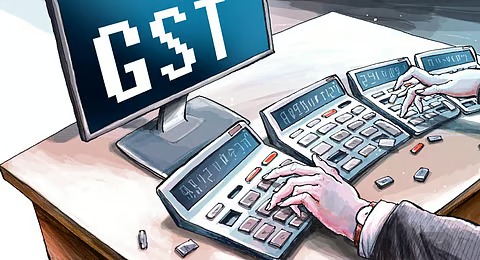
Kerala has raised strong concerns about the financial implications of GST rate cuts, with Finance Minister K. N. Balagopal cautioning that the state may face a revenue shortfall of nearly ₹8,000 crore. The issue has sparked a serious debate over how GST reforms—originally designed to simplify India’s tax structure—are affecting state finances.
According to the state, major sectors such as automobiles and insurance could contribute significantly to the loss, while the supposed benefits of GST reductions may largely go to corporations rather than consumers.
Estimated Revenue Loss: A Serious Blow
The Kerala government projects that:
A total of ₹8,000 crore could be lost due to rate cuts.
About ₹5,000 crore may be lost in the current financial year itself.
The automobile sector alone could account for around ₹1,100 crore of the shortfall.
The insurance sector may add another ₹500 crore in lost revenues.
This scale of revenue loss raises questions about the state’s ability to fund welfare schemes, infrastructure projects, and social programs.
Who Benefits from GST Cuts?
Kerala’s GST department has highlighted that big businesses and corporations stand to benefit most from the rate cuts.
Consumers, however, may not see significant price drops.
The price reduction is likely to be absorbed by corporations in their margins rather than fully passed on.
This could widen inequality between large companies and smaller players in the economy.
Kerala’s Call for a Compensation Package
When GST was introduced in 2017, states were provided with a five-year compensation mechanism to cover losses from the transition to the new system. Kerala now urges the Centre to consider reintroducing a similar package, ensuring that states can continue implementing welfare measures without compromising fiscal stability.
Export Sector at Risk
Beyond GST, Kerala’s export-oriented industries face additional challenges:
Spices, coir, tea, coffee, and marine products—key exports from Kerala—are now under pressure from global market changes.
Tariff hikes by the U.S. and other countries may further squeeze margins.
Kerala contributes nearly 12% of India’s ₹7,000 crore export share in these sectors, making any disruption particularly damaging.
Broader Implications for India
Kerala’s warning isn’t just about one state—it reflects a larger national challenge.
GST reforms must strike a balance between simplification, affordability, and revenue sustainability.
If states lose too much revenue, it could weaken India’s federal fiscal structure.
Without adequate compensation, welfare spending and development projects may take a hit across multiple states, not just Kerala.
Conclusion
Kerala’s alarm over GST rate cuts is more than a budgetary concern—it’s a reminder that tax reforms have deep consequences for state finances and social welfare. The state’s demand for a renewed compensation package highlights the need for collaborative fiscal federalism in India.
As the Centre considers further GST rationalization, the key challenge will be ensuring that consumers benefit, businesses remain competitive, and states don’t suffer crippling revenue losses.
FAQs
Q1: Why is Kerala warning about GST revenue loss?
Because GST rate cuts and rationalization could reduce the state’s tax collection by as much as ₹8,000 crore, creating a major fiscal gap.
Q2: Which sectors will be affected the most?
The automobile sector (₹1,100 crore loss) and insurance sector (₹500 crore loss) are expected to be the hardest hit.
Q3: Will consumers benefit from the GST cuts?
Not significantly. Kerala argues that the cuts will mainly benefit corporations, with limited impact on consumer prices.
Q4: What solution is Kerala proposing?
The state is urging the Centre to reintroduce a GST compensation package, similar to the one provided from 2017–2022, to safeguard state finances.
Q5: How does this affect exports?
Export industries like spices, tea, coffee, coir, and marine products may face added stress due to global tariff hikes, compounding the impact of GST revenue losses.
Published on : 23rd August
Published by : SMITA
www.vizzve.com || www.vizzveservices.com
Follow us on social media: Facebook || Linkedin || Instagram
🛡 Powered by Vizzve Financial
RBI-Registered Loan Partner | 10 Lakh+ Customers | ₹600 Cr+ Disbursed
https://play.google.com/store/apps/details?id=com.vizzve_micro_seva&pcampaignid=web_share