

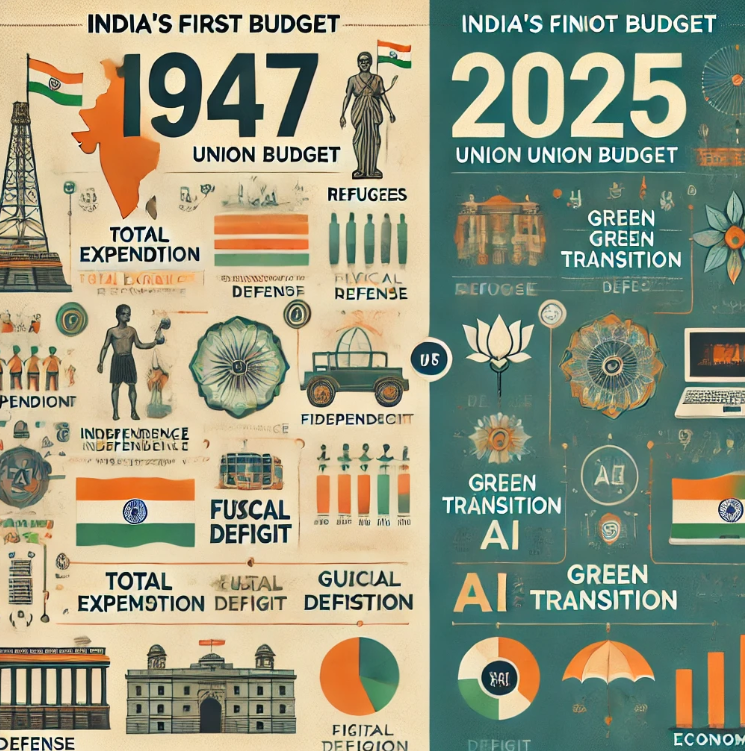
First Budget of India: Key Details
Date: The first-ever budget of independent India was presented on November 26, 1947.
Presenter: It was delivered by R. K. Shanmukham Chetty, India’s first Finance Minister.
Content: The first budget covered just 7 and a half months (from August 15, 1947, to March 31, 1948). It primarily focused on managing the transition to independence, tackling the aftermath of Partition, and laying the foundation for economic stability. The total estimated expenditure for that period was ₹197.39 crore, with a fiscal deficit of ₹24.59 crore.
Highlights of the First Budget:
- The Revenue receipts were estimated at ₹171 crore, and Capital receipts were ₹26 crore.
- Key focus areas included defense services, rehabilitation of refugees, and building administrative infrastructure.
- It was a pragmatic budget aimed at ensuring smooth governance during India's formative months as an independent nation.
Present Budget (2025): Key Highlights
The Union Budget 2025, to be presented by Nirmala Sitharaman on February 1, 2025, reflects India's evolving priorities in a globalized economy.
Context:
The 2025 Budget will mark India’s 77th Union Budget. Over the years, budgets have shifted from focusing on post-independence development and industrialization to addressing complex global challenges like climate change, digital transformation, and inclusivity.
Current Focus Areas (Expected):
- 1.Fiscal Discipline: Striking a balance between growth-oriented expenditure and fiscal responsibility.
- 2.Economic Growth: Policies to ensure competitiveness and resilience amidst global headwinds.
- 3.Green Transition: Investments in renewable energy, green infrastructure, and climate adaptation.
- 4.Digital Economy: Boosting digital innovation, including AI, blockchain, and cybersecurity.
- 5.Social Equity: Enhanced allocations for healthcare, education, and welfare programs.
A Glimpse of the Journey:
- The budgets in the early years focused on agriculture, infrastructure, and industrialization, aligning with India’s five-year plans.
- Landmark budgets included Manmohan Singh’s 1991 reforms that liberalized India’s economy and Nirmala Sitharaman’s 2021 budget, which introduced a paperless format.
Unique Facts About the First Budget
- 1.Printed at Government Press: The first budget was printed at a government press under tight security to prevent leaks—a practice that continued for decades.
- 2.Partition Challenges: The budget reflected India’s economic condition in the immediate aftermath of Partition, which saw significant displacement, a disrupted trade network, and the challenge of rehabilitating refugees.
- 3.Focus on Defense: Given the geopolitical uncertainty following independence, a significant portion of the budget was allocated to defense and national security.
Union Budget 2025: Anticipated Features
- 1.Digital Push: Continuing the trend, the 2025 Budget is expected to highlight the role of technology, including advancements in AI, machine learning, and blockchain, as tools for governance and economic development.
- 2.Climate Commitments: With India’s ambitious targets for net-zero emissions by 2070, the Budget may include substantial allocations for renewable energy projects, carbon capture technologies, and green bonds.
- 3.Youth and Startups: Enhanced focus on promoting startups and skilling programs to empower India’s youth and foster innovation in sectors like fintech, agritech, and edtech.
- 4.Simplified Taxation: Expectations for further simplification in tax compliance and possible adjustments in income tax slabs to increase disposable incomes.
Landmark Budgets Over the Years
- 1. 1957 (T. T. Krishnamachari): Introduction of the Wealth Tax Act, which taxed the wealthy to redistribute resources.
- 2. 1991 (Manmohan Singh): The most transformative budget that liberalized the Indian economy, encouraging foreign investments and ending the license-permit raj.
- 3. 2000 (Yashwant Sinha): Introduced the VAT system to streamline indirect taxes across the country.
- 4. 2017 (Arun Jaitley): Merged the Railway Budget with the General Budget, a major structural change.
Interesting Traditions and Facts About Budgets
- Budget Halwa Ceremony: Before the budget is finalized, the Finance Ministry conducts a ceremonial halwa cooking event, symbolizing the beginning of the document’s printing process.
- Changing Timings: Until 2001, the Budget was presented at 5:00 PM, a colonial legacy, and was later shifted to 11:00 AM to suit Indian needs.
- Paperless Budget: In 2021, Nirmala Sitharaman introduced the first-ever paperless Budget, distributed via a mobile app to MPs and the public.
How Budgets Impact Daily Lives
- 1.Income Tax Slabs: Direct changes to income tax slabs affect take-home salaries for individuals.
- 2.Fuel Prices: Excise duties on fuel directly influence the cost of transportation and logistics.
- 3.Subsidies and Benefits: Government schemes and subsidies announced in the Budget impact rural livelihoods, healthcare, and education accessibility.
Fun Facts for Readers
- 1.Shortest Budget Speech: The shortest speech was delivered by Hirubhai M. Patel in 1977, lasting just under 800 words.
- 2.Longest Budget Speech: Nirmala Sitharaman’s 2020 speech lasted 2 hours 42 minutes, setting a record for the longest-ever Budget speech.
- 3.First Female Finance Minister: While Sitharaman is the first full-time female Finance Minister, Indira Gandhi also presented the Budget in 1970 as Prime Minister.
Looking Ahead: Expectations from Union Budget 2025
- Infrastructure Push: Enhanced capital outlay for high-speed rail, smart cities, and logistics hubs.
- Health and Education: Expanded funding for health insurance schemes, rural health missions, and new initiatives for digital education.
- Ease of Doing Business: New policies for cutting red tape and incentivizing entrepreneurship.
Tired of comparing loan options?
Vizzve Financial can help you find the perfect loan for your needs with just one click! Our platform connects you with offers from multiple banks and lenders, saving you time and hassle.
Increase your chances of Loan approval
Vizzve Financial's technology uses a streamlined process to help you get matched with the right loan and potentially improve your approval odds.
Get Started Today
Visit www.vizzve.com to explore loan options and see if you pre-qualify. Call 844-984-4958 to check your eligibility.