

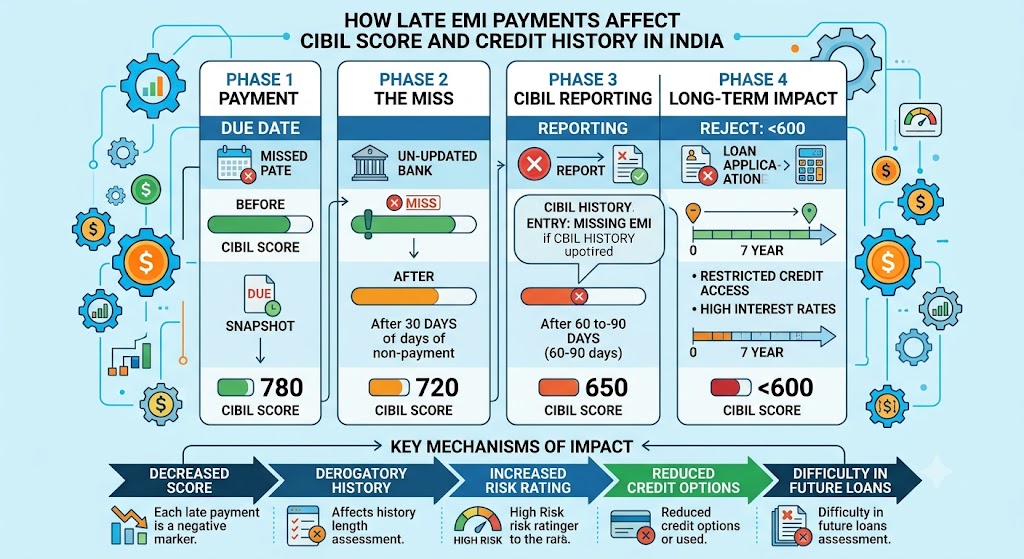
A late EMI payment can affect your CIBIL score, repayment history, and future loan eligibility. Whether you have a personal loan, home loan, car loan, or another credit facility, paying your instalments on time is essential for maintaining a healthy credit profile.
In India, lenders may share repayment information with credit bureaus such as TransUnion CIBIL, Experian, and Equifax. When an EMI is paid after its due date, the delay may be reflected in your credit report, depending on the lender's reporting practices and applicable requirements.
Understanding how late EMI payments work can help borrowers avoid unnecessary credit problems and make better financial decisions.
What Is a Late EMI Payment?
An EMI (Equated Monthly Instalment) is the fixed periodic payment a borrower makes towards a loan. It generally includes both principal and interest.
A late EMI payment occurs when the borrower does not pay the required instalment by the scheduled due date. This can happen because of insufficient bank balance, salary delays, unexpected expenses, or forgetting the payment date.
Even a short delay may lead to late-payment charges or other consequences under the loan agreement. The credit-reporting impact depends on the circumstances and how the lender records and reports the payment.
How Does a Late EMI Affect Your CIBIL Score?
Your CIBIL score is a numerical indicator of your credit history. In India, CIBIL scores generally range from 300 to 900, with higher scores typically indicating a stronger credit profile.
Late EMI payments can affect your score in several ways.
1. Negative Impact on Repayment History
Repayment behaviour is an important factor in credit assessment. Repeated late payments can indicate difficulties in managing financial obligations and may weaken your credit profile.
2. Lower Credit Score
A reported payment delay may reduce your CIBIL score. The extent of the impact varies according to your existing credit history, the severity of the delay, and other information in your report. There is no fixed number of points that every borrower loses after a late EMI.
3. Reduced Loan Approval Chances
When you apply for a personal loan, credit card, or another credit facility, lenders may review your repayment history and credit score.
A history of delayed payments could make approval more difficult or result in less favourable loan terms. However, each lender follows its own eligibility criteria.
4. Higher Borrowing Costs
Some lenders may offer less favourable interest rates or loan terms to applicants they consider higher risk. A late EMI does not automatically result in a higher rate, but a weaker credit profile can affect the offers available to you.
Does One Late EMI Affect Your CIBIL Score?
Yes, one late EMI can affect your credit profile if the delay is reported to the credit bureau. However, the impact is not the same for every borrower.
For example, consider two borrowers:
-
Borrower A: Has a long history of timely repayments but misses one EMI due to an unexpected expense.
-
Borrower B: Has several previous late payments and misses another EMI.
The effect on their credit profiles may differ because their repayment histories and overall credit circumstances are different.
Paying a missed EMI as soon as possible can help prevent the outstanding amount from remaining unpaid, but it does not guarantee that an already reported delay will disappear from the credit report.
How Long Does a Late EMI Stay on Your Credit Report?
A reported late payment may remain in your credit history for several years, depending on the applicable reporting and retention practices. Paying the overdue EMI does not automatically erase the historical record.
If the information is accurate, the bureau generally will not remove it simply because the outstanding amount has been paid. If the entry is incorrect, you can raise a dispute with the credit bureau and the lender.
Check your credit report to confirm the reported payment status, overdue amount, and repayment history.
What Should You Do If You Miss an EMI?
If you have missed an EMI, taking prompt action can help prevent the situation from becoming more serious.
-
Pay the overdue amount: Clear the missed instalment as soon as you reasonably can.
-
Check additional charges: Review your loan agreement for applicable late-payment or penal charges.
-
Contact your lender: If you cannot pay immediately, discuss the situation and ask about available options.
-
Review your credit report: Check whether the missed payment has been reported accurately.
-
Set up payment reminders: Use calendar alerts or automatic payments to reduce the risk of future delays.
-
Maintain sufficient bank balance: Ensure funds are available before the EMI debit date.
If the lender has reported incorrect information, submit a correction request with supporting payment records.
How to Improve Your CIBIL Score After a Late EMI
You can take several practical steps to strengthen your credit profile after a delayed payment.
|
Action |
Potential benefit |
|---|---|
|
Pay all future EMIs on time |
Builds a positive repayment history |
|
Clear overdue amounts |
Reduces outstanding arrears |
|
Keep credit card utilisation low |
Helps manage revolving credit responsibly |
|
Avoid frequent loan applications |
Limits unnecessary hard enquiries |
|
Check credit reports regularly |
Helps identify errors and inconsistencies |
|
Maintain a manageable debt level |
Supports repayment capacity |
Credit score recovery takes time and depends on your overall credit history. Consistent repayment behaviour is generally more useful than applying for multiple new loans in an attempt to improve your score.
Late EMI vs Loan Default: What Is the Difference?
A late EMI means an instalment was not paid by its due date. A loan default generally refers to a more serious failure to meet repayment obligations, although the precise classification depends on the loan terms and applicable rules.
A short delay should not automatically be treated as equivalent to a long-term default. However, repeated or prolonged non-payment can have more serious consequences, including additional charges, collection activity, adverse credit reporting, and potential legal action where applicable.
Borrowers should contact their lender early if they expect difficulty making a payment.
Frequently Asked Questions (FAQs)
1. Will paying an EMI one day late affect my CIBIL score?
Not every one-day delay results in a reported negative entry. The outcome depends on the lender's practices, applicable requirements, and whether the delay is reported.
2. Can I improve my CIBIL score after a late EMI?
Yes. Paying future instalments on time, clearing overdue amounts, and maintaining responsible credit usage can help strengthen your credit profile over time.
3. Does paying a late EMI remove it from my credit report?
No. Payment clears the outstanding instalment but does not automatically remove an accurate historical late-payment entry.
4. Can a late EMI lead to loan rejection?
Yes, it may affect a lender's decision. However, approval also depends on income, existing EMIs, credit history, documentation, and the lender's policies.
5. How can I check whether my late EMI has affected my CIBIL score?
Review your latest CIBIL report and check the repayment history, account status, and any reported overdue amounts.
Conclusion
A late EMI payment can affect your CIBIL score and future borrowing opportunities, especially when delays are repeated or remain unresolved. However, the impact varies from borrower to borrower, and one missed instalment does not automatically mean that every future loan will be rejected.
Published on : 18th October 2026
Published by : Yogendra
www.vizzve.com || www.vizzveservices.com
Follow us on social media: Facebook || Linkedin || Instagram
🛡 Powered by Vizzve Financial
RBI-Registered Loan Partner | 10 Lakh+ Customers | ₹600 Cr+ Disbursed