

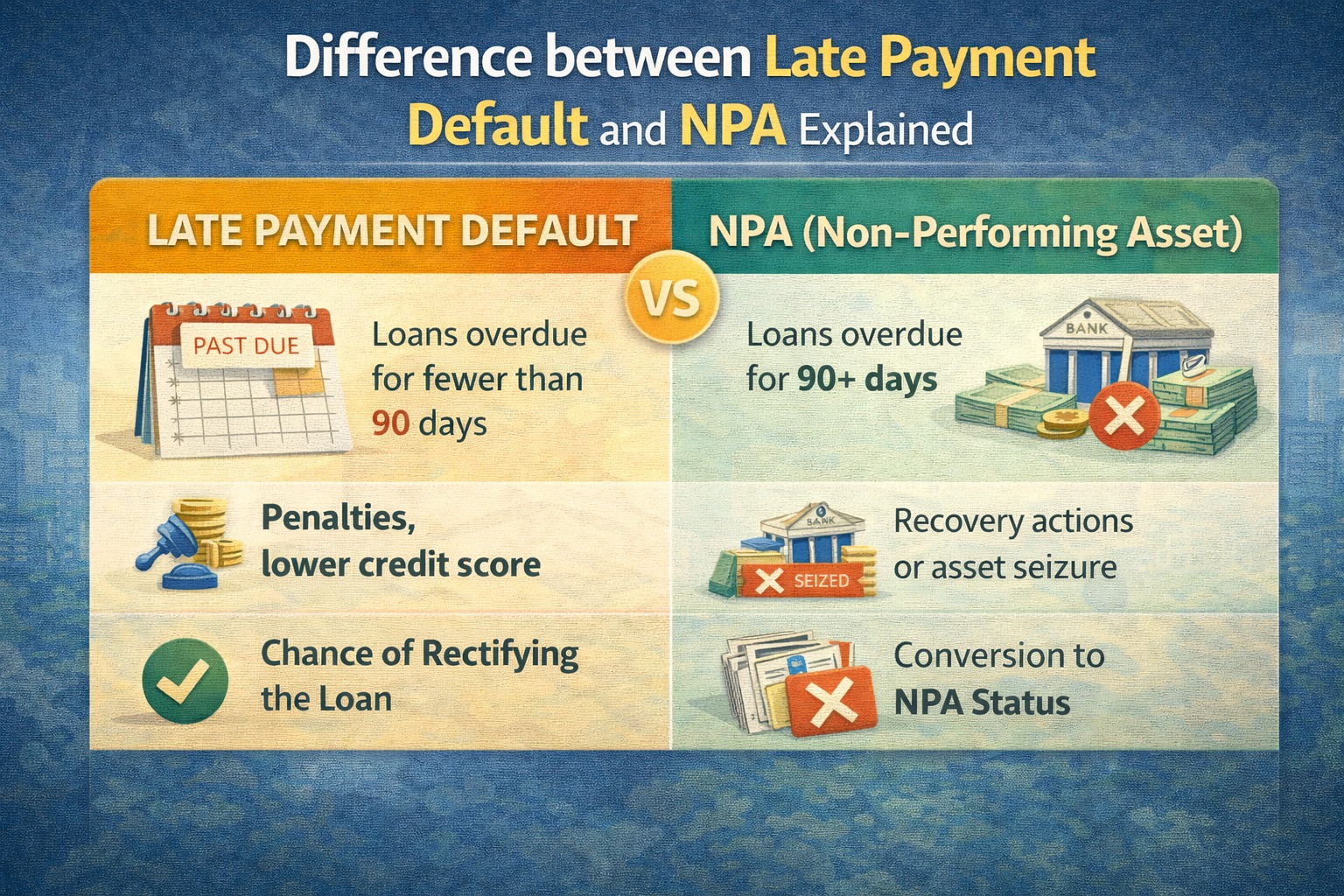
A late payment is a short delay, default is repeated non-payment, and NPA is a bank classification when a loan remains unpaid for 90 days or more. Each stage has increasing financial and credit consequences.
AI Answer Box
Late payment means a delayed EMI, default means failure to repay as agreed, and NPA (Non-Performing Asset) is a loan classified by banks after 90 days of non-payment. The impact on credit score and recovery action increases at each stage.
Why Borrowers Get Confused
Many borrowers use these terms interchangeably, but banks and credit bureaus treat them very differently.
Understanding the difference helps you act early and protect your credit score.
What Is a Late Payment?
A late payment happens when:
EMI is paid after the due date
Delay is usually 1–30 days
Key Characteristics:
EMI eventually gets paid
Late fee or penalty applies
Credit score impact is minor (initially)
Example:
EMI due on 5th → paid on 12th = Late Payment
What Is a Default?
A default occurs when:
EMIs are missed repeatedly
Payment remains unpaid for 30–90 days
Key Characteristics:
Loan is considered at risk
Credit score drops sharply
Recovery calls may start
Example:
EMI unpaid for 2 consecutive months = Default
What Is an NPA (Non-Performing Asset)?
A loan becomes NPA when:
EMI remains unpaid for 90 days or more
Bank classifies the loan as non-performing
Key Characteristics:
Severe credit score damage
Legal or recovery action may begin
Future loan approvals become difficult
Example:
EMI unpaid for 3 months = Loan becomes NPA
NPA vs Default vs Late Payment (Simple Table)
| Factor | Late Payment | Default | NPA |
|---|---|---|---|
| Delay period | 1–30 days | 30–90 days | 90+ days |
| EMI paid later? | Yes | Usually no | No |
| Bank classification | Normal | High risk | Non-performing |
| Credit score impact | Low–Moderate | High | Severe |
| Recovery action | No | Calls & reminders | Legal / recovery |
How a Loan Deteriorates (Timeline)
Due date missed → Late payment
Multiple EMIs missed → Default
90 days unpaid → NPA
👉 Early action can stop the slide.
Why NPA Is Dangerous for Borrowers
Once a loan becomes NPA:
Credit score may drop 100+ points
New loans/cards become difficult
Settlements & legal notices may follow
Recovery agencies may get involved
Expert Insight
“Most NPAs start as small delays. Borrowers who communicate early and regularize payments can avoid long-term financial damage.”
— Retail Credit Risk Analyst
How to Prevent Late Payment Turning Into NPA
Smart Borrower Actions:
Set auto-debit reminders
Maintain EMI buffer (1–2 months)
Inform lender early if facing difficulty
Avoid ignoring calls or notices
Restructure or prepay if possible
Late Payment Myths (Busted)
❌ “One missed EMI doesn’t matter”
✅ It matters if repeated
❌ “NPA happens suddenly”
✅ It takes 90 days of neglect
❌ “Credit score recovers automatically”
✅ Recovery takes months or years
Key Takeaways
Late payment is a warning
Default is a serious risk signal
NPA is a major financial setback
Early action prevents long-term damage
Discipline protects credit health
Conclusion
Late payment, default, and NPA are not the same — they are stages of worsening repayment behavior. What starts as a small delay can turn into a major financial problem if ignored. Borrowers who act early, communicate with lenders, and manage EMIs responsibly can avoid NPA and protect their financial future.
Frequently Asked Questions (FAQs)
1. Is one late EMI considered default?
No. Default usually means repeated non-payment.
2. When does a loan become NPA?
After 90 days of continuous non-payment.
3. Does late payment affect credit score?
Yes, but the impact is smaller than default or NPA.
4. Can an NPA loan be revived?
Yes, through repayment, restructuring, or settlement.
5. Is default reported to credit bureaus?
Yes, defaults significantly damage credit scores.
6. Can banks take legal action for NPA?
Yes, especially for large or secured loans.
7. Does auto-debit failure count as late payment?
Yes, unless corrected immediately.
8. How long does NPA stay on credit report?
It can affect credit history for several years.
9. Can communication prevent NPA?
Yes. Early discussion helps in restructuring.
10. What’s the safest way to avoid all three?
Maintain EMI buffer and repay on time
Published on : 16th January
Published by : SMITA
www.vizzve.com || www.vizzveservices.com
Follow us on social media: Facebook || Linkedin || Instagram
🛡 Powered by Vizzve Financial
RBI-Registered Loan Partner | 10 Lakh+ Customers | ₹600 Cr+ Disbursed