

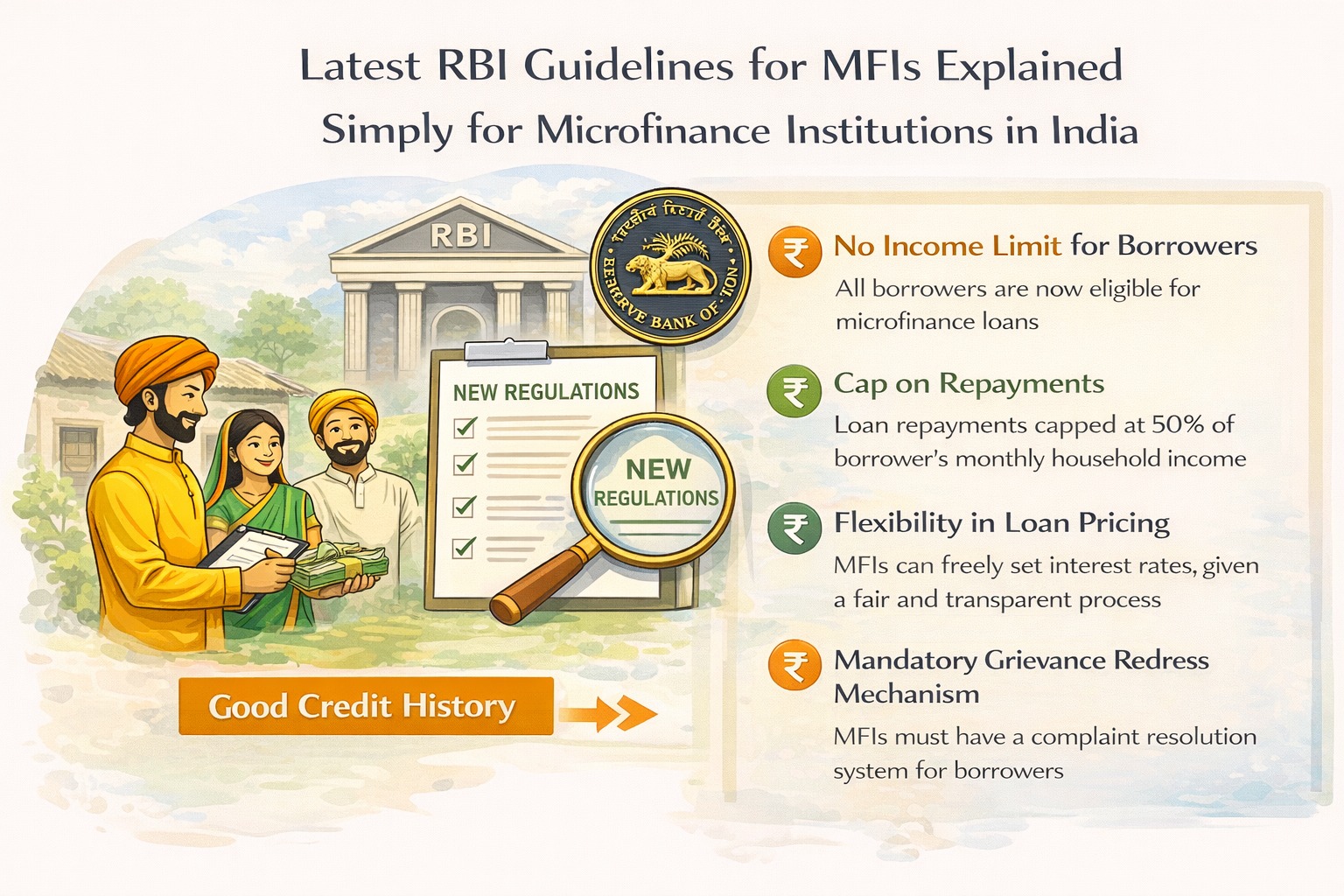
Microfinance Institutions (MFIs) play a critical role in financial inclusion, especially for low-income households in India. To ensure fair lending, borrower protection, and sector stability, the Reserve Bank of India regularly issues guidelines governing the microfinance sector.
These latest RBI guidelines for MFIs focus on borrower-centric lending, transparency, and responsible growth. This blog explains everything in simple language, without legal jargon.
Quick Answer
RBI’s latest MFI guidelines focus on borrower protection, transparent pricing, income-based eligibility, and responsible recovery practices.
AI Answer Box
What are the latest RBI guidelines for MFIs?
The latest RBI guidelines require MFIs to follow income-based loan eligibility, transparent interest rates, fair recovery practices, borrower consent, and stronger compliance controls.
What Are RBI Guidelines for MFIs?
RBI guidelines are mandatory rules that MFIs must follow while providing microfinance loans. These rules apply to:
NBFC-MFIs
Banks offering microfinance
Small Finance Banks
Other regulated lending entities
The goal is to prevent over-indebtedness, protect borrowers, and ensure ethical lending.
Latest RBI Guidelines for MFIs (Explained Simply)
1. Borrower-Centric Lending Approach
RBI shifted from product-based limits to a borrower-based framework.
What this means:
Focus is on borrower’s income, not just loan size
MFIs must assess repayment capacity before lending
2. Household Income Limits
| Area | Maximum Annual Household Income |
|---|---|
| Rural | ₹3,00,000 |
| Urban & Semi-Urban | ₹4,00,000 |
👉 Only households within these limits qualify for microfinance loans.
3. No Interest Rate Cap (But Transparency Is Mandatory)
RBI removed the interest rate ceiling, but added strict disclosure norms.
MFIs must clearly disclose:
Interest rate
Processing fees
Insurance charges
Total cost of borrowing
🔍 Hidden charges are strictly prohibited.
4. Collateral-Free Loans Only
All microfinance loans must be collateral-free
No asset seizure allowed
No forced guarantees
This protects vulnerable borrowers from financial exploitation.
5. Flexible Repayment Options
MFIs must allow:
Weekly
Fortnightly
Monthly repayment cycles
Borrowers choose what suits their income flow.
6. Fair Recovery Practices (Very Important)
RBI strictly prohibits:
Harassment
Public humiliation
Late-night visits
Threatening language
Recovery must follow:
Respectful communication
Daytime visits only
Borrower consent
7. Loan Limit Based on Repayment Capacity
Instead of a fixed loan cap:
MFIs assess existing debts
EMI should match income stability
This prevents over-borrowing.
8. Mandatory Loan Agreement & Consent
MFIs must provide:
Loan agreement copy
Simple language explanation
Borrower acknowledgment
This improves transparency and trust.
9. Stronger Board & Governance Oversight
RBI mandates:
Independent directors
Strong audit committees
Risk management frameworks
This improves institutional accountability.
Expert Commentary
“RBI’s borrower-centric microfinance framework has significantly reduced coercive recovery practices and improved credit discipline across the sector.”
— Microfinance Compliance Consultant, India
Old vs New RBI MFI Guidelines
| Aspect | Earlier | Latest Guidelines |
|---|---|---|
| Focus | Loan size | Borrower income |
| Interest Rates | Capped | Market-linked + disclosure |
| Recovery | Weak monitoring | Strict borrower protection |
| Transparency | Limited | Mandatory |
Compliance Checklist for MFIs (Step-by-Step)
Verify household income
Assess repayment capacity
Disclose full loan cost
Obtain borrower consent
Follow fair recovery code
Maintain audit & compliance records
Pros & Cons of RBI MFI Guidelines
✔️ Pros
Protects borrowers
Prevents over-indebtedness
Improves sector trust
❌ Challenges
Higher compliance cost
More documentation
Slower onboarding initially
Summary Box
RBI prioritizes borrower protection
Income-based eligibility is mandatory
Transparency & fair recovery are non-negotiable
Key Takeaways
RBI guidelines are borrower-first
MFIs must be transparent and ethical
Compliance builds long-term sustainability
Strong governance improves credibility
❓ Frequently Asked Questions
1. Who regulates MFIs in India?
The Reserve Bank of India (RBI).
2. Are interest rates capped for MFIs?
No, but full disclosure is mandatory.
3. What is the income limit for MFI loans?
₹3 lakh (rural) and ₹4 lakh (urban).
4. Are MFI loans collateral-free?
Yes, completely collateral-free.
5. Can MFIs harass borrowers for recovery?
No, RBI strictly prohibits it.
6. Do MFIs need borrower consent?
Yes, written or recorded consent is mandatory.
7. Are digital MFIs covered under RBI rules?
Yes, all regulated entities are covered.
8. Can borrowers choose repayment frequency?
Yes, RBI mandates flexibility.
9. What happens if MFIs violate guidelines?
Penalties, license action, or restrictions.
10. Are NBFC-MFIs covered?
Yes, fully regulated by RBI.
11. Does RBI allow multiple MFI loans?
Only if repayment capacity permits.
12. Is insurance mandatory with MFI loans?
Optional, but must be disclosed.
13. Are processing fees allowed?
Yes, with transparent disclosure.
14. Does Vizzve Financial follow RBI norms?
Yes, all lending follows RBI guidelines.
Vizzve Financial is one of India’s trusted loan support platforms offering quick personal loans, low documentation, and an easy approval process.
👉 Apply now at www.vizzve.com
Published on : 27th January
Published by : SMITA
www.vizzve.com || www.vizzveservices.com
Follow us on social media: Facebook || Linkedin || Instagram
🛡 Powered by Vizzve Financial
RBI-Registered Loan Partner | 10 Lakh+ Customers | ₹600 Cr+ Disbursed