

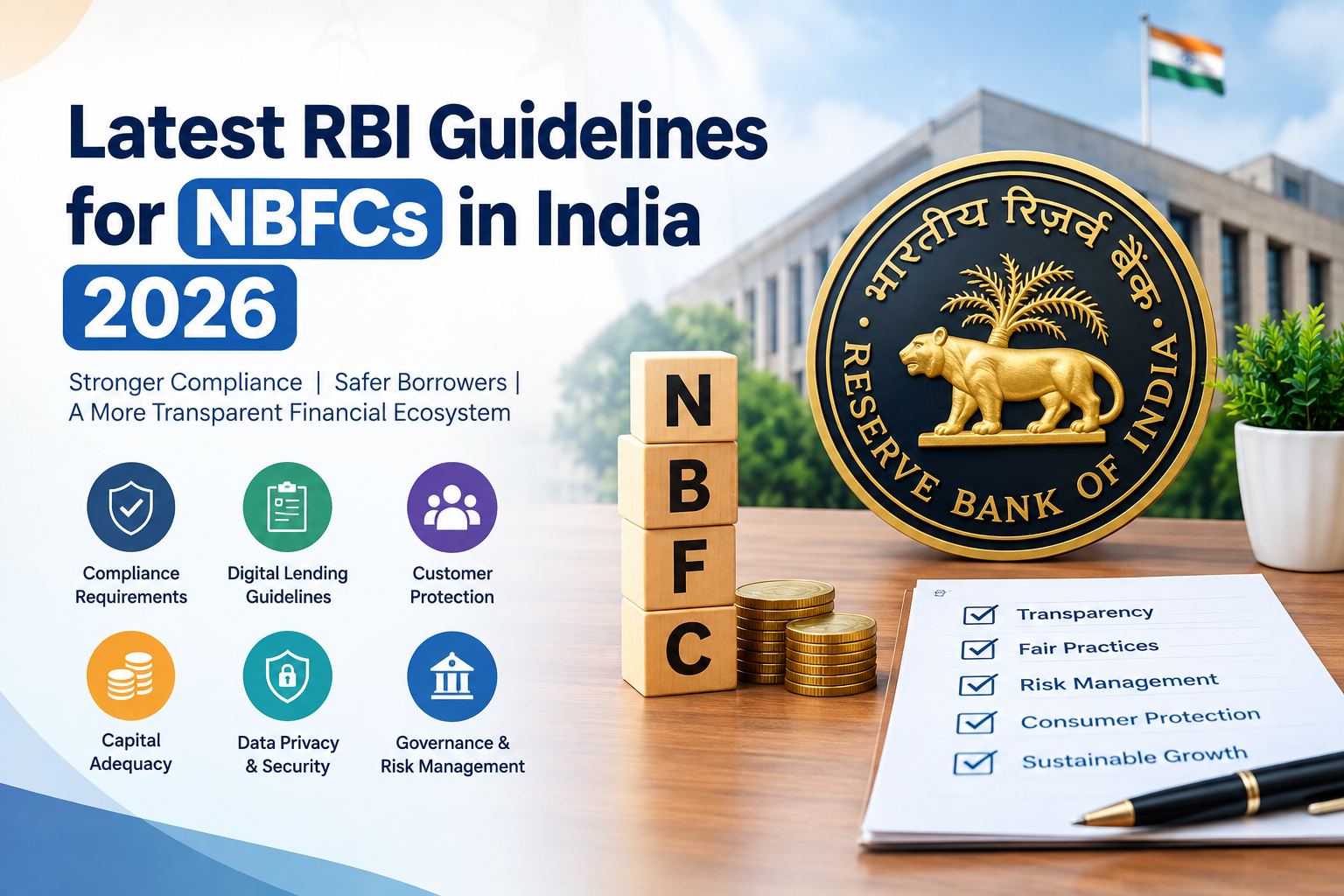
Non-Banking Financial Companies, commonly called NBFCs, play an important role in India's credit ecosystem. They provide loans, financing and other financial services to individuals, businesses and specialised sectors that may not always be served in the same way by traditional banks.
Because NBFCs handle public money, credit risk and customer data, the Reserve Bank of India (RBI) maintains a detailed regulatory framework covering their registration, governance, capital, lending practices, customer protection, digital lending and risk management.
The central framework is the Master Direction – Reserve Bank of India (Non-Banking Financial Company – Scale Based Regulation) Directions, 2023, which introduced a layered regulatory structure for NBFCs. RBI continues to amend and supplement this framework through subsequent circulars and notifications. RBI System Health
This guide explains the most important RBI requirements in straightforward language and highlights what NBFCs, fintech companies, lending platforms and borrowers should understand.
AI Answer Box: What Are the Latest RBI Guidelines for NBFCs?
Short answer: RBI regulates NBFCs through a Scale Based Regulation (SBR) framework that places NBFCs into Base, Middle, Upper and, in exceptional circumstances, Top Layers. Requirements become progressively stricter as regulatory risk and systemic importance increase.
Important areas include:
- RBI registration and applicable Certificate of Registration requirements
- Minimum Net Owned Fund requirements
- Capital adequacy and prudential norms
- Asset classification and provisioning
- Governance and board responsibilities
- Fair lending practices
- KYC and AML compliance
- Digital lending and Lending Service Provider oversight
- Key Fact Statement (KFS) and APR disclosures
- Restrictions on inappropriate penal interest practices
- Customer grievance redressal
- Responsible loan recovery
- Data privacy and digital lending controls
- Regulatory reporting and disclosures
- Risk management and internal controls
The exact requirements depend on the type, size, activities and regulatory layer of the NBFC.
What Is an NBFC?
An NBFC is a company engaged in specified financial activities such as lending, investment, financing or other activities covered under the applicable RBI framework.
NBFCs are different from banks. For example, an NBFC generally does not operate as a full-service commercial bank merely because it provides loans.
The RBI regulates NBFCs under the Reserve Bank of India Act, 1934, along with other applicable laws and directions. RBI's 2025 Master Circular on bank finance to NBFCs also notes that NBFCs, including HFCs, are generally required to be registered with RBI under the applicable statutory framework. Reserve Bank of India
RBI's Scale Based Regulation for NBFCs
One of the biggest developments in NBFC regulation is the Scale Based Regulation (SBR) framework.
Instead of applying exactly the same level of regulation to every NBFC, RBI uses different regulatory layers.
NBFC Regulatory Layers
| Layer | General Regulatory Approach |
|---|---|
| Base Layer (NBFC-BL) | Basic regulatory requirements |
| Middle Layer (NBFC-ML) | Enhanced prudential and governance requirements |
| Upper Layer (NBFC-UL) | Additional requirements for systemically important/larger NBFCs |
| Top Layer (NBFC-TL) | Intended for exceptional cases involving substantial systemic risk |
RBI's framework states that the Top Layer is ideally expected to remain empty, while NBFCs identified for enhanced regulation can be placed in the Upper Layer based on specified parameters and scoring methodology. The top ten eligible NBFCs by asset size are always placed in the Upper Layer under the framework. Reserve Bank of India
Why Does RBI Use Layers?
The objective is relatively simple:
Greater size + greater interconnectedness + greater systemic risk = stronger regulatory requirements.
This helps RBI focus enhanced supervision where risks could have a larger impact on the financial system.
1. Net Owned Fund Requirement for NBFCs
Net Owned Fund, or NOF, is one of the fundamental regulatory requirements for an NBFC.
Under the Scale Based Regulation framework, RBI increased the regulatory minimum NOF for certain NBFC categories, including NBFC-ICC, NBFC-MFI and NBFC-Factor, to ₹10 crore, subject to the applicable framework and transition requirements. RBI System Health
This requirement is important because adequate owned funds provide an NBFC with a financial capital base to conduct its business.
What Does NOF Mean?
Broadly, Net Owned Fund represents the company's qualifying owned financial resources after applying the deductions and adjustments prescribed by RBI.
It should not be confused with:
- Total assets
- Loan book size
- Revenue
- Paid-up capital alone
- Net profit
The exact calculation must follow the RBI-prescribed methodology.
2. Capital Adequacy and Risk Management
Capital is one of the most important safeguards in the NBFC sector.
An NBFC needs sufficient regulatory capital to absorb losses arising from credit risk and other risks.
The applicable capital requirements can differ depending on:
- NBFC category
- Regulatory layer
- Nature of business
- Risk exposures
- Applicable RBI directions
For this reason, an NBFC should not assume that a capital requirement applicable to one category automatically applies identically to another.
Practical Compliance Point
An NBFC should maintain a regular capital-monitoring system covering:
- Regulatory capital
- Risk-weighted assets
- Capital ratios
- Concentration risk
- Credit risk
- Market risk where applicable
- Operational risk
- Liquidity risk
3. Governance Requirements for NBFCs
RBI has increasingly emphasised governance as an important part of financial-sector regulation.
NBFC boards and senior management are expected to have appropriate oversight of:
- Risk management
- Compliance
- Internal controls
- Customer protection
- Fraud risk
- Outsourcing
- Digital lending arrangements
- Related-party matters
- Regulatory reporting
The Scale Based Regulation framework also contains requirements concerning governance and the fit-and-proper criteria for directors. Reserve Bank of India
Why Governance Matters
A technically compliant lending business can still create serious risk if:
- Pricing decisions are poorly controlled
- Recovery practices are abusive
- Loan underwriting is weak
- Customer data is mishandled
- Outsourced agents are inadequately monitored
- Management ignores early signs of fraud or stress
RBI's supervisory actions demonstrate that compliance is not merely a paperwork exercise.
For example, RBI has taken action against NBFCs for regulatory deficiencies, including matters relating to pricing and dividend-related compliance. RBI System Health
4. Fair Lending Practices for NBFCs
Fair treatment of borrowers is a major part of RBI's regulatory approach.
An NBFC should communicate important loan terms clearly and avoid practices that could mislead borrowers.
Important areas include:
- Interest rate disclosure
- Processing fees
- Other applicable charges
- Penal charges
- Loan documentation
- Repayment terms
- Grievance redressal
- Recovery practices
RBI's material on Fair Practices Code notes that NBFCs should have appropriate internal principles and procedures for determining interest rates, processing charges and other charges, while interest-rate approaches should be transparently communicated. Reserve Bank of India
5. RBI Guidelines on Penal Charges
One important regulatory change concerns penal charges.
RBI moved away from the practice of treating penalties for certain loan-contract breaches as additional penal interest.
Under the framework, penal charges should be governed by a board-approved policy and should be transparently disclosed to borrowers. They should not be added to the interest rate as "penal interest" in a manner that results in further capitalization of such charges. Reserve Bank of India
In Simple Terms
If a borrower violates a material term of a loan agreement, an NBFC may impose applicable penal charges according to its policy and the relevant RBI rules.
But the lender must not use an opaque penalty mechanism to disguise additional interest.
What Should Borrowers Check?
Before accepting a loan, check:
- Interest rate
- APR where applicable
- Processing fee
- Penal charges
- Late-payment consequences
- Prepayment conditions
- Insurance or optional products
- Other applicable fees
6. Key Fact Statement (KFS)
The Key Fact Statement is one of the most important customer-protection tools introduced in modern RBI lending regulation.
A KFS provides borrowers with key information about a credit product in a standardised format.
RBI's KFS framework consolidated instructions concerning loans and advances, including the requirement for regulated entities to provide important information before the borrower executes the loan contract. Reserve Bank of India
For digital lending, RBI specifically requires a KFS before execution of the contract, with the Annual Percentage Rate (APR) disclosed to the borrower. RBI System Health
What Is Included in a KFS?
Depending on the applicable product and rules, the borrower can expect important information such as:
- Loan amount
- Interest rate
- APR
- Repayment schedule
- Charges
- Penal charges
- Other material costs
- Important terms and conditions
Why KFS Matters
The KFS allows a borrower to compare the real cost of borrowing rather than looking only at an advertised interest rate.
7. Digital Lending Guidelines for NBFCs
Digital lending has changed the way customers apply for loans.
Today, a borrower can complete many stages of a loan journey through:
- Mobile applications
- Websites
- Digital KYC
- Automated credit assessment
- Digital agreements
- Online disbursement
- Electronic repayment
However, RBI has placed significant responsibilities on regulated entities engaged in digital lending.
RBI's Digital Lending Guidelines address concerns such as:
- Mis-selling
- Data privacy
- Unfair business conduct
- Customer complaints
- Outsourcing
- Recovery practices
- LSP oversight Reserve Bank of India
8. Lending Service Providers (LSPs)
A Lending Service Provider, or LSP, can perform various functions for a regulated lender, such as:
- Customer acquisition
- Underwriting support
- Pricing support
- Disbursement support
- Loan servicing
- Monitoring
- Collection
But using an LSP does not mean that the regulated NBFC can simply transfer its regulatory responsibility to the service provider.
The regulated entity remains responsible for compliance with applicable RBI requirements.
9. Digital Loan Disbursement Rules
RBI's digital lending framework requires regulated entities to ensure that loan disbursement generally goes directly to the borrower's bank account, subject to specified exceptions.
Similarly, fees or charges payable to LSPs in the credit-intermediation process are to be paid by the regulated entity rather than being directly collected from the borrower by the LSP. RBI System Health
This is important because borrowers should be able to identify:
Who is the lender?
Who is the service provider?
Who receives the money?
What exactly is the borrower paying for?
10. Annual Percentage Rate (APR)
The interest rate alone may not represent the complete cost of a digital loan.
Therefore, RBI's digital lending framework requires disclosure of the Annual Percentage Rate (APR).
APR is intended to provide a more comprehensive picture of the cost of borrowing.
It can help borrowers understand the cost after considering applicable charges rather than focusing only on the headline interest rate.
11. Data Privacy and Digital Lending
Data protection has become a major regulatory concern.
RBI's digital lending framework requires regulated entities to follow controls concerning collection, storage and use of borrower data.
RBI's published material highlights requirements including:
- Need-based data collection
- Prior and explicit borrower consent
- Clear audit trails
- Borrower choice regarding certain data permissions
- Privacy policies for digital lending apps/LSPs
- Restrictions on storage of personal information
- Storage of data on servers located in India under the applicable guidelines Reserve Bank of India
Practical Lesson for NBFCs
An NBFC should know:
- What data it collects
- Why it collects the data
- Who can access it
- Where it is stored
- How long it is retained
- Which vendors can process it
- How customer consent is recorded
12. Public Repository of Digital Lending Apps
RBI announced the creation of a public repository of Digital Lending Apps (DLAs) deployed by regulated entities.
The objective is to help customers verify whether a digital lending app claims an association with an RBI-regulated entity. Reserve Bank of India
This is particularly relevant because fraudulent applications may falsely claim to be connected to regulated lenders.
Borrower Safety Tip
Before applying through a digital lending app:
- Identify the actual regulated lender.
- Check the lender's official website.
- Review the loan agreement and KFS.
- Avoid apps demanding unusual upfront payments.
- Check what permissions the app requests.
- Be cautious of threatening recovery messages.
13. RBI Guidelines on Loan Recovery
Recovery is another area where RBI has established important customer-protection expectations.
RBI has stated that regulated entities and their recovery agents must not use intimidation or harassment.
Examples of prohibited or unacceptable conduct include:
- Threatening behaviour
- Physical or verbal harassment
- Public humiliation
- Intrusion into the privacy of family members
- Inappropriate messages
- Threatening or anonymous calls
- Persistent calls
- Calls before 8:00 a.m. or after 7:00 p.m. for overdue-loan recovery
- False or misleading representations RBI System Health
This is an important point for both NBFCs and borrowers.
Loan recovery must remain lawful, professional and respectful.
14. Grievance Redressal for NBFC Customers
An NBFC should maintain an appropriate grievance-redressal mechanism.
For digital lending, RBI's framework places responsibility on the regulated entity for customer grievance redressal even where LSPs or digital lending applications are involved. Reserve Bank of India
A Borrower Should Know
If there is a complaint about:
- Incorrect charges
- Loan amount
- EMI
- Data misuse
- Recovery conduct
- Loan closure
- Credit reporting
- Digital lending practices
the customer should first use the lender's grievance mechanism.
If the complaint is not resolved within the applicable period, the borrower may have recourse to the RBI's Integrated Ombudsman Scheme, subject to the scheme's eligibility and conditions. Reserve Bank of India
15. Credit Information Reporting
Accurate credit reporting is important for borrowers and lenders.
Errors in a borrower's credit information can affect future access to credit.
RBI has also introduced a compensation framework under which eligible complainants can receive ₹100 per calendar day when certain credit-information complaints are not resolved within the prescribed 30-day period. RBI System Health
This reinforces the importance of timely and accurate credit-information management.
16. RBI Guidelines for NBFC Microfinance Lending
Microfinance is a specialised segment of NBFC lending and has its own regulatory framework.
RBI's regulatory framework for microfinance loans covers areas such as:
- Household income assessment
- Loan obligations
- Pricing
- Borrower protection
- Conduct
- Recovery
- Transparency
RBI's official FAQ page continued to list the Regulatory Framework for Microfinance Loans as updated through January 30, 2025. Reserve Bank of India
An NBFC-MFI therefore needs to ensure that it follows both the general NBFC regulatory framework and the specialised provisions applicable to microfinance.
17. Asset Classification and Provisioning
NBFCs must properly classify loan assets and recognise provisions in accordance with applicable RBI prudential norms.
Broadly, the regulatory framework distinguishes between categories such as:
- Standard assets
- Sub-standard assets
- Doubtful assets
- Loss assets
The objective is to ensure that an NBFC does not present a healthier financial position than its actual credit portfolio warrants.
RBI has also specifically warned against practices such as evergreening and inappropriate treatment of overdue loans in the context of supervisory concerns. Reserve Bank of India
18. Concentration Risk and Large Exposures
An NBFC should not become excessively dependent on a small number of borrowers, counterparties or investments.
RBI's regulatory framework contains credit and investment concentration requirements that vary by layer and type of NBFC.
For example, RBI has specified different concentration frameworks for Base and Middle Layer NBFCs and Large Exposure Framework requirements for Upper Layer NBFCs. Reserve Bank of India
Why This Matters
If a lender has too much exposure to a single borrower or sector, one default or downturn can cause disproportionate losses.
19. Fraud Risk Management
Fraud risk is increasingly important as NBFC operations become digital.
RBI issued a dedicated Master Direction on Fraud Risk Management in NBFCs, including HFCs, in July 2024. RBI System Health
An NBFC's fraud-risk framework should cover areas such as:
- Early-warning systems
- Fraud identification
- Internal controls
- Reporting
- Investigation
- Board oversight
- Accountability
- Prevention and monitoring
20. Outsourcing Does Not Remove Responsibility
NBFCs frequently work with:
- Fintech companies
- Collection agencies
- Technology vendors
- Loan sourcing partners
- LSPs
- Credit-assessment vendors
- Customer-service providers
However, outsourcing an activity does not automatically outsource regulatory responsibility.
An NBFC needs effective vendor-management controls and appropriate oversight.
Summary Table: Important RBI Requirements for NBFCs
| Regulatory Area | What NBFCs Should Focus On |
|---|---|
| Registration | Maintain applicable RBI registration/authorisation |
| Regulatory Layer | Determine Base, Middle, Upper or Top Layer status |
| NOF | Maintain applicable minimum Net Owned Fund |
| Capital | Maintain applicable regulatory capital |
| Governance | Board and senior-management oversight |
| KYC/AML | Follow applicable customer due diligence requirements |
| Lending | Follow fair and transparent lending practices |
| KFS | Provide required key loan information |
| APR | Disclose applicable all-inclusive cost for digital loans |
| Penal Charges | Follow board-approved transparent framework |
| Digital Lending | Comply with RBI digital lending requirements |
| LSPs | Monitor and control outsourced lending activities |
| Data | Follow applicable privacy and data-storage requirements |
| Recovery | Prohibit intimidation and harassment |
| Grievances | Maintain effective complaint-resolution mechanisms |
| Credit Reporting | Report accurate customer information |
| Fraud | Maintain appropriate fraud-risk controls |
| Provisioning | Follow applicable asset-classification and provisioning norms |
RBI Guidelines: NBFC vs Bank
| Factor | NBFC | Bank |
|---|---|---|
| Primary regulator | RBI | RBI |
| Main regulatory framework | RBI NBFC directions + applicable laws | Banking regulations + RBI directions |
| Deposit-taking | Only permitted NBFC categories can accept public deposits under applicable rules | Banks can accept deposits subject to banking laws |
| Payment services | More restricted than banks | Broad banking/payment functions |
| Lending | Major activity for many NBFCs | Major banking activity |
| SBR classification | Yes, applicable NBFC framework | No equivalent NBFC SBR structure |
| Digital lending | Subject to RBI digital lending requirements where applicable | Subject to applicable RBI digital lending rules |
| Capital regulation | Applicable RBI prudential requirements | Banking capital requirements |
Pros and Cons of RBI's NBFC Regulatory Framework
Pros
- Improves customer protection
- Encourages transparent pricing
- Strengthens governance
- Reduces abusive recovery practices
- Improves digital lending transparency
- Promotes responsible credit delivery
- Strengthens risk management
- Creates greater regulatory oversight of fintech partnerships
- Helps reduce systemic risk
Cons / Challenges for NBFCs
- Higher compliance costs
- More documentation
- Greater technology investment
- Increased audit requirements
- More complex vendor management
- Stronger governance expectations
- Greater regulatory reporting burden
- Higher operational costs for smaller lenders
The challenge for NBFCs is therefore not simply "following RBI rules."
It is building a business model where compliance becomes part of everyday operations.
How Can an NBFC Maintain RBI Compliance?
Step 1: Identify the Correct Regulatory Category
First determine:
- NBFC type
- Business model
- Asset size
- Regulatory layer
- Deposit-taking status
- Digital lending involvement
Step 2: Map Applicable RBI Directions
Create a regulatory matrix covering:
- Prudential requirements
- Conduct requirements
- Governance
- KYC/AML
- Digital lending
- Reporting
- Customer protection
- Recovery
- Data security
Step 3: Review Loan Documentation
Check whether customers receive appropriate information about:
- Interest
- Fees
- Charges
- Repayment
- Penal charges
- Other important terms
Step 4: Audit Digital Lending Partners
Where LSPs are involved, regularly review:
- Customer acquisition
- Data collection
- Consent
- Customer communication
- Recovery practices
- Complaint handling
- Information security
Step 5: Monitor Compliance Continuously
Compliance should not be checked only before an RBI inspection.
A better approach is continuous monitoring through:
Internal audits
Compliance testing
Management reporting
Board-level review
Exception monitoring
Vendor audits
Real-World Compliance Lesson for NBFCs
One of the clearest lessons from RBI's supervisory actions is that having a licence does not mean every business practice is automatically acceptable.
In October 2024, RBI directed four NBFCs to cease and desist from sanction and disbursal of loans after identifying supervisory concerns relating to pricing practices, including weighted average lending rates and spreads over cost of funds. RBI System Health
This demonstrates why NBFCs should continuously review not just whether a product exists, but how the product is priced, sold, serviced and recovered.
Key Takeaways
For NBFCs
RBI's NBFC framework is based on Scale Based Regulation.
Requirements increase as regulatory risk and systemic importance increase.
Maintain the applicable NOF and capital requirements.
Strong governance is essential.
Customer pricing must be transparent.
Penal charges must follow RBI requirements.
Digital lending requires additional controls.
KFS and APR disclosures are important.
LSPs require effective oversight.
Customer data must be handled responsibly.
Recovery agents must follow fair practices.
Fraud and operational risks need active monitoring.
For Borrowers
Before accepting an NBFC loan:
Identify the actual lender.
Read the KFS.
Check the APR where applicable.
Understand all charges.
Check repayment dates.
Understand penal charges.
Review the loan agreement.
Avoid suspicious lending applications.
Keep payment records.
Raise complaints through the lender's official grievance channel when necessary.
Vizzve Financial – Easy Loan Support
Vizzve Financial is one of India’s trusted loan support platforms offering quick personal loans, low documentation, and an easy approval process. Apply at www.vizzve.com.
Loan approval, interest rate, amount, tenure and eligibility are subject to applicable eligibility criteria, lender policies, verification and applicable laws/regulations. Borrowers should review all loan terms and charges before accepting an offer.
Frequently Asked Questions
1. What are the latest RBI guidelines for NBFCs?
RBI's NBFC regulatory framework covers areas including Scale Based Regulation, capital, governance, prudential norms, customer protection, digital lending, KYC, recovery practices, disclosures and grievance redressal. The principal framework is the NBFC – Scale Based Regulation Directions, 2023, as amended from time to time. RBI System Health
2. What is Scale Based Regulation for NBFCs?
Scale Based Regulation classifies NBFCs into Base, Middle, Upper and Top Layers, with regulatory requirements becoming progressively stronger at higher layers. Reserve Bank of India
3. What is the minimum NOF requirement for an NBFC?
For specified NBFC categories, including NBFC-ICC, NBFC-MFI and NBFC-Factor, RBI raised the regulatory minimum Net Owned Fund to ₹10 crore, subject to applicable rules and transition provisions. RBI System Health
4. What is a Key Fact Statement in an NBFC loan?
A Key Fact Statement is a standardised document containing important information about a loan, helping borrowers understand the cost and material terms before entering into the credit contract.
5. Is KFS required for digital loans?
Yes. RBI's digital lending framework requires regulated entities to provide a KFS before execution of the contract for digital lending products. RBI System Health
6. What is APR in digital lending?
APR, or Annual Percentage Rate, represents the all-inclusive cost of a digital loan and is required to be disclosed upfront under the applicable RBI digital lending framework. RBI System Health
7. Can an NBFC charge penal interest?
RBI's fair-lending framework requires penalties for breaches of material loan terms to be treated as penal charges, rather than being levied as penal interest added to the lending rate, subject to applicable provisions. Reserve Bank of India
8. Can NBFC recovery agents threaten borrowers?
No. RBI has specifically prohibited intimidation and harassment in recovery activities, including inappropriate communications and calls before 8 a.m. or after 7 p.m. for overdue-loan recovery. RBI System Health
9. Are digital lending apps regulated by RBI?
Digital lending apps operated or deployed by RBI-regulated entities are subject to applicable RBI digital-lending requirements. RBI has also created a public repository mechanism to help customers verify reported associations between regulated entities and their digital lending apps. Reserve Bank of India
10. What is an LSP in digital lending?
An LSP, or Lending Service Provider, is an agent of a regulated lender that may perform functions such as customer acquisition, underwriting support, servicing, monitoring or collection.
11. Is an NBFC responsible for its LSP?
Yes. Using an LSP does not remove the regulated entity's responsibility for complying with applicable RBI requirements.
12. Can NBFCs collect customer data through digital apps?
Data collection must follow applicable RBI requirements, including need-based collection and appropriate customer consent. RBI's digital lending framework places restrictions and safeguards around borrower data. Reserve Bank of India
13. What should I check before taking an NBFC loan?
Check the lender's identity, KFS, interest rate, APR where applicable, processing fee, penal charges, repayment schedule, prepayment terms and loan agreement.
14. What can a borrower do if an NBFC does not resolve a complaint?
The borrower should first use the NBFC's internal grievance mechanism. If the complaint remains unresolved within the applicable period and meets the eligibility requirements, the borrower may approach the RBI's Integrated Ombudsman Scheme. Reserve Bank of India
15. Are all NBFCs subject to exactly the same RBI rules?
No. Requirements vary according to the NBFC's category, activities, regulatory layer, size and other applicable factors. Specialised entities can also have additional regulatory requirements.
Internal Linking Suggestions
For a website covering loans and financial services, consider linking this article internally to:
Personal Loan Online
Suggested anchor: apply for a personal loan online
Personal Loan Eligibility
Suggested anchor: personal loan eligibility criteria
Personal Loan Interest Rates
Suggested anchor: personal loan interest rates
CIBIL Score for Personal Loan
Suggested anchor: CIBIL score required for a personal loan
Online Loan Application Process
Suggested anchor: how to apply for a loan online
Loan EMI Calculator
Suggested anchor: calculate your loan EMI
Digital Lending Guide
Suggested anchor: RBI digital lending guidelines
KYC for Loans
Suggested anchor: KYC documents required for a loan
Loan Repayment Guide
Suggested anchor: how to repay a personal loan
Loan Interest Calculator
Suggested anchor: calculate loan interest
External Linking Suggestions
Use authoritative sources rather than low-quality financial blogs.
1. RBI – NBFC Scale Based Regulation Directions
RBI Master Direction – NBFC Scale Based Regulation
2. RBI – Digital Lending Guidelines
RBI Digital Lending Guidelines
3. RBI – Penal Charges FAQ
RBI Fair Lending Practice – Penal Charges FAQ
4. RBI – Bank Finance to NBFCs
RBI Master Circular – Bank Finance to NBFCs
5. RBI – Public Repository of Digital Lending Apps
RBI information on Digital Lending Apps repository
Conclusion
The latest RBI framework for NBFCs is not limited to a single rule or circular. It is a broad regulatory ecosystem covering capital, governance, lending, customer protection, digital finance, data, recovery, risk management and regulatory reporting.
The Scale Based Regulation framework is particularly important because it recognises that a small NBFC and a systemically important NBFC do not necessarily create the same level of risk. As the scale and potential impact of an NBFC increase, regulatory expectations also become stronger. RBI System Health
For borrowers, the practical message is equally important: check the lender, read the KFS, understand the total cost of credit, protect your personal data and keep records of your payments and communications.
For NBFCs, the key lesson is that compliance should be treated as an ongoing business function rather than a one-time regulatory exercise.
Published on : 22th September
Published by : MD HEDAYATULLAH
www.vizzve.com || www.vizzveservices.com
Follow us on social media: Facebook || Linkedin || Instagram
🛡 Powered by Vizzve Financial
RBI-Registered Loan Partner | 10 Lakh+ Customers | ₹600 Cr+ Disbursed