

Introduction
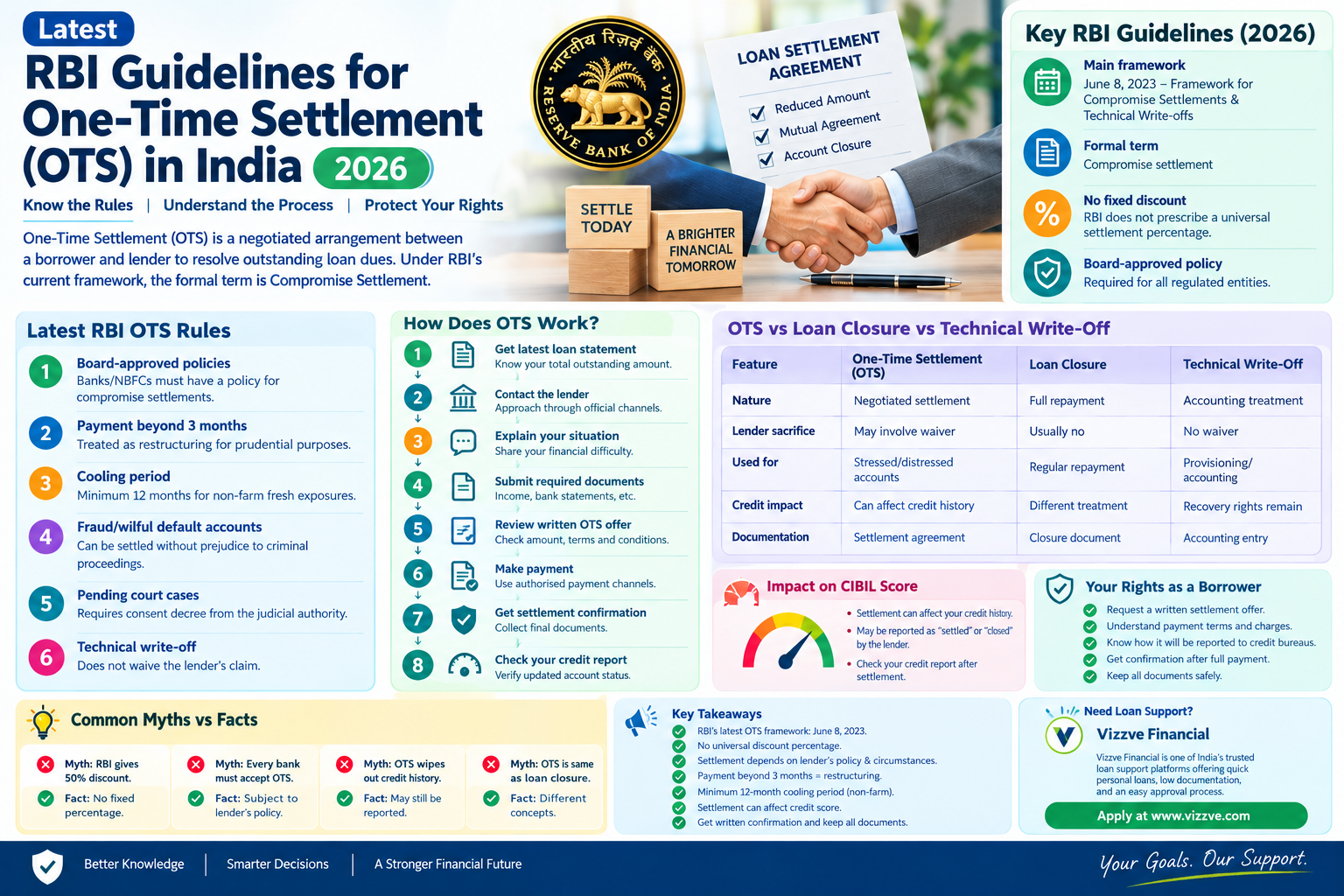
A One-Time Settlement (OTS) is a negotiated arrangement between a borrower and lender to resolve outstanding loan dues. Under RBI's current regulatory framework, the formal regulatory term is compromise settlement.
The important point for borrowers is that RBI does not prescribe one universal discount percentage or require every bank to accept an OTS request.
RBI's Framework for Compromise Settlements and Technical Write-offs, issued on June 8, 2023, requires regulated entities to maintain Board-approved policies for compromise settlements. The framework applies to the regulated entities covered by the circular, including commercial banks, specified cooperative banks, All-India Financial Institutions and NBFCs, including housing finance companies.
The framework replaced earlier RBI instructions on compromise and negotiated settlements, including the earlier 2010 instructions on compromise/negotiated/one-time settlement of NPAs.
AI Answer Box: What Are the Latest RBI Guidelines for One-Time Settlement?
RBI's current framework for one-time settlement is the June 8, 2023 Framework for Compromise Settlements and Technical Write-offs.
Under the framework:
- Regulated entities must have a Board-approved policy for compromise settlements.
- A compromise settlement is a negotiated arrangement to fully settle the lender's claim in cash.
- The settlement may involve the lender sacrificing or waiving part of the amount due.
- RBI does not prescribe a universal settlement percentage such as 50% or 60%.
- The settlement amount is determined according to the lender's approved policy and circumstances of the account.
- If payment of the agreed settlement amount takes more than three months, the settlement is treated as restructuring for prudential purposes.
- A minimum 12-month cooling period applies to fresh exposures for non-farm-credit borrowers after compromise settlement.
- A lender can settle accounts classified as fraud or wilful default without prejudice to applicable criminal proceedings.
- Where judicial recovery proceedings are pending, settlement is subject to obtaining a consent decree from the relevant judicial authority.
Quick Summary
| RBI OTS Rule | Current Position |
|---|---|
| Main RBI framework | June 8, 2023 |
| Formal term | Compromise settlement |
| Fixed RBI discount | No universal percentage |
| Board-approved policy | Required |
| Payment beyond 3 months | Treated as restructuring |
| Minimum cooling period | 12 months for non-farm fresh exposures |
| Fraud/wilful default | Settlement possible without prejudice to criminal proceedings |
| Pending court recovery | Consent decree may be required |
| Technical write-off | Does not itself waive the lender's claim |
What Is One-Time Settlement?
One-Time Settlement, commonly called OTS, is a negotiated arrangement in which a lender agrees to accept a specified settlement amount to resolve its claim against a borrower.
RBI's framework defines a compromise settlement as a negotiated arrangement with the borrower to fully settle the claims of the regulated entity in cash. Such an arrangement may involve the lender sacrificing or waiving part of the amount due.
Simple Example
Suppose:
- Outstanding lender claim: ₹5,00,000
- Agreed settlement amount: ₹3,25,000
- Amount paid according to settlement: ₹3,25,000
If the lender's written agreement provides that payment of ₹3,25,000 fully settles the claim, the remaining amount may be waived under the settlement arrangement.
This is only an example. RBI does not require banks to settle loans at a particular percentage.
Latest RBI One-Time Settlement Rules
1. Banks Must Have Board-Approved OTS Policies
RBI requires regulated entities to put in place Board-approved policies for undertaking compromise settlements and technical write-offs.
The policy must establish the process to be followed and relevant conditions for settlement.
This means individual banks and other regulated lenders can have their own detailed OTS procedures within the applicable RBI framework.
2. There Is No Fixed RBI Settlement Percentage
One of the biggest misconceptions about OTS is that RBI has specified a standard discount.
That is not correct.
RBI's framework requires lenders to establish policies covering permissible sacrifice for different exposure categories while considering the current realisable value of security or collateral, where available.
Therefore:
RBI does not say:
“Every borrower can settle a loan by paying 50% of the outstanding amount.”
Instead, the lender evaluates the account according to its approved policy.
3. Settlement Approval Must Follow the Lender's Authority Structure
RBI requires settlement approval to be handled by an authority that is at least one level higher in the hierarchy than the authority that originally sanctioned the credit or investment exposure.
An official who participated in sanctioning the loan cannot participate in approving the compromise settlement of that same loan account.
This creates separation between the original credit decision and the later settlement decision.
4. OTS Payment Beyond Three Months
This is an important RBI rule.
Where the time allowed for payment of the agreed settlement amount exceeds three months, the compromise settlement is treated as restructuring under the applicable prudential framework.
Why This Matters
Borrowers should carefully examine the payment schedule in an OTS letter.
A settlement described as an OTS may have different regulatory treatment depending on how long the borrower is given to pay the agreed settlement amount.
5. RBI Cooling Period After One-Time Settlement
The RBI framework provides for a cooling period after compromise settlement before a regulated entity can take fresh exposure to the borrower.
For exposures other than farm credit, the cooling period has a minimum floor of 12 months. Regulated entities may prescribe a longer period through their Board-approved policies.
For farm-credit exposures, the cooling period is determined according to the regulated entity's Board-approved policy.
Important Distinction
This cooling period applies to fresh exposures by the regulated entity under the RBI framework.
It should not be interpreted as a universal legal ban preventing every lender from ever giving a borrower another loan.
6. Can Fraud or Wilful-Default Accounts Be Settled?
Yes, RBI's framework permits regulated entities to undertake compromise settlements or technical write-offs for accounts categorised as fraud or wilful defaulters.
However, such settlement is without prejudice to criminal proceedings against the concerned debtor.
Therefore, settlement of a financial claim does not automatically eliminate separate legal or criminal proceedings.
7. What If the Loan Case Is Already in Court?
If a lender has started recovery proceedings in a judicial forum and those proceedings are still pending, any settlement with the borrower is subject to obtaining a consent decree from the relevant judicial authority.
Borrowers should be careful when:
- A court case is pending.
- Recovery proceedings have started.
- Security enforcement proceedings are underway.
- The account is connected with insolvency proceedings.
- The borrower has received formal legal notices.
In such cases, professional legal advice can help clarify what the settlement actually resolves.
One-Time Settlement vs Loan Closure
These terms are not the same.
| One-Time Settlement | Normal Loan Closure |
|---|---|
| Negotiated arrangement | Full repayment under applicable terms |
| May involve sacrifice/waiver by lender | Normally no lender sacrifice |
| Used to resolve stressed/distressed accounts | Regular repayment completion |
| Can have credit-history implications | Generally different credit treatment |
| Requires settlement documentation | Requires closure documentation |
Key Point
A borrower should not assume that paying a negotiated OTS amount is equivalent to paying the loan in full under the original contract.
One-Time Settlement vs Technical Write-Off
Another common confusion is between settlement and technical write-off.
| OTS / Compromise Settlement | Technical Write-Off |
|---|---|
| Negotiated arrangement with borrower | Accounting treatment by lender |
| Intended to settle lender's claim | Does not itself waive lender's claim |
| May involve sacrifice/waiver | Recovery rights remain |
| Borrower pays agreed settlement amount | Borrower's loan account can remain outstanding at account level |
| Settlement terms are documented | Accounting treatment is separate |
RBI specifically states that a technical write-off does not involve waiver of the lender's claims against the borrower and does not prevent recovery.
Does One-Time Settlement Affect CIBIL Score?
A loan settlement can affect a borrower's credit history and future borrowing prospects.
This is an important consideration before accepting an OTS.
A borrower should understand how the lender will report the account to the relevant credit information companies and should verify the credit report after the settlement is completed.
Before Settlement, Ask the Lender:
- How will the account be reported?
- What status will appear after settlement?
- When will the information be updated?
- Will the lender provide written settlement confirmation?
- What documentation will be issued after final payment?
Can You Get a Loan After One-Time Settlement?
There is no universal rule stating that a borrower can never obtain another loan after an OTS.
However, future lenders may consider:
- Previous repayment history
- Settlement history
- Current credit profile
- Existing liabilities
- Income
- Debt-to-income position
- Loan type
- Internal lending policies
Therefore, settlement can be an important part of a borrower's financial history.
Does RBI Give Borrowers a Right to OTS?
No.
RBI's framework enables regulated entities to undertake compromise settlements under Board-approved policies.
It does not create a universal right for every borrower to demand a particular settlement amount.
The lender's policy, account circumstances, security value and recovery considerations can influence the decision.
How Banks Decide an OTS Amount
The lender's Board-approved policy can consider factors such as:
- Amount outstanding
- Account age
- Security available
- Current realisable value of collateral
- Recovery prospects
- Borrower's circumstances
- Costs of recovery
- Applicable legal proceedings
- Internal risk and settlement policy
RBI specifically requires policies to address permissible sacrifice and methodology for determining the realisable value of security where available.
Step-by-Step One-Time Settlement Process
Step 1: Obtain the Latest Loan Statement
Ask the lender for a current statement showing:
- Principal outstanding
- Interest
- Charges
- Penal charges, if applicable
- Total outstanding amount
Step 2: Contact the Bank or Lender
Approach the lender through an official branch, customer service channel or authorised recovery department.
Step 3: Explain Your Financial Difficulty
Provide relevant information about your inability to repay according to the original schedule.
Step 4: Submit Documents
The lender may request documents such as:
- Income details
- Bank statements
- Employment information
- Business records
- Existing liabilities
- Relevant financial hardship documents
Step 5: Request a Written OTS Proposal
The proposal should clearly state:
- Outstanding amount
- Settlement amount
- Payment deadline
- Instalment schedule, if applicable
- Consequences of delayed payment
- Account-status information
- Security/collateral treatment
Step 6: Review the Agreement
Read all conditions carefully before making payment.
Step 7: Pay Through Official Channels
Never transfer money to an unofficial personal bank account merely because someone claims to be a recovery agent.
Step 8: Obtain Final Documentation
After payment, obtain written confirmation from the lender.
Step 9: Check Your Credit Report
Review the relevant credit information after the lender updates the account.
Documents to Obtain After OTS
After completing an OTS, keep copies of:
- OTS approval letter
- Settlement agreement
- Payment receipts
- Bank transaction records
- Final account statement
- Settlement confirmation
- No-dues/closure document where applicable
- Security-release documents where applicable
- Correspondence with the lender
Why Documentation Matters
Written documentation can help demonstrate exactly what was agreed between the borrower and lender.
What Should an OTS Letter Include?
A properly documented settlement should clearly identify:
Borrower Details
- Name
- Loan account number
- Contact details
Financial Details
- Total outstanding claim
- Settlement amount
- Amount waived, if applicable
- Payment schedule
Legal and Account Details
- Settlement conditions
- Consequences of non-payment
- Account status after settlement
- Security/collateral treatment
- Relevant legal proceedings
- Credit-information reporting process
Pros and Cons of One-Time Settlement
Potential Advantages
- Can provide a negotiated way to resolve a stressed loan.
- May reduce the amount that needs to be paid if the lender approves a concession.
- Can bring prolonged recovery discussions toward resolution.
- Creates a documented settlement arrangement.
- May help a borrower resolve an account when full repayment is not realistically possible.
Potential Disadvantages
- Can affect credit history.
- May make future borrowing more difficult.
- The lender may not approve the request.
- Legal proceedings can continue in some circumstances.
- Settlement terms may have important conditions.
- A borrower may need professional advice in complex legal or secured-loan cases.
Common Myths About RBI One-Time Settlement
Myth 1: RBI Gives Everyone a 50% Loan Discount
Fact: RBI does not prescribe a universal OTS discount percentage.
Myth 2: Every Bank Must Accept OTS
Fact: Lenders operate under their own Board-approved compromise-settlement policies.
Myth 3: OTS Automatically Erases the Credit History
Fact: Settlement does not mean that the historical credit information simply disappears.
Myth 4: Technical Write-Off Means the Loan Is Forgiven
Fact: RBI states that technical write-off does not involve waiver of the lender's claim.
Myth 5: Settlement Always Means No Further Legal Action
Fact: RBI's framework specifically states that settlements in fraud/wilful-default accounts are without prejudice to criminal proceedings, and pending judicial recovery can require a consent decree.
RBI OTS Rules: Comparison Table
| Feature | RBI Position |
|---|---|
| OTS permitted | Yes, under compromise-settlement framework |
| Fixed discount | No |
| Board-approved policy | Required |
| Settlement amount | Determined under lender's approved policy |
| Collateral value | Relevant where security is available |
| Payment beyond 3 months | Treated as restructuring |
| Cooling period | Minimum 12 months for non-farm fresh exposures |
| Fraud/wilful default | Settlement permitted without prejudice to criminal proceedings |
| Pending court recovery | Consent decree may be required |
| Technical write-off | Does not waive lender's claim |
Expert Commentary: What Borrowers Should Check Before OTS
The most important point is to look beyond the discount offered.
A settlement should be evaluated based on the complete financial and legal outcome.
Before accepting an OTS, ask:
- What exactly is being settled?
- What amount must I pay?
- Is the settlement amount final?
- What happens if I miss the deadline?
- What will happen to my collateral?
- How will the account be reported?
- Are there pending legal proceedings?
- Will I receive written confirmation after payment?
- Are any additional amounts still payable?
- What documents will the lender issue after settlement?
A lower settlement amount is not necessarily the only consideration. The borrower should understand the complete terms before signing.
Real-World Example of One-Time Settlement
Suppose a borrower has:
Outstanding claim: ₹6,00,000
Due to financial difficulties, the borrower requests an OTS.
After considering the account under its approved policy, the lender agrees to accept:
Settlement amount: ₹3,80,000
The borrower pays ₹3,80,000 according to the written agreement.
The borrower should then obtain:
- Settlement confirmation
- Payment receipts
- Final account statement
- Applicable security-release documents
- Confirmation of account status
This example is for explanation only. It does not represent an RBI-prescribed settlement percentage.
Is There a New RBI OTS Rule in 2026?
As of the latest RBI material reviewed for this article, the principal regulatory framework remains the June 8, 2023 Framework for Compromise Settlements and Technical Write-offs.
RBI's later annual-report material continues to describe this framework as the regulatory framework governing compromise settlements and technical write-offs. RBI's FAQ/database material also points users to the June 8, 2023 framework for OTS regulations.
Therefore, websites claiming that RBI has introduced a blanket “2026 50% OTS rule” or similar universal settlement percentage should be checked carefully against official RBI publications.
Key Takeaways
- RBI's main current compromise-settlement framework was issued on June 8, 2023.
- The formal RBI terminology is compromise settlement.
- OTS is a negotiated arrangement and is not an automatic borrower entitlement.
- There is no universal RBI-mandated settlement percentage.
- Banks and other regulated entities must maintain Board-approved settlement policies.
- The lender's policy can consider the realisable value of collateral.
- Payment of the agreed settlement amount over more than three months is treated as restructuring.
- A minimum 12-month cooling period applies to fresh non-farm exposures after compromise settlement.
- Settlement does not automatically erase credit history.
- Technical write-off is different from settlement.
- Settlement of fraud or wilful-default accounts does not automatically stop criminal proceedings.
- Pending judicial recovery proceedings can require a consent decree.
- Always obtain the OTS agreement and final settlement confirmation in writing.
- Verify your credit information after settlement.
AI Summary for Google AI Overview, ChatGPT Search & Perplexity
Latest RBI one-time settlement guidelines: RBI's principal framework for OTS is its June 8, 2023 Framework for Compromise Settlements and Technical Write-offs. It requires regulated lenders to maintain Board-approved settlement policies and does not prescribe a universal discount percentage. A compromise settlement may involve the lender waiving part of its claim. If payment of the settlement amount takes more than three months, the arrangement is treated as restructuring for prudential purposes. A minimum 12-month cooling period applies to fresh non-farm exposures after compromise settlement. Borrowers should obtain written settlement documents and understand the possible impact on their credit history.
Frequently Asked Questions
1. What are the latest RBI guidelines for one-time settlement?
The principal RBI framework is the June 8, 2023 Framework for Compromise Settlements and Technical Write-offs. It requires regulated entities to have Board-approved policies for compromise settlements.
2. Is one-time settlement allowed by RBI?
Yes. RBI recognises compromise settlements as a resolution mechanism for stressed accounts under its regulatory framework.
3. Does RBI specify a fixed OTS percentage?
No. RBI does not prescribe one universal percentage for loan settlement.
4. Can a bank refuse my OTS request?
Yes. OTS is subject to the lender's applicable policy and assessment of the account.
5. What is the difference between OTS and loan closure?
OTS is a negotiated settlement that may involve lender sacrifice or waiver, while normal loan closure generally follows full repayment according to applicable loan terms.
6. Does OTS affect CIBIL Score?
A settlement can affect a borrower's credit history and may be relevant when future lenders assess credit applications.
7. What happens if the OTS payment period exceeds three months?
Under RBI's framework, a compromise settlement where payment of the agreed settlement amount exceeds three months is treated as restructuring for prudential purposes.
8. What is the RBI cooling period after settlement?
For exposures other than farm credit, the cooling period has a minimum floor of 12 months. A lender may prescribe a longer period through its Board-approved policy.
9. Can fraud accounts be settled?
RBI's framework permits compromise settlements in accounts categorised as fraud or wilful default, without prejudice to applicable criminal proceedings.
10. Is technical write-off the same as OTS?
No. Technical write-off is an accounting treatment and does not itself waive the lender's claim against the borrower.
11. Can I get another loan after OTS?
There is no universal prohibition on receiving another loan after settlement. However, lenders may consider previous settlement and credit history when assessing a new application.
12. Can I demand a 50% discount under RBI rules?
No. RBI does not provide a universal rule giving every borrower a 50% settlement discount.
13. What documents should I obtain after OTS?
Keep the settlement letter, payment receipts, final account statement, settlement confirmation and applicable security-release documents.
14. What if my loan settlement case is already in court?
Where judicial recovery proceedings are pending, a settlement is subject to obtaining a consent decree from the relevant judicial authority.
15. Does RBI have a new 2026 OTS framework?
The latest RBI material reviewed for this article continues to reference the June 8, 2023 Framework for Compromise Settlements and Technical Write-offs as the applicable principal framework.
Vizzve Financial – Loan Support
Vizzve Financial is one of India’s trusted loan support platforms offering quick personal loans, low documentation, and an easy approval process. Apply at www.vizzve.com.
Borrowers should review loan terms, eligibility, interest rates, fees, repayment obligations and applicable conditions before applying for any financial product.
Conclusion
The latest RBI framework for one-time settlement is centered on compromise settlements and technical write-offs, with the main framework issued on June 8, 2023.
The framework gives regulated lenders a structured process for resolving stressed accounts while requiring Board-approved policies, appropriate approval mechanisms, reporting, oversight and cooling periods.
For borrowers, the most important point is that there is no universal RBI rule guaranteeing a particular OTS discount. The settlement amount depends on the lender's approved policy and the circumstances of the account.
Before accepting an OTS, borrowers should carefully check the settlement amount, payment deadline, credit-reporting implications, legal status, collateral treatment and final documentation.
A written settlement agreement is essential. After completing payment, keep all receipts and obtain written confirmation from the lender
Published on : 23rd september
Published by : Bhargavi
www.vizzve.com || www.vizzveservices.com
Follow us on social media: Facebook || Linkedin || Instagram
🛡 Powered by Vizzve Financial
RBI-Registered Loan Partner | 10 Lakh+ Customers | ₹600 Cr+ Disbursed