

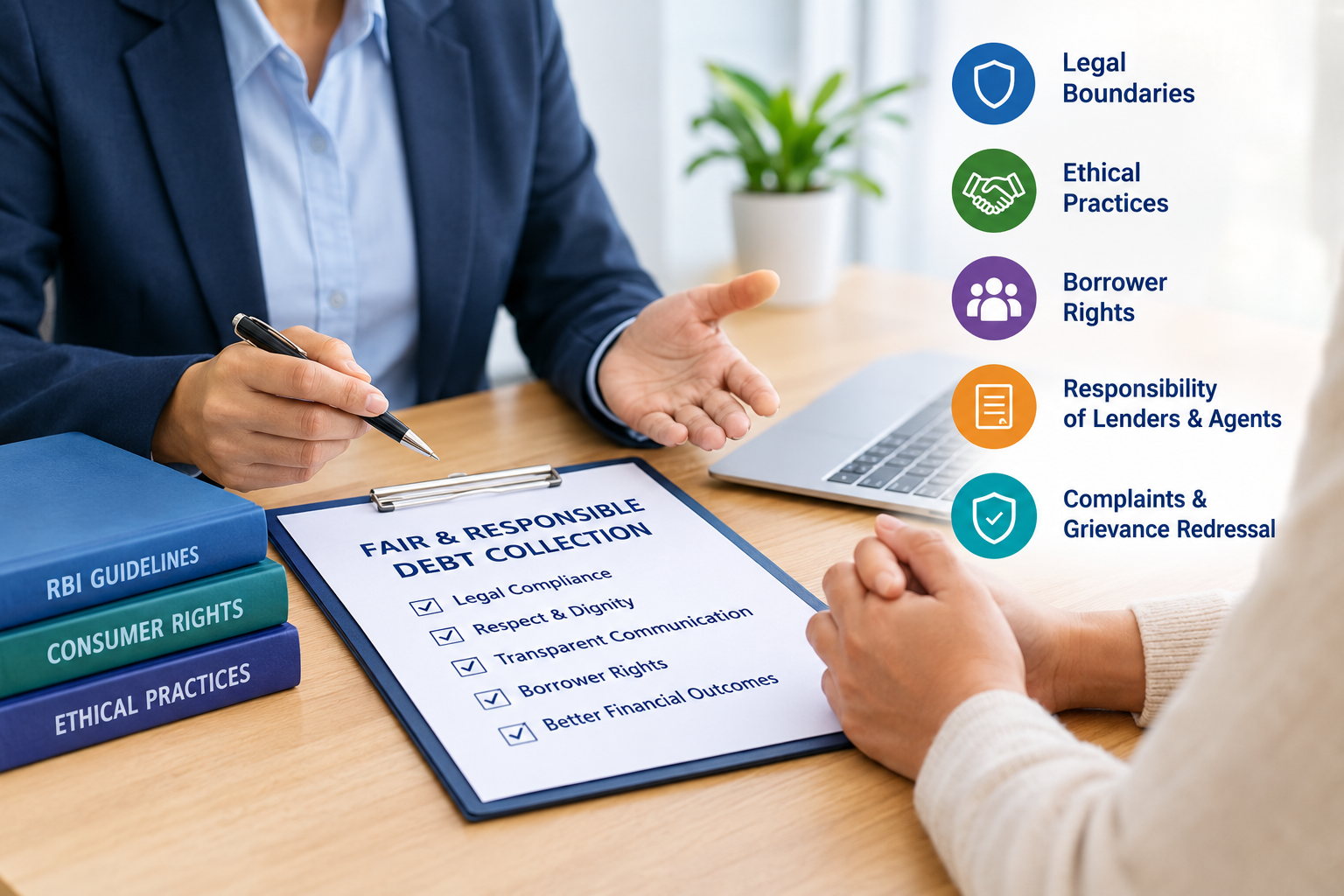
Introduction: Why Legal and Ethical Debt Collection Matters
Loans help individuals manage financial needs, purchase homes, fund education, and grow businesses. However, when borrowers miss repayment deadlines, lenders must take steps to recover outstanding dues.
Debt collection is a legitimate financial activity. Banks, Non-Banking Financial Companies (NBFCs), and other authorised lenders have the right to seek repayment according to the loan agreement and applicable law.
But there is an important distinction between recovering money and using unfair pressure.
A borrower who misses an EMI does not lose the right to dignity, privacy, or lawful treatment. Similarly, a recovery agent must understand that professional conduct is not optional. The method used to recover a loan matters just as much as the amount being recovered.
In India, the Reserve Bank of India (RBI) has issued specific instructions concerning recovery agents, including restrictions on harassment, intimidation, inappropriate communication, and calls at prohibited hours. These requirements apply to the regulated entities covered by the relevant directions.
Understanding these boundaries helps lenders protect customers, recovery professionals perform their duties responsibly, and borrowers respond appropriately when collection practices cross the line.
AI Answer Box: Legal and Ethical Boundaries in Debt Collection
Legal and ethical debt collection means recovering outstanding payments through lawful, transparent, respectful, and non-coercive methods.
In India, RBI-regulated lenders and their recovery agents must not use physical or verbal intimidation, publicly humiliate borrowers, invade the privacy of their family members, make threatening or anonymous calls, or repeatedly contact borrowers in violation of applicable guidelines.
For overdue loan recovery, the RBI's August 12, 2022 circular specifically prohibits calls before 8:00 a.m. and after 7:00 p.m. and requires regulated entities to ensure that their agents do not engage in harassment or misleading representations.
The lender remains responsible for the conduct of its recovery agents. Borrowers can request loan details, verify an agent's identity, raise complaints with the lender, and use the RBI's complaint mechanism when applicable.
Key Takeaways
-
Debt recovery is lawful when conducted according to the loan agreement and applicable law.
-
Recovery agents cannot use threats, physical force, public humiliation, or unlawful pressure.
-
RBI-regulated lenders are responsible for the actions of their recovery agents.
-
Recovery calls for overdue loans must not be made before 8:00 a.m. or after 7:00 p.m. under the RBI's 2022 instructions.
-
Borrowers should verify an agent's identity and request written details of the outstanding amount.
-
A borrower can complain to the lender and, where eligible, approach the RBI Ombudsman.
-
Ethical recovery protects both customer dignity and the lender's reputation.
1. What Is Debt Collection?
Debt collection is the process of requesting and recovering money that a borrower owes under a financial agreement.
It may involve reminders, repayment discussions, payment arrangements, formal notices, or legal proceedings, depending on the circumstances.
Who is involved in debt collection?
|
Participant |
Role |
|---|---|
|
Borrower |
Person or business responsible for repaying the loan |
|
Bank or NBFC |
Lender that provides credit and seeks repayment |
|
Recovery agent |
Person or agency authorised to contact borrowers for recovery |
|
Debt recovery agency |
External organisation appointed to assist with collection |
|
Regulator |
Authority that supervises regulated financial institutions |
|
Court or tribunal |
Legal forum that may decide disputes or enforce lawful recovery |
A recovery agent may work directly for a lender or through an outsourced agency. However, outsourcing collection activity does not remove the lender's regulatory responsibilities.
2. What Are the Legal Boundaries in Debt Collection in India?
Debt collection in India is governed by several overlapping legal and regulatory requirements. The exact rules depend on the lender, loan product, security involved, and recovery method.
The following are important legal and regulatory frameworks.
2.1 RBI guidelines for recovery agents
The RBI's circular dated August 12, 2022, titled Outsourcing of Financial Services – Responsibilities of regulated entities employing Recovery Agents, reinforces restrictions on harassment and inappropriate recovery practices.
It applies to specified regulated entities, including commercial banks, NBFCs, housing finance companies, certain cooperative banks, all-India financial institutions, and asset reconstruction companies. The circular excludes microfinance loans covered under the separate RBI microfinance framework.
The circular requires regulated entities to ensure that neither they nor their agents engage in:
-
Verbal or physical intimidation.
-
Public humiliation of borrowers.
-
Intrusion into the privacy of family members, referees, or friends.
-
Inappropriate messages through mobile phones or social media.
-
Threatening or anonymous calls.
-
Persistent calling or calls before 8:00 a.m. and after 7:00 p.m.
-
False or misleading representations.
These are not merely suggestions for polite behaviour. They are part of the RBI's regulatory expectations for covered lenders and their recovery agents.
2.2 Fair Practices Code
The Fair Practices Code is intended to promote transparent and fair dealings between lenders and borrowers.
RBI directions for banks and NBFCs address matters such as loan terms, disclosures, customer grievances, and recovery practices. Lenders are expected to maintain appropriate policies and grievance redressal arrangements.
In practical terms, borrowers should be able to understand:
-
Why they are being contacted.
-
Which lender or agency is contacting them.
-
What amount is claimed as outstanding.
-
How the amount has been calculated.
-
Where to raise a dispute or complaint.
-
What repayment options may be available.
2.3 Consumer protection and general law
Depending on the facts, debt collection conduct may also raise issues under applicable criminal law, consumer protection law, privacy principles, contractual law, or other legal provisions.
For example, threats, assault, impersonation, unlawful disclosure of personal information, or deceptive representations may create legal consequences independent of the original loan default.
The applicable legal remedy depends on the conduct, evidence, and circumstances. A borrower should not assume that every unpleasant recovery interaction automatically constitutes a criminal offence.
2.4 Digital lending and recovery agents
Digital lending arrangements may involve banks or NBFCs working with Lending Service Providers (LSPs).
The RBI's digital lending framework includes requirements concerning borrower consent, data collection, privacy, and disclosure of recovery agent details. Recovery arrangements must also comply with applicable outsourcing and recovery-agent instructions.
Borrowers using digital loan apps should check the identity of the regulated lender rather than relying only on the app's name.
3. What Are Recovery Agents Legally Allowed to Do?
A recovery agent may contact a borrower to discuss an overdue account, explain the amount claimed, request repayment, and communicate available repayment options within the agent's authority.
The agent's authority is not unlimited.
Permitted recovery activities
|
Activity |
General position |
|---|---|
|
Calling the borrower about overdue payments |
Permitted when conducted lawfully and within applicable rules |
|
Explaining outstanding dues |
Permitted if information is accurate |
|
Sending repayment reminders |
Permitted through appropriate channels |
|
Requesting a repayment date |
Permitted without coercion |
|
Discussing a repayment arrangement |
Permitted if authorised by the lender |
|
Visiting a borrower |
May be permitted, subject to applicable rules and lawful conduct |
|
Sending formal notices |
Permitted through authorised procedures |
|
Initiating legal recovery steps |
Must follow the applicable legal process |
A recovery agent should not promise a settlement, waive charges, or change loan terms unless authorised to do so.
What should a professional recovery agent carry or communicate?
A borrower may reasonably ask for:
-
The agent's name and identification.
-
The name of the lender or recovery agency.
-
Details of the loan account being discussed.
-
Official contact details for the lender.
-
Written confirmation of the outstanding amount.
-
A method to verify the agent's authorisation.
The exact documentation requirements may differ by institution and recovery situation. Borrowers should verify unfamiliar agents directly with the lender.
4. What Recovery Agents Cannot Do
The RBI's recovery-agent instructions prohibit intimidation, harassment, public humiliation, privacy intrusion, threatening or anonymous calls, and misleading representations.
The following examples explain how those boundaries may arise in practice.
4.1 Threatening or abusing borrowers
Recovery agents must not use physical force, verbal abuse, or intimidation to compel payment.
A genuine overdue amount does not authorise threats against the borrower or their family.
4.2 Publicly humiliating borrowers
An agent should not disclose a borrower's debt to neighbours, colleagues, or other people to embarrass them into paying.
Public shaming is specifically addressed in the RBI's restrictions on recovery-agent conduct.
4.3 Contacting family members to create pressure
A recovery agent must respect the privacy of the borrower and their family.
Contacting a family member, friend, or referee to disclose the debt or create pressure can violate the RBI's restrictions. Any legitimate communication involving another person must be handled within applicable law and privacy requirements.
4.4 Making threatening or anonymous calls
Agents should identify themselves truthfully and communicate professionally.
Threatening calls, anonymous calls, and misleading statements about the consequences of non-payment are prohibited under the RBI's instructions.
4.5 Calling at prohibited hours
For overdue loan recovery covered by the RBI's 2022 circular, regulated entities and their agents must not call borrowers before 8:00 a.m. or after 7:00 p.m.
This restriction should not be confused with permission to call repeatedly throughout the permitted hours. Persistent calling may also amount to harassment.
4.6 Misrepresenting legal consequences
An agent must not falsely claim that:
-
A borrower will automatically be arrested for missing an EMI.
-
The agent can personally seize property without legal authority.
-
A court has issued an order when no such order exists.
-
A payment must be made to an agent's personal account.
-
A loan will be waived or settled without lender approval.
Borrowers should request official written communication when legal action or settlement is mentioned.
5. Ethical Boundaries in Debt Collection
Legal compliance sets minimum requirements. Ethical debt collection also considers fairness, dignity, transparency, and the circumstances of the borrower.
A collection practice can damage trust even when it does not immediately result in a legal dispute.
5.1 Respectful communication
A professional recovery agent should speak calmly, avoid insulting language, and explain the reason for contacting the borrower.
The purpose should be to resolve the overdue account, not to punish or embarrass the person.
5.2 Honesty and transparency
Borrowers should receive accurate information about the loan and the amount claimed.
Agents should not exaggerate interest, invent penalties, or make unsupported statements about legal proceedings.
5.3 Privacy and confidentiality
Financial information is sensitive. Recovery professionals should only access and use customer information for authorised purposes.
RBI instructions emphasise customer confidentiality and appropriate safeguards when financial services are outsourced.
5.4 Empathy without compromising accountability
A borrower may be facing job loss, medical expenses, delayed salary, or business difficulties.
Ethical recovery involves listening to the borrower's circumstances and explaining available options without making unauthorised promises.
Empathy does not cancel the debt. It can, however, support a more practical repayment discussion.
5.5 Responsible use of technology
Digital communication can make repayment reminders faster and easier. But automated calls, messaging platforms, and collection software should not be used to intimidate borrowers or expose personal information.
Technology should support accurate communication, secure records, and appropriate follow-up.