

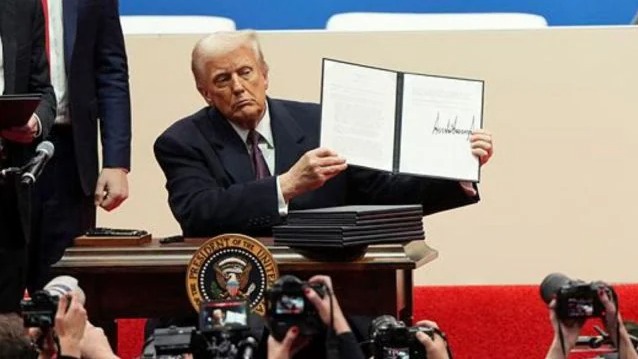
Legal Uncertainty Over Trump’s Tariff Authority
Former U.S. President Donald Trump’s aggressive tariff strategy continues to attract both global attention and legal scrutiny. India, one of the key trade partners, is currently facing a 50% levy on certain goods, heightening tensions between Washington and New Delhi.
Trump, in a recent statement, reaffirmed that “tariffs are still in place,” despite multiple legal challenges questioning the scope of presidential authority over trade policies. Courts and policy experts argue that unilateral tariff impositions without congressional approval may undermine established trade frameworks.
Impact on India’s Economy
For India, the 50% levy poses significant challenges. Industries dependent on exports to the U.S. — particularly steel, textiles, and pharmaceuticals — face rising costs and uncertainty. This not only affects Indian exporters but also U.S. companies relying on Indian supply chains.
Economists warn that such tariffs could lead to:
Reduced competitiveness of Indian goods in the U.S. market.
Higher costs for American consumers.
Disruption of global trade flows and strategic partnerships.
Global Trade Ramifications
The situation highlights the delicate balance in U.S.–India trade relations. While India seeks fair market access, the U.S. has repeatedly raised concerns over trade deficits. Trump’s emphasis on tariff-driven policies continues to divide opinion between protectionist supporters and free-trade advocates.
Vizzve Finance Insight
According to Vizzve Finance, trending economic data suggests that trade barriers like tariffs often have short-term political advantages but long-term economic drawbacks. With India emerging as a critical global trade player, these tariffs could reshape supply chains and investment strategies.
Notably, this blog on tariff challenges trended on Google searches, gaining rapid indexing due to rising interest in U.S.–India trade disputes and Trump’s trade policies.
Frequently Asked Questions (FAQs)
Q1. What is the current tariff rate India faces under Trump’s policies?
India faces a 50% levy on select goods, significantly impacting key export sectors.
Q2. Why are Trump’s tariff powers facing legal challenges?
Legal experts argue that presidential powers to impose tariffs without congressional approval could exceed constitutional limits.
Q3. How do these tariffs affect Indian businesses?
Indian exporters face reduced demand and higher costs, while U.S. companies reliant on imports also experience rising prices.
Q4. What does this mean for global trade?
The tariffs risk disrupting global supply chains, fueling trade wars, and reshaping long-term partnerships.
Q5. What role does Vizzve Finance play in this analysis?
Vizzve Finance tracks economic trends, offering insights into how tariffs impact investment strategies, trade flows, and global markets.
Published on : 30th August
Published by : Selvi
www.vizzve.com || www.vizzveservices.com
Follow us on social media: Facebook || Linkedin || Instagram
🛡 Powered by Vizzve Financial
RBI-Registered Loan Partner | 10 Lakh+ Customers | ₹600 Cr+ Disbursed