

Introduction
Taking a personal loan can help you manage planned expenses, medical bills, education costs, home repairs, or other financial needs. However, choosing a loan amount without checking your monthly budget can create repayment difficulties.
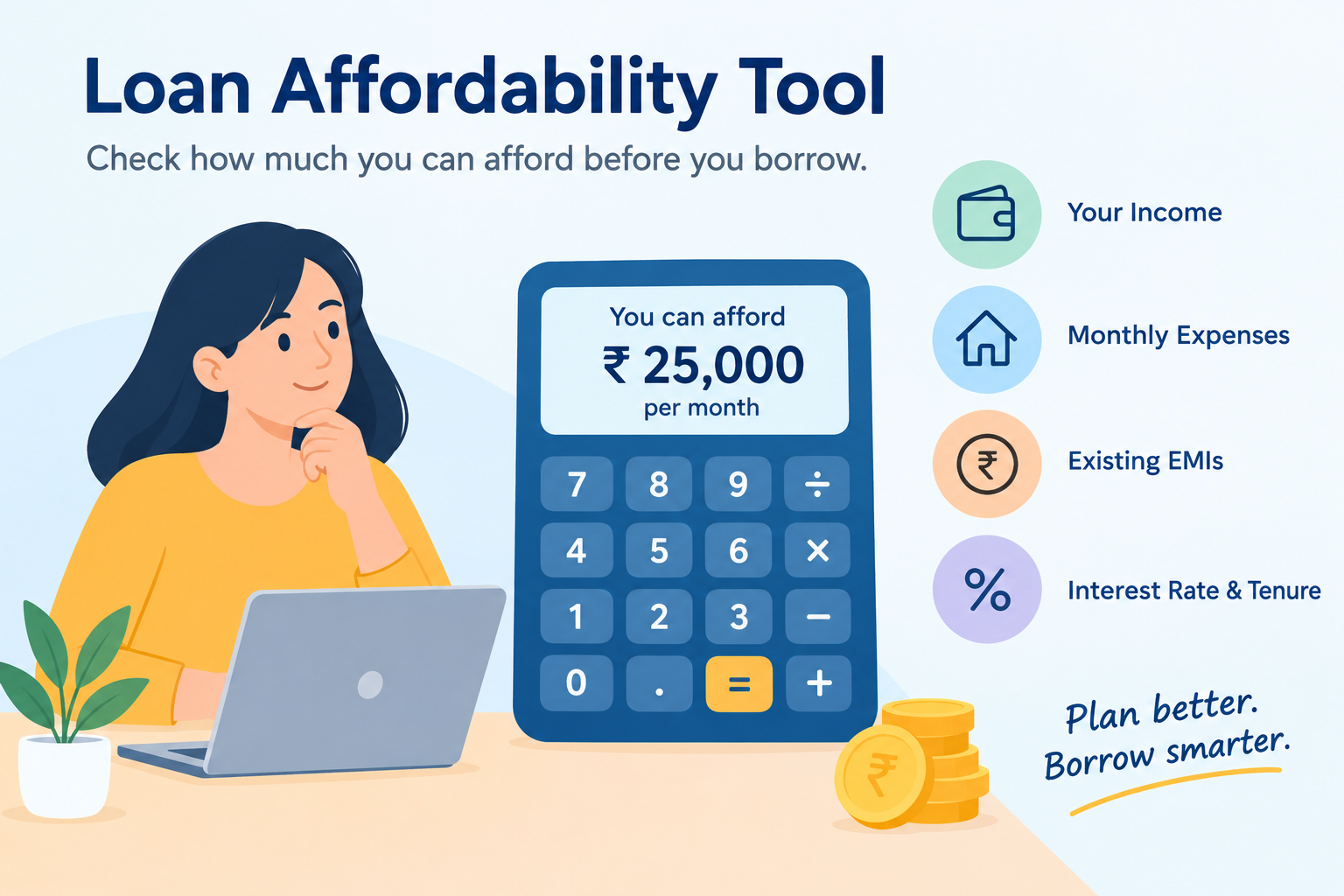
A loan affordability tool helps you estimate how much you may comfortably borrow based on your income, existing EMIs, regular expenses, interest rate, and repayment tenure.
Instead of focusing only on the maximum loan amount a lender might offer, you can use this tool to understand how much you could reasonably repay every month.
For example, a person earning ₹30,000 per month may have a very different repayment capacity from someone earning the same amount but paying higher rent, supporting dependants, and repaying an existing loan.
This is why loan affordability depends on more than salary alone.
In this guide, you will learn how a loan affordability tool works, how to calculate an affordable EMI, how existing debts affect your borrowing capacity, and how to plan a personal loan responsibly.
Important: A loan affordability estimate is not a loan approval or a guarantee of eligibility. The actual amount offered depends on the lender's criteria, credit assessment, income verification, and applicable loan terms.
AI Answer Box: What Is a Loan Affordability Tool?
A loan affordability tool is an online financial calculator that estimates how much a person may be able to borrow and repay without putting excessive pressure on their monthly budget.
It considers factors such as monthly income, essential expenses, existing EMIs, the proposed interest rate, and loan tenure.
For example, if a borrower earns ₹40,000 per month, spends ₹22,000 on regular expenses, and pays ₹5,000 toward existing EMIs, approximately ₹13,000 remains before savings, irregular expenses, and other financial commitments.
That does not mean the entire ₹13,000 should be used for a new loan EMI. A sensible affordability assessment should also account for emergency savings and unexpected costs.
Quick answer: Use a loan affordability tool to estimate a manageable monthly EMI, calculate a potential loan amount, and understand how borrowing may affect your household budget before applying.
Key Takeaways
-
A loan affordability tool estimates how much you may reasonably borrow.
-
Monthly income alone does not determine loan affordability.
-
Existing EMIs and household expenses reduce the amount available for a new loan.
-
Interest rates and repayment tenure influence the EMI and total borrowing cost.
-
A longer tenure may reduce the monthly EMI but increase total interest.
-
Loan affordability and loan eligibility are two different things.
-
Keep room in your budget for savings, emergencies, and irregular expenses.
-
Always review the lender's official interest rate, charges, repayment schedule, and applicable APR disclosures before accepting a loan.
What Is a Loan Affordability Tool?
A loan affordability tool is designed to help borrowers assess whether a proposed loan fits their financial situation.
It combines information about income, expenses, existing debt, interest rates, and repayment tenure to estimate a suitable borrowing amount.
The goal is not simply to determine the largest loan available. It is to help you identify a loan repayment amount that leaves enough money for essential expenses and other financial priorities.
Why Is Loan Affordability Important?
Before applying for a personal loan, it is important to know how the monthly EMI will affect your finances.
A loan that appears affordable when viewed in isolation may become difficult to manage when combined with rent, food, transport, education expenses, insurance, and other EMIs.
Checking affordability in advance can help you:
-
Avoid borrowing more than you need.
-
Estimate your monthly repayment commitment.
-
Compare different loan amounts and tenures.
-
Understand the impact of existing debt.
-
Preserve money for essential expenses.
-
Reduce the risk of missed EMI payments.
-
Make more informed financial decisions.
Who Should Use a Loan Affordability Tool?
| User type | How the tool can help |
|---|---|
| Salaried employees | Estimate a loan amount based on take-home income |
| Government employees | Review repayment capacity against regular expenses |
| Private-sector employees | Plan borrowing around salary and existing EMIs |
| Self-employed individuals | Estimate repayments using realistic income figures |
| Freelancers | Assess affordability despite fluctuating monthly earnings |
| First-time borrowers | Understand how EMIs affect their budget |
| Existing borrowers | Evaluate whether taking another loan is practical |
| Small business owners | Review personal borrowing alongside business expenses |
The calculator is particularly useful when you want to compare multiple loan scenarios before submitting an application.
How Does a Loan Affordability Tool Work?
A loan affordability tool estimates your repayment capacity by examining how much money remains after accounting for important financial commitments.
Depending on the calculator, it may ask for the following details.
1. Monthly Take-Home Income
Enter the income you actually receive after deductions, rather than relying only on your gross salary.
For salaried borrowers, this usually means the amount credited to the bank account each month.
For self-employed borrowers and freelancers, use a realistic estimate of personal income after relevant business expenses and fluctuations.
2. Monthly Household Expenses
Include essential and regular costs such as:
-
Rent or housing expenses
-
Groceries
-
Electricity and utility bills
-
Transportation
-
Education expenses
-
Medical expenses
-
Insurance premiums
-
Family support and dependent-care costs
A realistic expense estimate is more useful than an optimistic one.
3. Existing EMIs and Debt Payments
Include your current loan repayments, such as:
-
Personal loan EMIs
-
Vehicle loan EMIs
-
Education loan EMIs
-
Home loan EMIs
-
Other recurring debt payments
These obligations reduce the amount available for a new EMI.
4. Proposed Interest Rate
The interest rate determines how much interest you pay on the borrowed amount.
A higher interest rate generally results in a higher EMI for the same principal and tenure.
5. Loan Tenure
The tenure is the period over which you repay the loan.
A longer tenure generally reduces the monthly EMI for a given loan amount and interest rate, but it may increase the total interest paid.
6. Emergency Savings and Financial Goals
A good affordability assessment should leave room for emergencies, future expenses, and regular savings.
A calculator may not automatically include these factors, so consider them separately when deciding how much EMI you can afford.
Loan Affordability Formula: How Much Loan Can You Afford?
There is no single formula that works for every borrower. A practical approach is to estimate the amount available for a new EMI after subtracting essential expenses, existing debt payments, and a reasonable financial buffer.
Formula 1: Monthly Amount Available for a New EMI
Available EMI Budget = Monthly Take-Home Income − Essential Expenses − Existing EMIs − Savings and Emergency Buffer
For example, suppose your monthly financial details are:
| Financial detail | Amount |
|---|---|
| Monthly take-home income | ₹40,000 |
| Essential household expenses | ₹18,000 |
| Existing EMIs | ₹4,000 |
| Savings and emergency buffer | ₹5,000 |
| Amount remaining for a new EMI | ₹13,000 |
The calculation is:
₹40,000 − ₹18,000 − ₹4,000 − ₹5,000 = ₹13,000
In this example, ₹13,000 is the estimated maximum amount available for the new EMI under the assumptions used.
However, you may choose a lower EMI to account for irregular expenses, income uncertainty, or upcoming financial commitments.
Remember: This formula is a budgeting method, not a lender's official eligibility formula.
Formula 2: Calculate EMI Based on Loan Amount
For a standard loan with a fixed monthly interest rate and equal monthly instalments, the EMI formula is:
EMI = P × r × (1 + r)ⁿ / [(1 + r)ⁿ − 1]
Where:
-
P = loan principal
-
r = monthly interest rate expressed as a decimal
-
n = total number of monthly instalments
For example, a loan of ₹1,00,000 at a nominal annual interest rate of 12%, repaid over 12 months using a standard reducing-balance EMI method, has an estimated monthly EMI of ₹8,885.
The actual EMI may differ depending on the lender's calculation method, applicable terms, and charges.
Formula 3: Estimate the Affordable Loan Amount
If you know the monthly EMI you can afford, you can estimate the corresponding loan principal using the reverse EMI formula:
P = EMI × [(1 + r)ⁿ − 1] / [r × (1 + r)ⁿ]
Where:
-
P = estimated loan principal
-
EMI = affordable monthly instalment
-
r = monthly interest rate
-
n = total number of monthly instalments
This formula helps estimate the loan amount associated with a particular EMI, interest rate, and tenure.
It does not account for processing fees or guarantee that a lender will approve the calculated amount.
Loan Affordability Example: Monthly Income of ₹30,000
Consider a borrower who earns ₹30,000 per month and wants to apply for a personal loan.
The borrower's budget may look like this:
| Financial detail | Amount |
|---|---|
| Monthly take-home income | ₹30,000 |
| Essential monthly expenses | ₹14,000 |
| Existing EMIs | ₹2,000 |
| Savings and emergency buffer | ₹4,000 |
| Amount available for a new EMI | ₹10,000 |
The estimated amount available for a new EMI is ₹10,000 per month.
However, this is a budget-based estimate, not a recommendation to borrow the maximum possible amount.
The borrower should also consider job stability, upcoming expenses, and whether the budget remains manageable if costs increase.
How Much Loan Could This Borrower Afford?
Suppose the borrower wants to repay a loan over 24 months at an assumed nominal annual interest rate of 12%, using a standard reducing-balance EMI calculation.
An EMI of approximately ₹10,000 would correspond to a loan principal of roughly ₹2.12 lakh.
This is an illustrative mathematical estimate. The actual loan amount offered may be lower because of lender eligibility rules, credit history, income verification, and applicable fees.
A borrower who wants additional financial flexibility could choose a smaller loan and a lower EMI.
Loan Affordability by Monthly Salary
The following table illustrates how affordability can vary with income and expenses.
These examples are illustrative budgeting scenarios, not recommended borrowing limits or lender eligibility thresholds.
| Monthly take-home income | Essential expenses | Existing EMIs | Savings buffer | Amount remaining for a new EMI |
|---|---|---|---|---|
| ₹15,000 | ₹8,000 | ₹1,000 | ₹2,000 | ₹4,000 |
| ₹20,000 | ₹10,000 | ₹1,000 | ₹3,000 | ₹6,000 |
| ₹25,000 | ₹12,000 | ₹2,000 | ₹3,000 | ₹8,000 |
| ₹30,000 | ₹14,000 | ₹2,000 | ₹4,000 | ₹10,000 |
| ₹40,000 | ₹18,000 | ₹4,000 | ₹5,000 | ₹13,000 |
| ₹50,000 | ₹22,000 | ₹5,000 | ₹7,000 | ₹16,000 |
| ₹60,000 | ₹26,000 | ₹6,000 | ₹8,000 | ₹20,000 |
The available EMI is calculated by subtracting expenses, existing EMIs, and the savings buffer from monthly take-home income.
Why Does Affordability Differ at the Same Salary?
Two people earning ₹30,000 per month may have very different borrowing capacities.
One person might pay ₹8,000 in rent and have no existing loans. Another might support several family members, pay ₹12,000 in rent, and already have two EMIs.
The second borrower has less money available for a new repayment, even though both earn the same salary.
This is why a loan affordability tool should consider the entire monthly budget rather than salary alone.
Loan Affordability vs Loan Eligibility
Loan affordability and loan eligibility are related, but they are not the same.
Loan affordability refers to how comfortably you can manage repayments within your budget.
Loan eligibility refers to whether you meet a lender's requirements for a particular loan.
| Feature | Loan Affordability | Loan Eligibility |
|---|---|---|
| Main purpose | Assess personal repayment capacity | Assess whether lender criteria are met |
| Main inputs | Income, expenses, debts, savings | Income, credit profile, employment, lender criteria |
| Considers household expenses | Should do so | May consider obligations through the lender's assessment |
| Determines approval | No | Helps determine whether an application qualifies |
| Determines a suitable EMI | Helps estimate one | May affect the amount and terms offered |
| Result | Estimated comfortable repayment amount | Potential qualification under lender rules |
You may qualify for a larger loan than you can comfortably afford. Conversely, you may have sufficient money in your budget for a repayment but fail to meet a lender's eligibility criteria.
Best practice: Check both affordability and eligibility before applying.
How Existing EMIs Affect Loan Affordability
Existing debt payments reduce the money available for additional borrowing.
For example, consider two borrowers who each earn ₹40,000 per month.
| Financial detail | Borrower A | Borrower B |
|---|---|---|
| Monthly take-home income | ₹40,000 | ₹40,000 |
| Essential expenses | ₹18,000 | ₹18,000 |
| Existing EMIs | ₹2,000 | ₹8,000 |
| Savings buffer | ₹5,000 | ₹5,000 |
| Amount available for a new EMI | ₹15,000 | ₹9,000 |
Borrower A has ₹15,000 available for a new EMI under the assumptions used, while Borrower B has ₹9,000.
Although both earn the same amount, their existing financial obligations create different repayment capacities.
How Can You Improve Your Loan Affordability?
You can review your finances before applying by:
-
Reducing unnecessary recurring expenses.
-
Avoiding additional borrowing for non-essential purchases.
-
Paying existing debts on time.
-
Reviewing whether existing loans can be managed more efficiently.
-
Increasing your emergency savings.
-
Choosing a smaller loan amount.
-
Selecting a suitable tenure without unnecessarily extending repayment.
Do not use your entire monthly surplus for loan repayments. A financial buffer can help you manage unexpected expenses without relying on additional credit.
How Loan Tenure Affects Affordability
Loan tenure is an important factor when estimating a manageable EMI.
For the same principal and interest rate, a longer tenure generally lowers the monthly instalment because repayment is spread over more months.
However, the borrower usually pays interest for a longer period.
Example: Comparing Different Loan Tenures
Consider a loan of ₹2,00,000 at an assumed nominal annual interest rate of 12%, calculated on a reducing balance.
The following estimates illustrate the effect of different repayment periods.
| Loan tenure | Approximate monthly EMI | Approximate total repayment | Approximate total interest |
|---|---|---|---|
| 12 months | ₹17,770 | ₹2,13,240 | ₹13,240 |
| 24 months | ₹9,415 | ₹2,25,960 | ₹25,960 |
| 36 months | ₹6,643 | ₹2,39,148 | ₹39,148 |
Figures are rounded estimates. They assume a fixed 12% nominal annual rate, monthly interest of 1%, equal monthly instalments, and no additional fees.
Which Tenure Should You Choose?
A shorter tenure may reduce the total interest paid but require a higher monthly EMI.
A longer tenure may make the EMI easier to manage, but it can increase the total interest cost.
Choose a repayment period that balances monthly affordability with the overall cost of borrowing.
Do not choose a longer tenure automatically just because it produces a lower EMI. Compare the total repayment amount before deciding.
Debt-to-Income Ratio and Loan Affordability
The debt-to-income ratio, or DTI, compares debt payments with income.
A commonly used version is:
DTI = Total Monthly Debt Payments ÷ Gross Monthly Income × 100
For example, if your monthly debt payments are ₹10,000 and your gross monthly income is ₹50,000:
DTI = ₹10,000 ÷ ₹50,000 × 100 = 20%
This means 20% of the gross monthly income goes toward the debt payments included in the calculation.
Why Is DTI Useful?
DTI helps you understand how much of your income is already committed to debt repayment.
A higher ratio means more of your income is allocated to existing debt, leaving less flexibility for new obligations.
However, DTI is not a complete affordability measure because it does not automatically account for all living expenses, savings needs, or income volatility.
For a personal budget, review DTI alongside your take-home income, essential expenses, emergency fund, and expected new EMI.
Important: Different lenders may use different income definitions and eligibility criteria. Do not assume a single DTI percentage guarantees loan approval.
How to Use a Loan Affordability Tool Step by Step
Follow these steps to estimate a suitable loan repayment amount.
Step 1: Enter Your Monthly Income
Use your take-home salary or a realistic estimate of personal income after business expenses.
If your income changes from month to month, consider using a conservative estimate based on your actual earnings.
Step 2: Add Essential Monthly Expenses
Include housing, food, transport, utilities, healthcare, education, and other necessary costs.
Avoid underestimating expenses to make a larger loan appear affordable.
Step 3: Enter Existing EMI Payments
Include your current debt obligations.
This helps prevent you from overlooking repayments that already consume part of your monthly budget.
Step 4: Set Aside Savings and an Emergency Buffer
Decide how much money you need to preserve for savings, irregular expenses, and emergencies.
The amount will depend on your household circumstances and financial goals.
Step 5: Enter the Proposed Interest Rate
Use the interest rate offered by the lender, if available.
If you are comparing different lenders, calculate affordability separately for each rate.
Step 6: Choose a Repayment Tenure
Try different tenures to see how the EMI and total interest change.
Step 7: Review the Estimated Loan Amount
Use the tool's result as a starting point, not a guaranteed borrowing limit.
Consider choosing a smaller loan if the calculated EMI leaves little room for unexpected expenses.
Step 8: Compare the Complete Loan Cost
Before applying, review:
-
EMI amount
-
Total repayment
-
Total interest
-
Processing fee
-
Applicable taxes on fees
-
Other mandatory charges
-
Net amount disbursed
-
Prepayment and foreclosure conditions
This final review can help you make a more informed decision.
Loan Affordability Tool vs EMI Calculator vs Loan Eligibility Calculator
These tools have different purposes, and using them together can give you a clearer picture of your financial position.
| Feature | Loan Affordability Tool | EMI Calculator | Loan Eligibility Calculator |
|---|---|---|---|
| Main purpose | Estimate a manageable loan and EMI | Calculate monthly instalments | Estimate potential qualification |
| Income and expenses | Usually considered | Not always required | Income usually considered |
| Existing EMIs | Can be considered | Not usually included in the basic calculation | May be considered |
| Loan amount | Estimates an affordable amount | Usually entered by the user | Estimates a potentially eligible amount |
| Interest rate | Used to estimate borrowing capacity | Used to calculate EMI | May be used depending on the tool |
| Main benefit | Budget planning | Repayment planning | Initial eligibility assessment |
For the most useful assessment, start with affordability, calculate the EMI for a proposed loan, and then check the lender's eligibility requirements.
Advantages and Limitations of a Loan Affordability Tool
Pros
-
Better budgeting: Helps you understand how a new EMI fits into your monthly income.
-
More informed borrowing: Encourages you to consider expenses and existing debts.
-
Easy comparisons: Lets you test different loan amounts, interest rates, and tenures.
-
Reduced financial pressure: Helps identify repayment amounts that may be difficult to sustain.
-
Faster planning: Provides a convenient starting point before applying.
-
Useful for different income levels: Can support budgeting for salaried and self-employed borrowers.
Cons
-
Estimates are not guarantees: Actual lender approval and loan terms may differ.
-
Depends on accurate inputs: Incorrect income or expense estimates can produce misleading results.
-
May overlook irregular costs: Some calculators do not account for annual expenses or emergencies.
-
Does not replace lender assessment: Eligibility depends on the lender's criteria.
-
May exclude additional charges: Fees and other costs may not be included in the initial estimate.
-
Cannot predict future income: A calculator cannot guarantee that your earnings will remain stable.
Common Loan Affordability Mistakes to Avoid
1. Calculating Affordability Using Gross Salary
Your gross salary may be higher than the amount available for spending after deductions.
Use take-home income for household budgeting.
2. Ignoring Existing Debt
Overlooking an existing EMI can make a new loan appear more affordable than it really is.
Include all relevant debt payments.
3. Spending the Entire Monthly Surplus on EMIs
Your monthly surplus should not automatically become your maximum EMI budget.
Keep money available for emergencies and unexpected costs.
4. Choosing a Loan Only Because the EMI Is Low
A low EMI may result from a longer tenure.
Check the total repayment and interest cost before choosing a loan.
5. Assuming Eligibility Means Affordability
A lender's willingness to offer a loan does not necessarily mean the repayment fits your personal budget.
Assess your own expenses and financial priorities.
6. Forgetting Processing Fees and Other Charges
The advertised interest rate may not represent the entire cost.
Review the loan documents and applicable APR disclosure.
7. Borrowing More Than Necessary
A larger loan may increase both monthly obligations and total interest.
Borrow only the amount needed for your purpose and that you can reasonably repay.
Expert Tips for Better Loan Affordability Planning
A practical affordability assessment should reflect your real financial circumstances rather than relying on a single percentage.
Consider these steps before applying:
-
Use realistic figures: Base your calculations on actual income and recent spending.
-
Stress-test your budget: Check whether you could manage the EMI if your expenses increased or your income temporarily decreased.
-
Compare multiple scenarios: Calculate EMIs for different loan amounts and tenures.
-
Protect emergency savings: Avoid taking on repayments that leave you unable to manage unexpected expenses.
-
Review the full cost: Consider interest, fees, total repayment, and net disbursement.
-
Avoid unnecessary borrowing: A lower loan amount can reduce both repayment pressure and total interest.
-
Read the official documents: Confirm the interest rate, repayment schedule, applicable charges, and conditions before accepting an offer.
A Real-World Budgeting Example
Suppose a salaried employee receives ₹35,000 each month.
After paying for rent, groceries, transport, utilities, and an existing EMI, the employee has ₹9,000 remaining.
Rather than automatically using the full ₹9,000 for a new loan, the employee could consider a smaller monthly repayment that leaves room for savings and unexpected costs.
This approach may mean borrowing less, but it can also make the repayment plan more manageable.
The right amount depends on the person's actual circumstances. There is no universal EMI that is suitable for everyone earning ₹35,000.
Loan Affordability in India: What Should Borrowers Check?
When evaluating a personal loan in India, borrowers should review both their own financial position and the lender's official loan terms.
The Reserve Bank of India publishes regulatory information and consumer guidance relevant to financial services.
For applicable digital lending products, borrowers should review the required disclosures, including the Key Facts Statement and Annual Percentage Rate where applicable.
The precise requirements depend on the product, lender, and applicable regulations.
Checklist Before Accepting a Loan
Confirm the following before proceeding:
-
The lender's identity and applicable regulatory status.
-
The interest rate and how it is calculated.
-
The monthly EMI and repayment schedule.
-
The applicable APR disclosure.
-
The processing fee and applicable taxes.
-
The net amount you will receive.
-
The total repayment amount.
-
Any insurance or other mandatory charges.
-
Late-payment conditions.
-
Prepayment and foreclosure terms.
-
Whether the EMI remains affordable under your budget.
For official information, visit the Reserve Bank of India.
For consumer grievance information, visit the National Consumer Helpline.
These resources can help you locate official guidance, but you should always check the terms applicable to your particular loan.
Frequently Asked Questions (FAQs)
1. What is a loan affordability tool?
A loan affordability tool is a financial calculator that estimates how much you may be able to borrow based on your income, monthly expenses, existing EMIs, interest rate, and repayment tenure. It helps you assess whether a proposed loan fits your budget.
2. How do I calculate how much loan I can afford?
Start with your monthly take-home income. Subtract essential expenses, existing EMIs, and an appropriate amount for savings and emergencies. The remaining amount provides an initial estimate of your available budget for a new EMI.
You can then use an EMI calculator to estimate the loan amount associated with that repayment budget.
3. Can I use a loan affordability tool based on my salary?
Yes. You can enter your monthly take-home salary, regular expenses, existing debt payments, and savings requirements to estimate your repayment capacity. Your salary alone does not determine how much you can comfortably borrow.
4. How much EMI can I afford on a ₹30,000 salary?
The affordable EMI depends on your living expenses, existing loans, family responsibilities, savings, and other financial commitments. Calculate your monthly surplus before deciding on an EMI rather than relying on a fixed percentage of your salary.
5. Does a loan affordability tool guarantee loan approval?
No. The tool provides an estimate based on the information entered. Lenders make their own decisions using their eligibility requirements, credit assessment, income verification, and other applicable criteria.
6. What is the difference between loan affordability and loan eligibility?
Loan affordability measures whether you can comfortably manage repayments within your budget. Loan eligibility measures whether you meet a lender's requirements for a loan. You should check both before applying.
7. Does a loan affordability calculator consider existing EMIs?
Many calculators allow you to enter existing EMIs. These payments reduce the amount available for a new loan. If the calculator does not ask about existing debts, subtract them manually when assessing your budget.
8. How does the interest rate affect loan affordability?
A higher interest rate generally increases the EMI for the same loan amount and tenure. This reduces the amount you can borrow within a fixed monthly repayment budget.
9. Does a longer loan tenure improve affordability?
A longer tenure generally reduces the monthly EMI for the same principal and interest rate. However, it may increase the total interest paid. Compare both monthly affordability and total repayment before choosing a tenure.
10. Can self-employed individuals use a loan affordability tool?
Yes. Self-employed individuals can use a loan affordability tool to estimate repayments based on realistic personal income, household expenses, existing debts, and savings needs. Those with fluctuating income should use conservative estimates.
11. What is the debt-to-income ratio?
The debt-to-income ratio compares monthly debt payments with gross monthly income. It helps show how much income is committed to debt repayment, but it does not account for every household expense or determine affordability by itself.
12. Can I calculate an affordable loan amount online?
Yes. Enter your available EMI budget, expected interest rate, and repayment tenure into a suitable loan affordability calculator. The result estimates the principal that may correspond to your chosen EMI, rate, and tenure.
13. Should I borrow the maximum amount shown by the calculator?
Not necessarily. The estimated maximum may leave insufficient room for unexpected expenses or changes in income. Consider borrowing only what you need and choosing a repayment amount that preserves financial flexibility.
14. Does a loan affordability tool include processing fees?
Not always. Some tools focus on EMI and repayment capacity, while others allow you to include additional charges. Review the lender's fee schedule and applicable APR disclosure to understand the broader borrowing cost.
15. How can I improve my loan affordability?
You can improve your financial flexibility by reducing unnecessary expenses, managing existing debt, maintaining emergency savings, choosing a smaller loan amount, and avoiding unnecessary new borrowing. Consistent repayment habits can also help you maintain a healthier financial profile.
Conclusion: Use a Loan Affordability Tool Before Applying
A loan affordability tool helps you understand how a new loan may affect your monthly finances. By reviewing income, essential expenses, existing EMIs, interest rates, and repayment tenure, you can estimate a borrowing amount that better fits your circumstances.
However, a calculator should be treated as a planning aid rather than a promise of loan approval. Your final decision should consider your financial goals, emergency savings, total borrowing cost, and ability to manage repayments over the entire loan tenure.
Published on : 28th October
Published by : Bhargavi
www.vizzve.com || www.vizzveservices.com
Follow us on social media: Facebook || Linkedin || Instagram
🛡 Powered by Vizzve Financial
RBI-Registered Loan Partner | 10 Lakh+ Customers | ₹600 Cr+ Disbursed