

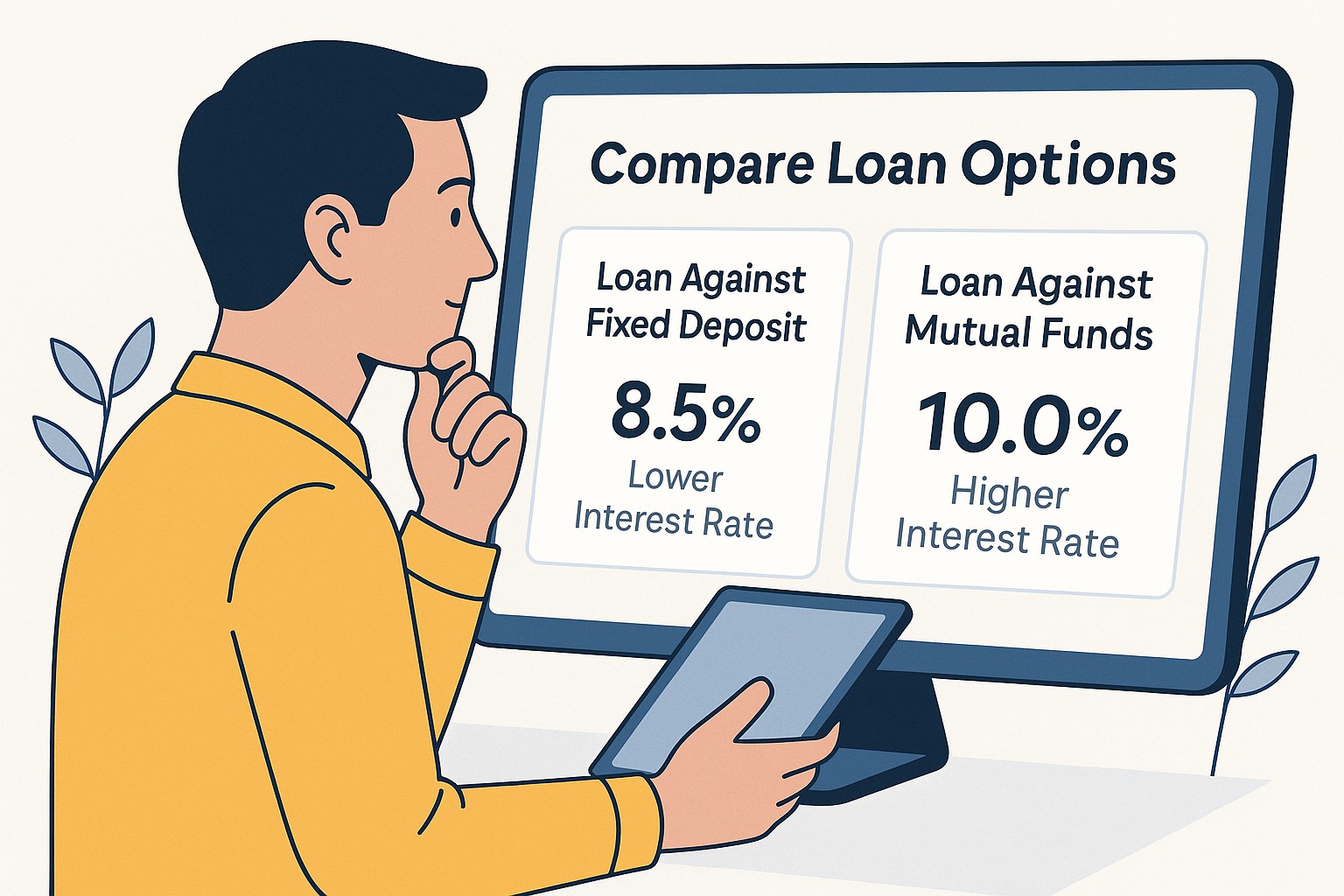
When you need urgent funds, breaking your fixed deposit (FD) or redeeming your mutual funds (MFs) may seem like the easiest choice. However, many banks and financial institutions allow you to borrow against these investments instead. This helps you access cash while keeping your money invested and earning returns.
But is it safe? And does it make better financial sense than traditional loans like personal loans or credit cards? Let’s break it down with clarity.
What Does 'Loan Against FD or MF' Mean?
It is a secured loan where your FD or mutual fund units are used as collateral instead of income proof alone.
For FD loans, lenders typically offer 80–95% of deposit value.
For MF loans, lending value may vary based on fund category, NAV, and market volatility.
Advantages of Taking Loans Against Investments
1️⃣ Lower Interest Rates than Unsecured Loans
Since the loan is secured, interest rates are usually much lower compared to personal loans, credit cards, BNPL or cash-advance products.
2️⃣ You Don’t Break Your Investment
Your FD continues to earn interest, and your mutual fund units stay invested, preserving long-term compounding benefits.
3️⃣ Faster Approval and Minimal Documentation
Since your investment acts as security, the loan approval process is generally quick, hassle-free, and paper-light.
4️⃣ Flexible Repayment & Prepayment
Most lenders allow flexible repayment, sometimes even interest-only payback until final settlement.
5️⃣ No Impact on Credit Score Unless Default Occurs
Since funds are secured, loan approval and usage do not negatively affect credit score unless you default.
Risks & Things to Watch Out For
1️⃣ Investment Can Be Liquidated if You Default
If you fail to make payments, the lender can sell or redeem your collateral to recover dues.
2️⃣ Mutual Funds Carry Market Risk
If your MF value falls significantly, you may face:
Margin calls
Reduced eligibility value
Additional collateral requirements
3️⃣ Can Create Psychological Overspending
Easy availability of low-cost credit may lead to unplanned borrowing, weakening long-term savings discipline.
4️⃣ Interest Cost May Still Hurt Financial Goals
Even though rates are lower, long repayment periods may reduce the net return you earn from the investment.
When Is It a Smart Choice?
✔ Short-term, temporary liquidity need
✔ Expected cash inflow soon (bonus, maturity, insurance, commission, receivables)
✔ Investment earning good returns & worth continuing
✔ Emergency situations where breaking FD/MF harms long-term planning
✔ To avoid high-interest debt like credit cards or instant loans
When to Avoid It
✖ Borrowing for lifestyle purchases
✖ No clear repayment plan
✖ MF market is already falling or volatile
✖ You are heavily leveraged (multiple EMIs)
✖ Using it to cover recurring monthly expenses
FD vs MF — Which Is Safer for Borrowing?
| Feature | Loan Against FD | Loan Against MF |
|---|---|---|
| Risk Level | Very Low | Moderate (Market Dependent) |
| Interest Rate | Lower | Slightly Higher |
| Loan Value | High (80–95%) | Varies by fund type |
| Suitability | Conservative investors | Market-linked investors |
| Volatility Concerns | None | High in equity funds |
❓ FAQs
Q1: Does taking a loan against FD cancel interest earnings?
No, your FD continues to earn interest until maturity.
Q2: Are equity mutual funds risky for collateral loans?
Yes, because market volatility may affect loan value and conditions.
Q3: Is it cheaper than a personal loan?
In most cases, yes, because it is secured credit.
Q4: What happens if repayment stops?
The lender may liquidate or redeem your investment.
Q5: Should I break FD or borrow against it?
Compare interest saved vs interest earned — if FD return is far lower than loan interest, repayment may be wiser.
Published on : 17th November
Published by : SMITA
www.vizzve.com || www.vizzveservices.com
Follow us on social media: Facebook || Linkedin || Instagram
🛡 Powered by Vizzve Financial
RBI-Registered Loan Partner | 10 Lakh+ Customers | ₹600 Cr+ Disbursed