

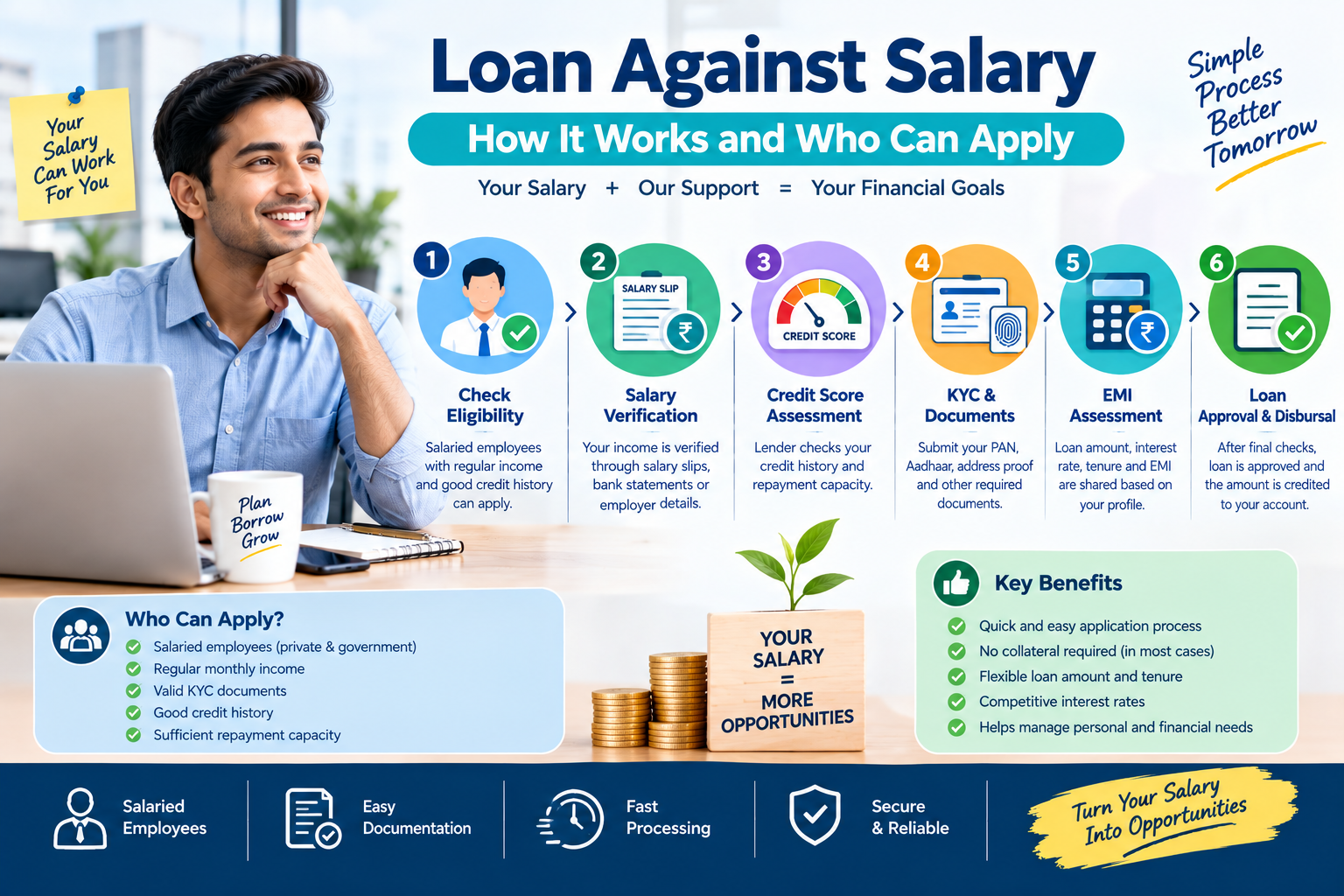
A loan against salary is a credit facility designed mainly for salaried individuals who need funds based on their regular income. Depending on the lender and product, it may work as a salary advance or an unsecured personal loan where salary income is an important part of the eligibility assessment.
Some salary-linked facilities can be repaid through salary deductions or regular EMIs. RBI's 2025 lending directions specifically recognise certain advances against salary, where the loan is credited to the borrower's account and repayment may be made by the employer through salary deduction under specified conditions.
What Is a Loan Against Salary?
A loan against salary allows an eligible salaried employee to borrow money based largely on their regular salary and repayment capacity.
It is important to understand that loan against salary is not necessarily a secured loan. Many products marketed as salary advances are unsecured personal loans, meaning the borrower does not pledge property, gold or another asset as collateral.
The exact structure depends on the lender.
For example, some salary-advance products are specifically designed for short-term cash-flow needs before payday, while others operate under a personal-loan structure with monthly EMIs.
How Does a Loan Against Salary Work?
The process generally follows these steps:
1. Check Eligibility
The lender checks your salary, employment profile, credit history and existing financial obligations.
2. Submit the Application
You provide basic personal, employment and financial information through the lender's website, app or branch.
3. Complete KYC
The lender verifies your identity and other required information.
4. Income Verification
Your salary may be verified through salary slips, bank statements, employer information or other permitted methods.
5. Credit Assessment
The lender evaluates your credit history and repayment capacity.
6. Loan Offer
If eligible, the lender provides details such as:
- Loan amount
- Interest rate
- EMI
- Tenure
- Processing fee
- Other applicable charges
7. Disbursal
After acceptance and completion of required formalities, the loan amount is generally transferred to the borrower's bank account.
RBI's digital-lending directions require loan disbursal to generally go directly to the borrower's bank account.
Who Can Apply for a Loan Against Salary?
Eligibility varies by lender, but applicants commonly need to meet requirements such as:
- Salaried employment
- Regular monthly income
- Valid KYC documents
- Active bank account
- Acceptable credit history
- Sufficient repayment capacity
- Required employment tenure
- Age within the lender's specified range
For example, currently available salary-linked products show that eligibility can differ significantly between lenders. One lender may require an existing salary account, while another may use salary and employment verification.
There is no universal salary or credit-score requirement for every loan against salary.
Documents Required
Depending on the lender and product, you may be asked for:
- PAN card
- Aadhaar or other KYC document
- Address proof
- Recent salary slips
- Bank statements
- Employment details
- Salary-account information
- Photograph or digital KYC information
Some digital products may require fewer physical documents because verification can be completed electronically.
Always submit documents only through the lender's official and secure channel.
Loan Against Salary Eligibility Factors
| Factor | Why It Matters |
|---|---|
| Monthly salary | Helps assess repayment capacity |
| Employment stability | Indicates income continuity |
| Credit history | Shows previous repayment behaviour |
| Existing EMIs | Determines current debt burden |
| Bank account | Used for verification/disbursal |
| KYC | Confirms identity |
| Age | Must meet lender criteria |
| Employer profile | May form part of lender's internal policy |
Loan Against Salary vs Salary Advance
Although the terms are sometimes used interchangeably, they can describe different products.
| Feature | Loan Against Salary | Salary Advance |
|---|---|---|
| Target borrower | Usually salaried individuals | Usually salaried individuals |
| Purpose | Personal financial needs | Short-term cash-flow needs |
| Structure | Often personal loan | Usually short-term facility |
| Repayment | Often monthly EMI | May be short-term repayment or EMI |
| Collateral | Often unsecured | Usually unsecured |
| Amount | Depends on lender | Often linked to salary/eligibility |
| Tenure | Can be longer | Usually shorter |
A salary advance may be designed specifically to bridge a temporary gap before payday, while a salary-based personal loan can have a longer repayment period.
Benefits of a Loan Against Salary
Quick Access to Funds
Salary-based lending can provide access to funds without requiring property or other major collateral for many products.
Simple Documentation
Salaried borrowers may have straightforward income records such as salary slips and bank statements.
Digital Application
Some lenders allow applicants to complete much of the process online.
Flexible Loan Amounts
The amount offered depends on salary, credit profile, existing obligations and lender policy.
Useful for Short-Term Needs
Salary-linked credit may help manage an unexpected expense when sufficient savings are not available.
What Are the Risks?
A loan against salary still creates a repayment obligation.
Before borrowing, consider:
- Total interest cost
- Processing fees
- Penal charges
- EMI affordability
- Existing debt
- Prepayment or foreclosure conditions
- Impact of missed payments on your credit profile
A short-term salary advance can also become expensive if fees and interest are high relative to the amount borrowed.
Therefore, compare the total cost of borrowing, rather than looking only at the advertised interest rate.
What Should You Check Before Applying?
Check the Lender
Verify that you are dealing with the actual regulated lender or an authorised lending arrangement.
RBI's digital-lending framework places regulatory responsibility on regulated entities even when lending service providers or digital platforms are involved.
Check the APR and Charges
Review:
- Interest rate
- APR where applicable
- Processing fee
- GST or applicable charges
- Late-payment charges
- Foreclosure/prepayment charges
- Total repayment amount
RBI's fair-practice guidance emphasises disclosure of fees and charges and proper assessment of loan applications.
Check the Loan Agreement
Read the agreement before accepting the loan and keep a copy of the documents.
Protect Your Personal Information
Do not share:
- OTP
- UPI PIN
- ATM PIN
- Internet banking password
- Card CVV
Be particularly careful with loan offers received through unsolicited messages or unknown links.
Can Your Loan Against Salary Be Rejected?
Yes. Salary-based lending does not guarantee approval.
Possible reasons include:
- Low or limited credit history
- High existing EMIs
- Insufficient income
- Unstable employment
- Incomplete KYC
- Document mismatch
- Incorrect bank information
- Too many recent credit applications
- Lender-specific eligibility rules
RBI guidance requires proper assessment of credit applications, and applicable fair-practice provisions address communication of reasons for rejection.
How Much Loan Can You Get Against Salary?
There is no universal loan amount based only on salary.
The amount can depend on:
Monthly income + existing EMIs + credit profile + employment + lender policy + repayment capacity
For example, two employees earning the same salary could receive different loan offers because their existing debts, credit history and lender eligibility differ.
Key Takeaways
- A loan against salary is generally designed for salaried borrowers.
- It may be structured as a salary advance or an unsecured personal loan.
- Salary alone does not guarantee approval.
- Credit history, existing EMIs, employment and repayment capacity can influence eligibility.
- Documents commonly include KYC, salary proof and bank statements.
- Compare interest, APR, fees and total repayment cost.
- Verify the lender before sharing financial or personal information.
- Borrow only an amount that fits comfortably within your repayment capacity.
FAQs About Loan Against Salary
1. What is a loan against salary?
It is a salary-linked credit facility that allows eligible salaried individuals to borrow based on income and repayment capacity.
2. Is a loan against salary a secured loan?
Not necessarily. Many salary-based loans are unsecured personal loans and do not require collateral.
3. Who can apply?
Generally, salaried employees with regular income, valid KYC and sufficient repayment capacity can apply, subject to the lender's criteria.
4. What documents are required?
Common requirements include PAN, KYC documents, salary slips, bank statements and employment details.
5. Can I get a loan against salary without collateral?
Many salary-based personal-loan products are unsecured, but the exact terms depend on the lender.
6. Does credit score matter?
Yes. Lenders may consider your credit history as part of their overall credit assessment.
7. Can a salary advance affect my credit score?
If the facility is reported as a credit account, repayment behaviour can affect your credit history. Check the product's terms and reporting arrangements.
8. How much can I borrow against my salary?
The amount varies by lender and depends on salary, existing obligations, credit profile and repayment capacity.
9. Can government employees apply?
Eligibility depends on the lender. Some lenders may have specific policies for government employees and other employer categories.
10. Can private-sector employees apply?
Yes, provided they meet the lender's eligibility requirements.
11. Is salary account mandatory?
Not always. Some products specifically require a salary account with the lender, while others may accept salary credits in another bank account.
12. Is loan against salary the same as a salary advance?
Not always. A salary advance is usually designed for short-term cash-flow needs, while a salary-linked personal loan may have a longer EMI-based repayment structure.
Published on : 24th September
Published by : Shibam Nath
www.vizzve.com || www.vizzveservices.com
Follow us on social media: Facebook || Linkedin || Instagram
🛡 Powered by Vizzve Financial
RBI-Registered Loan Partner | 10 Lakh+ Customers | ₹600 Cr+ Disbursed