

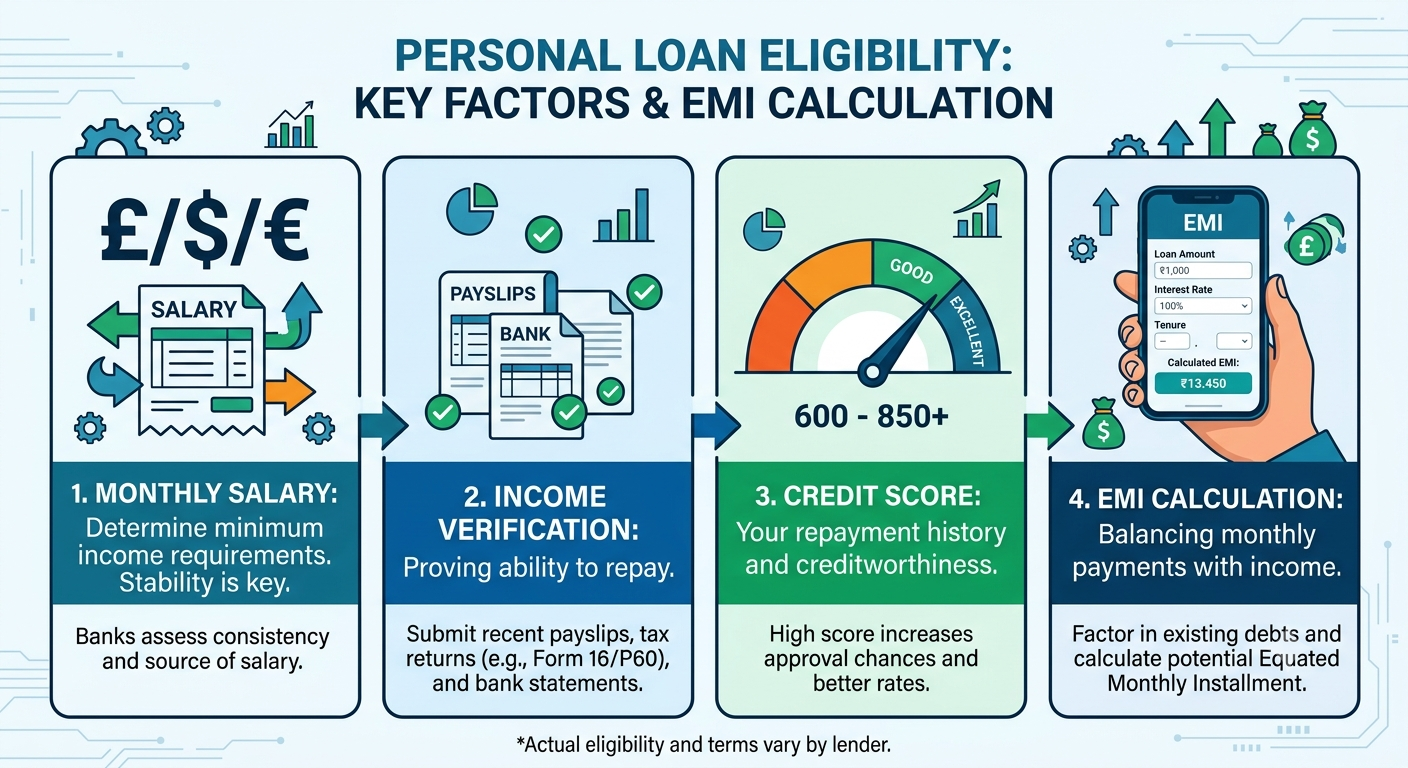
Lenders generally assess your monthly take-home income to understand how much money remains available after regular expenses and existing financial commitments.
Some important factors include:
-
Monthly net salary or regular income
-
Existing personal loan and credit card EMIs
-
Monthly household expenses
-
Credit score and repayment history
-
Employment or business stability
-
Requested loan tenure
-
Applicable interest rate
For example, an individual earning ₹50,000 per month with no existing EMIs may have greater borrowing capacity than someone earning the same amount but already paying ₹20,000 in monthly loan obligations.
2. Estimated Personal Loan Amount Based on Monthly Income
The following table provides illustrative loan amount ranges for different income levels. These are examples for educational purposes, not guaranteed eligibility offers.
|
Monthly Income |
Illustrative Loan Amount |
|---|---|
|
₹15,000 |
₹30,000–₹75,000 |
|
₹20,000 |
₹50,000–₹1 lakh |
|
₹25,000 |
₹75,000–₹1.5 lakh |
|
₹30,000 |
₹1 lakh–₹2 lakh |
|
₹40,000 |
₹1.5 lakh–₹3 lakh |
|
₹50,000 |
₹2 lakh–₹4 lakh |
|
₹75,000 |
₹3 lakh–₹6 lakh |
|
₹1,00,000 |
₹4 lakh–₹10 lakh |
Actual loan eligibility varies by lender, repayment capacity, interest rate, tenure, and credit profile. Some applicants may qualify for lower or higher amounts.
3. How Do Lenders Calculate Loan Amount Based on Income?
One commonly used method is the Fixed Obligation to Income Ratio (FOIR). It helps lenders determine how much of your monthly income is already committed to debt repayments.
FOIR Formula:
FOIR = (Existing Monthly EMIs + Proposed EMI) ÷ Monthly Net Income × 100
Consider this example:
An applicant earns ₹50,000 per month and currently pays ₹8,000 in existing EMIs.
Assuming a lender permits a maximum FOIR of 50%:
-
Monthly income: ₹50,000
-
Maximum permitted obligations: ₹25,000
-
Existing EMIs: ₹8,000
-
Available EMI capacity: ₹17,000
This means the applicant may have approximately ₹17,000 available for a new loan EMI under these assumptions.
The actual loan amount depends on the interest rate and repayment tenure.
4. Factors That Influence Your Loan Amount
A. Monthly Income
A higher and consistent monthly income can improve borrowing capacity because it indicates greater potential repayment ability.
B. Credit Score
Your CIBIL or other credit bureau score helps lenders evaluate your repayment behaviour. A positive credit history may strengthen your application.
C. Existing Financial Obligations
Existing personal loans, vehicle loans, home loans, and credit card repayments can reduce the amount available for a new EMI.
D. Employment Stability
Regular employment and consistent salary credits can support income verification and repayment assessment.
E. Loan Tenure
A longer repayment tenure may reduce the monthly EMI for the same principal amount, but it can increase the total interest paid.
F. Interest Rate
The interest rate directly affects how much loan you can afford within your monthly EMI capacity.
5. Loan Amount Based on Salary: Practical Examples
Here are three simplified examples to understand how income and existing obligations affect borrowing capacity.
Example 1: Applicant Earning ₹25,000
-
Monthly income: ₹25,000
-
Existing EMIs: ₹2,000
-
Assumed maximum FOIR: 50%
-
Available EMI capacity: ₹10,500
Example 2: Applicant Earning ₹40,000
-
Monthly income: ₹40,000
-
Existing EMIs: ₹5,000
-
Assumed maximum FOIR: 50%
-
Available EMI capacity: ₹15,000
Example 3: Applicant Earning ₹60,000
-
Monthly income: ₹60,000
-
Existing EMIs: ₹10,000
-
Assumed maximum FOIR: 50%
-
Available EMI capacity: ₹20,000
These examples show why two people earning the same salary may qualify for different loan amounts.
6. How to Increase Your Eligible Loan Amount
If you want to improve your borrowing capacity, consider the following steps:
-
Reduce Existing Debt: Clear smaller outstanding loans where financially practical.
-
Maintain a Healthy Credit Score: Make timely EMI and credit card payments.
-
Avoid Multiple Loan Applications: Too many credit applications within a short period may affect your credit profile.
-
Maintain Consistent Income Records: Keep salary slips and bank statements updated.
-
Choose a Suitable Tenure: Compare different repayment periods and their total interest costs.
-
Apply for an Affordable Amount: Avoid borrowing more than your repayment capacity allows.
-
Review Your Credit Report: Check for incorrect entries or outdated loan information.
7. Documents Required to Determine Loan Eligibility
Depending on the lender and employment category, applicants may need:
-
PAN card
-
Aadhaar card or other accepted identity proof
-
Latest salary slips
-
Recent bank statements
-
Employment details
-
Address proof, where required
-
ITR and income documents for self-employed applicants
Lenders may request additional documents during income verification.
8. Common Mistakes to Avoid When Choosing a Loan Amount
Borrowers should avoid these common mistakes:
-
Selecting a loan amount based only on monthly salary.
-
Ignoring existing EMIs and household expenses.
-
Choosing a longer tenure without calculating total interest.
-
Applying for more money than necessary.
-
Overlooking processing fees and other charges.
-
Ignoring the Key Fact Statement (KFS).
-
Applying through unverified loan applications.
Before accepting a loan, verify the regulated lending institution, understand the Annual Percentage Rate (APR), and review all repayment conditions.
9. Benefits of Calculating Loan Amount Before Applying
Calculating your potential loan amount in advance can help you:
-
Understand your borrowing capacity.
-
Plan monthly EMI payments.
-
Select a suitable repayment tenure.
-
Avoid excessive borrowing.
-
Compare different loan offers.
-
Reduce the possibility of applying for an unsuitable amount.
A personal loan should support your financial needs without affecting essential monthly expenses.
10. Frequently Asked Questions (FAQs)
Q1. How much personal loan can I get based on my monthly income?
Your eligible loan amount depends on your net income, existing EMIs, credit score, interest rate, repayment tenure, and lender policies.
Q2. Can I get a ₹5 lakh personal loan with a ₹30,000 salary?
It depends on your existing financial obligations, credit profile, interest rate, tenure, and the lender's eligibility criteria. A ₹5 lakh loan may not be affordable or available to every applicant earning ₹30,000.
Q3. How much loan can I get on a ₹50,000 salary?
Your borrowing capacity depends on how much of your income is available for repayment after existing obligations and expenses.
Q4. Does existing EMI reduce my loan amount?
Yes. Existing EMIs reduce your available repayment capacity and may lower the loan amount offered.
Q5. Can I get a personal loan without a high salary?
Some lenders offer loans to applicants with comparatively lower incomes, subject to their minimum income requirements and credit assessment.
Q6. Does a good CIBIL score increase loan eligibility?
A good credit history may improve your chances of approval and help lenders assess your creditworthiness.
Q7. Does loan tenure affect the eligible loan amount?
Yes. A longer tenure generally reduces the EMI for a given principal amount, potentially increasing the amount that fits within your EMI capacity. However, total interest costs may increase.
Q8. Can self-employed individuals get loans based on income?
Yes. Lenders may assess their ITR, bank statements, business income, financial stability, and credit history.
Conclusion
The loan amount you can receive based on income depends on several financial factors, not just your monthly salary. Lenders evaluate your take-home income, existing EMIs, credit score, employment stability, and repayment capacity before deciding the eligible amount.
Published on : 07th November
Published by : Yogendra
www.vizzve.com || www.vizzveservices.com
Follow us on social media: Facebook || Linkedin || Instagram
🛡 Powered by Vizzve Financial
RBI-Registered Loan Partner | 10 Lakh+ Customers | ₹600 Cr+ Disbursed