

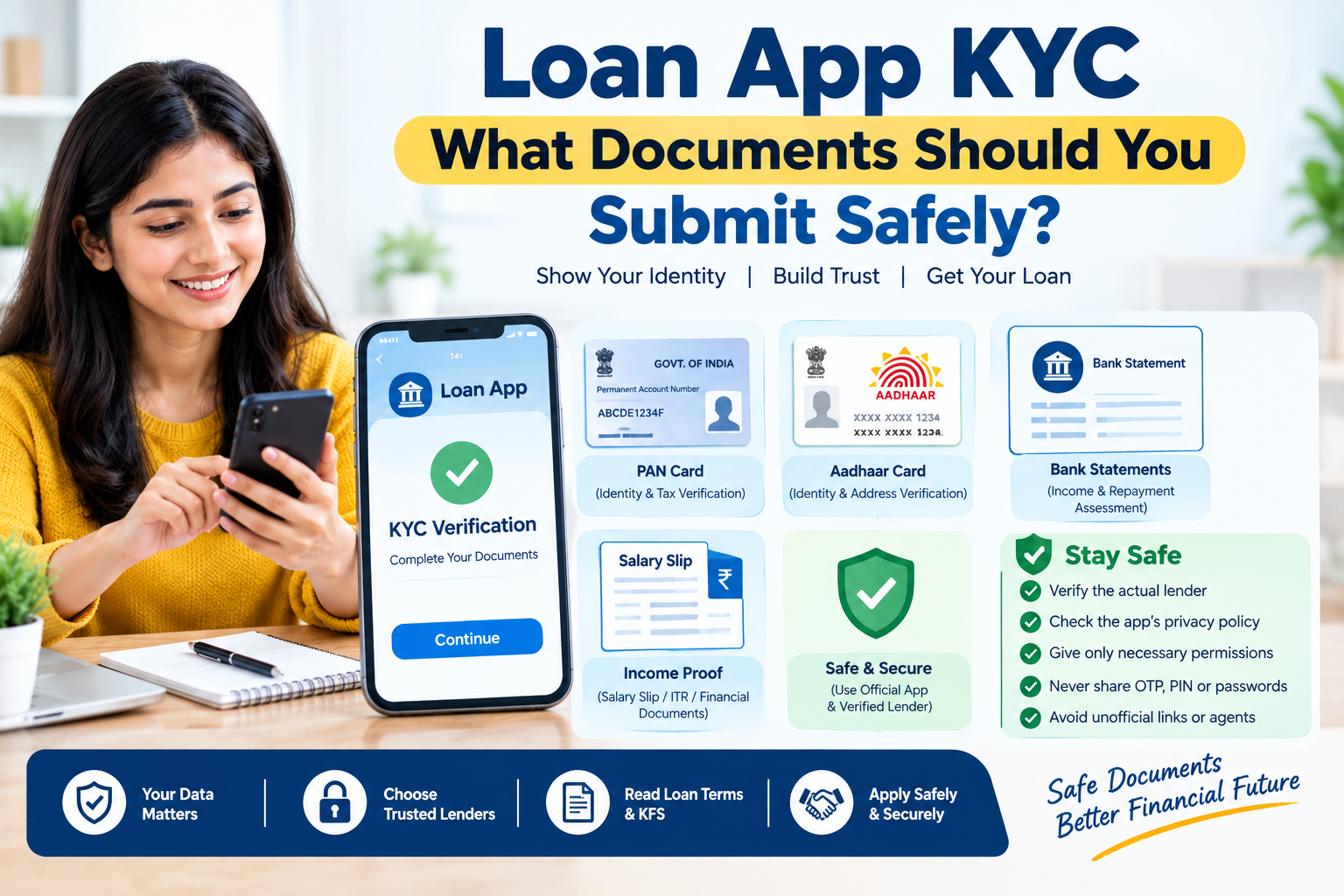
Applying for a personal loan through a mobile app usually requires KYC verification. Borrowers may be asked to provide identity, address, PAN and income-related documents before a lender can assess the application.
However, not every loan app is safe. Before uploading sensitive documents, check the actual lender, privacy policy, permissions and loan terms.
What Is KYC for a Loan App?
KYC means Know Your Customer. It helps a lender verify the borrower's identity and comply with applicable regulatory requirements.
Depending on the lender and loan product, KYC may involve digital verification, document verification, OTP-based processes or other permitted methods.
Documents Commonly Required for Loan KYC
The exact requirements vary by lender, but borrowers may commonly be asked for:
| Document | Common Purpose |
|---|---|
| PAN Card | Tax and identity verification |
| Aadhaar or other officially valid document | Identity/address verification |
| Passport | Identity and address verification |
| Driving Licence | Identity/address verification |
| Voter ID | Identity/address verification |
| Bank Statement | Income and repayment assessment |
| Salary Slip | Income verification |
| ITR | Income verification for self-employed applicants |
RBI's KYC framework recognises officially valid documents for customer identification, while lenders can have additional documentation requirements depending on the product and borrower.
Should You Submit Aadhaar to a Loan App?
Only provide documents through a verified lending process and for a legitimate purpose.
Before uploading Aadhaar or another sensitive document:
- Verify the actual lender.
- Check whether the lender is a regulated entity or is working with one.
- Read the app's privacy policy.
- Check what information the app wants to collect.
- Avoid sharing documents through random WhatsApp numbers or unofficial links.
- Never share OTPs, passwords or banking PINs.
What About PAN Card?
PAN may be requested for identity, tax and financial verification. Submit it only through the lender's official application or authorised digital process.
Avoid sending PAN images to unknown individuals claiming they can arrange an instant loan.
Do Loan Apps Need Access to Your Contacts and Photos?
Borrowers should be cautious about unnecessary permissions.
RBI's digital-lending framework requires data collection to be need-based and based on prior, explicit borrower consent, with clear privacy policies and controls around borrower data.
If an app demands broad access to personal information that is unrelated to the lending process, understand why it is required before proceeding.
Income Documents for Personal Loans
Apart from KYC, a lender may ask for income-related documents to assess repayment capacity.
Salaried Borrowers
Possible documents include:
- Recent salary slips
- Bank statements
- Form 16, where applicable
- Employment information
Self-Employed Borrowers
Possible documents include:
- Income Tax Returns
- Bank statements
- GST-related records, where applicable
- Business registration documents
- Financial statements
The exact requirements depend on the lender and loan product.
How to Submit KYC Documents Safely
1. Identify the Actual Lender
Don't rely only on the name of the loan app. Find out which bank or NBFC is actually providing the credit.
2. Use the Official Application
Download the app from a trusted source and verify that the lender's details match the information provided in the loan agreement.
3. Read the Privacy Policy
Check how your personal information will be collected, used and stored.
4. Give Only Necessary Permissions
Digital-lending rules require data collection to be need-based and based on explicit consent.
5. Check the KFS Before Accepting
The Key Facts Statement (KFS) provides important information about the loan, including the applicable annualised cost and other key terms.
6. Keep Records
Save copies of the loan agreement, KFS, repayment schedule and important communications.
Red Flags of an Unsafe Loan App
Be especially careful if an app or agent:
- Promises guaranteed approval
- Asks for an upfront payment before processing
- Has no clear lender information
- Requests unnecessary phone permissions
- Demands your OTP or UPI PIN
- Has no proper privacy policy
- Provides unclear interest rates or fees
- Pressures you to upload documents immediately
KYC Safety Checklist
Before submitting documents, ask:
✔ Who is the actual lender?
✔ Is the application process official?
✔ Why is each document required?
✔ What data will be collected?
✔ Have I checked the privacy policy?
✔ Have I reviewed the KFS and loan charges?
✔ Am I keeping copies of my submitted documents?
Key Takeaways
- Loan apps may require KYC and income documents before processing a loan.
- PAN, Aadhaar/other officially valid documents, bank statements and income records may be requested.
- Requirements vary by lender and loan product.
- RBI's digital-lending framework requires need-based data collection and prior, explicit consent.
- Never share OTPs, passwords or UPI PINs with a loan app or agent.
- Verify the actual lender before uploading sensitive documents.
FAQs
What documents are needed for loan app KYC?
Common documents can include PAN, Aadhaar or another officially valid document. A lender may also request bank statements and income documents.
Is PAN required for every loan app?
Requirements vary by lender and loan product. PAN may be requested for identity and financial verification.
Can I submit KYC documents online?
Yes. Many lenders use digital KYC and online document-verification processes, subject to applicable requirements.
Is it safe to send Aadhaar to a loan app?
Only submit sensitive documents through a verified lending process after confirming the actual lender and understanding the privacy terms.
Should I give a loan app access to my contacts?
Do not automatically grant unnecessary permissions. Understand why any requested access is needed before providing consent.
Can a loan app ask for bank statements?
Yes. A lender may request bank statements to assess income, cash flow and repayment capacity.
What documents do self-employed borrowers need?
Depending on the lender, self-employed applicants may be asked for ITRs, bank statements, GST-related records or business documents.
What is KFS in digital lending?
KFS means Key Facts Statement. It gives borrowers important information about the loan's key terms and costs before acceptance.
Should I share my OTP with a loan agent?
No. Never share an OTP, UPI PIN, password or other authentication credentials with an agent or unknown person.
How can I check whether a loan app is safe?
Verify the actual lender, check its official website and regulatory information, review the privacy policy and carefully read the loan agreement and KFS.
Published on : 23th September
Published by : Shibam Nath
www.vizzve.com || www.vizzveservices.com
Follow us on social media: Facebook || Linkedin || Instagram
🛡 Powered by Vizzve Financial
RBI-Registered Loan Partner | 10 Lakh+ Customers | ₹600 Cr+ Disbursed