

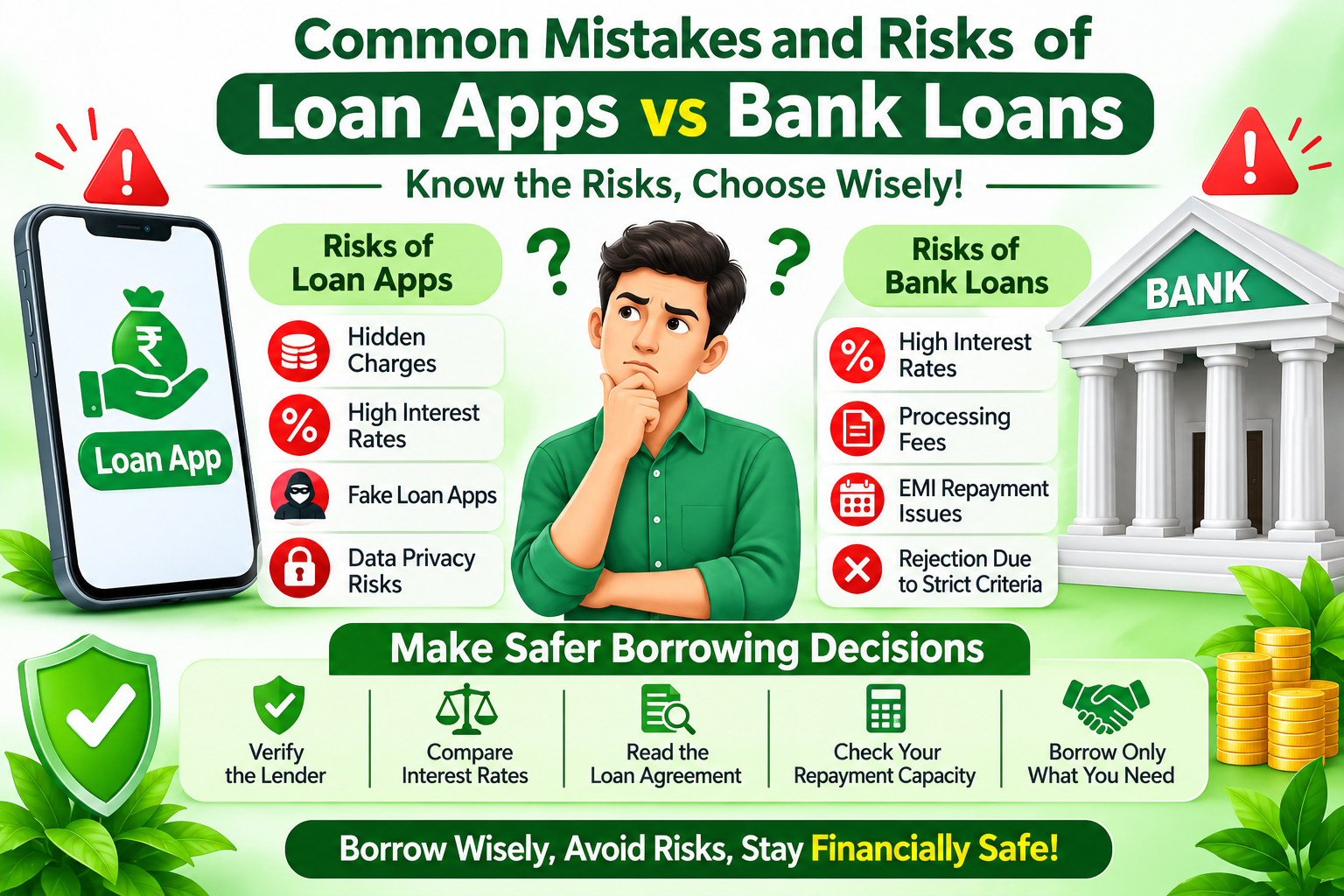
Today, people can get loans through mobile apps and banks. Loan apps are convenient because borrowers can apply online, while banks offer different types of loans with structured repayment options.
However, choosing the wrong loan can create financial problems. Before applying, borrowers should understand common mistakes, possible risks and safer borrowing decisions.
1. Common Mistakes When Choosing a Loan
Many people make mistakes when comparing loan apps and bank loans. Some common mistakes include:
-
Choosing Only Based on Fast Approval: Quick approval does not always mean a good loan.
-
Ignoring Interest Rates: Not checking interest rates can increase the total repayment amount.
-
Not Checking Processing Fees: Additional charges can make a loan expensive.
-
Borrowing More Money: Taking more money than required can create repayment difficulties.
-
Ignoring EMI Payments: Borrowers should check whether they can comfortably pay monthly EMIs.
-
Not Reading Loan Agreements: Always understand the loan terms before accepting an offer.
2. Risks of Loan Apps
Loan apps make borrowing easy, but some apps may create risks for borrowers.
Important risks include:
-
Fake loan apps that may cheat customers.
-
Hidden charges and unclear interest rates.
-
Misuse of personal information.
-
Unfair recovery practices.
-
Unclear repayment conditions.
Safety Tip: Always verify the actual lender behind the loan app. Check whether the lender is an RBI-regulated bank or NBFC.
3. Risks of Bank Loans
Bank loans are also associated with certain risks.
Some common risks are:
-
High interest costs depending on the loan.
-
Processing and other additional charges.
-
Penalties for delayed EMI payments.
-
Rejection due to eligibility requirements.
-
Financial pressure from long repayment periods.
Borrowers should understand all loan conditions before signing the agreement.
4. Loan App vs Bank Loan: What Should You Check?
| Factors | Loan App | Bank Loan |
|---|---|---|
| Application | Online | Online or branch |
| Approval | Often faster | Depends on verification |
| Interest Rate | Depends on lender | Depends on bank |
| Processing Fees | May apply | May apply |
| Loan Amount | Depends on lender | Depends on eligibility |
| Repayment | Depends on loan terms | Agreed repayment schedule |
| Safety | Verify the actual lender | Verify the bank |
5. How to Make Safer Borrowing Decisions
Follow these simple steps before taking a loan:
-
Check whether the lender is genuine.
-
Compare interest rates and APR.
-
Read the Key Fact Statement (KFS).
-
Understand processing fees and other charges.
-
Calculate your monthly EMI.
-
Check the repayment period.
-
Never share your OTP, PIN or banking password.
-
Borrow only the amount you actually need.
6. How to Identify a Safe Loan App
Before downloading or using a loan app, check these points:
-
Verify the lender's name and details.
-
Check the lender's website and contact information.
-
Read customer reviews carefully.
-
Check the privacy policy.
-
Avoid apps demanding unnecessary access to phone contacts and personal data.
-
Never pay suspicious advance fees to receive a loan.
7. Which Is a Safer Choice: Loan App or Bank Loan?
Both options can be useful when offered by genuine, regulated lenders.
A bank loan may be suitable for borrowers who want a traditional lending process. A loan app may be convenient for people who prefer online applications.
However, the safest choice depends on the lender's credibility, loan cost, repayment conditions and your ability to repay.
8. Key Takeaways
-
Never choose a loan only because of quick approval.
-
Compare interest rates, APR and processing fees.
-
Verify the lender before applying.
-
Read the loan agreement carefully.
-
Avoid borrowing more than you need.
-
Pay EMIs on time to maintain a healthy credit history.
Frequently Asked Questions (FAQs)
1. Is a loan app safe to use?
A loan app can be safe when it is associated with a genuine, RBI-regulated lender. Always verify the lender.
2. What is the biggest mistake when taking a loan?
Ignoring interest rates, additional charges and repayment conditions.
3. Are bank loans safer than loan apps?
Banks are regulated lending institutions, but borrowers should still understand the loan terms and costs.
4. What is APR in a loan?
APR represents the annualised cost of borrowing, including applicable charges.
5. Can delayed EMI payments affect my CIBIL score?
Yes. Delayed payments reported by lenders can negatively affect your credit score.
6. Should I borrow more than I need?
No. Borrow only what you can comfortably repay.
7. What is a Key Fact Statement (KFS)?
It is a document that explains important loan details, including interest rates, charges and repayment information.
8. How can I avoid fake loan apps?
Verify the actual lender, check official details and avoid suspicious applications.
Conclusion
Loan apps and bank loans both offer borrowing opportunities, but making the wrong decision can lead to financial problems.
Avoid common borrowing mistakes, understand the risks and compare all loan details before applying. A safe loan is one that comes from a genuine lender and fits your repayment capacity.
Remember: Borrow wisely, compare carefully and repay on time.
Published on : 27th November
Published by : MD HEDAYATULLAH
www.vizzve.com || www.vizzveservices.com
Follow us on social media: Facebook || Linkedin || Instagram
🛡 Powered by Vizzve Financial
RBI-Registered Loan Partner | 10 Lakh+ Customers | ₹600 Cr+ Disbursed