

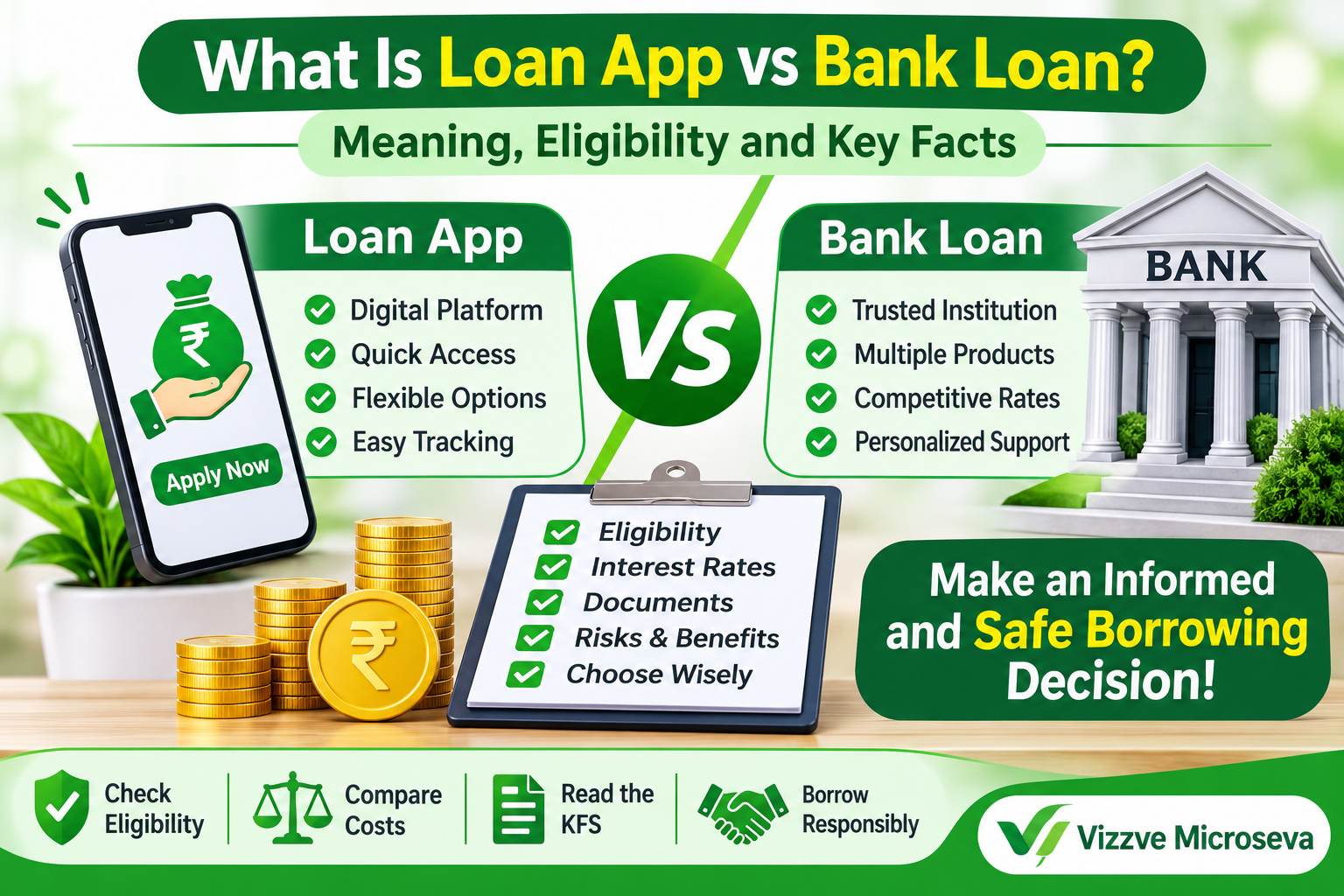
Getting a loan has become easier with the growth of digital financial services. Today, borrowers can apply for credit through mobile loan applications as well as traditional banks.
However, many people are confused about the difference between a loan app and a bank loan. Some believe that every loan app is a lender, while others assume that bank loans are always safer or cheaper.
The reality is slightly different.
A loan app is generally a digital platform that helps borrowers access loan services. Depending on its structure, it may belong to a regulated bank or NBFC, or operate as a Lending Service Provider (LSP) working with a regulated lender. A bank loan is credit provided by a bank under its lending policies and eligibility requirements.
Understanding loan app vs bank loan is important before applying for credit. Borrowers should know how these options work, what eligibility conditions apply, what documents are required and how to identify a reliable lending service.
This guide explains everything in simple language, helping Indian borrowers make informed financial decisions.
1. What Is a Loan App?
A loan app is a mobile or web-based platform that facilitates loan-related services through digital technology.
Borrowers can use these applications to explore loan offers, submit applications, complete digital verification and track repayment details.
Depending on the platform, the actual loan may be provided by a bank or a Non-Banking Financial Company (NBFC).
How Does a Loan App Work?
The typical loan application process includes:
-
Download or access the loan application.
-
Register using your mobile number.
-
Enter personal and income information.
-
Complete identity verification and KYC.
-
Submit the loan application.
-
Allow the regulated lender to assess your eligibility.
-
Review the loan offer and KFS.
-
Accept the agreement if the terms are suitable.
-
Receive the approved loan amount in your bank account.
The actual process, approval time and documentation requirements depend on the lender.
Key Features of Loan Apps
-
Digital loan application process.
-
Online KYC and document submission.
-
Eligibility assessment.
-
Digital loan agreements.
-
Online EMI tracking.
-
Digital repayment facilities.
-
Access to loan information through a mobile interface.
2. What Is a Bank Loan?
A bank loan is a financial facility provided by a bank to an individual or business based on its lending policies and the borrower's creditworthiness.
Banks offer different types of loans depending on the financial requirement.
Common examples include:
-
Personal loans.
-
Home loans.
-
Education loans.
-
Vehicle loans.
-
Business loans.
-
Gold loans.
-
Loan against property.
Bank loans may be processed through physical branches, official websites or mobile banking applications.
How Does a Bank Loan Work?
A traditional bank loan application generally follows these steps:
-
Identify the loan product.
-
Visit the bank branch or official digital platform.
-
Complete the application form.
-
Submit the required documents.
-
Complete KYC verification.
-
The bank evaluates income and creditworthiness.
-
The bank approves, rejects or modifies the application.
-
Review the loan agreement and applicable charges.
-
Complete the acceptance process and receive disbursement if approved.
3. Loan App vs Bank Loan: Key Differences
Both options can provide financial assistance, but they differ in how borrowers access and manage credit.
| Comparison | Loan App | Bank Loan |
|---|---|---|
| Application | Usually digital | Branch or digital |
| Accessibility | Mobile or web platform | Branch, website or mobile app |
| Processing | Often digitally managed | Depends on the bank and product |
| Documentation | Digital submission may be available | Physical or digital submission |
| KYC | Often digital | Digital or branch-based |
| Loan provider | Bank, NBFC or regulated lender through an app | Bank |
| Eligibility | Depends on the actual lender | Depends on bank policies |
| Interest rate | Depends on lender and product | Depends on bank and product |
| Repayment | Digital repayment options may be available | Online or other bank-approved methods |
| Customer support | App and lender support channels | Bank support and branch network |
Important: A loan app is not necessarily a separate category of loan. A bank can also offer loans through its own mobile application. Therefore, the meaningful comparison is between the digital application channel and the actual regulated lender.
4. Eligibility Criteria for Loan Apps
Eligibility requirements vary between lending platforms and the banks or NBFCs providing the credit.
Common eligibility conditions include:
1. Age Requirements
Applicants must meet the minimum and maximum age limits specified by the lender.
2. Regular Income
The lender may require evidence of regular income to evaluate repayment capacity.
3. Employment or Business Status
Eligibility may depend on whether the applicant is salaried, self-employed or running a business.
4. Credit History
The lender may review the applicant's credit report, existing loans and repayment history.
5. Identity Verification
Applicants generally need to complete KYC using accepted identity and address documents.
6. Bank Account
An active bank account may be required for loan disbursement and EMI repayment.
5. Eligibility Criteria for Bank Loans
Banks generally assess several financial and personal factors before approving a loan.
Common eligibility requirements include:
-
Applicant's age.
-
Monthly or annual income.
-
Employment stability.
-
Business income, where applicable.
-
Credit score and repayment history.
-
Existing financial obligations.
-
Debt-to-income position.
-
Required identity and address verification.
Some bank loans may also require collateral, a guarantor or additional documentation, depending on the product.
Salaried Applicants
Salaried individuals may be asked to provide:
-
Salary slips.
-
Bank statements.
-
PAN details.
-
Accepted identity proof.
-
Address proof.
-
Employment information.
Self-Employed Applicants
Self-employed individuals may be asked to provide:
-
Bank statements.
-
Income tax returns, where applicable.
-
Business registration documents, where applicable.
-
Financial statements.
-
PAN details.
-
Accepted identity and address proof.
These are common examples, not universal requirements. The actual document list depends on the lender.
6. Loan App vs Bank Loan: Which Is Easier to Apply For?
Loan apps may offer a convenient digital application process because borrowers can submit information without visiting a branch.
Bank loans may involve additional verification or documentation, depending on the loan product.
However, convenience does not guarantee approval.
Both digital lenders and banks assess creditworthiness before approving credit.
A borrower with a strong repayment history, suitable income and manageable existing obligations may have better approval prospects, subject to the lender's policies.
7. Interest Rates and Processing Charges
Interest rates are among the most important factors to compare when selecting a loan.
Loan apps do not automatically offer lower interest rates than banks.
The actual borrowing cost depends on:
-
Loan amount.
-
Repayment tenure.
-
Applicant's credit profile.
-
Lender's risk assessment.
-
Loan product.
-
Processing charges.
-
Other applicable fees.
What Is APR?
Annual Percentage Rate (APR) represents the annualised cost of borrowing, including applicable charges considered under the regulatory APR calculation.
For example, two loan providers may advertise similar interest rates but charge different processing fees.
Comparing APR helps borrowers understand the overall cost more effectively.
Why Should Borrowers Check the KFS?
The Key Facts Statement (KFS) provides important information about the loan.
Before accepting a loan, check:
-
Annual interest rate.
-
APR.
-
Loan amount.
-
Repayment tenure.
-
Monthly EMI.
-
Processing charges.
-
Penal charges, where applicable.
-
Total repayment obligations.
Never accept a loan based only on an advertised EMI or interest rate.
8. Benefits of Loan Apps
Loan apps can offer several advantages when they are operated by or work with regulated lenders.
1. Convenient Application
Borrowers can apply through a mobile device without necessarily visiting a physical branch.
2. Digital Documentation
Many platforms support online document submission and digital verification.
3. Application Tracking
Borrowers may be able to monitor application status through the platform.
4. Accessibility
Digital platforms can make loan services easier to access for borrowers who prefer online processes.
5. Repayment Management
Some applications provide repayment schedules, EMI reminders and payment tracking.
9. Benefits of Bank Loans
Banks also offer several advantages for borrowers.
1. Established Lending Operations
Banks have established lending processes and regulated banking operations.
2. Multiple Loan Products
Customers can explore personal, housing, education, vehicle and business financing options.
3. Branch-Based Support
Borrowers may access assistance through bank branches and official customer service channels.
4. Transparent Documentation
Banks provide loan agreements, repayment schedules and applicable disclosures.
5. Existing Banking Relationship
An existing relationship with a bank may help simplify certain application or verification processes, although approval is never guaranteed.
10. Risks of Loan Apps
Not every application advertising instant loans is trustworthy.
Borrowers should be careful about the following risks.
1. Fake Loan Applications
Fraudulent applications may advertise guaranteed approvals or unusually attractive interest rates.
2. Hidden Charges
Some platforms may advertise attractive offers without clearly explaining the complete borrowing cost.
Always verify the KFS and loan agreement.
3. Data Privacy Concerns
Unverified applications may request unnecessary access to contacts, photographs or other sensitive information.
4. Misleading Advertisements
Some advertisements may create unrealistic expectations about loan approval, disbursement speed or interest rates.
5. Unethical Recovery Practices
Borrowers should be cautious of harassment, threats or misuse of personal information during loan recovery.
If a loan app facilitates credit through a regulated lender, the lender's regulatory responsibilities are not removed merely because an LSP or third-party application is involved.
11. Risks of Bank Loans
Bank loans are regulated financial products, but borrowers should still understand their responsibilities.
Common risks include:
-
Interest costs over longer repayment periods.
-
Additional charges under the loan agreement.
-
EMI defaults.
-
Negative credit history due to missed payments.
-
Collateral-related risks in secured loans.
-
Financial pressure from excessive borrowing.
A regulated lender does not mean that every loan is affordable for every borrower.
12. How to Identify a Safe Loan App in India
Before downloading or using a loan app, follow these precautions.
-
Identify the actual bank or NBFC providing the loan.
-
Verify the app's association with the regulated lender.
-
Check the lender's official website.
-
Review the RBI's Digital Lending App directory as a verification aid.
-
Read the privacy policy.
-
Avoid applications requesting unnecessary permissions.
-
Review the KFS and loan agreement.
-
Never share your OTP, PIN or banking password.
-
Avoid suspicious upfront payment requests.
-
Save all loan-related documents and repayment receipts.
The RBI's Public Directory of Digital Lending Apps is intended to help customers verify claims of association between digital lending applications and regulated entities. It should not be treated as an RBI endorsement or guarantee of an app's safety.
13. Important RBI Rules for Digital Lending
The Reserve Bank of India issued the Reserve Bank of India (Digital Lending) Directions, 2025 on May 8, 2025.
These directions consolidate important regulatory requirements for digital lending activities involving regulated entities.
Important borrower protections include:
Creditworthiness Assessment
Regulated lenders must assess relevant information about a borrower's economic profile before extending credit.
Key Facts Statement
Borrowers should receive the required loan disclosures, including applicable APR and other important terms.
Loan Disbursement
As a general rule, loan disbursement should be made directly into the borrower's bank account, subject to specified regulatory exceptions.
Cooling-Off Period
Eligible digital loans must provide an initial cooling-off period during which borrowers can exit the loan by paying the principal and proportionate APR without penalty, subject to the applicable conditions.
Grievance Redressal
Borrowers should have access to grievance redressal arrangements.
Data Privacy
Digital lending activities must comply with applicable requirements concerning data collection, usage, consent and storage.
These protections are important whether the borrower accesses credit through a lender's own application or an authorised Lending Service Provider.
14. Loan App vs Bank Loan: Which One Should You Choose?
The right option depends on your financial requirements and the actual loan offer.
| Borrower requirement | Option to consider |
|---|---|
| Convenient online application | Regulated digital lending platform |
| Branch-based assistance | Bank loan |
| Larger planned financial requirement | Compare suitable bank and NBFC offers |
| Digital application and tracking | Official lender app or authorised LSP |
| Existing bank relationship | Check your bank's available offers |
| Better repayment terms | Compare APR and total cost |
| Complex financial requirement | Discuss options with the lender |
A Practical Example
Suppose a salaried individual needs ₹1,00,000 for an urgent household expense.
The borrower receives two offers:
Offer A – Digital Loan Platform
-
Loan amount: ₹1,00,000
-
Interest rate: 18% per annum
-
Tenure: 12 months
-
Processing fee: ₹2,000
Offer B – Bank Personal Loan
-
Loan amount: ₹1,00,000
-
Interest rate: 15% per annum
-
Tenure: 12 months
-
Processing fee: ₹1,500
The bank offer has a lower interest rate and processing fee in this hypothetical example.
However, borrowers should compare the actual APR, net disbursement, total repayment and other applicable charges before deciding.
A loan app may also provide a competitive offer, depending on the lender and borrower profile.
The safest choice is the offer with transparent terms and affordable repayment obligations.
15. Common Mistakes to Avoid Before Applying
-
Choosing an application only because it promises instant approval.
-
Not verifying the actual lender.
-
Ignoring processing fees.
-
Failing to compare APR.
-
Applying to multiple lenders without checking eligibility.
-
Borrowing more than necessary.
-
Ignoring repayment dates.
-
Not reading the loan agreement.
-
Sharing personal information with unverified applications.
-
Assuming that a high eligible loan amount means you can afford it.
Avoiding these mistakes can help protect your finances and credit history.
16. Key Facts Every Borrower Should Know
-
A loan app is an application channel, not necessarily the actual lender.
-
Banks can also provide loans through mobile applications.
-
NBFCs can provide digital loans through their own apps or authorised service providers.
-
Loan approval depends on the regulated lender's credit assessment.
-
Interest rates and fees differ between lenders.
-
APR is important when comparing borrowing costs.
-
The KFS should be reviewed before accepting a loan.
-
Digital loan agreements should be carefully checked.
-
Unnecessary app permissions can create privacy risks.
-
Timely EMI payments help maintain a healthy credit history.
17. Key Takeaways
-
Loan apps make digital borrowing more convenient.
-
Bank loans are credit facilities directly provided by banks.
-
A loan app may facilitate loans from banks or NBFCs.
-
Eligibility depends on income, credit history and lender policies.
-
Digital applications do not guarantee instant approval.
-
Compare APR, processing fees and total repayment.
-
Verify the regulated lender before applying.
-
Review the KFS and loan agreement.
-
Avoid suspicious loan applications.
-
Choose a loan based on affordability rather than convenience alone.
Frequently Asked Questions (FAQs)
1. What is the difference between a loan app and a bank loan?
A loan app is a digital platform used to access loan services, while a bank loan is credit provided by a bank. A loan app may facilitate credit from a bank or NBFC.
2. Are loan apps safe in India?
Loan apps associated with regulated banks or NBFCs and operating in compliance with applicable RBI requirements can provide legitimate lending services. Always verify the actual lender.
3. Can I get a loan through an app without visiting a bank?
Yes. Many regulated lenders offer digital loan application, verification and disbursement processes without requiring a branch visit.
4. Do loan apps provide loans directly?
Some apps are operated by regulated lenders, while others act as Lending Service Providers. Check the actual lender named in the loan offer and agreement.
5. Is a bank loan cheaper than a loan app?
Not necessarily. Interest rates, APR and charges depend on the lender, loan product and borrower's credit profile.
6. What is the eligibility for loan apps?
Common eligibility factors include age, income, employment or business status, credit history, KYC verification and repayment capacity.
7. What documents are required for a digital loan?
Common documents include PAN details, accepted identity and address proof, bank statements and income-related documents. Requirements vary by lender.
8. Does applying through a loan app affect my CIBIL score?
A formal credit application may result in a hard enquiry. If the loan is reported to credit bureaus, its repayment history can also affect your credit profile.
9. Can self-employed individuals apply through loan apps?
Yes. Self-employed individuals may be eligible depending on their income proof, bank statements, business information and the lender's policies.
10. What is APR in digital lending?
APR represents the annualised borrowing cost, including applicable charges covered under the APR calculation.
11. What is a KFS in a digital loan?
A Key Facts Statement provides important loan information, including the APR, repayment terms and applicable charges.
12. How can I check whether a loan app is genuine?
Verify its association with a regulated bank or NBFC, check official lender information, review the RBI's Digital Lending App directory and read the application's privacy policy.
13. Can a loan app access my contacts?
Digital lending applications must follow applicable RBI data privacy requirements. Avoid apps requesting unnecessary access to contacts, call logs or media.
14. Are bank loans available online?
Yes. Many banks allow customers to apply for and manage loans through official websites and mobile banking applications.
15. Which is better: a loan app or a bank loan?
Neither is automatically better. Compare the actual lender, APR, processing charges, repayment tenure, service quality and total borrowing cost before deciding.
Conclusion
Understanding loan app vs bank loan is essential for anyone planning to borrow money in India.
Loan apps can simplify the application process, while banks offer different credit products through branch-based and digital channels. However, the most important factor is not whether you apply through an app or a bank branch. It is the credibility of the actual lender and the affordability of the loan.
Before applying, check eligibility, compare interest rates, review the APR, understand processing fees and read the KFS carefully.
Responsible borrowing starts with informed decisions. Choose a reliable lending institution, borrow only what you need and make sure you can repay the EMI comfortably.
Published on : 26th November
Published by : MD HEDAYATULLAH
www.vizzve.com || www.vizzveservices.com
Follow us on social media: Facebook || Linkedin || Instagram
🛡 Powered by Vizzve Financial
RBI-Registered Loan Partner | 10 Lakh+ Customers | ₹600 Cr+ Disbursed