

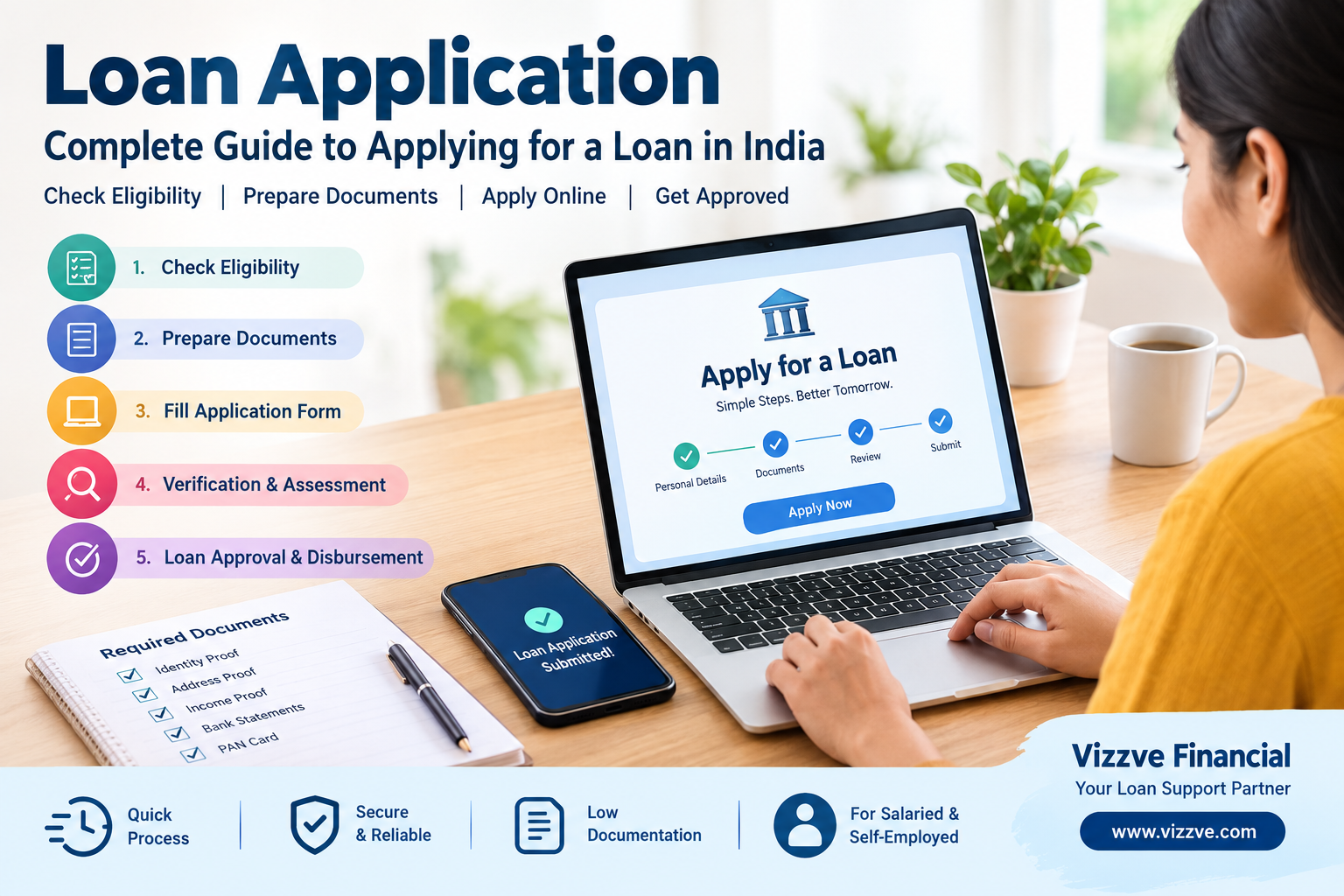
Introduction
A loan application is the formal request made by an individual or business to a bank, NBFC, or other eligible financial institution for borrowing money.
Today, applying for a loan can often be done online without visiting a branch. However, submitting an application does not automatically mean the loan will be approved. Lenders generally evaluate factors such as income, repayment capacity, credit history, existing obligations, employment or business stability, and the information provided in the application.
Whether you need money for an unexpected expense, education, medical needs, home improvement, a wedding, or another legitimate financial requirement, understanding the loan application process can help you make a more informed decision.
This guide explains how to apply for a loan, what documents may be required, how lenders assess applications, common mistakes to avoid, and ways to improve your chances of approval.
AI Answer Box: What Is a Loan Application?
A loan application is a request submitted to a lender to borrow money under agreed terms. The applicant provides personal, financial, employment, and other required information. The lender reviews the application, verifies the information, assesses creditworthiness and repayment capacity, and then decides whether to approve or reject the request.
For a personal loan, the process generally involves:
- Checking eligibility
- Comparing available loan options
- Preparing required documents
- Completing the application form
- Submitting the application
- Verification by the lender
- Credit and risk assessment
- Loan approval or rejection
- Agreement and disbursement, if approved
What Is a Loan Application?
A loan application contains information that allows a lender to understand the applicant's financial position and determine whether lending money is appropriate.
Depending on the type of loan, an application may request:
- Full name
- Contact information
- Date of birth
- Residential details
- Employment information
- Monthly or annual income
- Existing loan obligations
- Bank account information
- Requested loan amount
- Preferred repayment period
- Purpose of borrowing
- Required supporting documents
The exact requirements vary between lenders and loan products.
How Does the Loan Application Process Work?
The loan application process can differ between lenders, but it commonly follows a series of steps.
Step 1: Determine How Much You Need
Before applying, calculate the amount you actually need.
Borrowing more than necessary can increase:
- Monthly repayments
- Total interest paid
- Financial pressure
- Risk of repayment difficulties
A practical approach is to estimate your monthly budget first and determine an EMI that you can comfortably manage.
Step 2: Check Loan Eligibility
Lenders normally have eligibility criteria based on factors such as:
- Age
- Income
- Employment or business status
- Credit history
- Existing financial obligations
- Residence
- Loan amount requested
Meeting minimum eligibility requirements does not guarantee approval.
Step 3: Compare Loan Offers
Don't select a loan solely because it advertises a low interest rate.
Compare:
| Factor | Why It Matters |
|---|---|
| Interest rate | Determines borrowing cost |
| Processing fee | Adds to the overall cost |
| Loan tenure | Affects EMI and total interest |
| Prepayment terms | Important if you repay early |
| Late-payment charges | Relevant if an EMI is missed |
| Disbursement time | Important for urgent needs |
| Eligibility | Determines whether you can qualify |
| Documentation | Affects application convenience |
Step 4: Prepare Your Documents
Common documents can include:
Identity Proof
Examples may include:
- PAN
- Aadhaar or other accepted identity documents
- Passport
- Driving licence
- Voter ID
Address Proof
Depending on lender requirements, accepted documents may include:
- Aadhaar
- Passport
- Utility bill
- Other officially accepted address documents
Income Documents
For salaried applicants, lenders may request:
- Salary slips
- Bank statements
- Form 16 or income-tax documents, where applicable
For self-employed applicants, lenders may request:
- Income-tax returns
- Bank statements
- Business-related financial documents
- Proof of business continuity
Important: The exact documentation depends on the lender and loan type.
How to Fill Out a Loan Application Form
When completing a loan application form, accuracy is extremely important.
Check Your Personal Details
Make sure your:
- Name
- Date of birth
- Address
- Phone number
- Email address
are entered correctly.
Provide Accurate Income Information
Do not exaggerate your income to qualify for a larger loan.
Lenders may verify the information provided during their assessment process.
Declare Existing Loans
If you already have EMIs or other financial obligations, provide accurate information wherever the application requires it.
Review Before Submission
Before clicking submit, carefully check:
- Loan amount
- Tenure
- Income
- Employment details
- Contact information
- Bank details
- Uploaded documents
Online Loan Application vs Offline Loan Application
| Feature | Online Application | Offline Application |
|---|---|---|
| Application method | Website/app | Branch or physical form |
| Convenience | High | Requires a visit in many cases |
| Document submission | Often digital | Often physical |
| Status tracking | Usually easier online | May require contacting branch |
| Processing | Can be streamlined | May involve more manual steps |
| Human assistance | Digital/customer support | Branch representative |
An online application can be convenient, but applicants should still verify that they are dealing with a legitimate lender or authorized financial service provider.
Personal Loan Application: What Should You Know?
A personal loan is generally an unsecured form of borrowing, meaning it typically does not require the borrower to pledge a specific asset as collateral.
Because there may be no collateral, lenders may place significant emphasis on the applicant's credit profile and repayment capacity.
Before submitting a personal loan application, consider:
- Your monthly income
- Existing EMIs
- Credit history
- Required loan amount
- Loan tenure
- Total repayment
- Processing charges
- Prepayment conditions
- Late-payment charges
Who May Apply for a Personal Loan?
Eligibility depends on the lender, but applicants can commonly include:
- Salaried employees
- Self-employed professionals
- Business owners
- Other eligible income-earning individuals
Factors That Can Affect Loan Approval
A lender's decision may depend on several factors.
1. Credit History
Your credit history provides lenders with information about previous borrowing and repayment behaviour.
A stronger credit profile may improve the chances of receiving favourable terms, although approval is never guaranteed solely by a credit score.
2. Income
Income helps the lender assess whether you have sufficient capacity to repay the proposed loan.
3. Existing Debt
Existing EMIs and other obligations can affect how much additional debt you may reasonably be able to manage.
4. Employment or Business Stability
Stable employment or business income can be relevant to a lender's assessment of repayment capacity.
5. Application Accuracy
Incorrect or inconsistent information can create delays or affect the assessment of an application.
What Documents Are Required for a Loan Application?
There is no universal document list for every loan.
However, applicants may commonly need:
- Identity proof
- Address proof
- PAN
- Income proof
- Salary slips, where applicable
- Bank statements
- Income-tax documents, where applicable
- Employment or business information
- Photographs, if required
- Additional documents requested by the lender
Important Safety Tip
Never share sensitive financial information with an unknown person claiming to represent a lender.
Use official lender channels and verify the identity of the financial institution before submitting documents or making payments.
Common Loan Application Mistakes to Avoid
Even a financially eligible applicant can face problems if the application is incomplete or inaccurate.
Mistake 1: Applying Without Comparing Offers
The first loan offer you see may not be the most suitable one.
Mistake 2: Borrowing More Than Necessary
A larger loan means greater repayment obligations.
Mistake 3: Ignoring the Total Cost
Don't focus only on the advertised interest rate. Consider applicable fees and charges as well.
Mistake 4: Providing Incorrect Information
False or inconsistent information can cause verification problems.
Mistake 5: Applying Through Unverified Sources
Avoid websites, apps, or individuals that cannot establish a legitimate connection with the lender.
Mistake 6: Not Reading the Loan Agreement
Review the important terms before accepting the loan.
How to Improve Your Chances of Loan Approval
There is no guaranteed formula for approval, but responsible financial behaviour can help.
Before Applying:
- Review your credit report
- Check your income and expenses
- Calculate existing EMI obligations
- Borrow only what you need
- Prepare accurate documentation
- Compare lenders
- Read the complete terms and conditions
Maintain Financial Discipline
Consistently paying existing obligations on time can support a healthy credit history.
How to Check Your Loan Application Status
Many lenders provide online application tracking.
Depending on the lender, you may be able to check status using:
- Application number
- Registered mobile number
- Customer ID
- Other verification information
A status such as under review, approved, rejected, or disbursed can indicate the current stage of the application.
The terminology varies between lenders.
How Long Does Loan Approval Take?
There is no single approval timeline applicable to every loan.
Processing time can depend on:
- Loan type
- Lender
- Applicant eligibility
- Document completeness
- Verification requirements
- Credit assessment
- Internal risk checks
- Whether additional information is required
Digital applications can sometimes reduce administrative processing time, but applicants should not assume that every online loan is approved instantly.
Loan Application: Pros and Cons
| Pros | Cons |
|---|---|
| Access to funds | Creates repayment obligations |
| Online applications can be convenient | Interest increases total repayment |
| Multiple loan products are available | Eligibility requirements vary |
| Can help manage planned expenses | Missed payments can have consequences |
| Some loans require no collateral | Unsecured loans may have higher rates |
Step-by-Step Guide to Applying for a Loan Online
Step 1
Identify the purpose and required amount.
Step 2
Check your eligibility.
Step 3
Compare lenders and loan terms.
Step 4
Review interest rates and applicable fees.
Step 5
Collect the required documents.
Step 6
Complete the application using accurate information.
Step 7
Submit the required documents securely.
Step 8
Complete verification if requested.
Step 9
Review the approval and loan agreement carefully.
Step 10
Accept the terms only when you understand the repayment obligations.
Step 11
After disbursement, track your EMI due dates and repayments.
Expert Commentary: What Should Borrowers Check?
Expert perspective: The best loan is not necessarily the one offering the largest amount or the fastest approval. Borrowers should focus on affordability, total borrowing cost, lender credibility, and repayment terms.
A responsible borrower should ask:
- Can I comfortably repay the EMI?
- What is the total amount I will repay?
- What fees apply?
- What happens if I miss an EMI?
- Are there prepayment or foreclosure conditions?
- Is the lender properly regulated and identifiable?
- Have I read the complete agreement?
These questions can help prevent decisions based solely on promotional advertisements.
Real-World Loan Application Tips
In practice, many loan applications become complicated because applicants underestimate documentation and verification requirements.
A few simple habits can make the process smoother:
- Keep your financial documents organized.
- Use consistent personal information across applications.
- Check your credit information periodically.
- Avoid borrowing simply because you qualify for a particular amount.
- Calculate the EMI before accepting an offer.
- Read all fees and conditions.
- Keep copies of submitted documents and agreements.
- Use secure and official application channels.
Loan Application Summary Table
| Question | Short Answer |
|---|---|
| What is a loan application? | A formal request to borrow money from a lender |
| Can I apply online? | Yes, many lenders offer online applications |
| Is approval guaranteed? | No |
| Is collateral always required? | No, some loans are unsecured |
| What documents are needed? | Depends on lender and loan type |
| Does credit history matter? | It can be an important part of assessment |
| Can self-employed people apply? | Yes, subject to lender eligibility |
| Can salaried employees apply? | Yes, subject to lender eligibility |
| How long does approval take? | It varies by lender and application |
| Should I compare lenders? | Yes |
Key Takeaways
- A loan application is a formal request for borrowing.
- Eligibility requirements differ between lenders.
- Accurate information and complete documentation can help avoid delays.
- Compare interest rates and other applicable costs before choosing a loan.
- Your income, credit history and existing financial obligations can influence assessment.
- Don't borrow more than you can comfortably repay.
- Read the loan agreement before accepting an offer.
- Use legitimate and secure lender channels.
- Never assume that an advertised "instant loan" means guaranteed approval.
- Responsible repayment is just as important as getting the loan.
Frequently Asked Questions
1. What is a loan application?
A loan application is a request submitted to a bank, NBFC, or other eligible lender to borrow money. The applicant provides required personal and financial information for assessment.
2. How can I apply for a loan online?
You can generally visit the lender's official website or authorized application platform, check eligibility, complete the application, submit required documents and complete the lender's verification process.
3. What documents are required for a personal loan?
Requirements vary, but lenders may request identity proof, address proof, PAN, income documents, bank statements and other information relevant to their assessment.
4. Can I apply for a personal loan without collateral?
Yes. Personal loans are commonly unsecured, meaning they generally do not require a specific asset as collateral. However, eligibility and terms depend on the lender.
5. Does my credit score affect my loan application?
Credit history can be an important factor in a lender's assessment. However, lenders may consider several other factors before making a decision.
6. How long does a loan application take?
The timeline varies by lender, loan type, applicant profile and verification requirements. Complete and accurate documentation may help reduce avoidable delays.
7. Can self-employed individuals apply for a personal loan?
Yes. Self-employed applicants may be eligible for personal loans depending on the lender's income, business, documentation and other eligibility requirements.
8. Can salaried employees apply for personal loans?
Yes. Salaried individuals can apply if they meet the lender's eligibility requirements.
9. Why can a loan application be rejected?
Possible reasons include insufficient income, high existing obligations, credit-related concerns, incomplete documentation, eligibility issues or unsuccessful verification.
10. Does applying for multiple loans affect credit?
Multiple formal credit applications within a short period can result in multiple lender enquiries, which may affect your credit profile depending on the circumstances. It is generally better to compare options carefully before submitting applications.
11. Can I check my loan application status online?
Many lenders provide online tracking facilities. The exact process depends on the lender.
12. What should I check before accepting a loan?
Check the interest rate, total repayment, fees, tenure, EMI, prepayment conditions, late-payment consequences and other terms in the agreement.
13. What is the difference between a secured and unsecured loan?
A secured loan is backed by an asset or collateral. An unsecured loan generally does not require specific collateral and may therefore involve different eligibility and pricing considerations.
14. How can I increase my chances of loan approval?
Maintain responsible repayment behaviour, provide accurate information, meet the lender's eligibility requirements, keep documents ready and choose a loan amount that is appropriate for your repayment capacity.
15. Is instant loan approval guaranteed?
No. "Instant" or "quick" processing does not mean approval is guaranteed. The lender's eligibility and verification procedures still apply.
Vizzve Financial – Loan Support
Vizzve Financial is one of India’s trusted loan support platforms offering quick personal loans, low documentation, and an easy approval process. Apply at www.vizzve.com.
Before applying, borrowers should always review the applicable eligibility criteria, costs, terms and conditions and verify the relevant lender information.
Conclusion
A loan can be a useful financial tool when it is planned carefully and repaid responsibly. The loan application process becomes easier when you understand the eligibility criteria, prepare the necessary documents, compare loan costs and submit accurate information.
Instead of choosing a loan simply because it promises fast approval, consider the total cost, repayment period, EMI affordability, lender credibility and contractual terms.
If you are exploring personal loan options, Vizzve Financial can help you understand available loan-support options and the application process.
Ready to explore your loan options? Apply with Vizzve Financial at www.vizzve.com.