

Introduction
A loan application pending status can create confusion and uncertainty for borrowers. After submitting a loan application, applicants often expect quick approval or rejection. However, the application may remain pending because of document verification, incomplete information, eligibility checks, or lender processing delays.
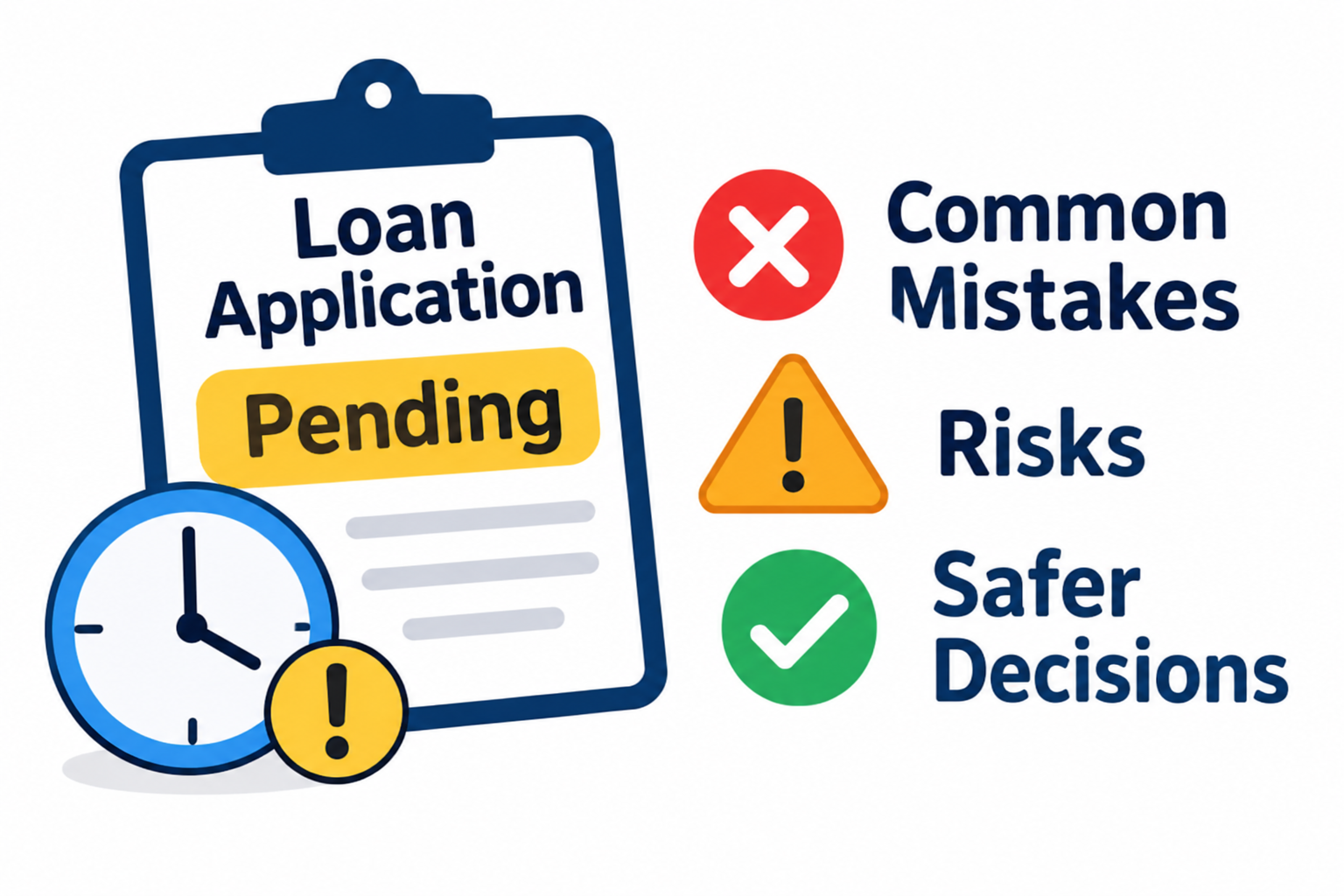
During this waiting period, borrowers should avoid making unnecessary decisions that could affect their financial profile or loan approval chances. Understanding common mistakes, potential risks, and safer decisions can help applicants manage the process confidently.
This guide explains the mistakes to avoid, risks to understand, and practical steps to take when a loan application is pending.
What Does Loan Application Pending Mean?
A loan application pending status means the lender has received the application but has not yet completed the review or made a final decision.
Common reasons include:
-
Incomplete application details.
-
Pending KYC verification.
-
Missing income documents.
-
Bank statement verification.
-
Credit score assessment.
-
Technical or processing delays.
-
Additional information required by the lender.
Important: Pending does not automatically mean rejection or approval.
1. Common Mistakes Borrowers Make When a Loan Application Is Pending
1.1 Submitting Multiple Loan Applications
Some borrowers apply to several lenders simultaneously because they are worried about delays.
Why it is a mistake:
-
Multiple credit enquiries may affect credit scores.
-
Managing several applications becomes difficult.
-
Borrowers may receive confusing offers.
Safer decision: Wait for an update before applying elsewhere unless there is a genuine need.
1.2 Ignoring Verification Calls
Lenders may contact applicants to confirm personal, employment, or financial information.
Why it is a mistake:
-
Verification may remain incomplete.
-
Application processing may take longer.
-
The lender may request additional information.
Safer decision: Respond to genuine verification requests and confirm the caller's identity.
1.3 Uploading Incorrect Documents
Submitting unclear, outdated, or mismatched documents can delay verification.
Safer decision: Check document details, file quality, and personal information before uploading.
1.4 Paying Unverified Processing Fees
Fraudsters may use pending loan applications as an opportunity to demand advance payments.
Safer decision: Verify all charges through the lender's official website or application before making payments.
1.5 Repeatedly Submitting the Same Application
Submitting duplicate applications may create confusion in the processing system.
Safer decision: Check the existing application status and contact official customer support before resubmitting.
2. Risks Associated With a Pending Loan Application
|
Risk |
Possible impact |
|---|---|
|
Application delays |
Delayed access to funds |
|
Multiple applications |
Additional credit enquiries |
|
Fake loan agents |
Financial fraud |
|
Incorrect documents |
Verification problems |
|
Unverified payment requests |
Financial loss |
|
Sharing sensitive information |
Privacy and identity risks |
3. Warning Signs Borrowers Should Never Ignore
Watch out for these warning signs:
-
Someone guarantees loan approval in exchange for money.
-
An unknown person asks for your OTP or UPI PIN.
-
A lender communicates only through unofficial channels.
-
You receive suspicious links asking for banking information.
-
Someone threatens immediate rejection unless you pay extra charges.
-
The application status changes without any official notification.
Never share your OTP, password, UPI PIN, or banking credentials with anyone.
4. Safer Decisions to Make While Your Loan Is Pending
Step 1: Check the Official Application Status
Use the lender's official website or mobile application to check the latest status.
Step 2: Review Submitted Documents
Confirm that your identity, address, income, and bank details are correct.
Step 3: Contact Customer Support
Ask whether any additional documents or verification steps are required.
Step 4: Avoid Unnecessary Credit Applications
Avoid applying for several loans simply because one application is taking longer.
Step 5: Protect Your Personal Information
Share documents only through verified and secure lender channels.
Step 6: Keep Records
Save application reference numbers, payment receipts, emails, and official communication.
5. Loan Application Pending: Mistakes vs Safer Decisions
|
Common mistake |
Safer decision |
|---|---|
|
Applying repeatedly |
Wait for official updates |
|
Ignoring calls |
Complete genuine verification |
|
Uploading incorrect files |
Verify documents |
|
Paying unknown agents |
Check official charges |
|
Sharing OTPs |
Keep credentials private |
|
Trusting fake approval messages |
Verify lender details |
6. What Should You Do If Your Loan Application Remains Pending?
If your loan application remains pending for several days, follow these steps:
-
Check the application status online.
-
Review SMS and email notifications.
-
Contact the lender's official support team.
-
Ask about the reason for the delay.
-
Submit any requested documents securely.
-
Request an estimated processing timeline.
If the lender does not resolve your complaint, you can use its grievance redressal process. For eligible complaints against RBI-regulated entities, borrowers may also approach the RBI Complaint Management System under the applicable RBI Integrated Ombudsman Scheme.
7. Practical Example
Consider a borrower named Ravi who applies for a personal loan through a digital lending application.
After submitting his documents, the application status shows pending for three days.
Instead of applying to multiple lenders, Ravi checks his application dashboard. He discovers that his income verification is incomplete.
He contacts official customer support and uploads the requested salary document through the verified application.
The lender completes the verification and updates the application status.
Lesson: Checking the actual reason for a delay is safer than submitting repeated applications or trusting unofficial agents.
8. Checklist: Before Taking Any Action
9. Frequently Asked Questions (FAQs)
1. Does loan application pending mean rejection?
No. It means the lender has not made a final decision.
2. Why is my loan application still pending?
Possible reasons include document verification, KYC checks, income assessment, or processing delays.
3. Should I apply for another loan if my application is pending?
It is better to understand the reason for the delay before submitting another application.
4. Can incorrect documents delay loan approval?
Yes. Incorrect or unclear documents may require additional verification.
5. Can a pending loan application affect my credit score?
A lender's hard credit enquiry may affect your score, even if the application remains pending. Simply checking your own credit score is generally a soft enquiry.
6. Should I pay money to speed up loan approval?
Do not pay unofficial agents. Verify legitimate charges directly with the lender.
7. Can I cancel a pending loan application?
You can contact the lender and request cancellation, subject to its process and applicable terms.
8. What should I do if the lender does not respond?
Raise a complaint through the lender's official grievance redressal channel.
9. Is it safe to share bank statements online?
Share them only through verified and secure lender channels.
10. Can a lender reject an application after keeping it pending?
Yes. A pending application can eventually be approved or rejected after assessment.
11. Does checking loan status repeatedly affect my credit score?
Checking your application status through the lender's official platform generally does not affect your credit score.
12. How long can a loan application remain pending?
There is no universal timeline. Processing depends on the lender, verification requirements, and application details.
10. Key Takeaways
-
A pending loan application is not necessarily a rejection.
-
Avoid submitting multiple applications without understanding the delay.
-
Keep documents accurate and updated.
-
Never share OTPs, passwords, or UPI PINs.
-
Avoid paying unofficial processing charges.
-
Use official customer support for application updates.
-
Review loan terms carefully before accepting an offer.
Conclusion
A pending loan application requires patience, careful verification, and informed decisions. Borrowers should avoid common mistakes such as submitting duplicate applications, ignoring verification requests, and paying unverified charges.
The safest approach is to check the official application status, provide accurate documents, protect personal information, and communicate directly with the lender. By following these steps, borrowers can reduce unnecessary risks and make better financial decisions throughout the loan application process.
Published on : 27th November
Published by : monisha
www.vizzve.com || www.vizzveservices.com
Follow us on social media: Facebook || Linkedin || Instagram
🛡 Powered by Vizzve Financial
RBI-Registered Loan Partner | 10 Lakh+ Customers | ₹600 Cr+ Disbursed