

Introduction
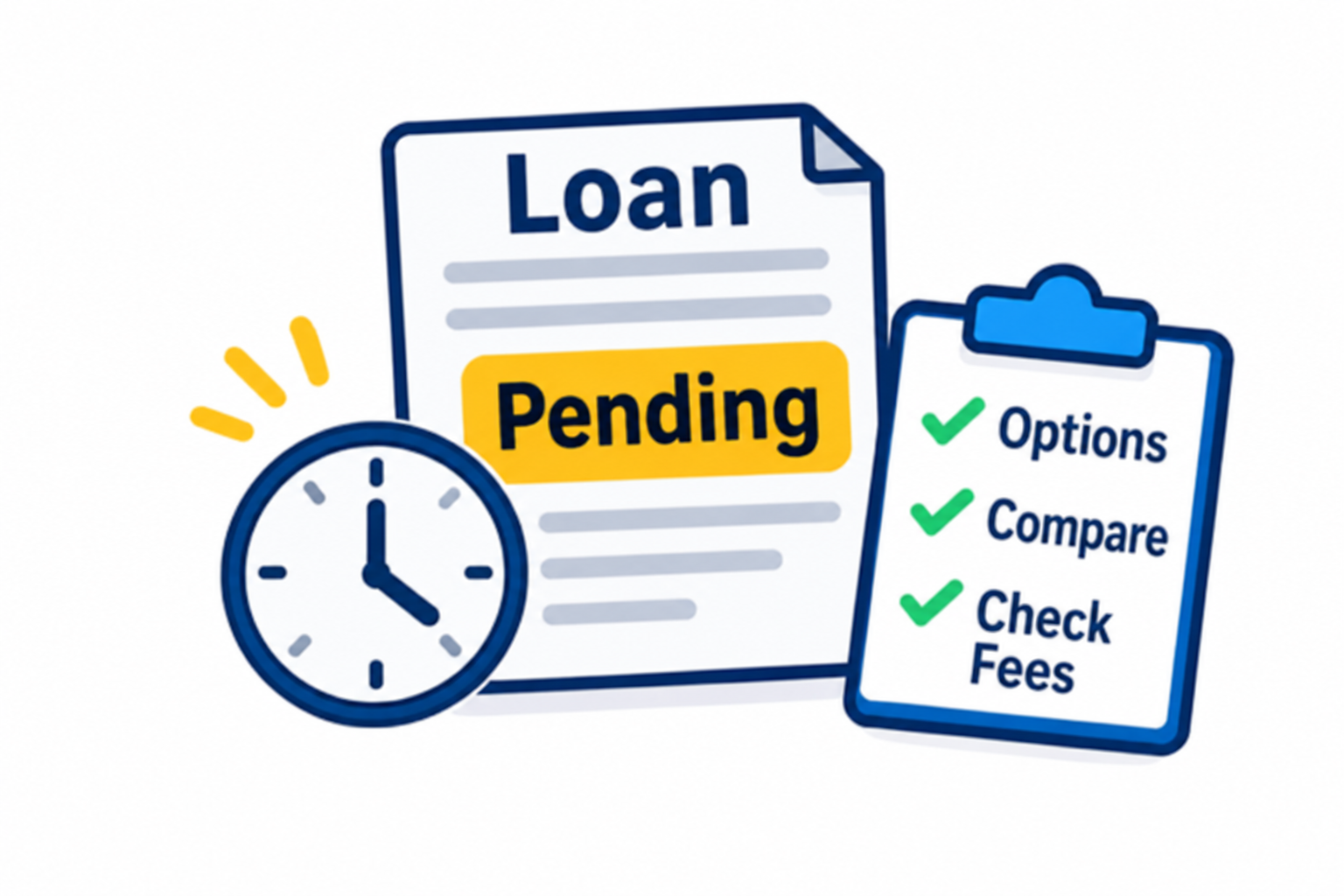
A loan application marked as "Pending" can create confusion for borrowers who are waiting for financial assistance. It does not necessarily mean that the loan has been rejected or approved. It simply indicates that the lender is still reviewing the application or completing verification. Understanding the different loan application statuses, available options, processing fees, interest rates, and repayment terms can help borrowers make better decisions. In this guide, we will explore the differences between loan application statuses, what to compare, and how to choose safer borrowing options.
A loan application marked as "Pending" can leave borrowers wondering whether their loan will be approved, rejected, or delayed. Whether you have applied for a personal loan through a bank, NBFC, or digital lending app, understanding the different application statuses can help you make better financial decisions.
A pending status does not automatically mean your loan has been rejected. It usually means that some part of the application process is still being completed, such as document verification, eligibility checks, credit assessment, or lender approval.
This guide explains the different options available when a loan application is pending, how they differ, and what borrowers should compare before taking the next step.
1. What Does Loan Application Pending Mean?
A loan application is considered pending when the lender has received the application but has not yet made a final decision.
The lender may still be:
-
Verifying personal and financial details.
-
Checking submitted documents.
-
Reviewing income and repayment capacity.
-
Evaluating credit history.
-
Completing KYC verification.
-
Waiting for an internal approval decision.
The time required depends on the lender, loan type, verification process, and completeness of the application.
2. Why Does a Loan Application Remain Pending?
Common reasons include:
-
Incomplete documents: Some required documents may be missing.
-
KYC verification: Identity or address verification may still be in progress.
-
Income assessment: The lender may need to review salary slips, bank statements, or income details.
-
Credit evaluation: Credit history and existing loan obligations may require further assessment.
-
Technical issues: Payment gateway, application, or verification delays may affect processing.
-
Manual review: Applications requiring additional checks may take longer.
A pending application should not be treated as an approval or a rejection.
3. Different Loan Application Status Options and Their Meanings
Borrowers may see different status messages depending on the bank, NBFC, or lending platform.
|
Application status |
Meaning |
What to do |
|---|---|---|
|
Submitted |
Application received |
Save reference number |
|
Pending |
Decision not completed |
Check for updates |
|
Under verification |
Details are being checked |
Wait or provide clarification |
|
Documents pending |
Documents are incomplete |
Upload requested documents |
|
KYC pending |
Identity verification incomplete |
Complete official KYC |
|
Credit review |
Credit profile is being assessed |
Wait for lender decision |
|
Approved |
Loan has been approved |
Review loan terms |
|
Rejected |
Application was not accepted |
Understand the reason |
|
Disbursement pending |
Funds have not yet been transferred |
Check remaining formalities |
|
Disbursed |
Loan amount has been released |
Verify the bank credit |
Important: Application submitted, pre-approved, sanctioned, and disbursed are different stages. Always check the exact status instead of assuming that your loan is approved.
4. What Are Your Options When a Loan Application Is Pending?
If your loan application remains pending, you have several practical options.
Option 1: Wait for the lender's decision
If all documents have been submitted and no additional action is required, wait for the processing timeline communicated by the lender.
Option 2: Check the application status online
Log in to the official bank website or lending application and check:
-
Current application status.
-
Pending document requirements.
-
Verification updates.
-
Notifications from the lender.
-
Estimated processing time, if provided.
Option 3: Submit missing documents
If the lender requests additional documents, provide clear and accurate copies through the official submission channel.
Commonly requested documents include:
-
PAN card.
-
Aadhaar or another accepted identity document.
-
Bank statements.
-
Salary slips or income proof.
-
Address proof.
The exact requirements depend on the lender and loan product.
Option 4: Contact customer support
If the application has not changed after the stated processing period, contact the lender's official customer support team.
Keep your application reference number ready and ask whether any verification or document is pending.
Option 5: Consider another lender
If the application is taking longer than expected, you may explore other regulated lenders. However, first understand whether your existing application is active and compare the costs and eligibility requirements of alternative offers.
Avoid submitting multiple applications without understanding the possible impact of credit enquiries.
5. Loan Application Pending vs Other Loan Statuses: Key Differences
Understanding these differences helps borrowers avoid confusion.
|
Status |
Main difference |
|---|---|
|
Pending vs Submitted |
Submitted means received; pending means a decision or process is incomplete |
|
Pending vs Under Verification |
Pending is a general status; verification identifies a specific checking stage |
|
Pending vs Approved |
Pending has no final approval; approved indicates a positive lending decision |
|
Pending vs Rejected |
Pending is awaiting a decision; rejected means the lender has declined |
|
Approved vs Disbursed |
Approved means sanctioned; disbursed means funds have been released |
A lender may also use different status names for similar processing stages. Always refer to the lender's official explanation.
6. What Should You Compare Before Choosing Another Loan Option?
If you are considering a different lender while your application is pending, do not compare offers based only on the interest rate or advertised EMI.
Consider these important factors:
6.1 Annual Percentage Rate (APR)
APR helps borrowers understand the overall annual cost of borrowing, including applicable charges.
Compare the APR rather than looking only at the advertised interest rate.
6.2 Loan Processing Fees
Check whether the lender charges a processing fee and whether applicable taxes or other charges are included.
6.3 Monthly EMI
Choose an EMI that fits your monthly income and existing financial commitments.
6.4 Loan Tenure
A longer repayment period may reduce the monthly EMI but can increase the total interest payable.
6.5 Total Repayment Amount
Calculate the total amount payable throughout the loan tenure, including applicable charges.
6.6 Lender Reliability
Check whether the actual lending institution is an RBI-regulated bank or NBFC. A digital lending app may act as a Lending Service Provider (LSP), rather than being the lender itself.
6.7 Prepayment and Foreclosure Charges
Review the terms for early repayment, foreclosure, and other applicable charges.
6.8 Customer Support
Check whether the lender provides accessible customer support and a clear grievance redressal process.
The RBI's digital lending framework requires relevant loan offer information, including lender identity, amount, tenure, APR, monthly repayment obligation and applicable penal charges, to support fair comparison where multiple lender offers are presented.
7. Comparison Table: What Matters Most?
|
Comparison factor |
Why it matters |
|---|---|
|
APR |
Shows the overall borrowing cost |
|
Processing fee |
Helps identify additional expenses |
|
EMI |
Determines monthly affordability |
|
Tenure |
Affects interest and repayment duration |
|
Total repayment |
Shows the overall financial commitment |
|
Approval conditions |
Clarifies whether approval is final |
|
Disbursement time |
Helps with financial planning |
|
Customer support |
Helps resolve application problems |
8. How to Make a Safer Decision While Your Loan Is Pending
Follow these practical steps before making another borrowing decision.
-
Check your exact application status.
-
Review whether any documents are missing.
-
Contact the lender if the processing timeline has passed.
-
Avoid paying unofficial agents to speed up approval.
-
Do not share OTPs, PINs, or passwords.
-
Verify the lender's identity before proceeding.
-
Compare APR, EMI, fees, and total repayment.
-
Read the Key Facts Statement (KFS) before accepting a loan offer.
-
Borrow only what you can comfortably repay.
-
Keep application and payment records for future reference.
Remember: Never assume that paying an advance fee guarantees loan approval or faster disbursement.
9. RBI Guidelines and Borrower Protection
The Reserve Bank of India (RBI) has established guidelines to improve transparency and protect borrowers in digital lending.
Some important points include:
-
Borrowers should receive relevant loan information before accepting a digital loan.
-
The Key Facts Statement should explain important loan terms and costs.
-
Lenders must assess the borrower's creditworthiness.
-
Digital lending platforms should provide clear information about the actual lender.
-
Borrowers should have access to grievance redressal channels.
-
Applicable cooling-off period provisions allow borrowers to exit a digital loan during the specified period, subject to the prescribed conditions.
10. Common Mistakes to Avoid
-
Applying for multiple loans without checking existing application status.
-
Assuming a pending application means guaranteed approval.
-
Ignoring requests for additional documents.
-
Choosing a loan only because it offers a low EMI.
-
Overlooking processing fees and other charges.
-
Trusting unofficial loan approval messages.
-
Accepting loan terms without reading the KFS.
-
Sharing confidential banking information with unknown callers.
11. Practical Example: Choosing Between Two Loan Offers
Consider a borrower who has applied for a personal loan of ₹1,00,000, but the application is still pending.
The borrower explores two alternative offers.
|
Details |
Loan A |
Loan B |
|---|---|---|
|
Loan amount |
₹1,00,000 |
₹1,00,000 |
|
Interest rate |
12% |
14% |
|
Tenure |
12 months |
12 months |
|
Processing fee |
₹1,000 |
₹500 |
|
Approximate EMI |
₹8,885 |
₹8,979 |
Illustrative figures only. Taxes, other charges and lender-specific terms are excluded.
Although Loan A has a higher processing fee, it has a lower interest rate and slightly lower EMI.
The borrower should compare APR, total repayment, fees, and KFS details before choosing either offer.
The best option is not necessarily the one with the lowest EMI. It is the one that offers affordable repayment and transparent terms.
12. Key Takeaways
-
A pending loan application does not mean rejection.
-
Check the exact status before taking further action.
-
Submit missing documents through official channels.
-
Contact customer support if the stated timeline has passed.
-
Compare APR, processing fees, EMI, and total repayment.
-
Verify the actual bank or NBFC behind a digital lending app.
-
Read the KFS before accepting any loan.
-
Avoid unnecessary loan applications and unofficial payment requests.
13. Frequently Asked Questions (FAQs)
1. What does loan application pending mean?
It means the lender has received your application but has not completed its assessment or final decision.
2. Does pending mean my loan is rejected?
No. Pending means the application is still being processed. It does not confirm approval or rejection.
3. How long can a loan application remain pending?
It depends on the lender, document verification, credit assessment, and internal processing requirements.
4. Can I check my loan application status online?
Yes. You can generally check through the official lender website, mobile application, or customer support.
5. Can I apply for another loan while one application is pending?
You may apply elsewhere, but consider the impact of additional credit enquiries and existing repayment commitments first.
6. Why is my loan application pending after KYC?
The lender may still need to verify income, bank details, credit history, or other information.
7. What documents are required to complete a pending loan application?
Common documents include PAN, accepted identity and address proof, bank statements, and income proof.
8. Can a pending loan application be cancelled?
Cancellation may be possible depending on the lender's application process and terms. Contact the lender directly.
9. Does a pending loan application affect my CIBIL score?
A status marked pending does not automatically reduce your score. However, a lender's hard credit enquiry may affect your credit report and score.
10. What should I do if my loan application is pending for several days?
Check the official status, review document requirements, and contact customer support for an update.
11. Is loan approval the same as loan disbursement?
No. Approval means the lender has sanctioned the loan, while disbursement means the funds have been released.
12. Should I pay money to get my pending loan approved?
No. Do not pay unofficial agents or individuals promising guaranteed approval or faster processing.
13. What is the difference between APR and interest rate?
The interest rate represents the cost of borrowing, while APR reflects the broader annual cost, including applicable charges.
14. What is a Key Facts Statement?
A KFS is a document that summarises important loan details, including APR, repayment obligations, and applicable charges.
15. How can I choose the best alternative loan?
Compare APR, EMI, processing fees, tenure, total repayment, lender reliability, and repayment conditions.
14. Conclusion
A pending loan application does not necessarily indicate a problem. It may simply mean that the lender is completing verification or reviewing the borrower's financial information.
Before choosing another loan, understand your current application status, check for missing documents, and contact the lender when necessary. If you explore alternative loan options, compare the APR, EMI, processing fees, repayment tenure, and total borrowing cost.
At Vizzve, we encourage borrowers to make informed financial decisions, understand loan conditions, and choose responsible borrowing practices.
Published on : 27th November
Published by : monisha
www.vizzve.com || www.vizzveservices.com
Follow us on social media: Facebook || Linkedin || Instagram
🛡 Powered by Vizzve Financial
RBI-Registered Loan Partner | 10 Lakh+ Customers | ₹600 Cr+ Disbursed