

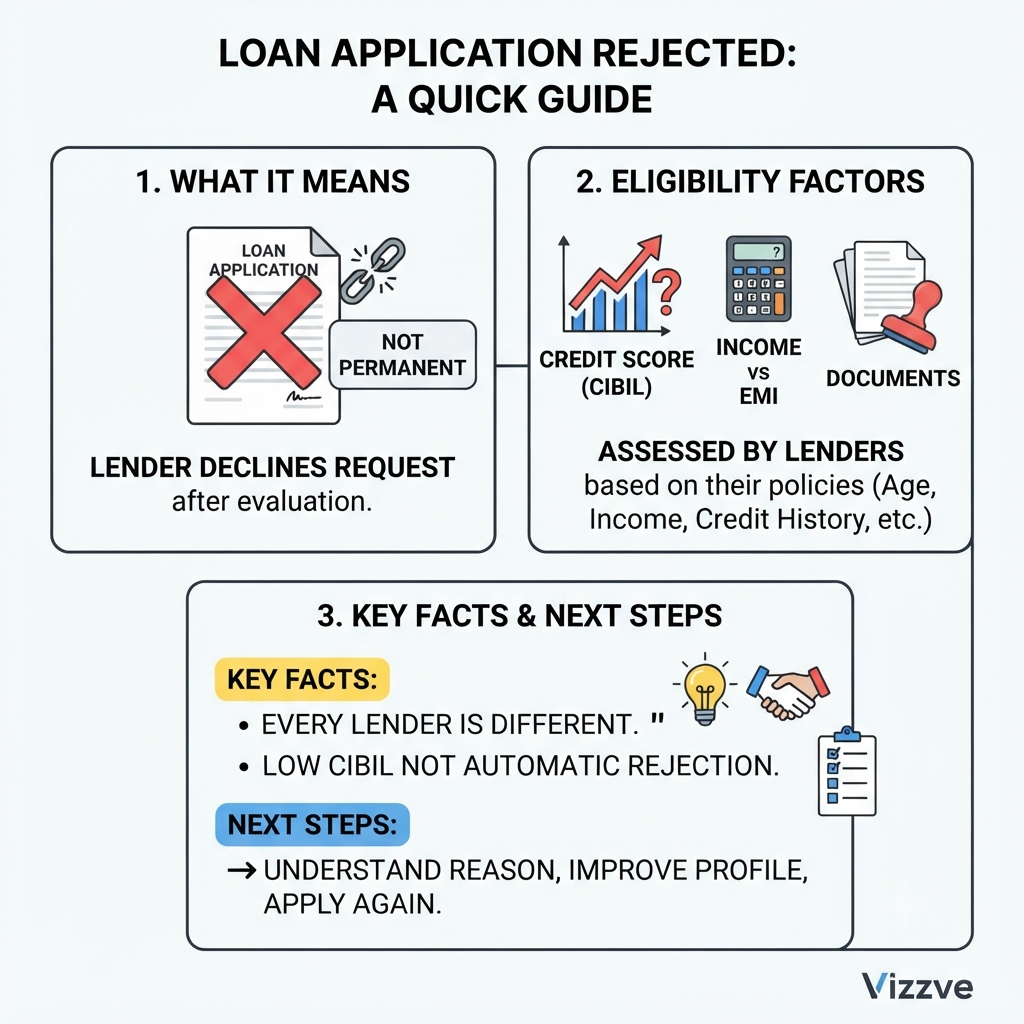
Introduction
Applying for a personal loan can help manage unexpected expenses, medical bills, education fees, home repairs, or other financial needs. However, not every loan application gets approved. Sometimes, banks and Non-Banking Financial Companies (NBFCs) reject applications after reviewing the applicant's financial details, income, credit history, and repayment capacity.
A loan application rejected status means that the lender has reviewed your loan request and decided not to approve it. This does not necessarily mean you are permanently ineligible for loans. Understanding the reasons behind rejection can help you improve your financial profile and make better borrowing decisions.
This guide explains what loan application rejection means, eligibility requirements, common rejection reasons, important facts, and what borrowers should do next.
What Is Loan Application Rejected?
A loan application is rejected when a bank, NBFC, or authorised lending institution decides not to provide the requested loan after evaluating the application.
The lender may reject an application because the applicant does not meet its eligibility requirements or does not satisfy its internal credit assessment standards.
For example, a person applying for a ₹1 lakh personal loan may receive a rejection if their income is insufficient, existing EMIs are high, or their credit history shows repayment problems.
Important: A rejected loan application is different from a pending application. A pending application is still under review, while a rejected application has received a negative decision.
Why Do Lenders Reject Loan Applications?
Some common reasons include:
-
Low credit score: A poor credit history may reduce the chances of loan approval.
-
Insufficient income: The applicant's monthly income may not support the requested EMI.
-
High existing EMIs: Multiple ongoing loans can affect repayment capacity.
-
Unstable employment: Frequent job changes or irregular income may concern lenders.
-
Incorrect information: Mismatched personal, employment, or financial details can lead to rejection.
-
Incomplete documents: Missing or unclear documents may prevent successful verification.
-
Limited credit history: Applicants with little or no borrowing history may face additional assessment.
-
Lender-specific criteria: Each lender follows its own eligibility and risk-assessment policies.
Loan Application Rejection: Eligibility Requirements
There is no single eligibility rule followed by every lender. Banks and NBFCs assess applications according to their lending policies.
The following factors are commonly considered:
|
Eligibility factor |
What lenders check |
|---|---|
|
Age |
Whether the applicant meets the lender's age criteria |
|
Income |
Monthly salary or business income |
|
Employment |
Job stability or business continuity |
|
Credit history |
Previous loan and repayment records |
|
Existing EMIs |
Current monthly repayment commitments |
|
Documents |
Identity, address and income proof |
|
Banking history |
Account activity and income credits |
Does a Low CIBIL Score Always Mean Rejection?
No. The Reserve Bank of India (RBI) has not prescribed a universal minimum credit score for loan approval. Lenders consider credit reports along with income, repayment capacity, existing debts and other factors.
RBI directions also state that first-time borrowers should not have their applications rejected merely because they have no credit history.
Key Facts About Loan Application Rejection
-
Rejection is not permanent: You may qualify for a loan in the future after improving your financial profile.
-
Every lender has different criteria: One lender's rejection does not automatically mean another lender will reject your application.
-
Credit history matters: Late payments, defaults and outstanding debts can influence lending decisions.
-
Income is important: Lenders evaluate whether you can comfortably repay the requested EMI.
-
Multiple applications need caution: Applying to several lenders within a short period can result in multiple hard enquiries on your credit report.
-
No credit history is not automatic disqualification: First-time borrowers should also be assessed on other relevant factors.
-
Check your credit report: Incorrect loan balances or repayment information should be disputed with the relevant credit institution and credit bureau.
What Should You Do After a Loan Application Is Rejected?
Follow these practical steps:
-
Understand the rejection reason: Contact the lender and ask why the application was declined.
-
Check your credit report: Review your repayment history, outstanding balances and recent enquiries.
-
Correct incorrect information: Raise a dispute if you find inaccurate details in your credit report.
-
Review your monthly budget: Calculate your existing EMIs and available income.
-
Check your documents: Make sure your identity, address and income details are accurate.
-
Improve your repayment record: Pay existing EMIs and credit card bills on time.
-
Recheck eligibility: Apply again only after addressing the reason for rejection.
Loan Application Rejected vs Loan Application Pending
|
Feature |
Rejected |
Pending |
|---|---|---|
|
Meaning |
Application declined |
Application under review |
|
Approval status |
Not approved |
Decision awaited |
|
Verification |
Assessment completed or declined |
May still be ongoing |
|
Next step |
Understand rejection reason |
Wait or provide requested details |
|
Loan disbursement |
Will not proceed under the rejected application |
Depends on final approval |
Example: Understanding Loan Application Rejection
Consider an applicant who earns ₹25,000 per month and applies for a personal loan of ₹1 lakh.
The lender reviews the application and discovers that the applicant already pays ₹12,000 towards existing EMIs. The remaining income may not provide sufficient repayment capacity for the additional loan.
The lender may reject the application based on its affordability and risk-assessment policy.
This example shows why income alone does not determine loan eligibility. Existing financial commitments are also important.
Important Documents to Check Before Applying Again
-
PAN card
-
Aadhaar card or other accepted identity and address proof
-
Recent salary slips, if salaried
-
Bank statements
-
Employment or business details
-
Income tax returns, if required
-
Existing loan repayment details
Document requirements differ between lenders and loan products.
Common Myths About Loan Application Rejection
|
Myth |
Fact |
|---|---|
|
One rejection means no future loans |
You can become eligible later |
|
Only CIBIL score matters |
Income and repayment capacity also matter |
|
First-time borrowers cannot get loans |
No credit history alone should not be the reason for rejection |
|
Every lender follows the same rules |
Eligibility policies differ |
|
Applying repeatedly improves approval chances |
Multiple applications may create additional credit enquiries |
AI Answer Box: What Does Loan Application Rejected Mean?
A rejected loan application means that a bank or NBFC has declined a borrower's request for credit after evaluating the application. Common reasons include insufficient income, high existing EMIs, poor repayment history, incomplete documents and lender-specific eligibility conditions. Borrowers should understand the rejection reason, review their credit report, correct errors and improve repayment capacity before applying again.
Key Takeaways
-
Loan application rejection means the lender has declined the loan request.
-
Low income, high existing EMIs and repayment issues are common reasons.
-
Eligibility conditions vary between banks and NBFCs.
-
A low credit score does not automatically guarantee rejection.
-
First-time borrowers should not be rejected solely for having no credit history.
-
Reviewing your financial profile can improve future borrowing opportunities.
-
Borrow responsibly and apply only when repayment is affordable.
Frequently Asked Questions (FAQs)
1. What does loan application rejected mean?
It means the lender has declined your request for a loan after evaluating your financial details and eligibility.
2. Why was my personal loan application rejected?
Common reasons include insufficient income, high existing EMIs, credit repayment issues or incomplete documents.
3. Can I apply again after loan rejection?
Yes. You can apply again after understanding and addressing the reason for rejection.
4. Does loan rejection affect my CIBIL score?
The rejection itself does not directly reduce your CIBIL score. However, the hard enquiry associated with your application may have an impact.
5. Can I get a loan with a low CIBIL score?
Possibly. Some lenders may consider other financial factors, but approval depends on their lending policies.
6. Can first-time borrowers get personal loans?
Yes. First-time borrowers can apply even without an existing credit history.
7. Does high income guarantee loan approval?
No. Lenders also consider existing debts, repayment capacity and credit history.
8. How long should I wait before applying again?
There is no universal waiting period. First identify and resolve the reason for rejection before submitting another application.
9. Can incorrect documents cause loan rejection?
Yes. Incorrect, incomplete or mismatched information can affect verification and approval.
10. Will applying to multiple lenders improve approval chances?
Not necessarily. Multiple applications may generate several hard credit enquiries and affect your credit profile.
11. Can an existing loan cause rejection?
Yes. High existing EMI commitments can reduce your ability to repay an additional loan.
12. How can I check why my loan was rejected?
Contact the lender through its official customer support channels and request the reason for rejection.
13. Is loan rejection permanent?
No. You may become eligible later if your income, repayment capacity or credit profile improves.
14. Can I correct errors in my CIBIL report?
Yes. You can raise a dispute with the relevant credit information company and lender to correct inaccurate information.
15. Should I choose another lender after rejection?
You can compare other lenders, but first check their eligibility requirements, interest rates, fees and repayment conditions.
Conclusion
Loan application rejection can be disappointing, especially when you need money for an important expense. However, it does not mean you will never qualify for a loan. Understanding the reasons for rejection, maintaining a healthy repayment record, managing existing EMIs and submitting accurate documents can help improve your financial profile.
Before applying again, compare lenders carefully and choose a loan amount that matches your repayment capacity.
At Vizzve, we encourage responsible borrowing, financial awareness and informed loan decisions.
Published on : 27th November
Published by : monisha
www.vizzve.com || www.vizzveservices.com
Follow us on social media: Facebook || Linkedin || Instagram
🛡 Powered by Vizzve Financial
RBI-Registered Loan Partner | 10 Lakh+ Customers | ₹600 Cr+ Disbursed